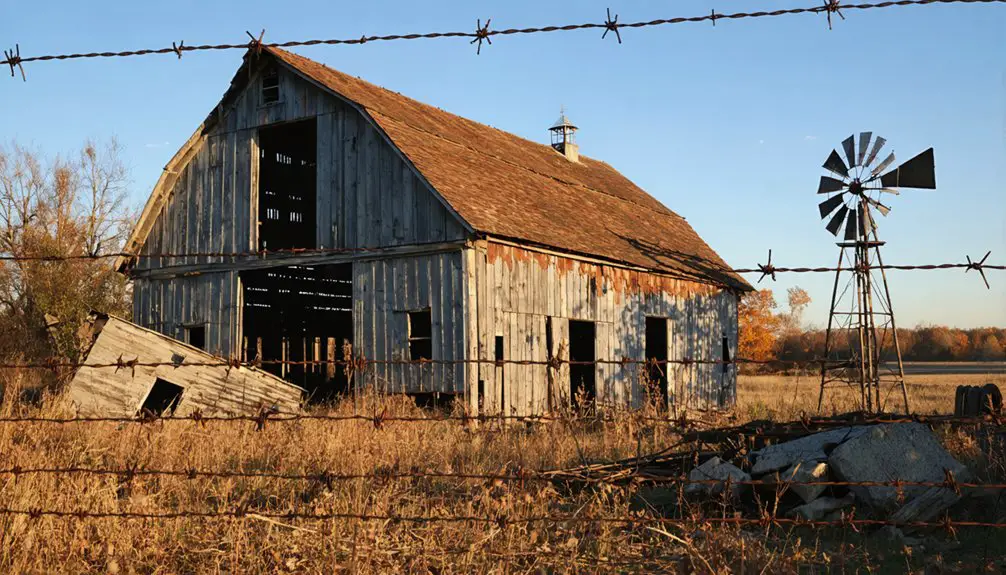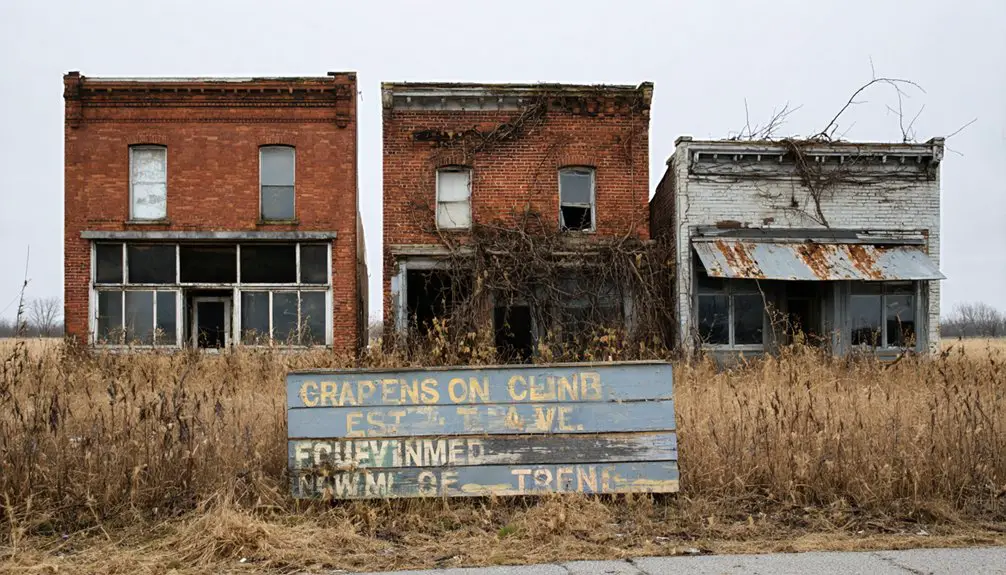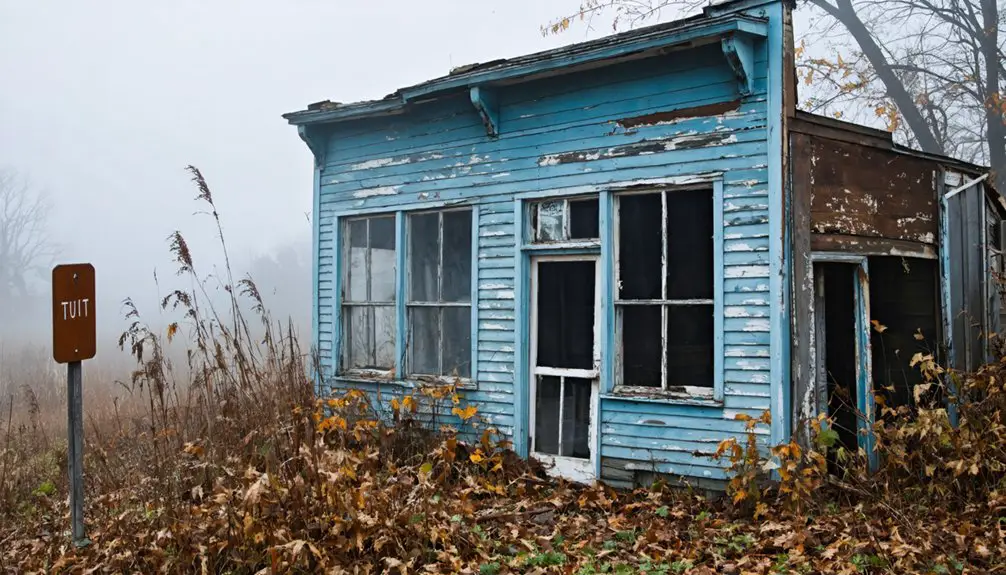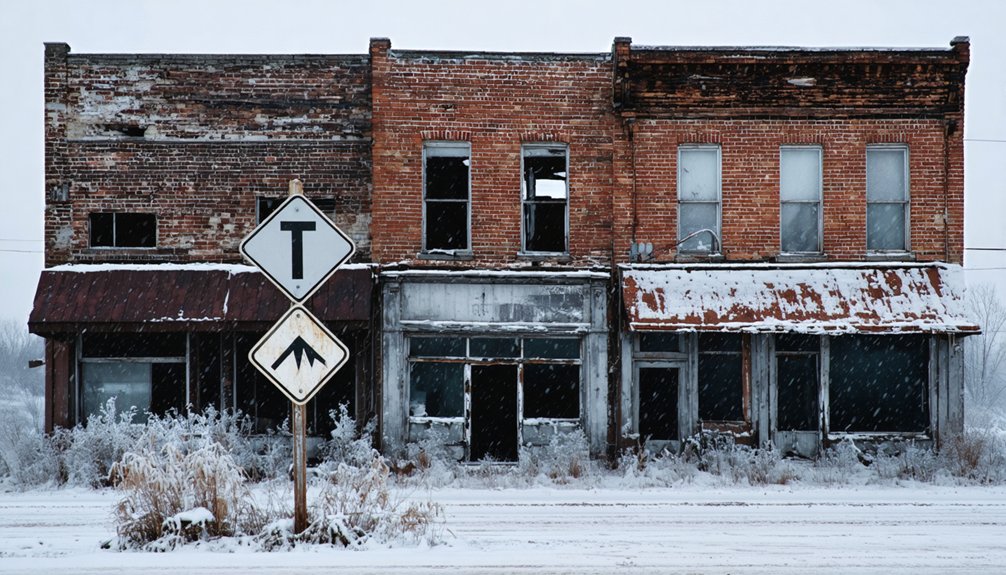
You’ll find Ohio’s most compelling ghost towns along winter trails where snow reveals hidden foundations and ice transforms ruins into ethereal landscapes. Moonville Tunnel’s 100-foot passage echoes with phantom legends, while Steubenville’s abandoned steel corridors stretch beneath restored bridges. Boston Mills preserves canal-era warehouses within Cuyahoga Valley, and Vinton Furnace’s Belgian coke ovens stand silent among bare forest trails. Egypt Valley’s haunted cemeteries tell darker stories along Black Oak Road, where frost amplifies the supernatural atmosphere. Each location offers distinct perspectives on Ohio’s vanished industrial past and the spirits that remain.
Key Takeaways
- Moonville Tunnel, built in 1856, offers phantom light sightings and ghostly legends enhanced by winter solitude on the Moonville Rail Trail.
- Steubenville preserves steel industry ruins including the restored Market Street Bridge and abandoned railroad corridors from its industrial peak.
- Boston Mills in Cuyahoga Valley National Park features canal-era warehouses and 1900s housing, with winter exposing canal foundations and lock ruins.
- Vinton Furnace displays 1875 Belgian coke ovens, abandoned mine shafts, and immigrant labor camps from Ohio’s charcoal-fired iron industry era.
- Egypt Valley’s haunted cemeteries and Black Oak Road offer paranormal encounters, with spirits reportedly more active during cold winter months.
Moonville Tunnel: A Haunted Railroad Relic in Vinton County
Deep in the wooded hollows of Vinton County, where bare winter branches claw at gray skies, the Moonville Tunnel stands as a dark sentinel to southeastern Ohio’s forgotten past.
Built in 1856 for the Marietta and Cincinnati Railroad, this 100-foot passage cuts through hillside rock where coal once fueled Hope Furnace’s Civil War weapons production.
Railroad history lives here—but so do its tragedies. Multiple fatal accidents spawned haunted legends that persist today.
You’ll hear tales of the decapitated brakeman swinging his lantern, Engineer Lawhead’s ghost floating from tunnel stones, and mysterious orbs dancing through darkness.
The railroad installed signals in 1981 after engineers kept emergency-braking for phantom lights.
Now part of the Moonville Rail Trail, you’re free to explore this National Register site year-round, though winter’s skeletal landscape amplifies its eerie solitude.
Steubenville: From Steel Boom to Festive Ghost Town
Where industrial giants once breathed fire and smoke into Ohio skies, Steubenville now stands as a monument to American manufacturing’s rise and fall. You’ll discover steel manufacturing heritage embedded throughout this Ohio River town, where blast furnaces roared from 1899 to 2005.
A century of molten steel and industrial might forged this riverside town before silence replaced the furnaces’ thunder.
Winter reveals industrial heritage through:
- Market Street Bridge (1905) – spanning to West Virginia’s former mill towns
- Number One Furnace site – operated 106 consecutive years
- Mural-covered downtown – preserving coal, steel, and quarry history
- Abandoned railroad corridors – once connecting thirty miles of plants
The population that peaked at 40,000 workers has vanished, leaving ghostly reminders of Wheeling Steel’s empire. The Market Street Bridge, restored in 2009 and reopened in 2011, carried pedestrians, trolleys, and automobiles during the town’s industrial heyday. Steubenville’s integrated operations included open hearth furnaces and blooming mills that produced hot and cold rolled products for America’s growing industrial demands. You’re free to explore construction sites and aging structures that chronicle when 5,500 men forged America’s industrial backbone.
Boston Mills: Historic Structures in Cuyahoga Valley
Nestled within 37 acres of Cuyahoga Valley National Park, Boston Mills reveals its layers like a historical palimpsest—canal-era warehouses standing shoulder-to-shoulder with early 1900s company housing.
You’ll trace freedom-seekers who built this settlement after the Ohio and Erie Canal opened in 1827, when 300 souls populated its boat-yards and stores.
The 1836 Boston Company Store—now a visitor center—showcases Federal and Greek Revival architecture with its striking rhomboid shape and blind fanlight.
Historic Preservation efforts earned it a 2020 restoration award.
Wander past patterned concrete block houses where Polish immigrants once lived during the Cleveland-Akron Bag Company’s reign (1900-1923).
The settlement’s name honors the Boston settlers who established the area’s first mill in the 1820s, launching decades of waterborne commerce.
The restored M.D. Garage now houses art exhibits while preserving its period gas pumps and vintage signage from the automotive era.
Winter’s stark landscape exposes the Canal Era foundations best, revealing lock ruins and abandoned mill sites where independence-minded merchants once prospered.
Vinton Furnace: Iron Industry Ruins Along Winter Trails
Along southeastern Ohio’s forested ridges, Vinton Furnace stands as a monument to industrial ambition and economic hubris—its charcoal-fired stack placed in blast in 1854, only to succumb to the Jay Cooke panic two decades later. Winter exploration reveals the iron industry’s scattered dreams through accessible forest trails.
Where charcoal-fed industry once roared, winter silence now blankets the crumbling monuments of Appalachian iron ambition.
You’ll discover remnants that tell a compelling failure narrative:
- Belgian coke ovens (1875) – 24 stone ruins from the failed sulfur-heavy coal experiment
- Rebuilt stack foundation – 50-foot steel-jacketed structure rated for 20 tons daily
- Abandoned mine shafts – 130-foot Quakertown No. 2 coal operation
- Immigrant worker camps – Where German and Polish laborers carved wilderness livelihoods
The snow-dusted ruins offer solitary wandering through Vinton Furnace State Forest, where Lake Superior’s superior ore deposits ultimately rendered these Appalachian operations obsolete by 1883. The ovens processed coal through 36-48 hour cycles, discharging coke automatically via a pushing engine that eliminated the need for manual raking. Each oven chamber measured 22 feet long and held approximately 180 bushels of coal during the coking process.
Egypt Valley and Black Oak Road: Frozen Spirits of Belmont County
When January’s frozen grip settles over Belmont County’s reclaimed strip mines, the Egypt Valley Wildlife Area transforms into something far darker than its 14,300 acres of conservation land suggest.
You’ll find two haunted cemeteries here—Salem Cemetery, where 13-year-old Louiza Fox rests after her brutal 1869 murder, and Old Egypt Cemetery, reportedly guarded by howling hellhounds.
Winter amplifies the eeriness along Butter Milk Road, where spirit sightings include a cemetery caretaker’s lantern glow moving through the darkness—he froze to death decades ago.
The 4.5-mile gravel path cuts through remote terrain, especially treacherous when ice covers the mud.
Black Oak Road connects these supernatural hotspots, creating a circuit of spine-tingling encounters.
Along this desolate stretch, witnesses report seeing the Lady of Black Oak Road, a tragic figure who froze to death in the 1800s and now walks alone through winter storms.
Visitors leave coins and tokens at Fox’s gravestone, offerings to her restless spirit that glint beneath winter frost.
Bundle up and bring your courage; these spirits don’t hibernate.
Frequently Asked Questions
What Safety Equipment Should I Bring When Visiting Ghost Towns in Winter?
You’ll need winter hiking essentials: waterproof insulated boots, traction devices for icy paths, layered clothing, and a all-encompassing emergency kit with headlamp, first aid supplies, fire starters, and extra food. Don’t forget your fully charged phone for remote exploration.
Are There Guided Tours Available for Ohio’s Ghost Towns During Winter Months?
Yes, you’ll find guided winter tours exploring Ohio’s haunted history. Jannette Quackenbush leads Moonville Tunnel expeditions featuring local legends and historical preservation efforts. You’ll experience authentic ghost hunting using vintage equipment while discovering railway folklore along moonlit trails.
Which Ghost Towns Are Wheelchair Accessible During Winter Conditions?
Ghost Town Findlay offers you wheelchair-friendly winter access with maintained pathways through historical preservation sites. You’ll explore local legends at the saloon and blacksmith shop while enjoying festive lights, warm drinks, and Santa visits—perfect freedom to roam comfortably.
Do I Need Permits to Explore Abandoned Buildings in These Locations?
You’ll need permits and permission before exploring—trespassing carries fines exceeding $50,000. Local regulations protect historical preservation efforts. State-managed properties like Moonville Tunnel offer legal access via hiking trails, letting you explore freely within designated areas.
What Are the Best Photography Settings for Capturing Ghost Towns in Snow?
Snow reflects 80% of sunlight, so you’ll need ISO 100-400 with lighting techniques like fill flash for shadowy interiors. Use camera stabilization or tripods at f/2.8-f/5.6, exposing right to preserve those brilliant white highlights without clipping.
References
- https://www.youtube.com/watch?v=WG-EIO_teyM
- https://www.moonvilletunnel.net
- https://ohio.org/travel-inspiration/articles/haunted-ohio-must-visit-places
- https://ohioghosttowns.org/top-10-ghost-towns/
- https://www.visitbelmontcounty.com/haunted-hills-of-belmont-county/
- https://www.ohioexploration.com/structures/moonvilletunnel/
- https://www.moonvilletunnel.net/Moonville_History.htm
- https://www.ravenwoodcastle.com/2015/07/14/legends-lore-moonville-tunnel/
- https://www.kitgentry.com/spooklights_moonville.html
- https://visitvintoncounty.org/history/moonville-tunnel/