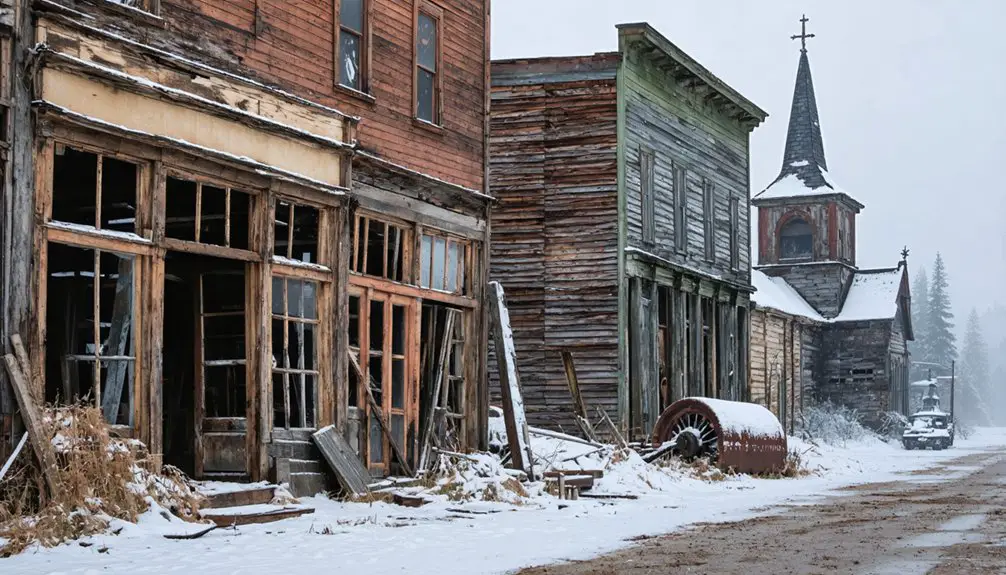
You’ll find West Virginia’s most mesmerizing ghost towns clustered along the 12-mile stretch of New River Gorge, where winter strips away summer foliage to reveal industrial ruins in stark detail. Kaymoor’s 821 steel steps descend past gated mine entrances, Thurmond’s 1904 depot still serves Amtrak trains with just five residents, and Nuttallburg’s Henry Ford-installed conveyor system snakes down snow-covered slopes. The frozen landscape transforms coke ovens and tipple foundations into hauntingly photogenic scenes, though you’ll need traction devices and sturdy boots to safely navigate icy trails that expose the region’s coal mining legacy.
Key Takeaways
- Over 60 ghost towns exist along New River Gorge, primarily former coal settlements preserved as national park sites since the 1970s.
- Kaymoor features 821 steel steps descending through mining ruins, including gated mine entrances and coke ovens from 1901.
- Thurmond maintains early 1900s buildings including a 1904 depot, now an Amtrak stop and visitor center with five current residents.
- Nuttallburg offers preserved coal infrastructure with interpretive signs, Henry Ford’s conveyor system, and worker houses; winter visits reveal detailed remnants.
- Winter hiking requires traction devices, sturdy boots, and flashlights as snow and ice obscure trails and create hazardous conditions.
Why New River Gorge Is West Virginia’s Premier Ghost Town Destination
Deep in the Appalachian Mountains, where the New River carved a gorge so steep that entire towns vanished into history, you’ll find America’s most concentrated collection of abandoned coal settlements. Over 60 ghost towns cluster along just 12 miles of gorge, preserved since the late 1970s when national park status froze these ruins in time.
Sixty ghost towns frozen in time along twelve miles of gorge—America’s densest cluster of abandoned coal settlements.
Railroad history made this possible—the Chesapeake & Ohio Railroad‘s completion sparked over 50 mining towns during the Industrial Period. At its 1920s peak, Thurmond processed more coal than Cincinnati.
But mining technology shifted from steam to diesel engines, and falling demand transformed prosperity into abandonment by 1950.
Today, you’re free to explore Thurmond’s eerie depot, Nuttallburg’s towering tipple, and countless sealed mine portals where forest reclaims rusted industrial giants.
Kaymoor: a Two-Tiered Mining Community With Multiple Trail Access Points
When you descend the 821 steel steps carved into the gorge wall at Kaymoor, you’re retracing the path where 560 miners once lived and worked across two vertical levels separated by 560 feet of sheer mountain.
This wasn’t your typical coal camp—inclines hauled workers up cliffsides each morning while separate tracks dragged millions of tons downward to waiting railcars.
The mining history here spans an impressive 62 years, outlasting most company towns by decades.
You’ll find urban decay claiming what remains: gated mine entrances, crumbling coke ovens, scattered equipment slowly disappearing beneath vegetation.
The coke ovens, numbered 102 to 120 and built in 1901, were lined with fire brick and faced with sandstone to withstand the intense heat needed for purifying coal.
Multiple trails now penetrate this ghost town through New River Gorge National Park, letting you explore both levels where African American and European immigrant families built lives in company houses that vanished by fire in 1960.
The community was established circa 1899 by Low Moor Iron Co. to supply coal to Virginia iron furnaces, making it one of the earliest mining operations in the gorge.
Thurmond: The Former Railroad Hub Frozen in Time
Picture a town where a poker game lasted fourteen years without interruption—that’s the legendary spirit of Thurmond, once the most prosperous railroad junction in West Virginia.
You’ll walk streets where freight operations once surpassed Cincinnati’s, where 18 train lines converged in a remote gorge accessible only by rail.
The railroad history comes alive through preserved structures—the 1904 depot now serves as both visitor center and Amtrak stop.
Explore the commercial row frozen since the 1950s, where saloons and banks stand empty along the tracks.
Winter reveals the bones of this boomtown without summer foliage obscuring your view.
The town’s notorious past earned it the nickname “Dodge City of the East”, where gambling, saloons, and outlaw activity thrived alongside the legitimate railroad business.
At its peak in 1910, the station processed 75,000 passengers annually, demonstrating the remarkable scale of operations in this remote mountain town.
With just four residents today, the National Park Service‘s town preservation efforts let you experience authentic abandonment while maintaining safe access to this railroad relic.
Nuttallburg: The Must-See Mining Complex Along the New River
You’ll find Nuttallburg more intact than any other coal mining complex in West Virginia, with clear interpretive signs guiding you through foundations where 100 families once lived along this half-mile stretch.
The trail climbs the hillside past the massive 1,385-foot conveyor that Henry Ford installed in the 1920s, still standing against the gorge walls. Ford operated the site as Fordson Coal Company to supply steam coal for his River Rouge Auto Plant.
Winter reveals the bones of this industrial site best—rusted tipple remains, beehive coke ovens, and views down to the Double Z rapid churning through the New River below. The National Park Service completed vegetation clearing and structure stabilization in 2011, making the complex easier to explore and photograph during the bare-branch season.
Marked Foundations and Informative Signs
As you navigate the half-mile trail through Nuttallburg’s remarkably preserved industrial complex, you’ll discover more than 50 marked foundations connected by interpretive signs that bring this coal camp’s 85-year history to life.
The National Park Service’s 2011 restoration employed advanced preservation techniques to stabilize structures while clearing decades of vegetation that had concealed the site.
Key features you’ll encounter include:
- Original tipple foundations where 171,000 tons of coal annually moved to trains via one of the longest conveyors ever installed, stretching 1,385 feet
- Residential building outlines showing layouts of 110 worker houses that stretched along New River
- Ford-era steel structures from the 1920s modernization period
- Company store remains where miners spent their wages
The mines extracted the highly prized Sewell coal seam, a 3½-foot-thick layer valued for being smokeless. Winter visits offer advantages—no artificial lighting needed during extended daylight hours, and leafless trees reveal architectural details hidden in summer’s dense foliage.
Double Z Rapid Views
Standing at Nuttallburg’s lower overlook, winter’s bare branches frame one of the New River’s most challenging whitewater features—the Class V Double Z rapid—which churns 400 feet below the abandoned tipple foundations.
You’ll spot kayakers threading through the rapid’s technical moves while eagles patrol the gorge’s thermal currents.
The National Park Service’s art preservation efforts have stabilized these overlook platforms, giving you unobstructed sightlines across the half-mile mining complex.
Winter transforms wildlife observation here—no summer foliage obscures your view of the industrious site where 342 miners once lived.
The juxtaposition strikes hard: nature’s raw power below, humanity’s abandoned ambition above, both existing without permission or apology in this rugged canyon.
Hillside Mine Complex Trail
The Conveyor Trail punches straight up the mountainside through 150 vertical feet of industrial archaeology, and your lungs will know it. This three-mile round-trip demands 5-6 hours and rewards you with West Virginia’s most intact coal mining complex.
While underground exploration isn’t permitted, the surface mining equipment tells the complete story of a 90-year operation.
What You’ll Encounter:
- Henry Ford’s 1,385-foot rope-and-button conveyor – one of the longest ever built, snaking down the slope
- Headhouse and mine entrance at the Sewell seam, where coal emerged intact
- 80 coke ovens that transformed raw coal into steel-grade fuel
- Tipple ruins connecting to the C&O Railroad’s mainline
Bundle up, pack traction devices for icy sections, and give yourself a full winter day.
Semi-Occupied Towns: Winona and Thurmond’s Remaining Residents
While most ghost towns sit completely abandoned, Winona and Thurmond tell a different story—one of communities clinging to existence with just a handful of determined souls.
You’ll find fewer than 200 residents in Winona, down from its 1910 peak of 1,100 during the coal boom. Thurmond’s even more dramatic—just five people called it home in 2020, compared to 462 in 1930.
These aren’t typical ghost towns; they’re living museums where real people maintain century-old structures.
The National Park Service owns most of Thurmond’s buildings now, leading preservation efforts alongside dedicated locals.
In Winona, you’ll encounter local community stories from hikers and climbers who’ve brought new life to abandoned storefronts.
These semi-occupied settlements offer something rare: authentic glimpses into Appalachia’s past, preserved by those who refuse to let history fade completely.
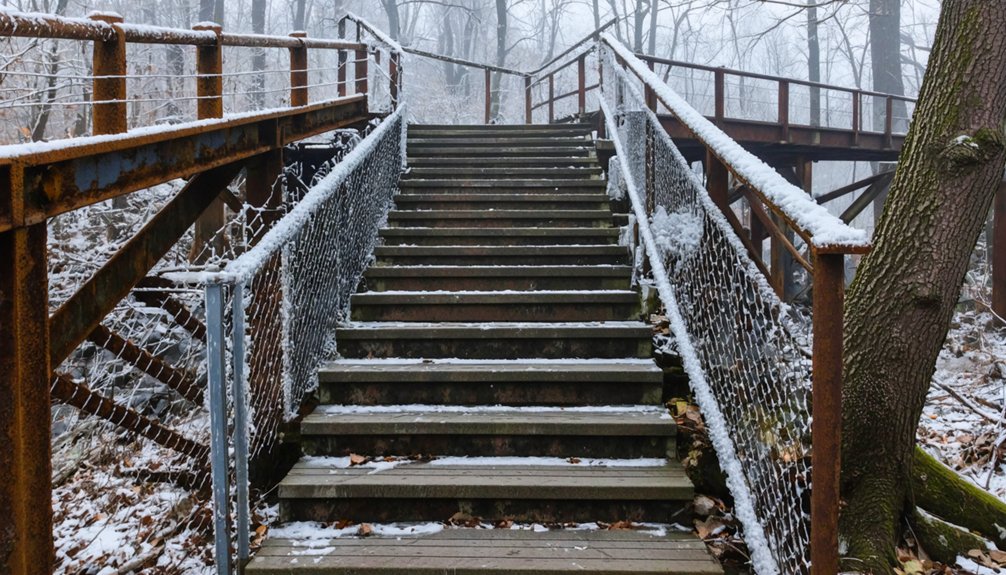
You’ll face 821 wooden steps descending through the forest to reach Kaymoor’s coal processing ruins— a drop equivalent to an 80-story building that retraces the exact path miners climbed daily since the 1800s.
The steep descent feels manageable going down, but every step demands the energy to climb back up.
So pack water and start early in winter’s shorter daylight.
Ice transforms these already-strenuous stairs into a treacherous challenge, making proper boots and checking trail conditions essential before attempting the journey to this moss-covered ghost town.
Trail Difficulty and Preparation
Descending the Kaymoor Miners Trail feels less like a casual hike and more like stepping into the grueling daily reality of West Virginia coal miners. You’ll tackle 900 feet of elevation drop across 1.0 mile, with 821 wooden steps plunging at a breathtaking 43.5% grade.
Winter hazards multiply on icy stairs and frost-covered switchbacks, while trail maintenance doesn’t eliminate nature’s challenges.
Essential Preparation:
- Footwear matters – Sturdy boots grip rocky terrain and prevent ankle rolls on uneven stairs
- Pack extra water – This high-intensity climb demands hydration you can’t find at the trailhead
- Check closure schedules – Upper sections close Mondays-Thursdays during peak seasons
- Respect the railroad – Active tracks at Kaymoor Bottom prohibit crossing
Remember: you’re climbing back up every single step. There’s no easy escape route from the river.
Historical Features Along Descent
The 821 steps carry you through layers of coal mining history, each section revealing artifacts that miners passed daily during their brutal commutes.
At 0.2 miles, you’ll spot the gorge overlook before reaching the historic steel I-beam sign at Sewell Bench—”Your family wants you to work safely”—a stark reminder of dangerous conditions.
Mining machinery emerges from moss-covered ruins as you descend, rusted equipment frozen in time among rock formations that once echoed with steam-powered haulage systems.
The midpoint reveals Kaymoor Mine’s gated entrances, where coal seams fed America’s industrial appetite for six decades.
At river level, coke ovens and processing plant remains stand silent among scattered coal deposits—tangible evidence of the town that thrived here before abandonment claimed it in 1963.
Winter Safety Considerations
While summer hikers can navigate Kaymoor’s 821 steps with relative ease, winter transforms this descent into a technical challenge that demands meticulous preparation.
Winter clothing becomes your first line of defense—layer moisture-wicking base layers beneath an outer shell to combat temperature swings during the 400-foot drop.
Trail navigation demands heightened awareness when ice obscures switchbacks and stair edges.
Essential winter considerations include:
- Trekking poles for stability on ice-covered stairs
- Winter boots with aggressive traction to prevent dangerous slips
- Flashlight for shortened daylight hours
- Extra water for the cardiovascular-intensive return climb
Check weather forecasts obsessively. Mountain conditions shift rapidly, and that innocent-looking cloud cover can unleash hazardous ice storms.
You’ll need physical conditioning before attempting this—ascending 821 frozen stairs tests even experienced adventurers.
Exploring Historic Buildings and Original Structures During Winter Walks
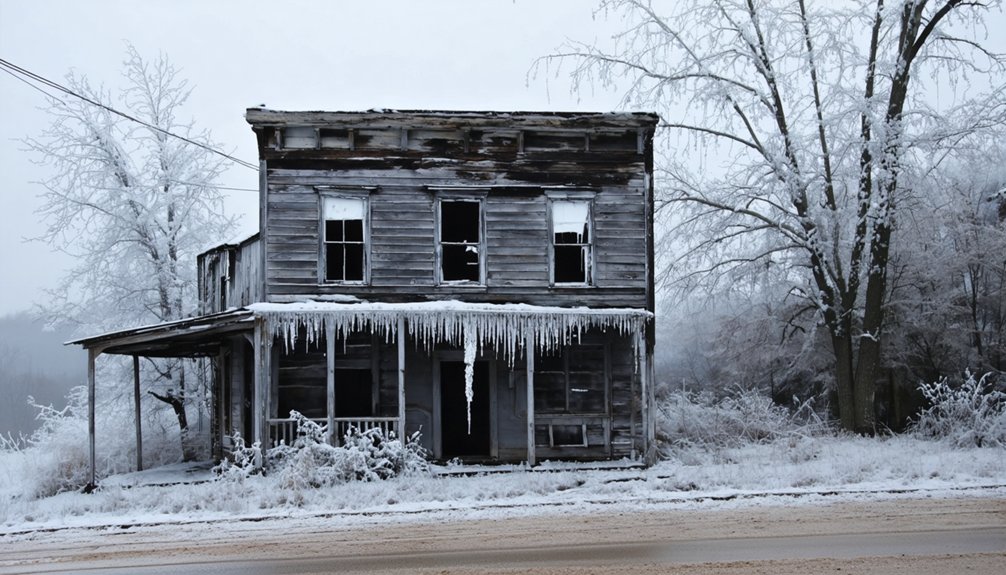
Winter transforms West Virginia’s ghost towns into stark, skeletal landscapes where original structures emerge from dormancy with crystalline clarity. You’ll peer through stabilized windows at Thurmond’s National Bank, built in 1917, where once-bustling apartments and Western Union offices now stand frozen in time.
The National Park Service’s preservation efforts since 2003 function like art restoration, revealing authentic architectural bones without interference. At Nuttallburg, towering coal processing equipment rises through bare branches—rusted giants that’ve become wildlife habitat for winter birds and denning mammals.
Snow highlights Sewell’s 50+ coke ovens from 1874, their stone arches defying decay. Kaymoor’s 821-stair descent exposes machinery foundations and rail lines, while Dun Glen’s stone remnants appear ghost-like against white slopes, accessible only to those willing to climb.
Safety Considerations for Winter Ghost Town Adventures
Before you lace up your boots for a winter expedition to West Virginia’s abandoned settlements, recognize that these remote sites present compounded dangers when temperatures plummet. Accessibility challenges multiply when ice coats Kaymoor’s 821 steps and snow obscures trail markers leading to Thurmond.
Seasonal weather risks demand serious preparation:
- Pack emergency supplies: Two weeks of nonperishable food, water, extra layers, flashlight, first aid kit, and phone charger for unexpected delays.
- Monitor conditions relentlessly: Mountainous terrain means rapid weather deterioration; avoid travel during active storms.
- Prepare your vehicle: Check tire tread, clear all snow/ice, and carry traction aids for steep, unplowed access roads.
- Watch for structural hazards: Snow-loaded roofs on unstable historic buildings increase collapse risks near rusted mining equipment.
Freedom to explore requires respecting nature’s winter fury.
Frequently Asked Questions
Are There Any Guided Ghost Town Tours Available During Winter Months?
You won’t find guided ghost town tours during winter, but Harpers Ferry’s nightly ghost walks offer winter tour safety with bundled layers. For true guided tour availability, you’ll need to explore abandoned sites independently until spring.
What Are the Operating Hours for New River Gorge Ghost Town Sites?
You’ll find Thurmond’s streets open during daylight hours year-round, offering exceptional photography opportunities among preserved structures. The Canyon Rim Visitor Center operates 9 AM-5 PM daily for historical preservation insights, though winter weather impacts accessibility.
Is Camping Permitted Near the Ghost Towns in Winter?
Camping near ghost towns isn’t officially documented, so you’ll need to verify local regulations first. Pack winter weather preparations like insulated gear, and follow essential safety precautions—hypothermia doesn’t care about your adventure spirit when temperatures plummet.
Do Any Ghost Towns Charge Admission or Parking Fees?
You’ll find admission policies vary widely at West Virginia’s historic sites. Historical preservation costs money—some locations charge $14-$25, while others like Sutton’s museum welcome you free. Always bring cash since credit cards aren’t universally accepted.
Are the Ghost Towns Wheelchair Accessible for Visitors With Mobility Issues?
Unfortunately, wheelchair accessibility is extremely limited at West Virginia’s ghost towns. You’ll face steep stairs, rugged terrain, and absent mobility assistance. Thurmond’s depot offers access, but exploring requires traversing challenging paths. Consider nearby accessible trails instead for easier exploration.
References
- https://www.youtube.com/watch?v=-EeLwLa2t90
- https://wvtourism.com/5-wv-ghost-towns/
- https://officialbridgeday.com/bridge-blog/kaymoor-revisiting-a-wv-ghost-town
- https://nuttyhiker.com/thurmond-west-virginia/
- https://www.onlyinyourstate.com/trip-ideas/west-virginia/abandoned-trip-wv
- https://newrivergorgecvb.com/thurmond-west-virginia-a-ghost-town/
- https://abandonedonline.net/4-must-see-new-river-ghost-towns/
- https://minskysabandoned.com/2015/07/30/west-virginia-ghost-towns-part-1-nuttallburg/
- https://www.youtube.com/watch?v=2x_SbnBKfq4
- https://theclio.com/tour/1943