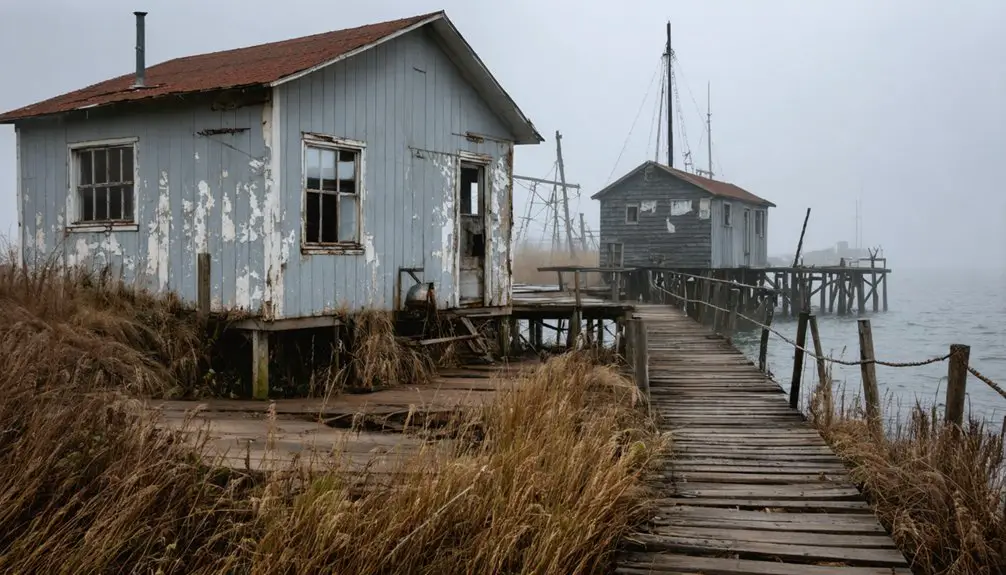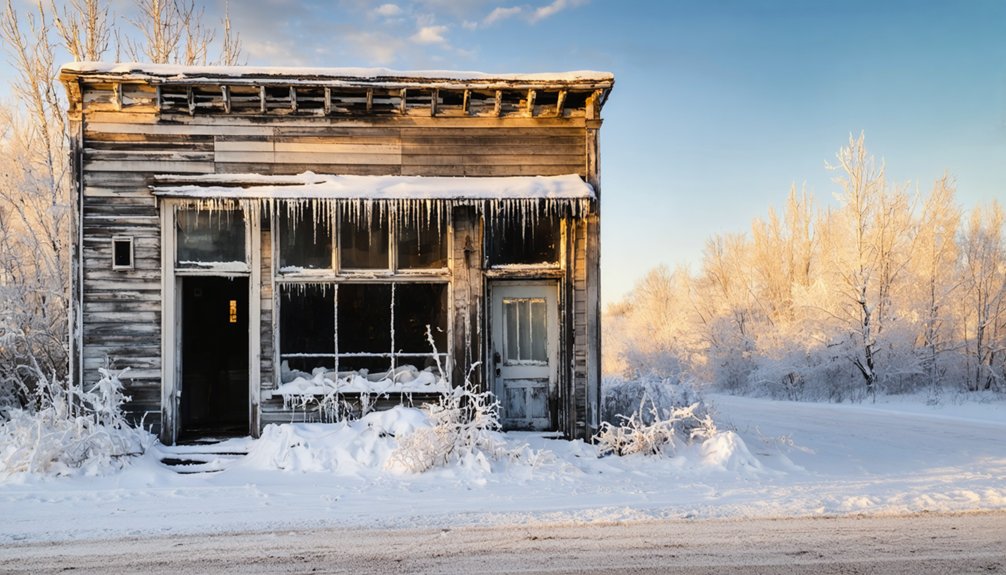
You’ll find Wisconsin’s most atmospheric ghost towns along the frozen Namekagon River, where Veazie’s 1860s logging camp lies accessible only by snowshoe when ice seals the waterway. Door County’s lighthouse circuit offers haunted maritime history at Pottawatomie and Sherwood Point, while Old World Wisconsin’s 60+ immigrant structures stand silent beneath snow blankets. The Wisconsin Dells Ghost Boat navigates Cold Water Canyon’s abandoned passages with live actors and eerie lighting. Proper sub-zero gear and offline GPS coordinates prove essential for these remote winter explorations that reveal stories you won’t discover during warmer months.
Key Takeaways
- Veazie Ghost Town on the Namekagon River is accessible via snowshoe or ski when frozen, revealing 1860s logging remnants.
- Old World Wisconsin offers snowshoeing through over 60 authentic immigrant structures, including the 1839 St. Peter’s Church.
- Sherwood Point Lighthouse near Sturgeon Bay features ghostly phenomena and is viewable year-round from Olde Stone Quarry Park.
- Door County’s haunted lighthouse circuit includes Pottawatomie and Chambers Island, with intensified atmosphere during winter ice lock.
- Wisconsin Dells Ghost Boat traverses Cold Water Canyon, abandoned since 1950, with tours running Thursday–Saturday until Halloween.
Veazie Ghost Town on the Namekagon River
Deep in Wisconsin’s Namekagon River corridor, between the small towns of Trego and Earl, you’ll find what remains of Veazie—a ghost town that once thrived as the beating heart of the region’s logging operations.
Founded in the 1860s by Marine lumberman William Veazie, this settlement supplied remote timber camps until the pine ran out in 1886.
Winter transforms your approach to these historic remnants. When the Namekagon freezes solid, you can snowshoe or ski directly to the old dam site—a freedom summer paddlers don’t enjoy.
The National Park Service offers ranger programs highlighting Veazie’s role in the timber boom of 1861-1901, when ox teams hauled supplies along tote roads from Stillwater. The Namekagon River, whose name derives from the Ojibwe word meaning “place abundant with sturgeon,” served as the main highway for transporting logs downstream to the St. Croix River. Archaeological discoveries near Nevers Dam have uncovered artifacts like clay pipes and kerosene lamps dating from this era.
Come warmer months, river adventures by canoe reveal this ghost town from its original transportation route.
Pottawatomie Lighthouse at Rock Island State Park
While most ghost towns crumble into anonymity, Wisconsin’s oldest lighthouse stands defiant against Lake Michigan’s fury on Rock Island—a limestone sentinel that’s guided ships since 1858.
You’ll need to earn this adventure. Ferry to the car-free island, then hike to Pottawatomie Lighthouse, where lighthouse architecture tells stories through locally quarried stone and a nine-sided lantern room.
The fourth-order Fresnel lens once threw light fourteen nautical miles across Rock Island Passage, guiding vessels between Green Bay and Detroit.
Though winter tours aren’t available, maritime history enthusiasts can explore from Memorial Day through Columbus Day.
Volunteer docents—living in the keeper’s duplex—share tales of civilian keepers who tended this beacon from 1836 to 1946. The lighthouse earned its place on the National Register of Historic Places in 1979, cementing its significance in Wisconsin’s maritime heritage.
Climb the wooden tower yourself and understand why isolation attracted those seeking purpose beyond civilization’s grip. The lighthouse displayed a steady white beam that served as a navigational marker for ships traversing these treacherous waters.
Sherwood Point Lighthouse Near Sturgeon Bay
Standing alone on its limestone bluff since 1883, Sherwood Point Lighthouse marks the western approach to Sturgeon Bay with red brick walls that glow like embers against winter’s white canvas.
Red brick walls glow like embers against winter’s white canvas, marking Sturgeon Bay’s entrance since 1883.
You’ll find Door County’s only attached tower design here, where haunted lighthouse myths aren’t just tourist bait—caretakers report phantom footsteps climbing the tower stairs, tools vanishing during renovations, and beds shaking through quiet nights.
Locals credit Minnie Hesh, who died upstairs in 1928 after serving as one of the Great Lakes’ rare female assistant keepers.
While winter lighthouse tours are limited, you can view this beauty year-round from Olde Stone Quarry County Park across the bay. The best opportunity for an up-close look comes during the annual Door County Lighthouse Festival, when the private Coast Guard property opens to visitors.
The lighthouse was automated in 1983, becoming the last manned station on the Great Lakes. During the 1930s, the station received upgrades including electricity and running water, modernizing life for the keepers who maintained this remote outpost.
Door County’s Haunted Lighthouse Circuit
Sherwood Point’s ghostly keeper isn’t the only restless spirit watching over Door County’s waters. You’ll find haunted lighthouse stories throughout this maritime peninsula, where winter maritime legends come alive in the howling wind.
At Pottawatomie Lighthouse on Rock Island, keeper David Corbin’s presence lingers near his island grave. Visitors report phantom children’s laughter echoing through empty halls. Built in 1836, this oldest lighthouse in Door County has witnessed over 180 years of maritime history and supernatural activity.
Chambers Island Lighthouse hosts Lewis Williams, who still opens doors and shakes beds—caretakers Joel and Mary Blahnik regularly chase down mysteriously vanishing tools. The original keeper’s spirit was reportedly quieted in 1987 when nuns arrived to break the haunting through prayer.
These isolated towers become even more atmospheric when ice locks the shoreline. You can explore Eagle Bluff year-round in Peninsula State Park, while Cana Island’s 89-foot tower offers frozen Lake Michigan vistas.
Plan summer visits for boat-access locations like the privately-owned Birdcage Lighthouse.
Wisconsin Dells Ghost Boat and Cold Water Canyon
When darkness falls over the Wisconsin River, the Ghost Boat departs from downtown Dells on a journey that transforms familiar sandstone cliffs into something far more sinister. You’ll cruise upriver into complete darkness before docking at Cold Water Canyon—a site mysteriously abandoned in 1950 after reports of strange lights and missing passengers.
Journey into darkness where Wisconsin River legends emerge from abandoned canyons and unexplained disappearances still echo through the night.
The 1.5-hour experience combines haunted boat rides with canyon exploration through winding passages where live actors, horror sound effects, and eerie lighting bring decades-old legends to life. The canyon remained undisturbed for decades, keeping its scenic wonders hidden from public view until recently. After disembarking, you can warm up with light-hearted resort activities including an indoor waterpark, arcade, and zipline course.
What Makes This Experience Unforgettable:
- Complete darkness intensifies the scares as you navigate jet-black waters and shadowy forest trails
- Cold Water Canyon’s genuine mystery surrounds its abrupt closure 75 years ago
- Interactive trail elements feature frightening props and apparition stories throughout craggy corners
Note: Tours run Thursday through Saturday nights until Halloween, weather permitting.
Old World Wisconsin’s Frozen Historic Village
You’ll find yourself transported to Wisconsin’s immigrant past as you wander through 65 preserved buildings scattered across nearly 600 acres of snow-covered farmsteads and villages.
The frozen landscape transforms these authentic 19th-century structures—from German homesteads to Norwegian churches—into a quieter, more contemplative version of their summer selves, where your footsteps crunch the only sound breaking the stillness.
I’ve discovered that strapping on snowshoes and exploring the connecting trails between settlements offers an intimate winter experience you won’t get during crowded peak season, though you’ll want to dress in layers since those historic buildings weren’t designed with modern heating in mind.
Preserved 19th-Century Buildings
Nestled against the rolling hills of Kettle Moraine State Forest, Old World Wisconsin spreads across 600 acres like a time capsule frozen in the 1800s. You’ll discover over 60 authentic structures relocated from their original Wisconsin locations, each representing the preservation strategies that saved them from demolition.
The historic architecture tells stories of German blacksmiths, Finnish homesteaders, and Danish farmers who carved freedom from wilderness.
Winter transforms these buildings into stark monuments:
- St. Peter’s Church (1839) stands as Milwaukee’s first Catholic church, its white clapboards brilliant against snow
- Koepsel House maintains National Register status with original timber framing exposed
- Schulz Farm’s summer kitchen reveals 1860s survival tactics through period-accurate furnishings
You’re free to explore authentically restored workshops, homes, and stores—each building a testament to immigrant determination and self-reliance.
Winter Snowshoeing Trail Access
Beyond the historic village’s weathered buildings, Kettle Moraine State Forest unfolds into 600 acres of snowshoeing terrain that’ll test your endurance and reward your ambition.
The John Muir Trail’s five loops range from a gentle 0.4-mile warm-up to a punishing 10-mile trek through glacial moraines. Emma Carlin’s marked routes slice through snow-laden hardwoods.
Winter trail maintenance keeps paths navigable, though you’ll want to check conditions before venturing out.
The Ice Age National Scenic Trail cuts straight through, offering miles of uninterrupted wilderness exploration.
Pack your own snowshoes—there’s no on-site rentals—and respect snowshoe safety basics: layer up, bring water, and stick to marked routes.
These restored trails deliver genuine solitude, far from the preserved village’s scripted past.
Best Practices for Winter Ghost Town Exploration
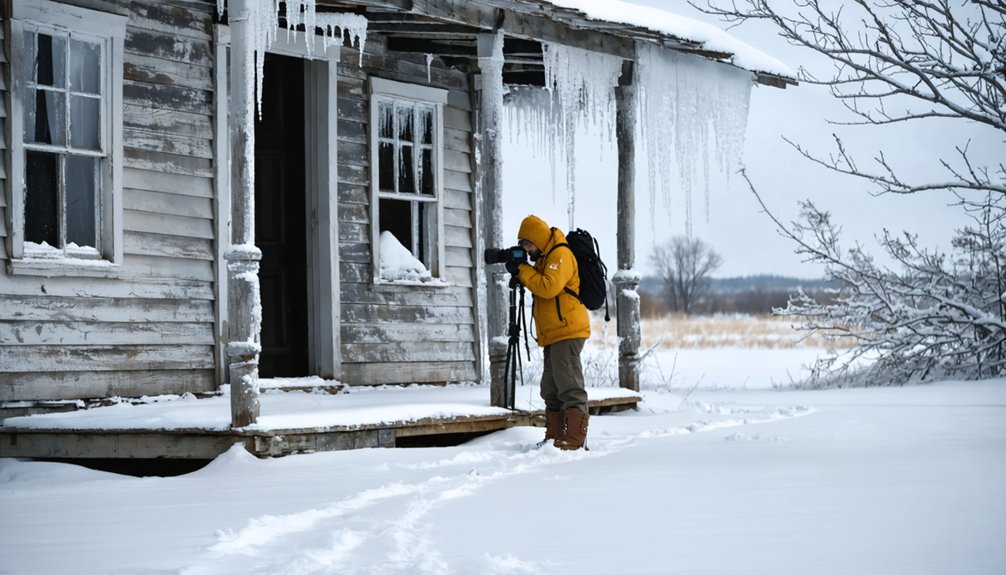
When temperatures plummet and snow blankets Wisconsin’s abandoned settlements, exploring ghost towns transforms from a casual weekend activity into a backcountry expedition requiring genuine preparation. Your winter gear arsenal must include insulated layers rated for sub-zero conditions, thermal boots, and waterproof outer shells.
Essential safety precautions mean informing someone of your exact itinerary—whether you’re heading to Old Tyrone or Nelsonville—and traveling with companions who can assist if hypothermia strikes.
Critical practices for winter exploration:
- Limit site visits to 30-60 minutes to prevent frostbite in exposed locations like Gratiot House ruins
- Download offline GPS coordinates before departure, as cell signals vanish in remote areas
- Pack high-calorie snacks and hot thermoses to maintain core temperature during extended outdoor exposure
Respect fragile structures and minimize environmental impact while documenting your discoveries.
Frequently Asked Questions
Are There Overnight Accommodations Near Wisconsin’s Winter Ghost Town Locations?
You’ll find plenty of overnight stays near Wisconsin’s ghost towns—no need to livestream your winter camping struggles. Gratiot House Farm B&B, Lake Geneva hotels, and Crandon lodges offer warm refuge. Prioritize winter travel safety when exploring these remote historical sites.
What Photography Equipment Works Best in Freezing Conditions at Ghost Sites?
You’ll need carbon fiber tripods for stability on frozen ground and prime lenses that handle cold better than zooms. Keep backup batteries warm against your body, and use lens warmers to prevent frost buildup during exploration.
Do Any Ghost Towns Offer Guided Winter Tours With Paranormal Investigators?
No Wisconsin ghost towns currently offer paranormal tour guides during winter months. You’ll find winter ghost town legends through self-guided exploration instead. Historic sites like abandoned settlements near Baraboo let you experience authentic, unrestricted supernatural investigations independently.
Which Ghost Town Sites Are Wheelchair Accessible During Winter Months?
You’ll find Wyalusing State Park’s boardwalk and Pendarvis’s accessible trails welcoming your wheels. Winter safety tips: check trail conditions beforehand, bring traction aids, and dress warmly. These sites honor your independence while delivering authentic ghost town adventures year-round.
Are Pets Allowed at Wisconsin Ghost Town Locations During Winter?
Yes, you’ll find most Wisconsin ghost town sites welcome leashed pets during winter visits. Pet policies vary by location, so check state park rules beforehand. Winter safety requires proper paw protection and vigilance near frozen hazards while exploring freely.
References
- https://www.getyourguide.com/explorer/wisconsin-ttd1184/winter-in-wisconsin/
- https://www.wisdells.com/wisconsin-dells-attractions/All-Attractions/Fall-and-Winter-Attractions
- https://www.travelwisconsin.com/article/tours/spooky-wisconsin-eerie-activities-for-the-halloween-season
- https://www.doorcounty.com/newsletter/5-scary-fun-haunted-attractions
- https://northcentralwisconsin.com/winter/
- https://www.nps.gov/sacn/blogs/veazie-ghost-town-of-the-namekagon.htm
- https://oldworldwisconsin.wisconsinhistory.org
- https://namekagonriver.org/history/
- https://npshistory.com/publications/sacn/hrs/chap2.htm
- https://en.wikipedia.org/wiki/Namekagon_River