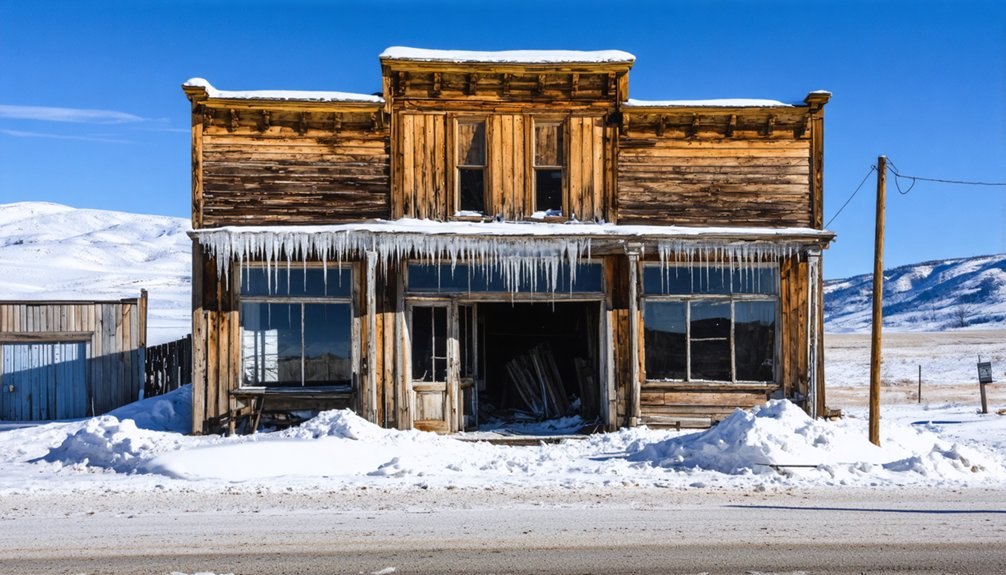
You’ll find Wyoming’s most accessible winter ghost towns at South Pass City, where 40+ gold rush structures stand preserved beneath snow, and Gebo, whose coal town ruins offer dramatic high-desert photography with foundations emerging from white drifts. While Miner’s Delight becomes impassable November through April, these sites reward four-wheel-drive adventurers with crumbling chimneys against frosted hills and weathered headstones that tell stories of 1860s hardship. Beyond these weathered remnants lie avalanche towns, railroad settlements, and essential preparation tips for traveling Wyoming’s treacherous winter backroads.
Key Takeaways
- Gebo remains accessible in winter with dramatic lighting on ruins, cemetery headstones, and scattered foundations in the high desert landscape.
- South Pass City features over 40 original structures from the 1867 gold rush, including the historic Carissa Mine and mining artifacts.
- Miner’s Delight becomes impassable November through April due to heavy snow on unpaved roads; interpretive signs maintained year-round.
- Winter travel requires four-wheel drive, emergency supplies including blankets and chains, and preparation for black ice and whiteout conditions.
- Snow-covered ruins create stunning photography opportunities with frosted foundations, crumbling chimneys, and stark contrasts against white drifts.
South Pass City: a Protected Canyon Retreat With Gold Rush Heritage
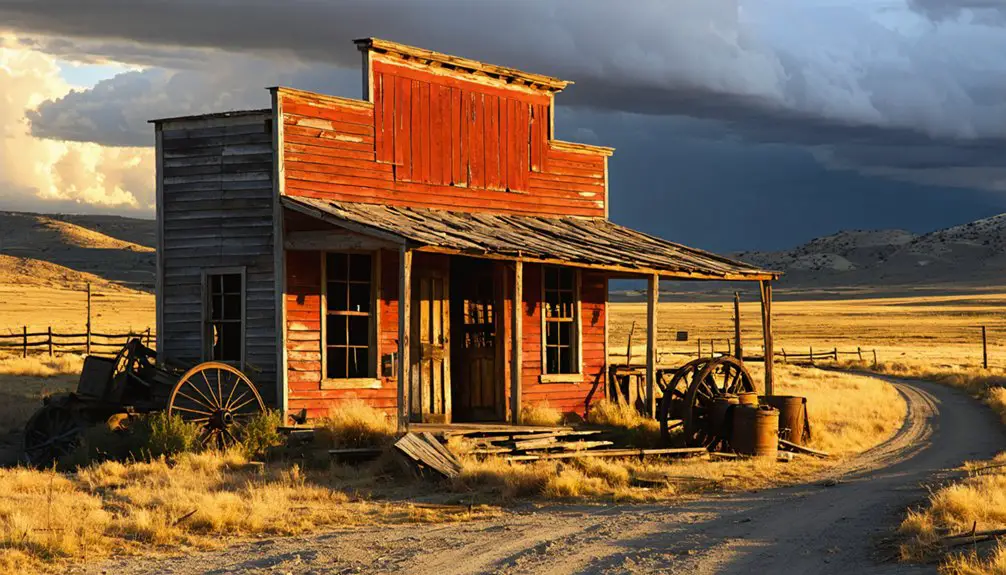
Tucked into a windswept canyon where sagebrush meets snow-dusted peaks, South Pass City stands frozen in time—a remarkably intact ghost town that whispers stories of gold fever and frontier ambition. You’ll find over 40 original structures that’ve weathered Wyoming’s brutal winters since the 1867 gold rush brought 3,000 fortune-seekers to this remote corner of Dakota Territory.
Historical preservation efforts have transformed this once-dying settlement into a living museum. Here, you can explore the massive Carissa Mine, Wyoming’s longest-producing gold operation. Mining artifacts fill every building—from stamp mills that crushed ore to hand-forged tools miners wielded underground.
Winter’s quiet amplifies the site’s haunting authenticity. You’re free to pan for gold, watch operational machinery demonstrations, and wander through the 30-square-mile historic mining area at your own pace. The town’s rapid growth saw 50 houses and stamping mills constructed by November 1867, just months after the initial discovery that sparked the boom. Just two miles east in Palmetto Gulch, prospectors worked rich placer claims where partnerships of seven men would construct three-mile ditches to channel water for sluicing operations.
Understanding Winter Road Conditions and Vehicle Requirements
Before you set out to explore Wyoming’s ghost towns, you’ll need to reckon with winter roads that transform from passable to treacherous within hours. Black ice coats I-25 between Casper and Cheyenne without warning, while blowing snow creates whiteout conditions that’ll strand you miles from nowhere.
Winter vehicle safety demands four-wheel drive for remote access roads to Kirwin, high clearance for muddy tracks near Gebo, and sturdy tires for cactus-dotted terrain around Bryan.
Four-wheel drive, high clearance, and tough tires aren’t suggestions for Wyoming’s ghost town roads—they’re requirements for survival.
You can’t wing it here. Monitor WYDOT’s road closure updates religiously—highways stay shut 24+ hours after major storms, and high-impact advisories mean exactly what they say. The WYDOT 511 app delivers real-time traffic and weather updates you’ll need for route planning across the state. Pack water, even in freezing temperatures, because desolate routes to places like Wendover offer zero services. Watch for rutted roads from rain that freeze into hazardous ice ridges during winter months, especially when accessing coal camp sites.
Your freedom depends on respecting these conditions, not fighting them.
Kirwin: The Avalanche Town in the Absaroka Mountains
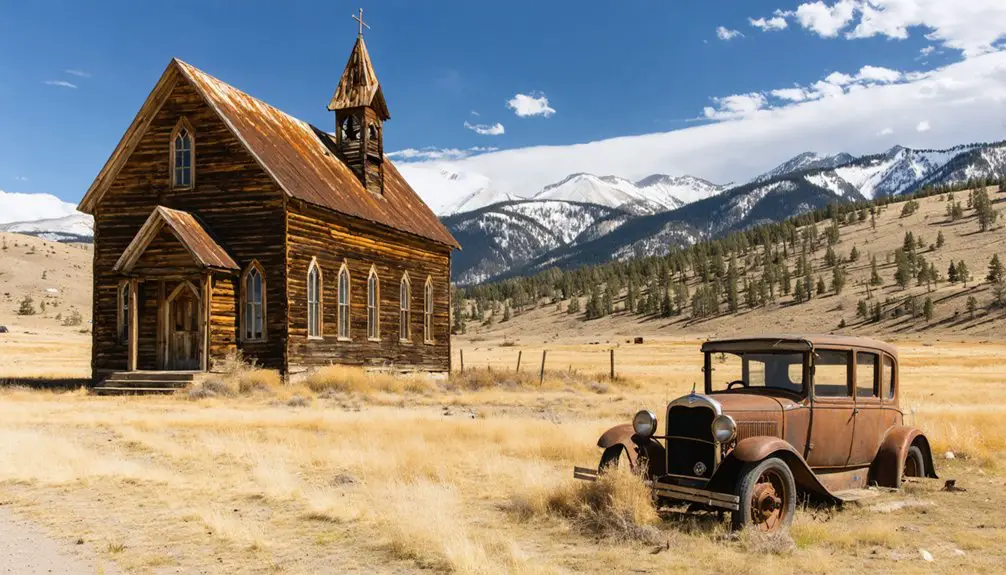
Thirty-four miles of unpaved Forest Service Road 200 brings you to Kirwin, where weathered cabins slump against snowdrifts at 9,200 feet in the Absaroka Mountains. You’ll find a settlement that once housed 200 souls before February 5, 1907, when an avalanche buried it under fifty feet of snow, killing three residents and sending survivors fleeing by spring.
Historical preservation efforts have stabilized the remaining structures—a hotel, boarding house, and scattered cabins—but winter safety demands respect here. The same steep terrain that trapped miners still threatens snowslides after heavy storms. The abandoned buildings stand with their tools and structures left in place, now overgrown with vegetation where miners once worked. The 40-mile-long telephone line that once connected this modern mining camp to civilization now lies abandoned alongside the machinery and homes.
You’ll need winter driving skills and avalanche awareness to reach this remote headwaters location where William Kirwin discovered gold in 1885, then watched nature reclaim his namesake town two decades later.
Piedmont’s Railroad Legacy and Charcoal Kilns
Where railroad ambition met frontier resourcefulness, Piedmont rose in 1867 as Moses Byrne’s solution to the Union Pacific’s hunger for fuel and water.
You’ll discover five beehive kilns where ox teams once hauled Uinta Mountain timber, transforming aspen and pine into charcoal for Salt Lake City’s foundries. Three kilns stand intact, their scorched interiors still reeking of century-old smoke.
Winter transforms this ghost town into tracking territory—you’ll spot elk and deer prints in fresh snow surrounding the crumbling adobe structures. Ice formations drip from the kilns’ stone archways like frozen time. The Byrne and Guild families, connected through two sisters, established the settlement in the mid-1860s before railroad construction crews arrived. The town initially served as Muddy River Station, providing essential wood and water resources for transcontinental railroad operations.
The railroad that birthed Piedmont ultimately killed it; tunnel rerouting left behind only cemetery stones and weathered foundations. Access remains easy via I-80, though the dirt road rewards those seeking solitude over convenience.
Gebo: Coal Town Ruins Across the Sage Hills
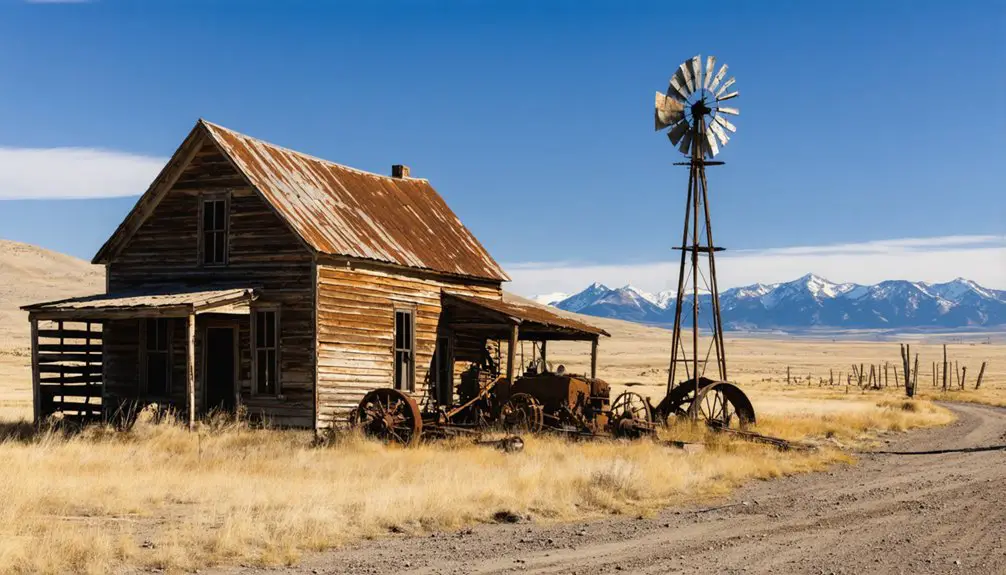
The high desert wind cuts across the sage hills near Thermopolis, where crumbling stone walls rise from the snow like broken teeth—all that remains of Gebo, once the largest town in the Bighorn Basin with 2,000 souls.
They were drawn by coal that burned hotter and cleaner than any other in Wyoming. You’ll find extraordinary winter light here, when low-angled sun casts dramatic shadows across foundation ruins and transforms the maintained cemetery into a photographer’s dream.
Its weathered headstones from the early 1900s tell stories of sixteen nationalities who chased prosperity into these remote hills. Among the graves rest many infants lost to epidemic outbreaks, their small headstones ordered from catalogs by grieving families who faced impossible choices when vaccines were scarce. The seasonal silence mirrors the mines themselves, which once closed each summer and now lie permanently still.
The town thrived with unexpected amenities for such a remote outpost, including a pool hall, school, and the spirited Gebo Town Band that once echoed across these valleys. Their legacy is written in stone fragments scattered across frozen ground.
Coal Mining Heritage
Today’s small cemetery tells harder truths—weathered headstones marking children and infants, coins and flowers left by those who remember freedom’s price.
Winter Photography Opportunities
Beyond the sage-covered ridges north of Thermopolis, Gebo’s scattered ruins transform into a photographer’s dream when winter strips away summer’s concealing brush.
You’ll frame crumbling chimneys against snow-draped hills, their brick edges sharpened by that merciless badlands light. Snow accentuates every stone foundation, creating stark contrasts that summer vegetation hides.
Bring photography gear suited for Wyoming’s bite—your camera battery drains fast at twenty below. Long exposures capture wind-sculpted sagebrush dancing through concrete grids, while frosted cellar remnants emerge dramatically from white drifts.
Historical preservation efforts have left interpretive signs that won’t clutter your compositions.
The rolling terrain offers endless vantage points. You’ll discover glass shards catching winter sun, foundations spanning hillsides like ghostly blueprints, and that profound solitude only abandoned places deliver.
Jibo: Badlands Coal Mining Settlement
Nestled twelve miles north of Thermopolis in the windswept badlands of Hot Springs County, Gebo once thrived as the largest municipality in the entire Bighorn Basin.
You’ll discover remnants of a 2,000-resident coal-mining powerhouse where sixteen nationalities carved homes from unforgiving terrain. Winter weather strips away summer’s distractions, revealing skeletal foundations where company houses stood rent-free and $1.00 coal deliveries kept families warm.
The cemetery remains—weathered headstones testifying to lives lived hard and fast in this boom-then-bust landscape.
Travel safety demands respect here; winter transforms gravel roads into treacherous passages.
You’ll walk where miners once trudged three miles daily to Kirby’s rail hub, their high-quality coal burning hot with merely 3% ash.
Federal corruption investigations and dwindling demand killed Gebo by 1938, leaving you free to explore authenticated solitude.
Miner’s Delight and Seasonal Accessibility Challenges
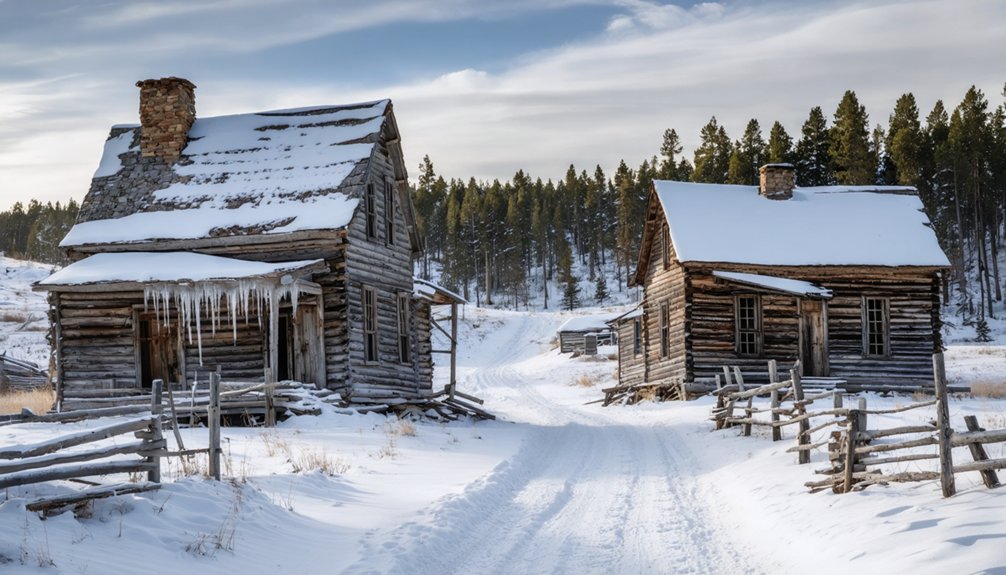
While Gebo’s badlands isolation offers winter adventurers manageable access, you’ll face entirely different obstacles when seeking Miner’s Delight in Fremont County‘s southeastern Wind River Range.
Unlike accessible Gebo, winter seekers targeting Miner’s Delight confront formidable challenges in Fremont County’s remote Wind River terrain.
This 1867 gold rush settlement sits near the Continental Divide, where unpaved Fort Stambaugh Road transforms into an impassable snowdrift maze from November through April. You’ll discover seventeen weathered structures—cabins, a saloon, shaft houses—standing proof to historical preservation efforts that protect Jonathan Pugh’s once-productive mining camp.
The quarter-mile trail from parking to site becomes treacherous under ice, and seasonal impact closes access completely during heavy snowfall periods. Though the Bureau of Land Management maintains interpretive signs year-round, winter’s grip makes this $5-million gold producer strictly a warmer-months destination.
Save Miner’s Delight for summer exploration when freedom means safe passage.
Winter Camping and Lodging Options Near Ghost Towns
Your winter ghost town adventures require strategic camping decisions that balance rugged accessibility with creature comforts. Near Kirwin, you’ll find seven Wood River campsites nestled 9 miles from town—perfect for spotting winter wildlife along scenic trails. The rough road demands four-wheel-drive, especially when crossing streams and snow drifts.
Sage Creek offers unique ghost town immersion at a Hipcamp property surrounded by five-foot sagebrush, where you’ll pass abandoned homes through a gated entry.
For cozy cabin options, consider Meeteetse’s lodging before tackling Kirwin’s stream crossings.
Boysen State Park provides essential facilities along South Pass City routes, while Encampment’s Lazy Acres Campground supports aerial tram explorations.
Each location delivers authentic frontier solitude without sacrificing winter accessibility.
Preparing Your Vehicle for Winter Ghost Town Adventures
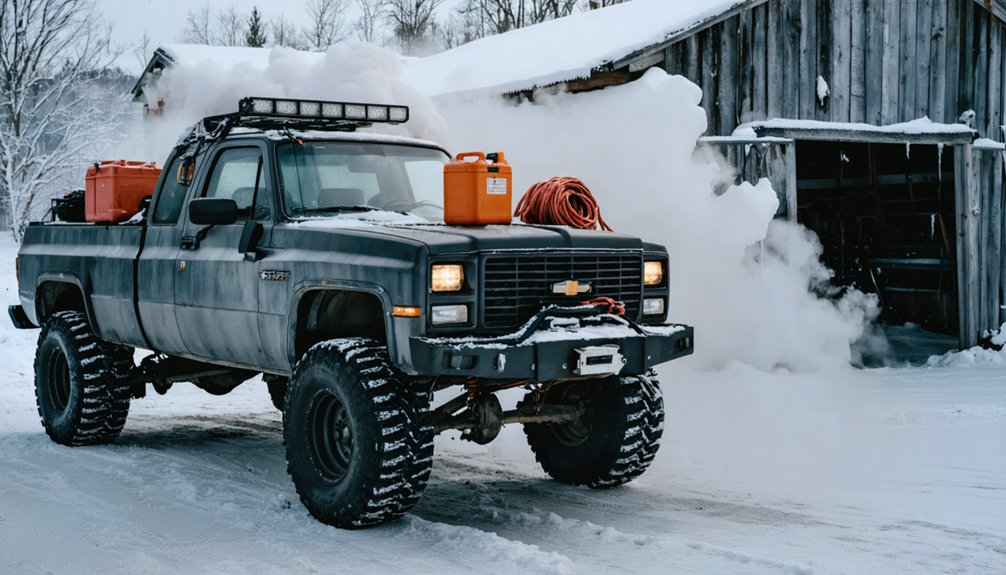
Your vehicle becomes your lifeline when Wyoming’s winter winds howl across desolate valleys where ghost towns sleep beneath snowdrifts.
I learned this the hard way during a January trip to Atlantic City when my two-wheel-drive sedan spun helplessly on black ice, stranding me for six hours until a rancher’s plow truck appeared.
Before you venture down those abandoned roads where frozen streams and waist-high drifts wait, you’ll need four-wheel drive, tire chains rattling in your trunk, and enough emergency supplies to survive if the weather turns savage.
Four-Wheel Drive Essential
When the temperature drops below zero and snow drifts pile three feet high across abandoned mining roads, the difference between reaching South Pass City and getting stranded halfway becomes crystal clear—it’s what’s under your hood and beneath your tires.
You’ll need genuine four-wheel drive, not just all wheel drive. There’s a difference when you’re crawling up a frozen gulch where no plow has ventured since October. Feel the shudder as your drivetrain locks in, pulling you through ruts that would swallow a sedan whole.
Pack tire chains regardless of your confidence. I’ve watched locals with lifted trucks claw sideways on black ice, humble enough to chain up when pride won’t cut it. That metallic bite into frozen earth means freedom to explore, not freedom to require rescue.
Stream Crossing Preparation
Before you even think about pointing your truck toward Atlantic City or Miners Delight, freezing streams will test whether you’ve prepared or just hoped for the best. Stream crossing demands more than bravado—your mechanic becomes your best ally before winter. Check those hoses for leaks that’ll strand you mid-creek.
Test your battery’s strength because three-year-old cells die when you need them most. Inspect your tires for tread that grips submerged ice.
Top off fluids rated for freezing temps, especially windshield washer—you’ll need clear visibility after splashing through. Keep your gas tank half-full to prevent fuel line freezing. Clean all sensors and cameras; mud and ice create a vehicle barrier between you and safety.
Practice low-speed maneuvering in empty lots first. Freedom means self-reliance, not rescue calls.
Emergency Winter Equipment
The howl of wind against your stranded truck at midnight teaches lessons no YouTube video ever could—lessons best learned in your garage, not fifteen miles from the nearest plowed road. Pack your emergency kit like you’re defending your independence: wool blankets, high-calorie trail mix, sand for traction, jumper cables, and a shovel that’s actually metal.
Those historic preservation sites won’t have cell service when your battery dies at twenty below. Keep winter-grade washer fluid, spare gloves, and a flashlight within arm’s reach. Wildlife encounters increase near abandoned settlements where deer seek shelter from storms—you’ll need that bright emergency flag if you slide into a snowbank watching elk cross crumbling Main Street at dusk.
Frequently Asked Questions
What Winter Photography Equipment Works Best in Wyoming Ghost Town Conditions?
You’ll need robust winter gear including spare batteries that won’t die in freezing temps, weatherproof bags, and telephoto camera upgrades reaching 400-800mm. These capture distant, snow-draped structures while you’re bundled against Wyoming’s biting wind.
Are Guided Ghost Town Tours Available During Winter Months?
Guided tours aren’t confirmed for winter months—roads freeze, avalanches threaten, darkness falls fast. Tour availability shifts to May-September when winter safety concerns ease. You’ll need self-reliance, proper gear, and adventurous spirit to explore independently during snowy seasons.
Which Ghost Towns Allow Metal Detecting or Artifact Collection?
You’ll find Gebo and Fossil ghost towns welcome metal detecting, though artifact collection rules require you to leave discoveries in place. These sites offer thrilling hunts for relics while respecting metal detecting policies that preserve Wyoming’s rugged historical heritage for future explorers.
What Wildlife Might Visitors Encounter Near Winter Ghost Towns?
You’ll spot icy animal tracks from elk, moose, and coyotes crossing frozen paths. Winter birdwatching reveals ravens and ptarmigan near crumbling cabins. I’ve encountered deer pawing through snow at dawn—pure wilderness freedom surrounds these abandoned sites.
Do Any Ghost Towns Have Cell Phone Service for Emergencies?
Your phone might betray you when you need it most—cell service limitations plague remote ghost towns. You’ll find spotty reception at best, so emergency preparedness means programming backup numbers and keeping ICE contacts ready before exploring Wyoming’s forgotten places.
References
- https://travelwyoming.com/blog/stories/post/5-wyoming-ghost-towns-you-need-to-explore/
- https://www.youtube.com/watch?v=GEoxbcwf8Ks
- https://takingthekids.com/long-abandoned-wyoming-ghost-towns-where-the-old-west-still-lingers/
- https://windriver.org/spookiest-places-wyoming/
- https://www.tripadvisor.com/Attraction_Review-g60442-d4432765-Reviews-Kirwin_Ghost_Town_Tours-Cody_Wyoming.html
- https://www.wyomingcarboncounty.com/?id=123:5-ghost-towns-to-explore
- https://www.visitkeweenaw.com/listing/wyoming-the-ghost-town/519/
- https://www.discovernorthamerica.co.uk/holidays/kirwin-ghost-town-tours-by-cody-wyoming-adventures/
- https://www.wyohistory.org/encyclopedia/south-pass-gold-rush
- https://cowboystatedaily.com/2025/08/17/wyoming-history-the-miners-cure-for-laziness-at-south-pass-city/