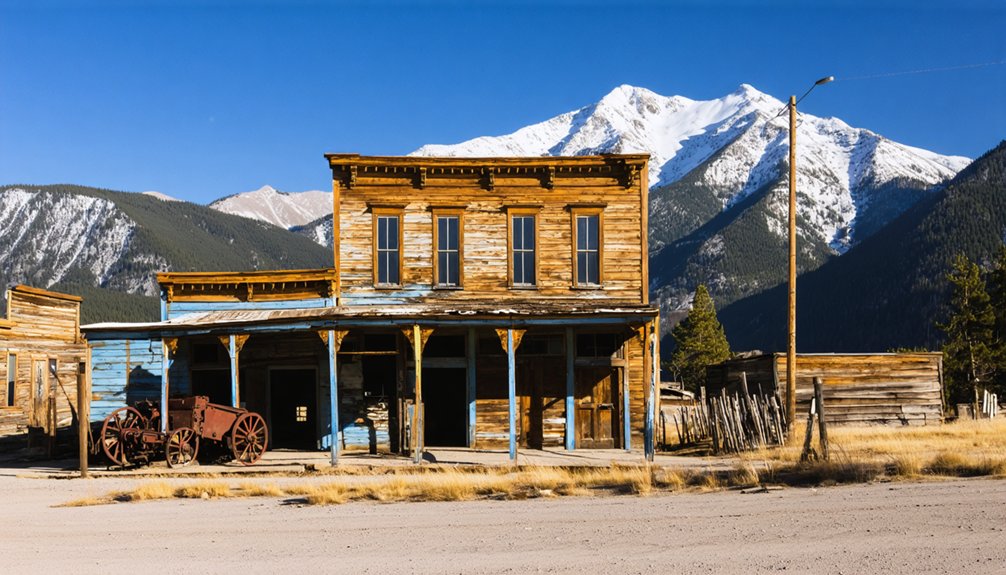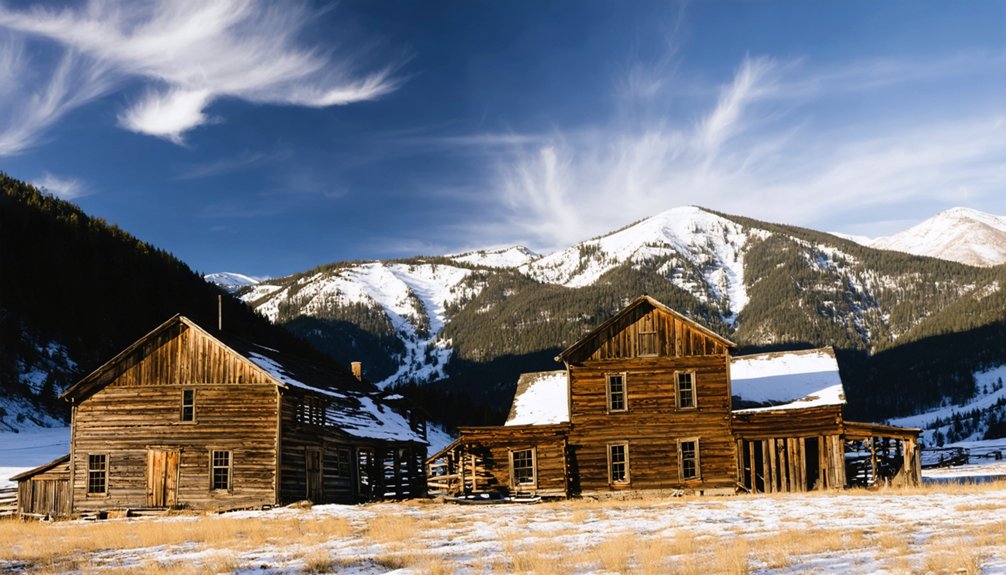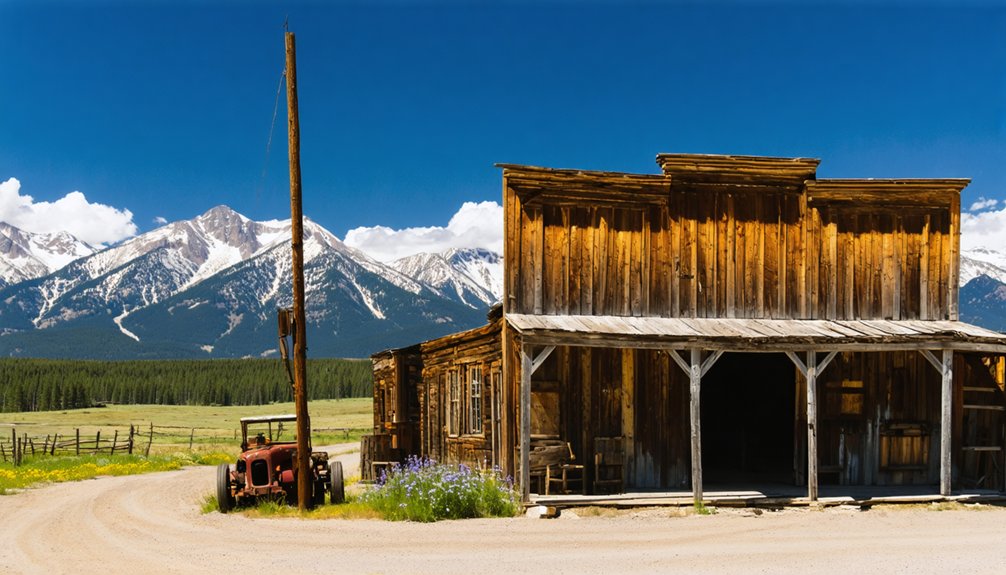
You’ll find Colorado’s best summer ghost towns perched high in the Rockies, where preserved 1880s buildings tell stories of gold rushes and boom-to-bust cycles. St. Elmo at 10,000 feet offers 150 original structures and an operating general store, while Animas Forks sits even higher at 11,200 feet with stunning Victorian architecture. Pack your 4WD vehicle, bring layers for unpredictable mountain weather, and prepare for challenging backcountry roads that reward you with authentic frontier history frozen in time—each location revealing different chapters of Colorado’s mining heritage.
Key Takeaways
- St. Elmo at 10,000 feet features 150 preserved 1880s structures, accessible May–October via ATV with a general store still operating.
- Animas Forks sits at 11,200 feet in the San Juans, requiring high-clearance 4WD to reach well-preserved Victorian-era buildings.
- Ashcroft near Aspen offers guided tours, restored saloons, and interpretive signage maintained by the Aspen Historical Society.
- The 65-mile Alpine Loop connects Silverton, Lake City, and Ouray through rugged terrain, wildflower meadows, and multiple ghost towns.
- Summer visits require 4WD vehicles, layered clothing, water supplies, and caution around unstable mining structures at high elevations.
St. Elmo: Colorado’s Best-Preserved Ghost Town
Nestled at 10,000 feet in the heart of the Sawatch Range, St. Elmo stands as Colorado’s most authentic mining relic. You’ll discover approximately 150 original structures frozen in time since the 1880s boom that drew 2,000 fortune-seekers to these peaks. The ghost town architecture remains remarkably intact—explore the general store, schoolhouse, and American House Hotel showcasing cramped one-room mining quarters.
Early settler stories come alive through preserved buildings that survived where others vanished. The Stark family’s dedication kept this place authentic for decades, operating the store and cabins year-round when only seven souls remained by 1930. The Mary Murphy Mine once shipped 50-75 tons of ore daily to smelters, making it the area’s largest operation.
From May through October, you’ll find the general store open, offering supplies before you venture onto 150+ old mining roads by ATV or jeep—pure mountain freedom awaits. At Chipmunk Crossing on Main Street, tourists can purchase sunflower seeds for fifty cents per bag to feed the local chipmunks that have become a beloved attraction.
Animas Forks: A High-Altitude Mining Marvel
You’ll need a high-clearance 4WD vehicle to reach Animas Forks in summer, ideally tackling the Alpine Loop from Silverton’s side where the route proves most forgiving.
Once you arrive at this 11,200-foot ghost town, make the Duncan House your first stop—peer through its historic windows to glimpse the restored interior where miner William Duncan once lived in 1879.
The building’s preservation offers a rare, intimate look at daily life in what residents boldly claimed was “the largest city in the world” at that altitude.
The town thrived during the 1880s when over 450 summer residents called this remote mountain settlement home, supporting amenities like saloons, a hotel, and even a jail.
During the severe 1884 blizzard, residents survived 23 days of continuous snowfall by digging tunnels between buildings to navigate the 25 feet of accumulated snow.
Historic Duncan House Window
Perched at 11,584 feet in the San Juan Mountains, the Duncan House commands attention with its distinctive bay window—a Victorian architectural flourish that seems almost audacious in this harsh alpine environment. This historic window, built in 1879 by postman-turned-miner William Duncan, frames the kind of mountain vistas that make you understand why he chose this exact spot for his family’s home.
What Makes This Historic Window Remarkable:
- Strategic positioning captures panoramic views of surrounding peaks from the cramped living room.
- Shatterproof polycarbonate installation (2013-2014) represents modern preservation technique protecting original character.
- Victorian elegance in a mining town shifting from rough log cabins.
- Weather survivor enduring 140+ brutal mountain winters.
- Architectural statement marking Duncan’s newfound mining wealth.
You’ll find this well-preserved treasure open for summer tours, offering authentic glimpses into Colorado’s mining heritage. The house later became part of the Walsh family legacy when Tom Walsh purchased it for his daughter Evalyn, though she never lived in the property despite her father’s intentions. The rumor connecting Evalyn Walsh McLean to the Duncan House proved significant for its preservation, as her colorful story purchasing the Hope Diamond drew sustained interest to the historic structure.
Summer Four-Wheel Drive Access
Getting to Animas Forks isn’t a casual Sunday drive—it’s an adventure that demands respect for both your vehicle’s capabilities and the unforgiving mountain terrain.
You’ll need a high-clearance 4WD to tackle the 13.5-mile route from Silverton, where paved roads give way to graded gravel before turning seriously rocky.
Summer access runs June through September, offering your best window for exploration.
Don’t have the right rig? Vehicle rentals like Polaris RZRs or Tomcars are available from Silverton outfitters—they’re purpose-built for these conditions.
Off-road safety isn’t optional here. Those narrow sections with steep drop-offs in the final 3.5 miles won’t forgive mistakes.
Remember: uphill traffic owns the right-of-way. The road follows the path of an old railroad track that was built beside the Animas River, adding historical significance to your journey.
This route is part of the 65-mile Colorado Alpine Loop, connecting Lake City, Ouray, and Silverton through some of the state’s most dramatic high-altitude terrain.
Budget 4-5 hours round-trip, and you’ll experience freedom few travelers ever know.
Vicksburg: Where Burros Discovered Gold
Among Colorado’s ghost towns, Vicksburg stands out for its peculiar origin story—one involving thirsty pack animals rather than shrewd prospectors.
Unlike most gold rush towns founded by prospectors, Vicksburg owes its discovery to burros who stumbled upon the precious metal while seeking water.
In 1867, wandering burros led Leadville miners to gold glittering in Clear Creek’s bed, sparking a settlement that swelled to 700 residents.
You’ll find historic architecture from the 1880s boom still standing—40 original structures once bustled with life.
The town’s distinctive balsam poplars, packed in by burro, still shade the main street thanks to ingenious irrigation ditches miners carved throughout town.
The settlement was named after Vick Keller, who operated the local general store.
What makes Vicksburg worth your visit:
- Try gold panning in Clear Creek where burros made their discovery
- Explore preserved buildings maintained by Chaffee County Historical Society
- Walk among century-old poplar trees planted by original settlers
- Examine the elaborate ditch system that kept provisions cold
- National Register site since 1977
The town reached its peak during the 1870s with approximately 1,000 residents supported by two hotels, multiple saloons, and various essential businesses including a post office and school.
Capitol City: Silver Rush Remnants Along the Alpine Loop
You’ll find Capitol City’s haunting remnants at 9,480 feet along Engineer Pass.
This is where George S. Lee’s 1877 dream of creating Colorado’s state capital collapsed with the silver crash of 1893.
The original post office and Lee’s crumbling smelter stack still stand among aspens that have reclaimed the 200-acre townsite.
Once, 800 residents lived in brick buildings and two-story mansions there.
Pack your 4×4 for the rugged Alpine Loop from Lake City—accessible late spring through fall.
You’ll walk the same mountainside where fortunes rose and vanished in less than two decades.
History and Founding Era
In 1877, George S. Lee transformed a failed smelting operation into Capitol City, fueled by boundless optimism and an audacious dream—he wanted Colorado’s state capital right here in the mountains. The founder stories reveal Lee’s bold vision: he’d become governor, and his two-story brick mansion would serve as the official residence.
Mining history shows the town’s meteoric rise to 800 residents during the silver boom.
Capitol City’s ambitious infrastructure included:
- George Lee’s brick mansion (built as future governor’s residence)
- Multiple smelters processing local silver ore
- Rose Lime Kiln for construction materials
- Schoolhouse, hotels, and saloons across 200 acres
- Post office operating until 1920
Lee’s whimsical naming strategy and brick construction conveyed permanence, though silver price crashes and transportation difficulties ultimately crushed his frontier aspirations.
Scenic Summer Hiking Access
Reaching Capitol City requires traversing the legendary Alpine Loop, a 65-mile unpaved ribbon of backcountry road that’s become a pilgrimage route for adventure seekers. You’ll need a high-clearance 4WD to navigate the narrow, rugged terrain climbing two 12,000-foot passes between Silverton, Lake City, and Ouray.
Summer transforms this remote ghost town into hiking paradise. Trails weave through wildflower meadows bursting with color, connecting Capitol City to nearby mills and mine ruins. The moderate-to-strenuous paths reward you with scenic overlooks framing dramatic alpine peaks and abandoned silver-era structures. The weathered Ute-Ulay Mill complex stands as an indicator to the Silver Rush.
Pack layers; weather shifts fast at elevation. Combine your visit with nearby Animas Forks for a full-day adventure through Colorado’s mining past.
Ashcroft: Restored History in the Castle Creek Valley
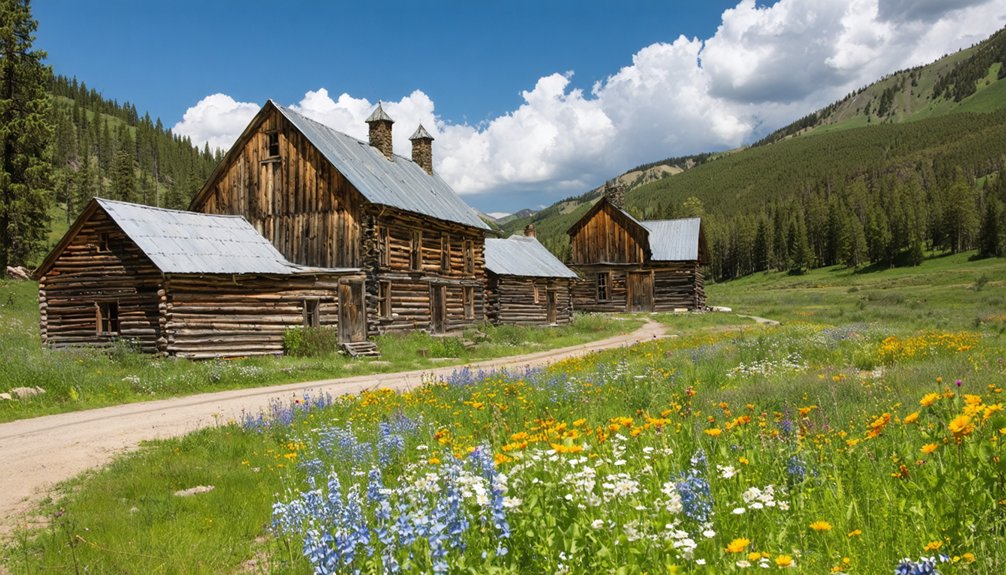
Nestled in the Castle Creek Valley just 11 miles south of Aspen, Ashcroft stands as one of Colorado’s most photogenic and well-preserved ghost towns. You’ll discover authentic mining history through restored buildings that once served 3,500 fortune-seekers during the 1880s silver boom. The Aspen Historical Society’s preservation efforts have maintained structures like the Blue Mirror Saloon and Kinney Mercantile, allowing you to step back into frontier life.
What Makes Ashcroft Worth Your Summer Visit:
- Interpretive signage and seasonal docents share stories of boom-to-bust transformation
- Free exploration through 840-lot townsite at your own pace
- Alpine meadow setting offers stunning photography opportunities
- Guided tours available revealing details about daily mining camp life
- National Register listing guarantees authentic historical integrity
The dirt road accessing Ashcroft rewards adventurous spirits seeking unpolished Western heritage.
Mayflower Gulch: Mining Ruins Meet Wildflower Meadows
While Ashcroft offers preserved buildings and interpretive tours, Mayflower Gulch delivers a more adventurous ghost town experience where you’ll earn your historical exploration through a spectacular 2-mile alpine hike.
You’ll climb 765 feet through conifer forests before emerging into a stunning basin at nearly 12,000 feet, where three weathered log cabins mark Boston Mine’s 1890s mining heritage. The largest structure—likely the old boarding house—stands roofless against Fletcher Mountain’s 13,958-foot backdrop.
Summer transforms this abandoned settlement into wildflower landscapes that’ll take your breath away (what’s left after the altitude).
Navigate muddy patches along the old jeep road, cross streams, and you’ll discover mining equipment remnants scattered throughout the meadow. Arrive early—this accessible treasure draws crowds, but sunrise solitude rewards ambitious explorers.
Tin Cup: Rowdy Past and Historic Cemeteries
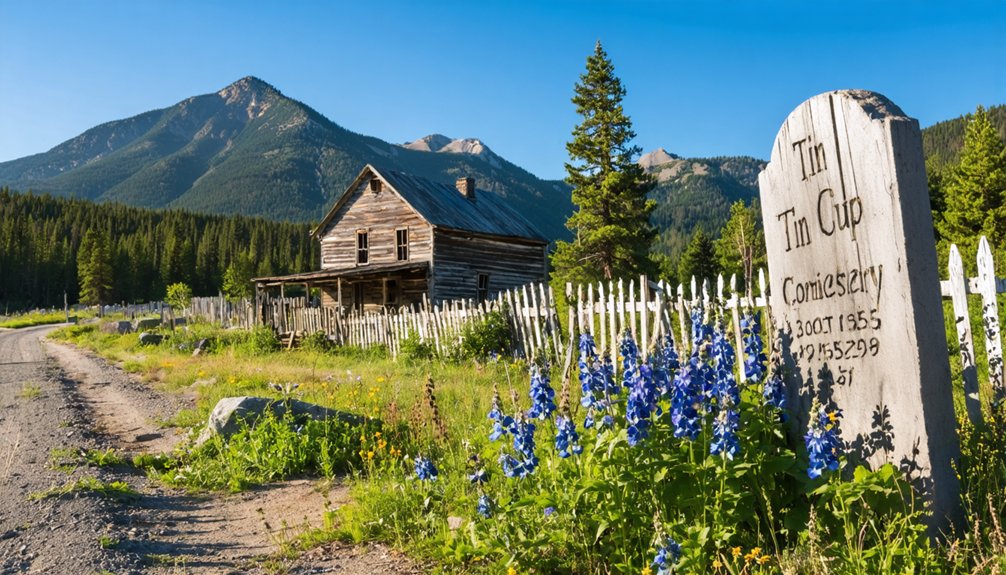
Unlike Mayflower Gulch’s peaceful wildflower meadows, Tin Cup earned its reputation through gunsmoke and violence—two town marshals gunned down within a year of each other during the 1880s boom.
Tin Cup’s violent past stands in stark contrast to Colorado’s gentler mining camps—two marshals fell to gunfire in just twelve months.
You’ll discover local ghost stories at Boothill Cemetery, where outlaws and lawmen rest together. “Black Jack” Cameron’s marker reads “He Held Five Aces”—a warning against cheating at cards.
What Makes Tin Cup Essential Summer Exploring:
- Historic preservation by vacationers saved original 1880s buildings from decay
- Frenchy’s log cabin restaurant serves authentic mountain fare
- Boothill Cemetery showcases primitive wooden markers alongside modern headstones
- Colorado Road 765 winds past Taylor Park Reservoir (1.5 hours from Crested Butte)
- Great Divide crossing at Tincup Pass rewards adventurous travelers
The town’s criminal element created legends you’ll still hear whispered today.
Planning Your Colorado Ghost Town Adventure
Before you set out to explore Colorado’s abandoned mining camps, you’ll need to understand that these destinations demand more preparation than your typical road trip. Pack a high-clearance or 4WD vehicle for remote sites like Animas Forks at 11,200 feet. Throw in water, food, and weather layers—alpine conditions shift fast.
GPS devices trump cell service in the San Juans’ backcountry, where you’re truly off-grid.
Summer opens these cultural heritage sites when snow retreats from mountain passes. You’ll discover local legends at places like Vicksburg’s audio-guided tours or Ball Cabin’s historic artifacts.
Watch for unstable mine structures and collapsed buildings—they’re fascinating but dangerous. Hydrate constantly at high elevations.
The Alpine Loop Back Country Byway connects multiple ghost towns, letting you chase freedom through Colorado’s rugged mining past.
Frequently Asked Questions
Are Dogs Allowed at Colorado Ghost Town Sites?
Dogs are generally allowed at Colorado ghost town sites, but you’ll need to follow dog leash regulations. Most locations lack pet-friendly amenities, so pack water and waste bags. Check specific site rules beforehand for your adventure freedom.
Exploring abandoned towns in Colorado for visitors can reveal rich histories and stunning landscapes. Remember to bring your camera to capture the eerie beauty of these historical sites. As you wander through the remnants of the past, let your imagination run wild with the stories hidden within these ghostly landscapes.
Can You Camp Overnight Near These Ghost Towns?
You can camp overnight near many Colorado ghost towns on BLM and National Forest lands. Just follow camping regulations for your chosen spot, respect 14-day limits, and prioritize overnight safety by researching each location’s specific rules beforehand.
Exploring ghost towns to explore in Colorado offers a unique glimpse into the state’s rich mining history. Many of these locations are steeped in fascinating stories and picturesque ruins, making them ideal for both history buffs and adventurous spirits. Ensure you take the time to learn about each town’s past, as it can greatly enhance your visit and deepen your appreciation for the Colorado wilderness.
During the colder months, the allure of winter adventures in ghost towns becomes even more pronounced. The picturesque, snow-covered landscapes transform these historical sites into a winter wonderland, perfect for snowshoeing or photography. Embrace the serenity of the season while uncovering the hidden tales that linger amongst the ruins.
Are There Entrance Fees to Visit These Ghost Towns?
Your wallet can mostly stay tucked away—most sites are free, though St. Elmo and Independence request $5 for historical preservation. Ghost Town Museum charges admission. Always exercise safety precautions when exploring these untamed remnants of Colorado’s past.
What Wildlife Might I Encounter While Visiting Ghost Towns?
You’ll encounter incredible wildlife spotting opportunities—antelope on hillsides, bighorn sheep near buildings, and massive rodents in abandoned structures. Animal encounters include hawks circling overhead, elk roaming ghost towns, and herons fishing nearby ponds at sunset.
Are These Ghost Towns Suitable for Young Children?
Yes, they’re perfect for kids! Over 80% of families rate ghost towns as educational adventures. You’ll find child safety features like indoor museums and accessible trails, plus hands-on educational opportunities including gold panning and historical exploration that’ll spark curiosity.
References
- https://www.milehighmamas.com/blog/2025/06/27/step-back-in-time-colorados-best-ghost-towns-to-explore-this-summer/
- https://www.longmontleader.com/colorado/explore/20-must-visit-ghost-towns-in-colorado-for-an-eerie-adventure-10192944
- https://www.visitouray.com/ghost-towns
- https://www.colorado.com/articles/colorado-ghost-towns
- https://www.durango.com/colorado-ghost-towns/
- https://leadville.com/the-ghost-towns-of-leadville-and-beyond/
- https://ghosttownmuseum.com
- https://aspenhistory.org/ashcroft-ghost-town/
- https://www.legendsofamerica.com/co-stelmo/
- https://blogs.loc.gov/law/2025/09/st-elmo-colorado-administering-a-ghost-town/