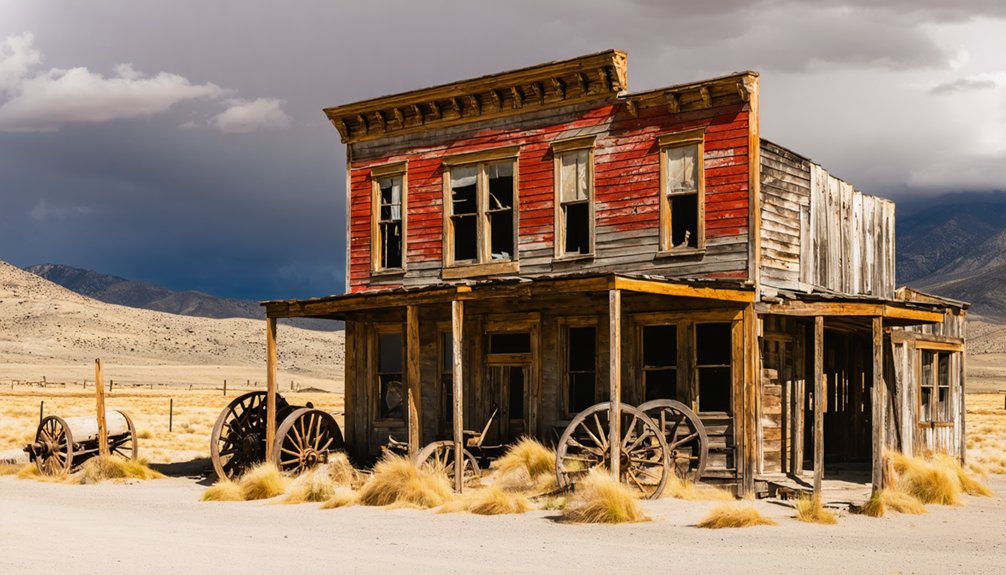
You’ll find underwater ghost towns are real settlements submerged by dam construction, economic collapse, or natural disasters. St. Thomas, Nevada sits beneath Lake Mead after Hoover Dam flooded it in 1938, while Kennett, California lies under Shasta Lake following 1944 inundation. These sites preserve intact buildings, artifacts, and infrastructure—archaeological evidence of displaced communities. Lake Texoma, Appalachian reservoirs, and China’s Shi Cheng contain similar submerged towns. Droughts periodically expose foundations, graves, and remnants, offering researchers documented windows into past civilizations and the consequences of human intervention.
Key Takeaways
- Underwater ghost towns are settlements submerged by dam construction, rising sea levels, flooding, or economic decline, preserving historical artifacts.
- Notable examples include St. Thomas, Nevada; Kennett, California; and Appalachian communities drowned by TVA dam projects in the 1930s-1940s.
- Droughts periodically expose submerged structures, foundations, cemeteries, and artifacts, enabling archaeological study and public exploration opportunities.
- Exploration faces challenges including water depth, poor visibility, fragile relics, and legal restrictions requiring specialized diving and conservation techniques.
- These sites serve as underwater museums, attracting tourism and research while memorializing displaced communities and environmental changes.
St. Thomas, Nevada: A Mormon Settlement Beneath Lake Mead
In January 1865, Mormon settlers led by Thomas Smith established St. Thomas near the Virgin and Muddy Rivers confluence, following Brigham Young’s directive.
St. Thomas arose from directive and devotion—Mormon pioneers answering Brigham Young’s call at the confluence of two desert rivers.
You’ll find this settlement’s cultural heritage reflects autonomous colonization—600 acres divided into five-acre lots supporting 45 families by 1866.
Boundary disputes forced most residents to abandon the town in 1871 when Nevada demanded back taxes in gold.
The community resurged in the 1880s, peaking at 500 residents with railroad and highway connections.
A railroad branch was built to St. Thomas in 1911-12 by the San Pedro, Los Angeles and Salt Lake Railroad, enhancing the town’s transportation infrastructure.
Hoover Dam’s construction sealed its fate; Lake Mead inundated the townsite in 1938.
Archaeological discoveries emerge during drought-induced low water levels, with National Park Service protection preserving these ruins.
The St. Thomas Interpretive Center documents this submerged settlement’s evidence-based history.
The settlement’s namesake reflects the Mormon tradition of naming communities after religious figures and founding leaders.
Kennett, California: Railroad Hub Under Shasta Lake
Kennett’s transformation from a thriving copper mining and railroad center to a submerged settlement beneath Shasta Lake represents one of California’s most significant town relocations.
The community reached its economic peak during World War I with major operations at the Mammoth and Golinsky mines, forty saloons, and critical Southern Pacific Railroad infrastructure before complete submersion in 1944.
The town disincorporated in 1931 as the mining economy collapsed following the permanent closure of the Mammoth mine in 1923 and declining post-war copper demand.
During severe drought conditions, receding lake waters expose structural remnants—concrete foundations, railroad equipment, and mining artifacts—that document the town’s industrial past 400 feet below normal water levels.
The name “Kennett” identifies multiple places and entities, requiring disambiguation to direct researchers to the specific California settlement now underwater rather than other locations bearing the same name.
Mining and Railroad Glory
How did a remote stretch along Backbone Creek transform into Northern California’s most dynamic copper mining center? George Graves’s late 1880s copper discovery triggered an industrial revolution. The Mammoth Copper Mining Company’s operations produced exceptionally pure ore, generating substantial wealth for early investors.
You’ll find railroad development intrinsically linked to this mining history—the California and Oregon Railroad employed over 1,000 Chinese laborers in 1883, while the 1884 Shasta Railroad Train Tunnel revolutionized transportation access. The tunnel served the growing railroad hub until flooding submerged Kennett following Shasta Dam’s construction in the 1940s.
Extensive Industrial Infrastructure:
- Mammoth and Golinsky Mines operated simultaneously, establishing Kennett as the region’s premier mining hub outside Redding.
- Railroad spur connected directly to the Mammoth Smelter warehouse in Copper City.
- Charles Butters acquired 6,000 acres by 1905, systematically developing extensive infrastructure.
- Diamond Saloon basement housed Justice of the Peace offices, demonstrating civic establishment.
- The proximity to Southern Pacific Railroad increased trade opportunities, attracting business owners and miners to the flourishing community.
Complete Submersion in 1941
The prosperity that mining and railroad operations brought to Kennett couldn’t withstand federal hydroelectric ambitions. Construction began in 1935, and by 1940, reservoir filling commenced without documented public hearings for residents.
The government dismissed the diminished population as insignificant. While most residents sold their land willingly, others waited until rising waters forced abandonment in 1943.
Complete submersion occurred in 1944, burying the town under 400 feet of water—the deepest section of Shasta Lake.
Around 175 buildings were relocated to higher ground, while most faced demolition. Workers exhumed 1,200 bodies from graveyards, though some ancestral graves remain submerged.
Today’s underwater archaeology reveals foundations, streets, and railways during extreme droughts, spawning haunted legends among divers exploring structures 60 feet below the surface. The ghost town becomes visible when lake level drops below 1,050 feet, exposing fragments that photographers eagerly document.
Drought Reveals Lost Structures
When Shasta Lake’s water levels drop below 40% capacity during severe drought conditions, remnants of Kennett’s infrastructure emerge from depths that normally exceed 300 feet. You’ll discover foundations, railroad tracks, and building remnants that provide rare opportunities for archaeological exploration without government restriction.
Historical preservation efforts remain limited, as federal authorities control access to these submerged sites.
Notable exposed structures include:
- Railroad bed sections from the California and Oregon Railroad constructed in 1883
- Concrete foundations from the smelter operations that processed copper ore
- Stone building bases from trade stores and the hospital infrastructure
- Portions of the roadways Charles Butters developed across his 6,000-acre holdings
These drought-exposed artifacts offer tangible evidence of the town‘s economic prosperity before federal dam construction erased this mining center. The community once thrived as the second most important mining center outside Redding and Shasta, demonstrating the region’s significance in California’s mineral extraction industry.
Lake Texoma’s Submerged Texas and Oklahoma Communities
Between 1944 and the lake’s completion, Lake Texoma’s rising waters permanently erased more than a dozen communities along the Red and Washita Rivers.
Lake Texoma’s creation drowned more than a dozen riverside communities beneath 89,000 acres of rising water between 1944 and completion.
You’ll find evidence of this forced displacement in the documented populations: Woodville held 360 residents, Cedar Mills had dwindled to 50, and Hagerman counted 150 before submersion.
Flood mitigation through the Denison Dam project, championed by Sam Rayburn in the 1930s, prioritized regional benefits over local autonomy.
Community relocation funding varied drastically—Oklahoma towns like Aylesworth received insufficient compensation while Texas landowners often secured adequate payments.
The project consumed Basin Springs, the area’s oldest settlement, along with Preston Bend’s historic crossing point for the Butterfield Stage Lines.
Infrastructure including railroads, highways, and cemeteries required systematic relocation as waters rose across 89,000 acres.
Preston’s prosperity stemmed from its strategic location for trade and military routes before the railroad bypassed it.
Willis lost its ferry service, gaining a bridge in 1960.
Appalachian Towns Lost to Dam Construction

During World War II’s critical manufacturing phase, Tennessee Valley Authority‘s Fontana Dam project displaced four North Carolina communities in just two years of construction. The $74.7 million undertaking submerged Proctor, Forney, Almond, and Japan beneath an 11,000-acre reservoir.
Creating hidden archaeology sites accessible only through backcountry trails and ferry routes to relocated cemeteries.
Similar dam projects transformed Appalachia’s landscape:
- Loyston, Tennessee vanished under Norris Dam’s waters in 1935, with remnants surfacing during droughts.
- Jocassee Valley’s flooded forests stand preserved underwater, forming underwater art installations resembling moonlit woodlands.
- Cave Run Lake consumed Yale community after 1973 completion, displacing six family graveyards.
- Smith Mountain Lake inundated farming communities in 1963, submerging two historic bridges beneath 100-foot depths.
You’ll find these ghost towns represent governmental power over individual property rights.
Oklahoma’s Flooded Farming and Frontier Settlements
Oklahoma’s reservoir construction between the 1940s and 1970s permanently submerged multiple frontier settlements that had served as critical trading posts and territorial centers.
You’ll find Lake Eufaula covers North Fork Town, which hosted the historic 1842 Grand Council of eighteen tribes, while its cemetery was relocated before flooding and the outlaw Belle Starr‘s associated sites remain downstream.
Kaw Lake’s 1976 impoundment forced residents of Kaw City to either sell their properties to the government or physically relocate their homes uphill.
Former Washunga residents compared watching bulldozers demolish their neighborhood to attending a funeral without a casket.
Kaw Lake’s Lost Communities
When the Army Corps of Engineers closed the Kaw Dam gates in 1976, the Arkansas River permanently submerged Kaw City, Uncas, and Washungah—three communities whose collective histories spanned from 1902 frontier settlements to 1930s oil boom towns.
You’ll find examples of aquatic archaeology when lake levels drop, revealing submerged architecture foundations along park roads that follow original street grids.
The 15-year relocation process documented:
- Population displacement: 1,001 residents (1930 census) received compensation options to sell or relocate structures
- Cultural preservation: Kaw Council House relocated stone-by-stone; cemetery moved near Newkirk
- Infrastructure salvage: Four-story hotel’s art collection transferred to Philbrook Museum; railroad depot moved west
- Jurisdictional complexity: Contested Federal-Osage lands with tribal mineral rights during oil era
Former residents maintain Uncas reunions, while park rangers field ongoing queries about burial sites and property boundaries.
Belle Starr’s Submerged Legacy
Before Lake Eufaula’s 1964 impoundment submerged 102,500 acres of Canadian River bottomland, Younger’s Bend Ranch operated as Belle Starr’s documented criminal refuge from 1880 until her unsolved murder in 1889.
You’ll find the legendary outlaw’s preserved gravesite east of the dam, maintained by Ron Hood since 2010, while her cabin—reconstructed by descendant Gene Starr from historical photographs—stands as physical evidence of this hidden refuge.
The ranch’s strategic canyon access provided defensible terrain where Belle hosted James-Younger Gang associates and other fugitives.
Bass Reeves arrested her in 1883 for horse theft—her only conviction before Judge Isaac Parker.
Cherokee authorities raided the property that year, recovering stolen goods.
She died February 3, 1889, from shotgun wounds; suspects included neighbor Edgar Watson, son Edward, or unknown assailants. The murder remains unsolved.
Eastern Reservoir Towns: From Maryland to Massachusetts

The eastern United States systematically sacrificed dozens of rural communities between 1901 and 1960 to construct reservoir systems for expanding urban populations.
Between 1901 and 1960, rural towns were systematically erased to supply water for growing eastern cities.
You’ll find eminent domain displaced thousands—Ashokan Reservoir alone condemned 12,000 acres, destroying 500 homes and forcing eight hamlet relocations. Government authorities paid $15 per grave to relocate 32 cemeteries, though Olive hamlet’s cemetery now sits beneath wetlands.
Ecological impacts and cultural preservation losses include:
- Round Valley’s 24+ drownings since 1971, disrupting former Native American hunting grounds
- Neversink’s 340 evictions from 6,149 condemned acres, erasing “continuously flowing” heritage
- Pepacton’s 974 displaced residents and demolished Delaware railroad infrastructure
- Cannonsville, Beerston, Rock Rift, Rock Royal, and Granton bulldozed completely
These reservoir projects prioritized urban water demands over individual property rights and community sovereignty.
When Drought Reveals the Past: Visibility and Exploration
Severe droughts between 2002 and 2024 transformed sunken ghost towns into accessible archaeological sites, exposing structures that typically remain submerged beneath 60 to 110 feet of water.
You’ll find Lake Mead‘s receding waters revealed St. Thomas’s school and ice cream parlor via a 3-mile dirt road, while Lake Buchanan’s 50% depth reduction exposed Bluffton’s cotton gin and blacksmith tools.
Cultural preservation efforts document legacy artifacts before water levels rise: prehistoric skulls, freed slave graves, and medicine bottles from Texas; entire medieval churches from Spain’s Sau Reservoir.
Toledo Bend’s 2006 and 2011 droughts uncovered ten family cemeteries, prompting grave relocations.
Guided tours by operators like Vanishing Texas River Cruise provide structured access to these temporary archaeological windows, documenting foundations and remnants before reservoir levels recover.
Shi Cheng: China’s Ancient Lion City Underwater
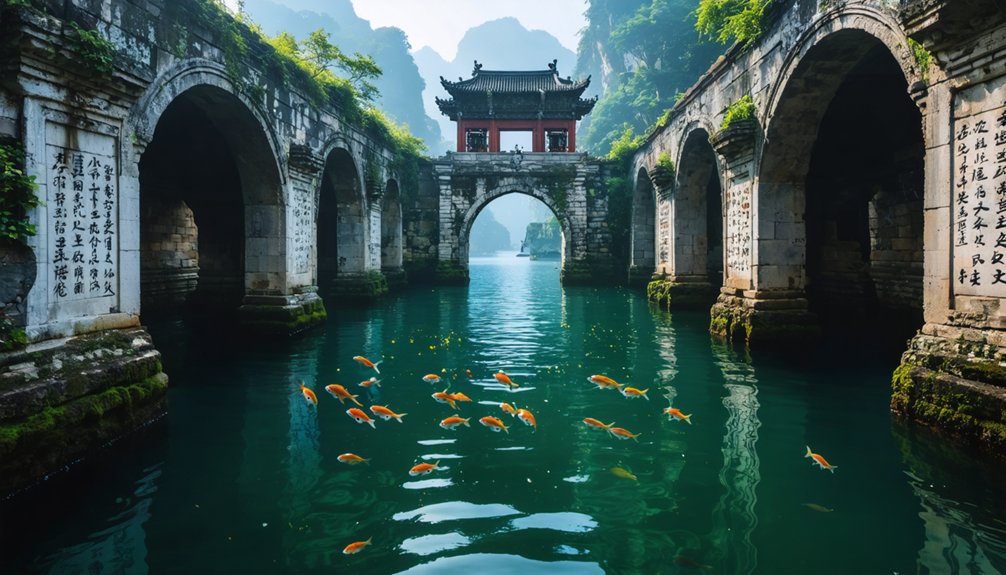
While North American droughts temporarily expose submerged settlements, China’s Shi Cheng represents a permanently flooded archaeological site that has remained continuously underwater since 1959.
You’ll find this Tang Dynasty city, built in 621 AD, submerged 25-40 meters below Qiandao Lake‘s surface following deliberate flooding for the Xin’an River hydroelectric project.
The submersion paradoxically enabled cultural preservation by protecting structures from urban decay:
- 265 carved arches featuring lions, dragons, and phoenixes remain intact
- Five city gates and towers preserve unusual architectural planning
- Guardian lions and 1700s inscriptions document historical governance
- Paved roads and temples span an area exceeding 60 football fields
Government divers rediscovered the site in 2001, establishing it as a protected historical relic by 2011.
You can now explore this underwater museum, where depth shields ancient craftsmanship.
Frequently Asked Questions
Can You Scuba Dive to Visit Submerged Ghost Towns?
Yes, you can scuba dive to visit submerged ghost towns with proper certification and equipment. Underwater exploration requires adherence to scuba safety protocols, depth limits, and site-specific regulations. You’ll need permits for restricted locations like Port Royal’s protected archaeological zones.
Were Residents Compensated When Their Towns Were Flooded?
Money talks: Yes, you’d receive compensation through eminent domain, though relocation disputes arose over below-market valuations. Property rights were technically honored—Ashokan paid $15 per grave—but residents couldn’t challenge fixed government sums during forced acquisitions.
What Happened to Cemeteries When Towns Were Submerged?
You’ll find cemeteries were relocated to higher ground—like 7,000 bodies moved before Neversink Reservoir flooded—while some remained submerged. Historical preservation efforts documented sites, and underwater archaeology revealed graves during droughts, though artifact removal stayed illegal.
Are Artifacts From Underwater Ghost Towns Protected by Law?
Yes, you’ll find legal protections preserve underwater artifacts through state permits and federal laws. Massachusetts mandates authorization before recovering resources, while historical preservation regulations restrict removal, ensuring you’re free to explore but not extract without proper documentation.
How Long Do Submerged Structures Remain Intact Underwater?
Structural degradation varies widely based on environmental conditions—you’ll find cold, oxygen-free waters with quick sediment burial best preserve archaeological sites for centuries, while shallow, warm, aerobic environments accelerate deterioration within decades through biological and chemical processes.
References
- https://www.idyllicpursuit.com/5-underwater-ghost-towns-in-the-us-visible-from-the-surface/
- https://www.thewanderingappalachian.com/post/the-underwater-towns-of-appalachia
- https://cedarbayoumarina.com/four-ghost-towns-under-lake-texoma/
- https://z94.com/lost-oklahoma-towns-underwater/
- https://www.youtube.com/watch?v=E0mfoxW3XIs
- https://www.atlasobscura.com/articles/drowned-towns-lost-to-progress
- https://www.youtube.com/shorts/759eAhrOYb0
- https://www.nvexpeditions.com/clark/stthomas.php
- https://en.wikipedia.org/wiki/St._Thomas
- https://orc.library.atu.edu/atu_faculty_books/63/