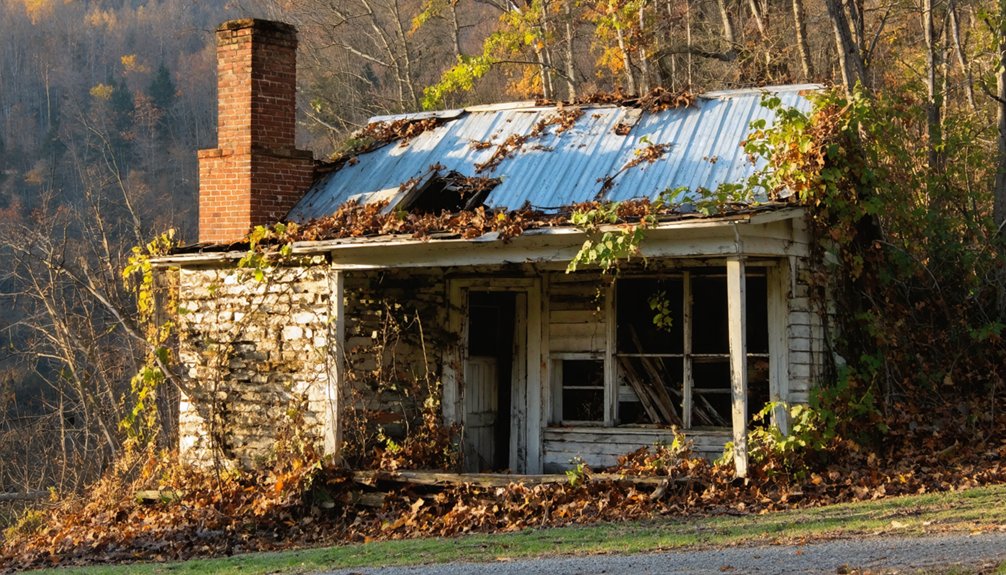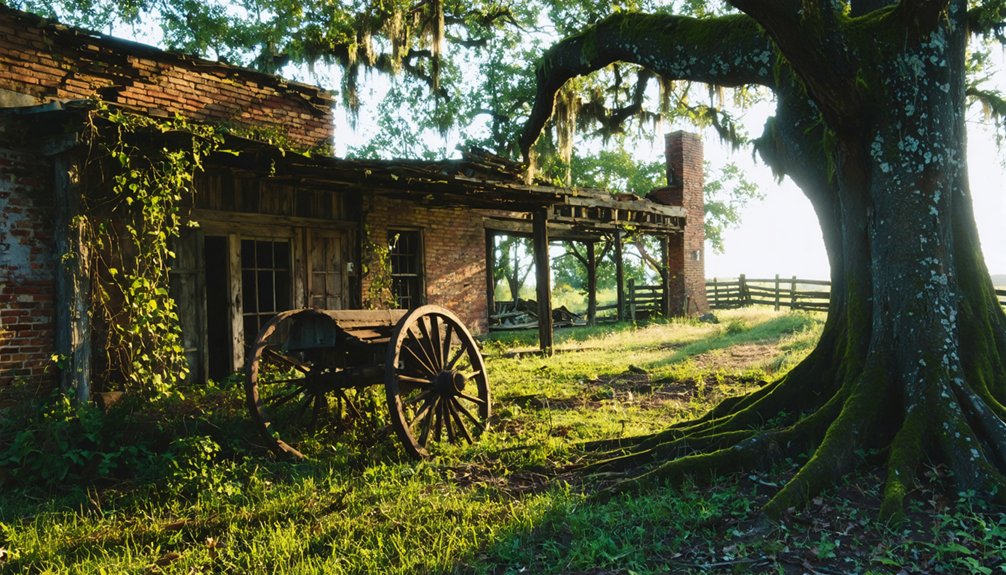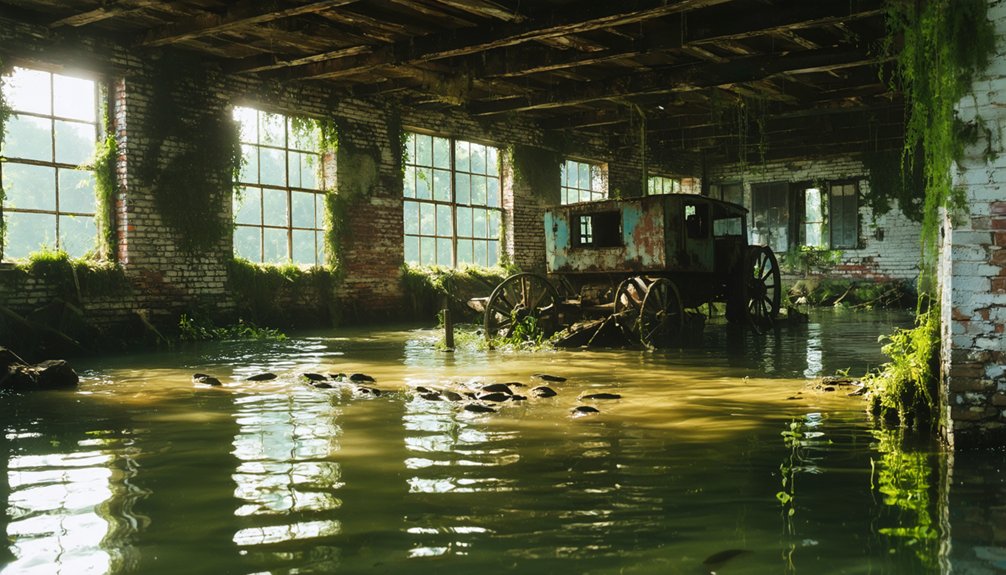
You’ll find Arkansas’s most significant underwater ghost towns beneath Beaver Lake and Greers Ferry Lake, both created by 1960s Army Corps dam projects. Monte Ne, William Hope Harvey’s early 1900s resort near Rogers, lies submerged with its hotels, amphitheater, and Harvey’s concrete tomb visible only during droughts. Greers Ferry Lake flooded communities like Shiloh, Higden, and Miller between 1962-1963, leaving church steeples and foundations beneath the surface. Water level fluctuations periodically expose these weathered remnants, offering rare glimpses into deliberately drowned settlements that face ongoing preservation challenges.
Key Takeaways
- Monte Ne, founded by William Hope Harvey near Rogers, was submerged by Beaver Lake in 1962 after dam construction by the Army Corps of Engineers.
- The Corps demolished historic hotels like Oklahoma Row and Missouri Row before flooding, miscalculating final water levels that left foundations exposed.
- Greers Ferry Lake submerged multiple Arkansas communities including Miller, Higden, Shiloh, and Edgemont between 1962-1963 following federal flood control acts.
- Water level fluctuations periodically expose submerged structures, foundations, and artifacts, notably during droughts in 1977 and 2005.
- Underwater sites contain weathered foundations, amphitheater remnants, Harvey’s concrete tomb, and scattered artifacts with limited archaeological documentation.
The Rise and Fall of Monte Ne: William Hope Harvey’s Ozark Vision
While serving as an economic advisor to William Jennings Bryan’s 1896 presidential campaign, William Hope Harvey discovered the rugged beauty of the Arkansas Ozarks during a visit to Rogers—terrain that reminded him of West Virginia’s familiar landscapes.
He purchased Silver Springs in 1900, establishing Monte Ne as a health resort and planned community. From 1901 through the 1920s, Harvey constructed massive log hotels, an indoor pool allowing mixed-gender swimming, and imported Venetian gondolas.
He issued local scrip currency and built a dedicated rail line he proclaimed America’s widest. Despite innovative features challenging folklore legends of conservative Ozark culture, few businesses relocated. Harvey’s vision also included Monte Ne serving as a political hub and publishing center, reflecting his broader ambitions beyond the resort’s recreational amenities. The site hosted Arkansas’s only presidential convention in 1931, when Harvey’s Liberty Party attracted 786 delegates.
From Health Resort to Submerged Ruins: The Monte Ne Timeline
You’ll trace Monte Ne’s transformation through three distinct phases: Harvey’s operational health resort with its Italian gondolas and dedicated railroad, the 1920s bankruptcy that fragmented the property into camps and schools, and the 1962 Beaver Dam construction that submerged most structures.
The Corps of Engineers’ miscalculated 1960 survey prompted unnecessary hotel demolition, leaving only Oklahoma Row’s foundation and Missouri Row’s fireplace above the rising waters.
Today’s fluctuating lake levels periodically expose limestone foundations, the amphitheater retaining wall, and Harvey’s relocated tomb—physical evidence of a resort town that existed for barely two decades. The amphitheater once seated 500-1,000 people and hosted Harvey’s 1932 presidential convention for the Liberty Party before the lake’s formation. Harvey’s vision extended beyond the resort itself through his formation of the Ozark Trails Association, which aimed to improve regional roads and promote tourism throughout the area.
Harvey’s Grand Vision Realized
When William Hope “Coin” Harvey established Monte Ne in the early 1900s near Rogers, Arkansas, he envisioned a health resort that would capitalize on the area’s natural springs and temperature-regulating valley.
You’ll find evidence of his ambitious infrastructure throughout the ruins: Arkansas’ first indoor pool, a dedicated railroad from Lowell, and Italian gondolas that transported guests across the lagoon.
Harvey built multiple hotels—Missouri Row, Oklahoma Row, and Hotel Monte Ne—alongside a bank issuing his own scrip, transforming wilderness into a self-sufficient community.
His son Tom documented developments through the Monte Ne Herald.
The resort became so popular that it attracted thousands annually, putting Northwest Arkansas on the map as a premier vacation destination.
The community also included The General Store, which would later be operated as a multifunctional convenience store, post office, and bait shop by Kenneth and Irene Doescher, who maintained deep connections to Harvey’s legacy.
Today, aerial photography reveals foundations and structures partially submerged by Beaver Lake, while local legends preserve stories of Harvey’s ultimate vision: a 130-foot pyramid designed to outlast civilization itself.
Bankruptcy and Property Division
As automobile culture transformed American leisure patterns in the 1910s, Monte Ne’s extended-stay resort model became economically unsustainable.
You’ll find that Harvey redirected his depleted resources toward the amphitheater in 1920, abandoning traditional resort operations.
By 1927, foreclosure claimed most properties as cultural traditions of grand resorts yielded to road-trip vacationing.
The site evolved through successive owners: Camp Joyzelle (1923-1930s), Ozark Industrial College (until 1932), and intermittent community use.
Harvey’s 1932 presidential campaign highlighted his financial collapse—the pyramid intended to preserve ancient artifacts remained incomplete, its time capsule empty.
Progressive asset liquidation culminated in complete land and water rights sales by 1948, twelve years after Harvey’s death. Harvey was laid to rest in a concrete vault at Monte Ne following his death in 1936.
The resort’s thirty-year operation ended in bankruptcy, its buildings repurposed until Beaver Lake’s creation.
Missouri Row and Oklahoma Row were sold to a theological school, which later operated the property as a girl’s camp.
Beaver Lake Covers Resort
Following decades of abandonment and piecemeal land sales, Monte Ne faced its final transformation in the 1960s when the U.S. Army Corps of Engineers began constructing Beaver Lake dam. By 1965, rising waters submerged most of Harvey’s resort, creating what you’ll find today as underwater archaeological remnants.
When lake levels drop, you can observe the amphitheater base and Hotel Monte Ne’s foundation—ancient artifacts of Arkansas’s tourism history preserved beneath the surface. Missouri Row and Oklahoma Row remain partially visible above water, with Oklahoma Row’s 316-foot length constructed from 6,000 logs and 40,000 cubic feet of stone still standing. The Oklahoma Row tower was removed in 2023 for safety reasons, marking another chapter in the site’s gradual disappearance.
Think of it as deep sea exploration without diving equipment—you’re witnessing a drowned monument to early 20th-century leisure, added to the National Register in 1978.
Oklahoma Row: Arkansas’s First Indoor Pool and Pioneering Concrete Architecture
Though financing for Oklahoma Row’s construction came from nearly 300 investors and stockholders beginning in 1907, architect A.O. Clarke created one of Arkansas’s architectural marvels. His design incorporated log and tile construction crowned by a distinctive three-story concrete tower—pioneering concrete architecture for its era.
A.O. Clarke’s pioneering design blended log and tile with an innovative three-story concrete tower, funded by nearly 300 investors.
The 1909 opening revealed groundbreaking amenities:
- Arkansas’s first indoor heated pool (25 by 50 feet) with slides and springboards
- 40 rooms featuring electric lights, indoor plumbing, and running spring water
- Individual fireplaces in each guest room
You’ll find this resort’s innovations particularly significant. Oklahoma Row held the distinction as the largest log hotel in the world when completed. While haunted legends now surround the underwater ruins, the tower and foundation served as fishing piers until 2023. Despite Corps of Engineers preservation attempts, trespassing and damage necessitated demolition.
The site remains mostly submerged in Beaver Lake.
The Creation of Beaver Lake and the 1964 Submersion
The U.S. Army Corps of Engineers began constructing Beaver Dam in 1960, impounding the White River valley by 1964 to create a reservoir extending 73 miles with 487 miles of shoreline across three counties.
This $60 million flood-control project submerged Monte Ne and displaced valley residents. It required the Corps to purchase over 40,000 acres and relocate cemeteries.
Property owners made a critical error by demolishing Oklahoma Row‘s historic hotel—including Arkansas’s first indoor pool—before the Corps acquired the land. They mistakenly believed the structure would be flooded when final lake elevations would have preserved it.
Army Corps Construction Project
When Congress passed the Flood Control Act of 1954, it set in motion an engineering project that would permanently alter the White River Basin landscape and erase entire communities beneath what would become Beaver Lake. The U.S. Army Corps of Engineers initiated land acquisition in 1958, targeting over 40,000 acres of White River valley farmland.
Construction commenced in 1960, with the powerhouse following in 1963.
The project’s scope presented significant engineering challenges:
- Dam completion in March 1964 enabled immediate water impoundment
- Commercial power generation began May 1965
- Total cost reached $43 million, finished under budget by 1966
These environmental impacts proved irreversible—displacing families, relocating cemeteries, and submerging historical sites like Monte Ne forever beneath the lake’s 31,700-acre expanse.
Mistaken Hotel Demolition Decision
Before demolition crews dismantled Missouri Row and Oklahoma Row—two of the world’s largest log buildings—a critical survey error by the U.S. Corps of Engineers sealed their fate.
The Corps miscalculated flood levels, wrongly determining these hotel architecture landmarks would be submerged beneath Beaver Lake. Based on faulty data, they purchased and demolished the properties before the 1964 lake creation.
The hotels, converted to schools after the resort’s decline, showcased exceptional construction techniques in multi-level log building design.
Today, you’ll find only remnants: Oklahoma Row’s foundation, basement, and concrete tower section; Missouri Row’s fireplace, chimney, and retaining wall.
When water levels drop, the uncompleted Arkansas Hotel’s foundation emerges—tangible evidence of administrative overreach that destroyed irreplaceable architectural heritage unnecessarily.
What Remains Above Water: Exploring Monte Ne’s Visible Structures
Until its demolition in February 2023, Oklahoma Row’s concrete tower dominated Monte Ne’s waterlogged landscape as the resort’s most recognizable remnant. The three-story structure served as an ancient artifact from Harvey’s ambitious vision. Visitors could walk through graffiti-covered rooms and examine basement fireplaces at low water levels.
Today’s explorable ruins include:
- Missouri Row’s four-sided concrete fireplace surrounded by foundation pieces and retaining walls
- 165-foot stone retaining wall built for Harvey’s unbuilt 130-foot pyramid spire
- Harvey’s 40-ton concrete tomb relocated to hilltops near the boat launch
These structures now function as wildlife habitats while preserving architectural evidence of the resort’s former grandeur. You’ll find additional artifacts—including concrete amphitheater chairs and Harvey’s death mask—displayed at Rogers Historical Museum.
When the Water Recedes: Discovering Hidden Foundations and Amphitheaters
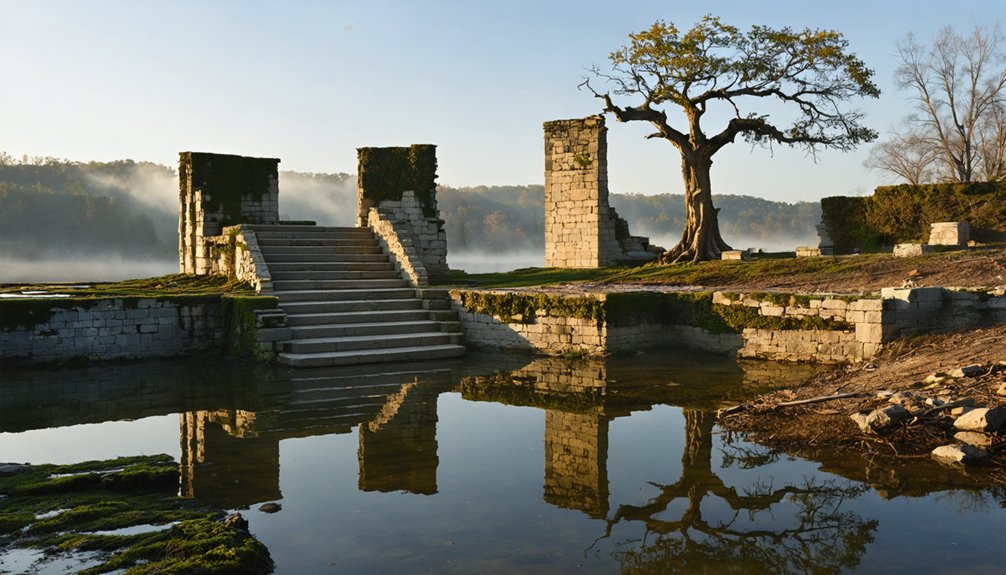
During drought periods, Beaver Lake’s receding waters expose Monte Ne‘s most haunting feature: a concrete amphitheater that’s remained submerged since 1966.
You’ll find it emerged dramatically in 1977 when water levels dropped 27 feet, and again in 2005, allowing unprecedented access to photograph these ruins.
The exposed foundations resemble ancient myths of lost civilizations—concrete hotel basements, retaining walls for an unbuilt pyramid, and massive theater chairs create an Atlantis-like landscape.
Missouri Row appears as a lone fireplace amid scattered foundations, while Oklahoma Row’s multi-story concrete base rises from the lakebed.
These folklore legends aren’t fiction; they’re documented architectural remnants managed by the Army Corps of Engineers, accessible via the Monte Ne boat launch despite vandalism and deterioration.
Shiloh and the Greers Ferry Lake Communities: Arkansas’s Other Lost Towns
While Monte Ne draws most attention from underwater archaeology enthusiasts, Greers Ferry Lake conceals an entire network of bottomland communities that disappeared beneath its 40,000-acre expanse between 1962 and 1963.
Greers Ferry Lake submerged multiple Arkansas communities in the early 1960s, creating an underwater landscape of forgotten towns and abandoned structures.
The Flood Control Act authorized dam construction in 1957, submerging Miller, Higden, Shiloh, and Edgemont without successful citizen resistance.
Unlike ancient myths and folklore legends of lost civilizations, these towns left tangible evidence:
- Sonar-detected concrete foundations mark former home sites
- Storm cellars remained visible during pre-submersion periods
- Historic maps align submerged road networks across current lake bed
Divers report encountering houses, vehicles, and structural remains, though rumors of intact church steeples and unexcavated cemeteries lack verification.
Higden received complete relocation including infrastructure, while Shiloh residents simply evacuated their flood-prone valley, leaving history beneath the surface.
Diving Into History: Underwater Ghost Towns Beneath Greers Ferry Lake
Since Congress authorized the Flood Control Act in 1938, the U.S. Army Corps of Engineers transformed the Little Red River basin into a 40,000-acre reservoir.
This project created unexpected opportunities for marine archaeology. You’ll find divers exploring underwater foundations, storm cellars, and old vehicles—tangible remnants of six displaced communities including Higden, Shiloh, and Choctaw.
Sonar equipment reveals former roads now serving as boat launches, while concrete foundations mark where homes once stood. Church steeples reportedly remain visible beneath the surface in certain sections.
Yet legend storytelling often obscures documented facts: while officials relocated cemeteries before the 1960s impoundment, persistent rumors claim entire graveyards remain submerged.
No confirmed photographs exist of intact structures underwater, though divers continue documenting this preserved slice of Arkansas history beneath Greers Ferry Lake‘s depths.
Preserving Submerged Heritage: Challenges and Current Conditions
Beneath Arkansas’s reservoir surfaces, environmental forces wage a relentless campaign against these historic remnants. Sedimentation progressively covers structures in Greers Ferry Lake, while silt and aquatic growth erode bridges and foundations in Table Rock Lake.
You’ll find that fluctuating water levels create cyclical exposure-submersion patterns, accelerating deterioration of sites like Monte Ne’s amphitheater.
Marine archaeology efforts face distinct obstacles:
- Annual flooding buries Hopefield’s archaeological remains under swamp-like conditions.
- Vandalism and trespassing complicate preservation attempts at accessible sites.
- Corps of Engineers’ preservation plans remain largely unmaterialized.
Despite Monte Ne’s 1978 National Register designation, its concrete tower required demolition in 2023.
Local legends persist around submerged artifacts, though systematic documentation remains limited. Low water events periodically grant you access to these sites, revealing weathered foundations and scattered structural elements across all three reservoirs.
Frequently Asked Questions
Can You Scuba Dive to Explore the Underwater Ruins at Monte Ne?
No, you can’t scuba dive Monte Ne’s submerged ruins. Like a forbidden treasure chest, the site lacks designated dive permissions from the Corps of Engineers. Underwater navigation remains restricted; you’ll need standard scuba gear requirements met elsewhere for exploration freedom.
Are There Other Sunken Towns in Arkansas Besides Monte Ne and Shiloh?
Yes, you’ll find several submerged Arkansas towns beyond Monte Ne and Shiloh. Crossroads lies beneath Lake Maumelle, while Dubuque and Kingdon Springs rest under Bull Shoals Lake. Greers Ferry Lake conceals Choctaw, Edgemont, and Higden—compelling historical preservation sites and unique tourist attractions.
The history of Rodney, Mississippi reveals stories of once-thriving communities now lost to time, echoing the tales of submerged towns elsewhere. Artifacts and remnants of this forgotten settlement attract historians and curious explorers alike, keen to uncover the past. The haunting beauty of what remains in Rodney invites reflection on the interplay between nature and human settlement, much like the submerged towns of Arkansas.
What Happens to Wildlife Living in the Ruins When Water Levels Change?
You’ll observe aquatic ecosystems transform dramatically—fish relocate to deeper waters while terrestrial animals claim exposed ruins. Wildlife adaptation occurs through both migration and behavioral flexibility, documented across decades of water level fluctuations in these Arkansas reservoirs.
Is It Legal to Remove Artifacts From the Submerged Ghost Town Sites?
No, you can’t legally remove artifacts from these sites. Legal considerations include federal property laws and National Register protections. Artifact protection regulations prohibit collection without permits, as the Corps manages these submerged ruins as preserved historical resources.
How Do Drought Conditions Affect Visibility of the Underwater Town Structures?
Drought conditions dramatically improve your access to submerged structures by lowering water levels and enhancing water clarity. However, you’ll notice sediment disturbance initially clouds visibility until settled, then reveals foundations, roads, and artifacts previously hidden beneath normal lake depths.
References
- https://www.thetravel.com/what-happened-to-monte-ne-underwater-city-arkansas/
- https://onlyinark.com/places-and-travel/monte-ne-arkansas-underwater-resort-revealed/
- https://www.youtube.com/watch?v=xKXw_D3sBJk
- https://onlyinark.com/culture/shiloh-memories-under-water/
- https://www.youtube.com/watch?v=1wqvMF04Mzs
- https://www.youtube.com/watch?v=LtTrLsRikYE
- http://arkansasroadstories.com/history/montene.html
- https://en.wikipedia.org/wiki/Monte_Ne
- https://dosouthmag.com/silver-and-gold-part-two-the-william-hope-coin-harvey-story/
- https://www.monteneinnchicken.net/history/