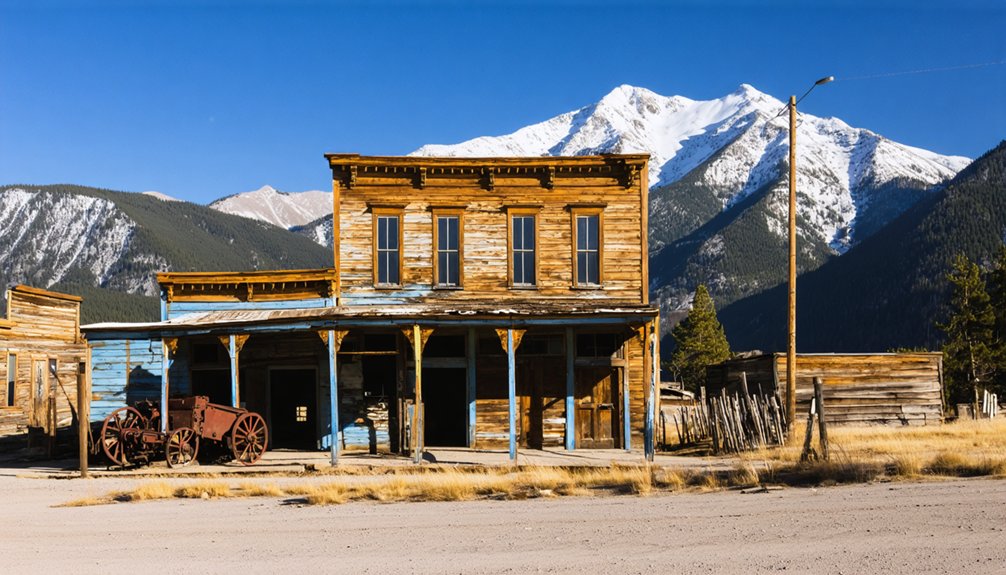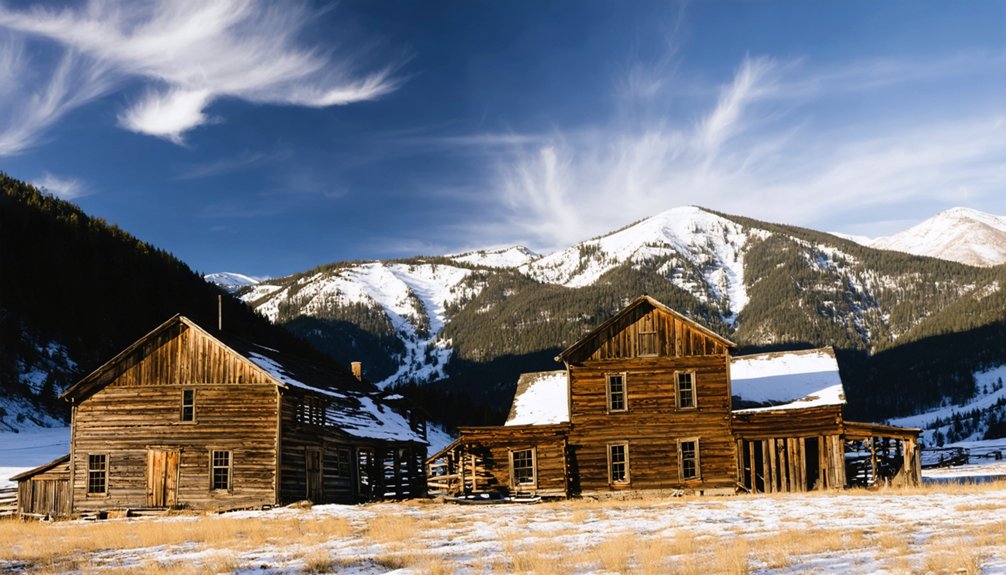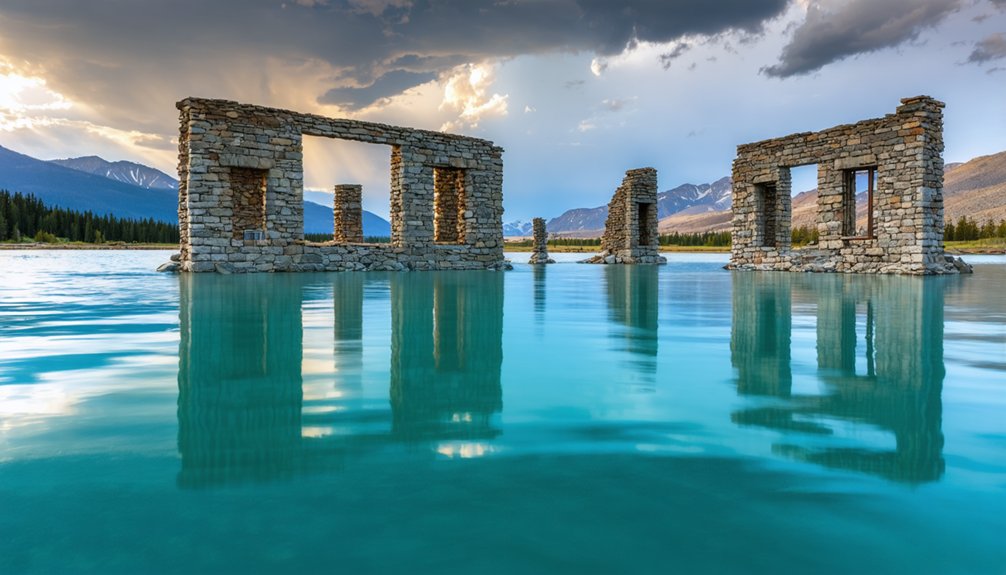
You’ll find at least five complete Colorado towns submerged beneath reservoirs, flooded between 1951 and 1966 for Front Range water supply. Montgomery (1957) lies beneath Montgomery Reservoir at 10,873 feet elevation, while Dillon was relocated three times before its 1963 submersion created Summit County’s largest reservoir. Stout’s sandstone quarry community disappeared under Horsetooth Reservoir in 1951, and Iola’s remnants occasionally emerge when water levels drop to 39% capacity. Sapinero and Cebolla rest beneath Blue Mesa Reservoir‘s deepest sections, their artifacts salvaged and cemeteries relocated before controlled flooding displaced hundreds of residents whose stories reveal the calculated trade-offs behind Colorado’s water infrastructure.
Key Takeaways
- Colorado has at least six ghost towns submerged beneath reservoirs, including Montgomery, Dillon, Stout, Iola, Sapinero, and Cebolla.
- Most towns were flooded between 1951-1966 for water infrastructure projects serving Denver and surrounding municipalities.
- Dillon Reservoir submerged its namesake town in 1963, becoming Summit County’s largest reservoir after three previous relocations.
- Remnants like building foundations, petroglyphs, and artifacts remain underwater, occasionally visible during low water levels.
- Communities ranged from mining towns to quarry settlements, displacing hundreds of residents for Colorado’s water development needs.
Montgomery: Silver Mining Boom Town Beneath the Reservoir
Deep beneath Montgomery Reservoir’s crystalline waters lies a once-thriving silver mining community that flourished during Colorado’s 1860s mineral rush.
You’ll find this submerged architecture at 10,873 feet elevation, where 150 cabins, hotels, and five sawmills once housed over 1,000 residents between 1881-1888.
When Colorado Springs purchased the abandoned townsite in 1957 for the Continental-Hoosier System Project, they flooded 95 acres of mining history.
Historic preservation efforts couldn’t save Montgomery from becoming one of seven Colorado towns sacrificed for water development.
Today, you can explore the surviving Magnolia Mill perched above the dam in the Mosquito Range, while the remainder stays entombed beneath crystal-clear waters.
The town’s bustling past included a dance hall, hotels, a saloon, and numerous establishments that served the mining community before population decline set in as mineral riches disappeared.
Founded in 1861, Montgomery originally emerged as a community dedicated to silver deposit mining and supporting railroad workers who facilitated the transport of precious metals.
The reservoir now serves dual purposes: municipal drinking water and rainbow trout fishing recreation.
Dillon: The Town That Moved Three Times Before Submersion
Before Denver’s growing water demands permanently submerged it in 1963, Dillon relocated three times across the Blue River Valley—a confirmation of frontier pragmatism and economic survival.
Dillon’s three relocations across the Blue River Valley embodied frontier adaptability before Denver’s reservoir permanently claimed the town.
Founded in 1881 as a mining trading post, you’ll find Dillon’s history intrinsically linked to transportation infrastructure. Each relocation followed railroad development:
- 1883: Moved west after Denver and Rio Grande Railroad bypassed original site
- 1892: Relocated to Blue River, Snake River, and Tenmile Creek confluence for consolidated rail access
- 1961: Final move before dam construction flooded Old Town
Denver Water Board systematically acquired water rights through Depression-era property tax defaults. By 1956, they’d secured everything needed. Construction began in 1961, completing the 23-mile Harold D. Roberts Tunnel by 1963. The resulting Dillon Reservoir became the largest freshwater reservoir in Summit County.
This urban development required relocating 300+ graves, moving ten homes, and demolishing remaining structures—leaving only underwater foundations. The reservoir now holds a capacity of 83 billion gallons, supplying critical water resources to Denver across the Continental Divide.
Stout: Sandstone Quarry Community Lost to Federal Water Projects
Southwest of Fort Collins in Larimer County’s valley—now occupied by Horsetooth Reservoir—Stout emerged in the 1860s as a quarry workers’ camp built around exceptional sandstone deposits still visible flanking the reservoir today. During its 1880s peak, hundreds of citizens inhabited this thriving town featuring a post-office, blacksmith shop, and boxing matches.
Stout’s historical architecture shaped the region: its sandstone built Colorado’s Capitol, Chicago’s 1893 World’s Fair buildings, and sidewalks throughout Denver, Omaha, and Lincoln. The town’s proximity to rail lines enabled efficient transportation of the high-quality stone to Denver and surrounding markets.
Asphalt’s rise in the late 1880s devastated the sandstone industry. The 1893 financial crisis accelerated Stout’s decline as workers abandoned the failing quarries.
By 1946, the Bureau of Reclamation acquired the schoolhouse for the Colorado-Big Thompson Project headquarters. The project aimed at water management across the region as part of federal flood control initiatives.
Dams flooded the valley in January 1951, erasing Stout’s community legacy—though foundations remain submerged, accessible only by boat.
Iola: Reemerging Remnants When Waters Recede
At 39% capacity, you’ll observe striking remnants:
- 10-15 building foundations including the Big Little Store
- School flagpole base carved with student initials and cattle brands
- Vintage Coors cans opened with church keys
The environmental impact extends beyond human displacement. Prehistoric Indian mounds, tepee rings, and petroglyphs vanished permanently beneath 830,000 acre-feet of water, erasing millennia of heritage without archaeological documentation.
Iola once served as a vital shipping point along the Gunnison River for cattle and goods during the late 19th century. The flooding exemplifies the tension between infrastructure development and the displacement of established communities, a conflict that continues to resonate in discussions about water resource management. The dam’s construction displaced 200 to 300 people over a ten-year period, forcing families to abandon multi-generational homesteads.
Sapinero and Cebolla: Ranching Communities Sacrificed for Front Range Water
While Iola’s foundations periodically resurface, Sapinero and Cebolla remain permanently submerged under Blue Mesa Reservoir’s deepest sections.
These communities, displaced between 1962-1966, represented nearly 300 residents who’d built ranching operations and fishing lodges along the Gunnison River since the 1880s.
Community displacement came when federal authorities acquired properties at market rates for Front Range water needs, constructing Colorado’s largest reservoir at 830,000 acre-feet capacity.
Historical preservation efforts salvaged limited artifacts before submersion.
You’ll find petroglyphs from Sapinero at Elk Creek Visitor Center—one tangible remnant of towns that hosted presidents and movie stars.
The government systematically burned structures to prevent floating debris, moved Sapinero Cemetery upslope, and cleared the lake bottom over eight years.
Cebolla’s Sportsmen’s Hotel had welcomed President Herbert Hoover in summer 1939, offering hot springs and fishing before its submersion.
The reservoir now serves as a popular water sport destination, drawing visitors to the same waters that displaced entire communities.
Today, the Dillon Pinnacles stand as silent witnesses to vanished communities beneath twenty miles of reservoir.
Frequently Asked Questions
Can You Scuba Dive or Boat Over These Submerged Ghost Towns?
You can boat over these sites like drifting above ancient ruins, but scuba diving isn’t explicitly permitted. Diving hazards include submerged structures, cold temperatures, and altitude effects. Always verify current regulations with reservoir authorities before exploring these preserved underwater historical locations.
Were Residents Compensated When Their Towns Were Flooded for Reservoirs?
Residents received property payments from government agencies, though historical preservation wasn’t prioritized over water needs. You’d find resettlement challenges were significant—families lost multi-generational homesteads with compensation rarely matching their cultural and economic losses during forced relocations.
Are There Other Underwater Ghost Towns in Colorado Not Mentioned Here?
Like memories fading beneath murky waters, you’ll find other submerged settlements exist, though documentation remains limited. Historical preservation efforts and environmental impact assessments rarely catalogued smaller communities displaced by Colorado’s expanding reservoir system throughout the twentieth century.
What Happens to Cemeteries When Towns Are Deliberately Flooded for Reservoirs?
Cemeteries are completely exhumed before deliberate flooding, with graves relocated to designated sites above waterlines. You’ll find historical preservation protocols guarantee environmental impact compliance, maintaining burial integrity through documented transfers—protecting both heritage and your community’s ancestral connections.
Could These Towns Ever Be Permanently Drained and Restored for Tourism?
You won’t see permanent draining—water rights, infrastructure dependence, and dam engineering prevent restoration. Historical preservation remains underwater or relocated. Environmental impact from draining would destabilize ecosystems and compromise your region’s drinking water supply indefinitely.
References
- https://www.onlyinyourstate.com/trip-ideas/colorado/underwater-colorado-ghost-town
- https://kekbfm.com/colorado-old-dillon-ghost-town/
- https://collegeavemag.com/246811/features/horsetooth-reservoir-the-underwater-history-of-a-long-lost-ghost-town/
- https://www.uncovercolorado.com/colorado-abanonded-towns-under-lakes/
- https://bmoreenergy.wordpress.com/2022/08/10/top-ten-cool-facts-about-lake-dillon-co-an-underwater-ghost-town/
- https://history.fcgov.com/newsflashback/stout
- https://www.wef.org/publications/news/wef-news/ghost-town-emerges-from-the-depths-of-lake-mead/
- https://www.youtube.com/shorts/759eAhrOYb0
- https://k99.com/montgomery-colorado-a-ghost-town-beneath-the-water/
- https://en.wikipedia.org/wiki/List_of_ghost_towns_in_Colorado