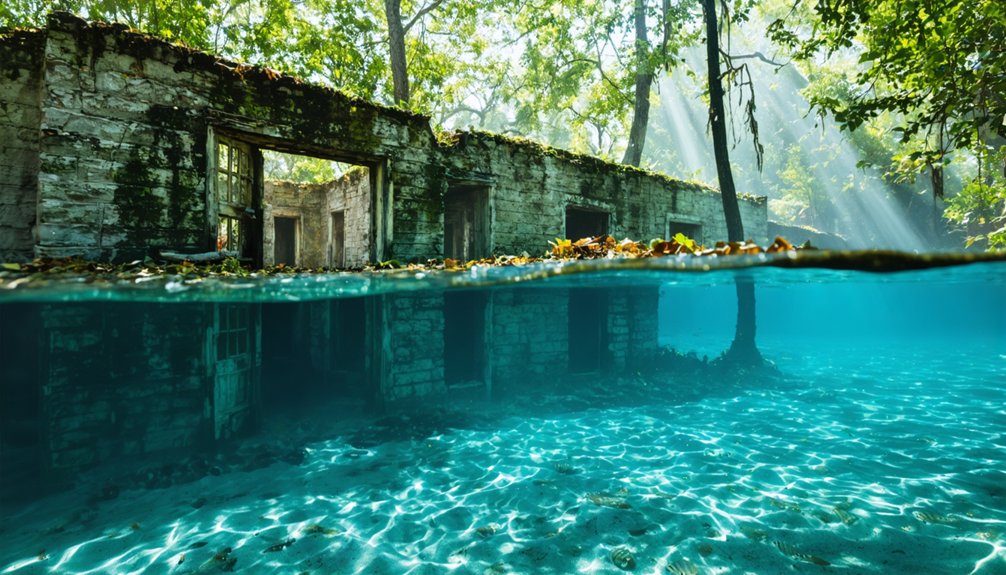
You’ll find Florida’s underwater ghost towns primarily around Lake Okeechobee, where the catastrophic 1928 hurricane destroyed settlements like Kreamer Island, Utopia, and numerous sugar field communities, leaving over 2,500 dead and entire towns submerged beneath 20-foot walls of water. Archaeological sites off Venice’s coast reveal 7,000-year-old burial grounds 21 feet underwater, while Fort Center‘s charnel pond contains remains of 150+ individuals and carved wooden platforms. These submerged locations preserve ancient burial practices, prehistoric artifacts, and modern disaster victims in mass graves—each site offering distinct insights into Florida’s layered histories beneath the surface.
Key Takeaways
- The 1928 hurricane submerged settlements around Lake Okeechobee, creating ghost towns like Chosen, Fruitcrest, and Okeelanta beneath floodwaters.
- Lake Okeechobee’s fluctuating water levels periodically expose and submerge pre-Columbian settlements, burial mounds, and archaeological sites dating back millennia.
- Fort Center features submerged earthworks and a charnel pond with wooden platforms, revealing ancient underwater burial practices and ritual sites.
- Manasota Key Offshore preserves a 7,000-year-old burial ground 21 feet underwater, submerged after Ice Age glaciers melted and raised sea levels.
- Post-1928 flood control infrastructure altered water flows, permanently changing the landscape and submerging communities that were never rebuilt or recovered.
Lake Okeechobee’s Mysterious Underwater Graveyard
Dozens of skeletal remains emerged from Lake Okeechobee’s receding waters in the early 1900s, revealing an archaeological phenomenon that has challenged researchers for over a century.
Lake Okeechobee’s falling water levels in the early 1900s unveiled skeletal remains that continue to puzzle archaeologists more than a century later.
You’ll find this underwater graveyard contains skulls, bone fragments, and artifacts dating back over a millennium—possibly to the 1700s or earlier.
The site differs markedly from typical shipwreck mysteries; these remains represent indigenous peoples who inhabited this region since 400 B.C.
Chris Davenport and Victor Thompson have documented middens that served as burial sites and temple foundations.
Today, fishermen occasionally encounter bone fragments while monitoring fish migration patterns.
The lake’s Seminole name translates to “big water,” reflecting its massive scale as Florida’s largest body of freshwater.
Over decades, pesticides and fertilizers leached into the soil and were carried by runoff into the lake, depositing onto sediments at the bottom.
Florida’s largest freshwater lake continues protecting these archaeological deposits beneath accumulated sediment layers, preserving evidence of pre-Columbian cultures that exploited wild food resources along hammock edges and creek levees.
Seminole Tribe Legends and Oral Traditions
While archaeologists excavate physical evidence from Florida’s submerged landscapes, the Seminole Tribe’s oral traditions preserve equally essential historical knowledge through generations of systematic storytelling. You’ll find these Spirit storytelling sessions occurred at nighttime campfires, where elders transmitted creation narratives explaining geological formations like New River at Fort Lauderdale—formed when southeastern winds caused ground tremors that collapsed underground coral ridges.
Cultural preservation efforts documented these accounts in “Legends of the Seminoles,” ensuring narratives about Crawfish forming landmasses from underwater earth and the Great Father’s teachings wouldn’t disappear. Dr. Betty Mae Jumper championed this transmission methodology at festivals statewide.
The Seminoles’ creation mythology established foundational environmental knowledge—Wind’s omnipresence, sequential animal emergence patterns, and subsistence strategies—providing autonomous communities with practical frameworks for *guiding* Florida’s dynamic water-dominated landscapes without external institutional control. Seminole leader Osceola, who became a prominent figure in the Second Seminole War, spent his youth swimming and fishing at Silver Springs, a site Native Americans called Sua-illeaha, meaning sunglinting water. For centuries, the tribe maintained Lake Okeechobee as a key cultural site, recognizing its integral role in the regional ecosystem that provided essential resources for their communities.
Ancient Belle Glade Settlement Beneath the Waters
Beneath Lake Okeechobee’s modern waters lies evidence of the Belle Glade culture, a sophisticated wetland civilization that thrived from approximately 1000 BCE to 1700 CE across the Kissimmee-Okeechobee-Everglades watershed. You’ll find their monumental earthworks—circular ditches, habitation mounds, and geometrically shaped embankments—partially submerged throughout the region.
Modern drainage exposed these pre-Columbian sites, revealing artifacts and human remains that document 2,700 years of wetland adaptation.
The Fort Center site exemplifies their engineering prowess: a charnel pond with cremation platforms, multiple mounds, and precisely constructed earthworks dated to 800 BCE. Water level fluctuations continue exposing archaeological evidence, though they threaten site integrity. The site’s 400-yard diameter circular ditch features an internal embankment with multiple concentric ditches that may have served ceremonial or recreational purposes.
These communities maintained native plant preservation zones on tree-island hammocks while constructing elaborate canal systems. Their Belle Glade Plain pottery, distinctive bone tools, and imported marine shells demonstrate extensive trade networks extending to Calusa territories. Artisans of this culture produced small carved cypress statues, possibly representing shamans or ancestors, showcasing their remarkable woodworking craftsmanship.
The Catastrophic 1928 Hurricane and Its Victims
The 1928 hurricane‘s breach of Lake Okeechobee‘s inadequate 5-foot dike created a 20-foot wall of water that killed at least 2,500 people, with entire communities disappearing beneath the surge.
You’ll find the physical evidence of this catastrophe preserved in West Palm Beach’s mass graves—674 African Americans interred at Tamarind and 25th Street, and 69 white victims at Woodland Cemetery—sites that researchers located through archival records and ground-penetrating equipment. These gravesites remain accessible to visitors who come to pay respects to the hurricane’s victims each year.
Port Mayaca, located on the lake’s east side, became the site with the highest number of burials due to its elevated position above the floodwaters.
This disaster’s legacy extends beyond the victims to the engineering response: the construction of a 40-foot barrier and the permanent abandonment of multiple lakeside settlements.
Dam Break Disaster Details
On September 13, 1928, a Category 5 hurricane slammed into Puerto Rico with 160 mph winds before tracking northwest toward Florida’s east coast.
Unlike earthquake myths that blamed natural disasters on supernatural forces, you’ll find documented evidence of engineering failure here.
The storm’s 18-hour assault generated a 3-meter surge that overtopped Lake Okeechobee’s inadequate 1.5-2.4 meter dikes. Water rose at 25 millimeters per minute in Belle Glade—7 feet in minutes.
The catastrophic breach swept 120 kilometers wide, submerging communities under 20 feet of water.
Forest preservation efforts couldn’t save the region’s natural barriers.
Belle Glade, Canal Point, Chosen, Pahokee, and South Bay vanished beneath floodwaters that pushed hundreds of square miles inland, claiming at least 2,500 lives in Florida alone.
The storm made U.S. landfall on September 16 near Jupiter and Boca Raton, causing severe coastline damage before tracking northwest across Lake Okeechobee.
The hurricane’s total destruction reached approximately $100 million in damages, equivalent to over 1.8 billion today, with at least 4,114 fatalities across the Caribbean and southeastern United States.
Mass Gravesite Memorial Today
While historians documented at least 2,500 Florida deaths from the 1928 hurricane, you’ll find the final resting places of most victims concentrated in segregated mass graves that reflect both public health urgency and the era’s racial divisions.
Cemetery preservation efforts today focus on:
- The Tamarind and 25th Street site in West Palm Beach, where 674 Black victims remain interred without individual markers.
- Pahokee’s documented mass grave, preserved through State Library photographic archives showing coffins and sanitation operations.
- Woodlawn Cemetery’s segregated section, where white victims received individual casket burials.
- Lost communities like Chosen, Fruitcrest, and Okeelanta, where recovery never occurred.
Modern memorials acknowledge these unmarked sites, though complete accountability remains impossible due to rapid, health-driven disposal protocols and flood-swept distances exceeding eight miles.
Storm’s Lasting Dark Legacy
Beyond immediate devastation, the 1928 hurricane fundamentally altered Florida’s approach to flood control infrastructure and disaster preparedness—though these changes came too late for the estimated 2,500 who drowned around Lake Okeechobee.
You’ll find the storm’s environmental impact remains evident: the inadequate 5-foot dike was replaced with a 40-foot barrier, fundamentally reshaping the lake’s hydrology and surrounding ecosystems. This engineering response transformed natural water flow patterns through the Everglades headwaters.
The tragedy also exposed systematic inequality—674 African Americans versus 69 white victims in West Palm Beach’s mass grave reflect disproportionate deaths among vulnerable communities.
Belle Glade partially rebuilt, while other settlements became permanent ghost towns, their locations now submerged beneath controlled water levels that prevent another catastrophic overflow.
Archaeological Discoveries at Fort Center
The site’s most significant features include:
- Charnel pond with wooden platform – preserved intricate animal carvings and remains of 150 individuals.
- Mound B – grew to 14 feet through layered sand and bone bundles.
- Underwater burial practices – controlled decomposition odors while reflecting spiritual beliefs.
- Realistic wooden sculptures – intentionally deposited over centuries alongside human remains.
Recent analysis by Spivey and Seinfeld suggests these artifacts weren’t accidental fire casualties but deliberate post-use depositions.
This discovery is connecting South Florida’s burial practices to broader Southeastern tribal traditions.
Florida’s Largest Lake and Its Submerged Secrets
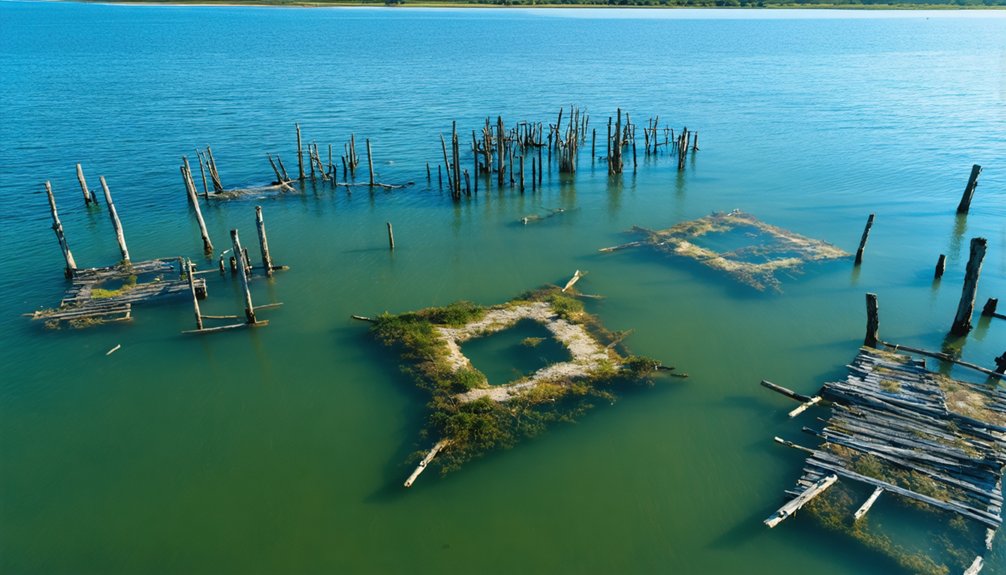
You’ll find Florida’s most extensive freshwater lake conceals archaeological evidence spanning millennia beneath its shallow, 730-square-mile expanse. Lake Okeechobee’s limestone basin, formed 6,000 years ago as ocean waters receded, preserves pre-Columbian burial mounds and settlement sites now submerged under an average depth of nine feet.
Recent surveys have documented these underwater cultural resources, revealing how fluctuating water levels—from the 2007 drought low of 8.82 feet to modern regulatory controls—continuously expose and resubmerge artifacts critical to understanding Florida’s indigenous populations.
Lake Okeechobee’s Hidden Past
When examining Florida’s largest freshwater lake, you’ll discover that Lake Okeechobee’s 730-square-mile expanse conceals a catastrophic chapter in the state’s history. The 1928 hurricane claimed thousands of lives when the dam failed, submerging 450 square miles and erasing entire communities from existence.
The disaster’s aftermath fundamentally altered the region:
- Kreamer Island – A 19th-century settlement on the southeast shore, isolated when the Herbert Hoover Dike severed road access.
- Utopia – A northeast shore town located 10 miles southeast of Okeechobee City, completely swept away and removed from maps.
- Sugar field communities – Multiple Palm Beach County settlements destroyed in the southern region.
- Mass gravesites – Thousands buried near the lake, marking unprecedented devastation.
Modern water renewal and eco restoration efforts now focus on the 20-foot dike encircling the lake, though abandoned roadways remain visible on satellite imagery.
Ancient Burial Grounds Below
Beyond catastrophic storms and flooded settlements, Florida’s submerged landscapes preserve far older human histories beneath coastal waters. The Manasota Key Offshore site, discovered in 2016 off Venice, reveals a 7,000-year-old burial ground now resting 21 feet below the Gulf’s surface.
What was once a freshwater pond nine feet above sea level became an underwater tomb as Ice Age glaciers melted. Archaeological teams documented at least six individuals, employing non-invasive magnetometry and sub-bottom profiling to map the site without disturbing ancestral remains.
Underwater artifacts including sharpened wooden stakes, textile fragments, and carved markers demonstrate sophisticated burial customs of Early Archaic peoples. Peat preservation prevented decay, maintaining organic materials that hurricanes couldn’t destroy.
The Seminole Tribe now collaborates with archaeologists, ensuring respectful stewardship of these submerged ancestors.
Frequently Asked Questions
Can Divers Legally Explore the Underwater Graveyard in Lake Okeechobee?
You can’t legally dive the underwater graveyard due to legal challenges protecting human remains and archaeological sites under Florida Chapter 267. Historical authenticity demands preservation—disturbing these protected waters constitutes a felony, restricting your exploration freedom entirely.
What Techniques Do Archaeologists Use to Date Submerged Skeletal Remains?
When examining Lake Okeechobee’s submerged cemetery remains, you’ll find archaeologists employ radiocarbon dating on bone collagen and stratigraphic analysis of sediment layers. These methods let you independently verify death dates while respecting preservation protocols for historical documentation.
Are There Other Underwater Graveyards Discovered in Florida’s Lakes?
You’ll find ancient shipwrecks containing human remains and fossilized vertebrates from prehistoric megafauna in Florida’s springs and lakes. These archaeological sites require careful documentation and protection to preserve irreplaceable evidence of past civilizations and extinct species.
How Do Modern Fishing Regulations Address Accidentally Disturbing Human Remains?
You’ll face immediate reporting requirements if you accidentally disturb human remains while fishing. Florida mandates contacting authorities within 24 hours, recognizing their cultural significance. Legal implications include felony charges unless you demonstrate good-faith discovery and proper notification protocols.
What Preservation Methods Protect Submerged Archaeological Sites From Deterioration?
You’ll employ marine conservation techniques like reburial with sandbags and geotextile mats for artifact stabilization. Environmental monitoring, sediment trapping with artificial seagrass, and controlled desalination guarantee you’re protecting sites from anaerobic deterioration and salt damage effectively.
References
- https://www.onlyinyourstate.com/experiences/florida/underwater-ghost-town-fl
- https://www.natalijaugrina.com/post/unveiling-the-mysteries-of-lake-okeechobee-myths-legends-and-the-underwater-ghost-town
- https://fdc.com/blog/ghost-towns-in-florida/
- https://www.journaloffloridastudies.org/0102ghosttowns.html
- https://historiumunearthia.com/episodes/episode-8-a-mysterious-underwater-graveyard-lies-at-the-bottom-of-floridas-lake-okeechobee/
- https://www.youtube.com/watch?v=pjRdqRH_rHw
- https://en.wikipedia.org/wiki/List_of_flooded_towns_in_the_United_States
- https://www.youtube.com/watch?v=ez-e7qBrh_o
- https://www.the-express.com/news/us-news/141278/florida-Lake-Okeechobee-underwater-hospital-graveyard
- https://www.saj.usace.army.mil/Missions/Civil-Works/Lake-Okeechobee/Okeechobee-Waterway-OWW/South-Florida-Operations-Office/Environmental-Stewardship/Cultural-Resources/