You’ll find two complete communities submerged beneath Maryland’s reservoirs: Warren, a cotton mill town of 900 residents acquired secretly by Baltimore in 1922 for $1 million, now lies under Loch Raven Reservoir following its 1923 flooding that raised water levels 66 feet. Conowingo, submerged in 1928 by dam construction, resurfaces during droughts to reveal foundations and roadbeds along the Susquehanna River. Both displacements resulted from municipal water infrastructure expansion, with Warren’s 55-foot flagpole marking the submerged site for decades. The mechanisms behind these engineered submersions reveal broader patterns in resource prioritization.
Key Takeaways
- Warren, a cotton mill town of 900 residents, was demolished in 1922 and submerged beneath Loch Raven Reservoir by 1923.
- A 55-foot flagpole marked Warren’s location underwater for 25 years, becoming a memorial symbol for displaced families.
- Conowingo was flooded in 1928 by dam construction, resurfacing during droughts to reveal foundations and roadbeds.
- Baltimore secretly purchased Warren for $1 million, evicting residents within four months without documented compensation or consent.
- Both towns were sacrificed for water infrastructure, with Conowingo’s 14-mile forebay destroying farms along the Susquehanna River.
Warren: The Mill Town That Vanished Beneath Loch Raven Reservoir
Following secret negotiations, the city acquired Warren for $1 million in 1922. You’d have witnessed complete demolition within four months—mills shuttered in February, all structures razed by June.
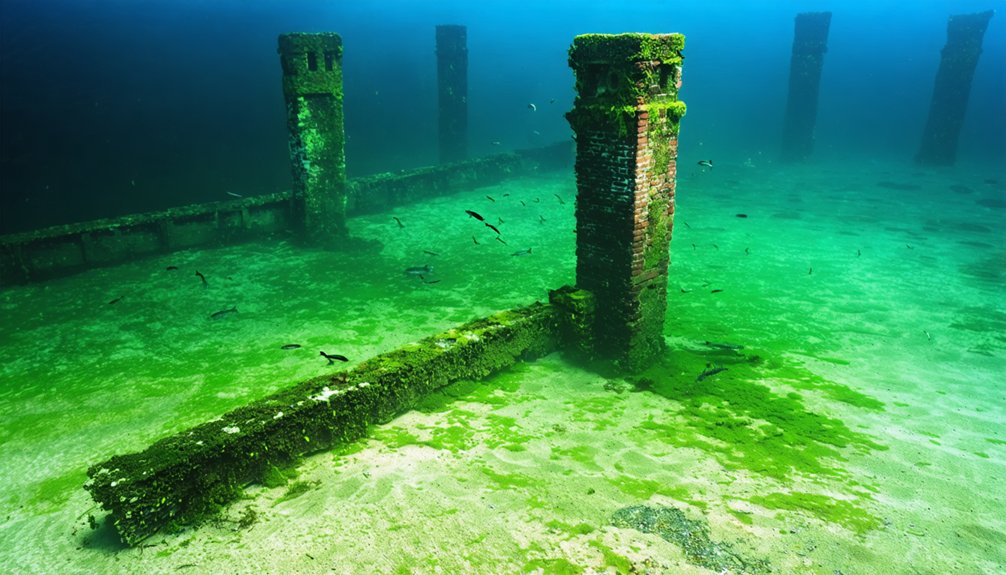
The 1923 dam expansion raised the reservoir from 51 to 117 feet, flooding the hollow with 23 billion gallons. Only a submerged flagpole remained visible for decades, marking where this industrial community once stood.
Before its watery fate, Warren had been a cotton mill town that now rests beneath what became a crucial part of Baltimore’s water supply system. Over 70 black-and-white photographs documented the town’s final years, preserving images of schoolchildren, community gatherings, and the original bridge before the waters rose.
Baltimore’s Growing Thirst and the Need for More Water
While Warren’s submersion solved Baltimore’s water crisis of the 1920s, the region now faces renewed supply challenges as prolonged drought conditions strain the very reservoirs built to secure its future.
Liberty Reservoir reached historically low levels by 2025, while Loch Raven and Prettyboy also declined.
Urban water scarcity triggered voluntary restrictions across five jurisdictions, targeting public water customers with conservation strategies including leak reporting and postponed lawn irrigation. The restrictions, issued on May 8, 2025, focused on limiting non-essential water use throughout the high-demand spring and summer seasons.
Six months of severe drought persisted through May 2025, with 59% of Maryland experiencing drought conditions by January 2026.
You’ll find Baltimore County’s projected metered water revenue increasing to $66 million in FY2026, reflecting intensified demand amid declining supply.
Beyond reservoir capacity concerns, long-term water quality decline has been observed across the Baltimore region’s waterways, with major deterioration in Baltimore Harbor, Tidal Patapsco, and Gwynns Falls watersheds.
The irony remains stark: communities drowned to prevent water shortages now witness those same reservoirs failing their original purpose.
The Forced Removal of 900 Residents
Once Baltimore City officials completed their clandestine negotiations with the Warren Manufacturing Company in 1922, approximately 900 residents faced immediate displacement from what had functioned as a company-controlled settlement along the Gunpowder River.
You’ll find no records of compensation or consent in this transaction—residents received eviction orders following years of secretive legal haggling between corporate ownership and municipal authorities.
The economic impact devastated families who’d built livelihoods around the mills, while community displacement occurred without recourse for those who’d established generational roots.
Following the legal settlement, structures underwent systematic demolition before 23 billion gallons submerged the site beneath Loch Raven Reservoir.
Only four management bungalows survived relocation to Old Bosley Road, preserving physical evidence of administrative privilege while worker housing vanished entirely.
these remnants are a glimpse into the past, sparking interest in exploring ghost towns in Arkansas. Each deserted structure tells a story of the communities that once thrived, drawing in adventurers and history enthusiasts alike. As visitors uncover these hidden gems, they piece together the narratives of resilience and change that shaped the region.
The town’s location in a flood-prone valley had made its displacement inevitable as reservoir expansion plans advanced to meet Baltimore’s growing water demands.
Today, the site remains submerged beneath the reservoir’s serene waters, marked only by the infrastructure that necessitated the community’s erasure.
The Flagpole That Marked a Sunken Community
The systematic demolition of Warren’s structures left behind one prominent vertical marker: a 55-foot wooden flagpole that would define the reservoir’s most haunting landmark for the next quarter-century. You’ll find this structure documented in Baltimore’s water department archives—over 70 photographs capturing its presence before submersion.
The flagpole’s flag symbolism transcended mere navigation; it became the physical anchor for community memory among displaced families and subsequent generations. Boaters referenced specific coordinates like “Schoolhouse Cove” when searching for the submerged marker, preserving Warren’s geography through oral tradition.
Structural integrity lasted approximately 25 years before water exposure and oxidation caused complete deterioration. Historical Society researcher Sally Riley’s documentation confirms the flagpole served as Warren’s final tangible connection—a vertical monument to governmental power prioritizing urban water infrastructure over established settlements containing nearly 1,000 residents. The reservoir’s water naturally flows downhill toward the Chesapeake Bay, following the region’s terrain and elevation patterns. The site is now known as Loch Raven, corresponding to the location where Warren once stood.
Conowingo: A Ghost Town That Reappears During Droughts
How does an entire community vanish beneath 9,000 acres of water, only to resurface decades later when nature reclaims what technology submerged?
You’ll witness Conowingo’s cyclical resurrection during drought conditions, when reservoir levels expose foundations, roadbeds, and structural remnants of the pre-1928 settlement. The Philadelphia Electric Company’s hydroelectric project created a 14-mile-long forebay that obliterated subsistence farming operations and generational homesteads along the Susquehanna River.
When water recedes, you can observe tangible evidence of displaced infrastructure—church foundations, residential footprints, and transportation corridors.
These periodic exposures document ecological impacts: sediment redistribution patterns, altered riparian zones, and transformed aquatic habitats. Tropical Storm Lee’s 2011 discharge through 44 flood gates demonstrates the reservoir’s hydraulic variability. The dam’s construction required 3,800 temporary workers who built extensive cofferdams of timber and relocated rail lines to complete the project. The masonry gravity structure, completed in 1928, ranks among the largest non-federal hydroelectric dams in the United States.
You’re observing engineered landscape modification where a community’s physical traces emerge only when environmental conditions permit temporary revelation.
Frequently Asked Questions
Are There Other Submerged Towns in Maryland Besides Warren and Conowingo?
You’ll find Warren and Conowingo are Maryland’s primary documented submerged settlements. While Daniels experienced partial submersion, most “lost” towns faced erosion rather than reservoir flooding. Historic preservation efforts can’t reverse these ecological impacts from dam construction.
Can Divers Legally Explore the Underwater Remains of Warren Today?
You cannot legally dive Warren’s remains. Loch Raven Reservoir’s diving regulations prohibit underwater exploration due to drinking water contamination risks. Historical preservation occurs through archival documentation only. Unauthorized submersion violates water quality laws protecting public health infrastructure.
What Happened to Warren Manufacturing Company After the Town Was Demolished?
Warren Manufacturing Company vanished like submerged sediment after 1922’s $1-million sale. You’ll find no continuation records—the economic impact ended operations permanently. Environmental effects included complete asset liquidation as Baltimore’s reservoir expansion erased the industrial footprint entirely.
Were Any Artifacts Salvaged From Warren Before It Was Flooded?
You’ll find no records documenting systematic artifact salvage before Warren’s flooding. Historical preservation wasn’t prioritized—only four bungalows survived relocation. Archaeological discoveries remain submerged beneath 23 billion gallons, with gravestones and structures untouched since 1922’s forced evacuation.
How Do Modern Reservoir Towns Prevent Displacement Situations Like Warren’s?
Shattering the past’s echo, you’ll find modern projects mandate thorough community relocation plans, historical preservation documentation, and anti-displacement strategies. Data-driven engagement ensures residents control their移 destiny through subsidized housing production and formal consultation processes before reservoir development.
References
- https://www.baltimoremagazine.com/section/community/warren-town-under-loch-raven-reservoir/
- https://www.idyllicpursuit.com/5-underwater-ghost-towns-in-the-us-visible-from-the-surface/
- https://www.youtube.com/watch?v=FoTBXomVN4k
- https://www.youtube.com/watch?v=tP7rWBi6OLk
- https://www.trillmag.com/videos/warren-the-forgotten-town-that-was-purposely-destroyed-in-1922/
- https://en.wikipedia.org/wiki/List_of_flooded_towns_in_the_United_States
- https://en.wikipedia.org/wiki/Loch_Raven_Reservoir
- http://www.hsobc.org/wp-content/uploads/2017/06/htv039n4.pdf
- https://www.youtube.com/watch?v=u_5NCJ9NIMs
- https://www.youtube.com/watch?v=OZXRFFmwAL8