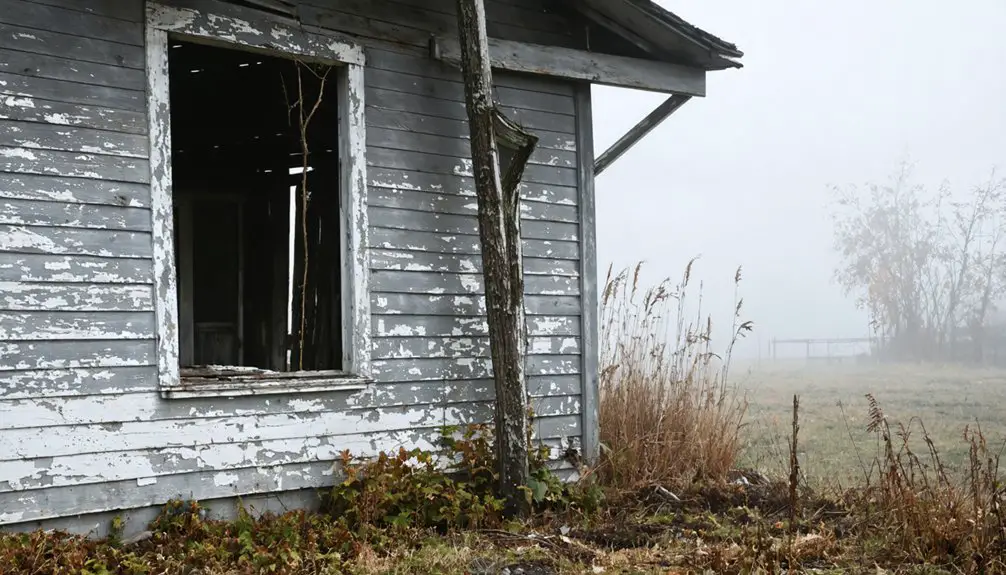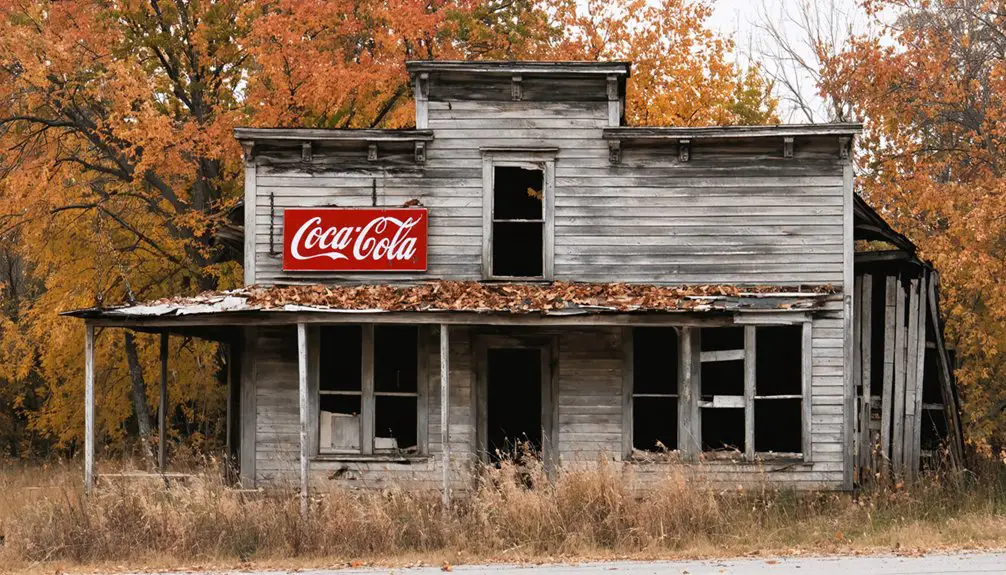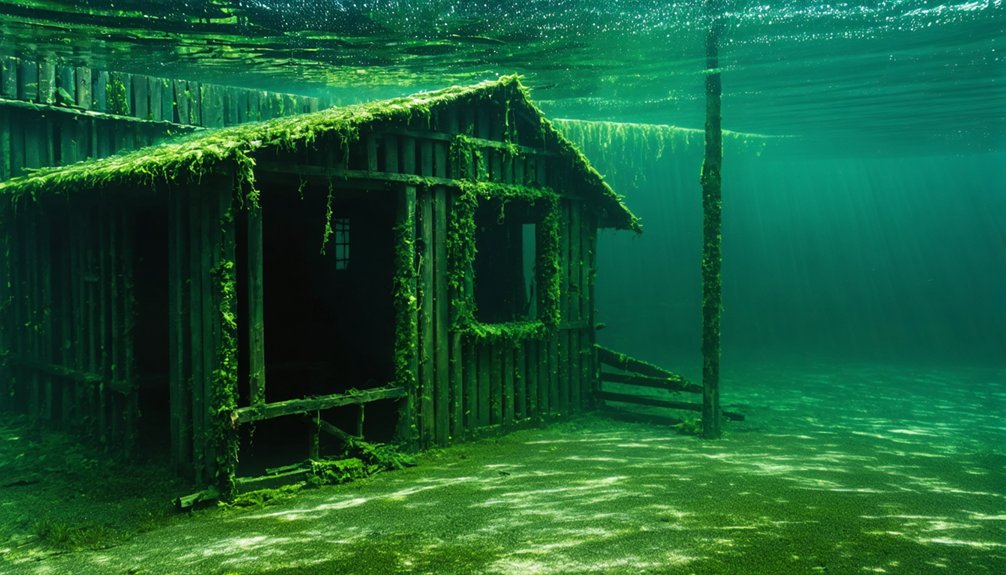
Michigan’s underwater ghost towns emerged through three distinct processes you’ll find fascinating. Singapore, established in 1836, was buried by advancing sand dunes after the 1871 Holland Fire destroyed timber windbreaks, causing dunes to migrate 10 feet annually. Rawsonville, founded in 1800, was deliberately submerged in 1925 when the French Landing Dam created Belleville Lake. Clark Lake features an intentionally curated collection of boats and platforms positioned 15-27 feet deep for recreational diving. Each site’s preservation mechanisms and historical artifacts offer unique insights into Michigan’s industrial past and environmental transformations.
Key Takeaways
- Singapore was a thriving lumber town buried by advancing sand dunes in the 1880s after deforestation removed natural windbreaks.
- Rawsonville was intentionally flooded in 1925 when French Landing Dam created Belleville Lake, submerging portions of the original settlement.
- Deforestation for timber exports caused unanchored dunes to advance 10 feet annually, burying Singapore’s streets and buildings completely.
- Archaeological excavations at Singapore recovered approximately 200 artifacts, earning it the nickname “Michigan’s Imaginary Pompeii.”
- Cold lake waters and oxygen-free conditions in Michigan’s underwater sites preserve submerged structures, tools, and pathways remarkably well.
Singapore: From Lumber Boom to Sand-Buried Ghost Town
In 1836, New England migrants established Singapore along the Kalamazoo River near present-day Saugatuck, creating what would become one of Michigan’s most prosperous—and ultimately most peculiar—vanished settlements.
Pioneer Oshea Wilder developed this lumber export town in 1837, and it thrived through shipping industries supplying Great Lakes cities. The community peaked at 100 residents, featuring two hotels, mills, and Michigan’s first underground schoolhouse.
However, deforestation eliminated vital windbreaks. Lake Michigan winds advanced sand dunes 10 feet annually, burying streets and buildings by the late 1870s. The town experienced a major boom supplying lumber to Chicago’s reconstruction after the devastating 1871 Great Fire before overharvesting ultimately sealed its fate. A 40-day blizzard in 1842 nearly destroyed the settlement, though residents survived thanks to provisions from a nearby shipwreck.
Residents evacuated by mid-1870s, relocating structures across frozen river. Today’s cultural significance lies in its “Michigan’s Pompeii” designation.
Archaeological discoveries remain preserved beneath Saugatuck Dunes, where wood structures survive intact, accessible through historical cruises documenting this cautionary environmental tale.
The 1871 Holland Fire and Singapore’s Timber Economy Collapse
The simultaneous fires of October 8, 1871—Holland, Chicago, and Peshtigo—destroyed over 3,900 square miles across Michigan, incinerating the virgin timber forests that supplied Singapore’s three sawmills.
Singapore’s entire economic model depended on continuous access to dense woodlands within transport distance, but the fire consumed these resources across a region stretching from Lake Huron to Lake Michigan.
You’ll find that Singapore’s mills, which had already depleted local stands through years of supplying lumber to rebuild Chicago, faced immediate collapse when the 1871 conflagration eliminated their remaining timber inventory.
The Holland fire alone destroyed 64 stores, 6 churches, 3 hotels, and over 200 homes, demonstrating the catastrophic scale of destruction that extended far beyond the forests themselves. The fire left 300 families homeless in Holland, with rebuilding efforts consuming the entire 1870s and marking the community’s transition from its pioneer era to a functioning Midwestern city.
Holland Fire Devastates Forests
When drought conditions peaked following an unusually dry September, Holland faced catastrophic fire on October 8, 1871. You’ll find gale-force winds from a cyclonic storm transformed common brush fires into an uncontrollable blaze that swept northeasterly through the region.
The inferno consumed logging slash and standing timber, destroying the forest resources that sustained regional lumber operations. Modern archaeological surveys reveal burn patterns extending from southwest of Holland through dense woodlands to Black Lake’s shores. By noon on that Sunday, the entire town was ablaze, with community members desperately fighting flames using shovels and sand supplied by local hardware stores.
This devastation eliminated lumber supplies needed for reconstruction—a constraint that severely impacted both Holland’s recovery and neighboring Singapore’s timber-dependent economy. The fire ultimately burned over 3,900 square miles statewide, claiming 500-1,000 lives and altering Michigan’s economic landscape permanently. Land clearing practices and logging operations had left massive amounts of timber debris that served as fuel for the rapidly spreading flames.
Today’s flood mitigation studies document how this deforestation transformed regional hydrology.
Singapore’s Timber Industry Ends
Founded with ambitions to rival Chicago as a Great Lakes economic hub, Singapore emerged as Michigan’s timber industry centerpiece positioned strategically near coastal dunes for lumber shipping via the Kalamazoo River.
When the 1871 Great Chicago Fire destroyed 17,500 buildings and displaced 100,000 residents, you’d witness Singapore supply massive lumber quantities for reconstruction—$222 million in property damage demanded unprecedented resources.
This boom proved catastrophic. Accelerated clear-cutting stripped surrounding forests within years, eliminating vegetation that stabilized sand dunes.
The environmental impact was irreversible: migrating dunes progressively buried structures as residents abandoned the site by mid-1870s. The hot, dry, and windy autumn conditions that enabled the Chicago Fire’s rapid spread had created such extensive devastation that Singapore’s entire forest reserves were depleted meeting reconstruction demands.
The town’s peak population remained under 500, reflecting its character as primarily a lumber and shipbuilding factory rather than a typical residential community.
You’ll find archaeological evidence today—200 artifacts recovered in 2017—marking where human mismanagement transformed a promising settlement into Michigan’s “Imaginary Pompeii,” with 11 houses relocated to neighboring towns before complete sand engulfment.
How Forest Removal Led to Dune Encroachment
Singapore’s forests functioned as a critical windbreak system, anchoring sand dunes that bordered Lake Michigan and preventing their inland migration.
When 19th-century lumbering operations cleared these trees during the town’s peak activity near the Kalamazoo River mouth, coastal winds immediately mobilized the unanchored sand.
Within years of forest removal in the 1870s, sand drifts began encroaching on streets and doorsteps, initiating the burial process that transformed Singapore into a ghost town by the early 1880s.
Similarly, Clark Lake south of Jackson conceals remnants of human activity beneath its surface, though its submerged collection formed through different circumstances than Singapore’s sandy fate.
Rawsonville met its watery end when Detroit Edison’s dam created Belleville Lake in 1925, flooding the once-thriving Civil War-era settlement along the Huron River.
Singapore’s Protective Forest Barrier
Along Michigan’s eastern shoreline, the lumber town of Singapore once relied on surrounding forests to stabilize the massive sand dunes that defined the landscape. When loggers cleared these protective barriers for timber and fuel—mirroring Singapore’s 99% primary forest loss since 1819—the natural anchoring system collapsed.
Trees that once regulated water cycles and prevented soil washout vanished, leaving dunes unprotected against wave action and storm surges. Without this urban green infrastructure, sand migration accelerated dramatically.
The biodiversity conservation failure proved catastrophic: exposed dunes shifted freely, burying structures and infrastructure. You’ll find this pattern repeated globally—where coastal forests disappear, erosion intensifies and protective functions cease.
Singapore’s mangrove loss of 95% demonstrates identical consequences: disrupted climate patterns, impaired water quality, and compromised natural defenses against environmental forces.
Post-Logging Sand Burial
When white pine lumber operations commenced in 1881 along the Platte River, loggers extracted dense stands at rates that exceeded natural regeneration capacity. By 1875, you’d find no trees remaining—the protective barrier that stabilized coastal sands had vanished.
Without forest conservation practices, Lake Michigan’s winds drove dunes directly into the unprotected settlement. The ecosystem that once provided wildfire management and erosion control was eliminated for immediate profit.
Singapore’s structures couldn’t withstand the advancing sand after losing their natural defense system. The town now lies buried beneath dunes near the Kalamazoo River mouth, demonstrating how resource extraction without ecological consideration transforms landscapes permanently.
You’re witnessing consequences of prioritizing short-term economic gain over environmental sustainability—a cautionary outcome preserved in sand.
Rawsonville: Snow’s Landing on the Huron River
Henry Snow’s arrival in 1800 established the settlement that would become known as Snow’s Landing, positioned strategically on the Huron River where flatboats carrying up to 20 tons of goods could navigate upstream to deliver supplies for incoming settlers.
River transportation made this site critical for regional commerce. You’ll find Amariah Rawson filed the community plat as Michigan City in 1836, later renamed Rawsonville by legislative act in 1839.
The village thrived through the Civil War era with grist mills, saw mills, and various industries. Railroad construction bypassed Rawsonville, devastating its economy.
The post office closed permanently in 1902. Few residents remained by 1900.
Historical preservation efforts culminated in Michigan State Historic Site designation on October 27, 1983, documenting this vanished commercial hub.
The Submersion of Rawsonville Under Belleville Lake
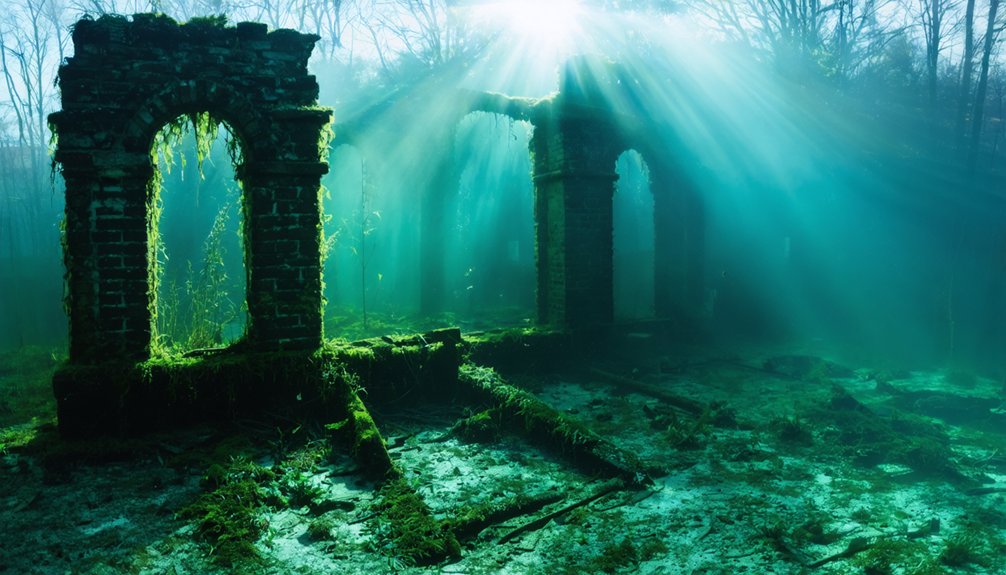
The Detroit Edison Company acquired Rawsonville’s remaining land parcels in 1910 to construct a hydroelectric dam on the Huron River.
Following the economic decline triggered by failed railroad expansion in the 1880s, you’ll find that most residents had already abandoned their properties.
Eastern Michigan Edison Company completed the French Landing Dam in 1925, creating Belleville Lake—an artificial reservoir that submerged portions of the historic village site.
This land development transformed the geography permanently, placing remnants of mills and structures underwater.
You can verify that modern Rawsonville exists west of the original settlement, occupying much of the unflooded territory.
The historical marker at Rawsonville Road incorrectly suggests complete submersion, though only small sections actually lie beneath the reservoir’s surface today.
Clark Lake’s Intentional Underwater Graveyard
Unlike traditional ghost towns submerged through dam construction, Clark Lake’s underwater graveyard represents a deliberate archaeological assemblage created by professional divers.
Clark Lake’s submerged collection emerged from intentional curation, not natural disaster, distinguishing it from accidental underwater ruins.
You’ll find this marine preservation site 60 yards off the west end near Columbia Township Park in Jackson County, where salvaged boats, jetskis, snowmobiles, and platforms rest 15 to 27 feet below the surface.
Professional divers established this underwater archaeology site by collecting decades-old aquatic equipment scattered across the lakebed, centralizing items while removing hazardous debris.
You’re free to explore this intentional collection during summer months with proper diving equipment and underwater cameras for documentation.
The graveyard serves dual purposes: preventing scattered wreckage from endangering swimmers and creating an accessible dive site showcasing historical watercraft.
You’ll discover no buildings—just concentrated nautical artifacts available for unrestricted exploration.
Three Different Burial Mechanisms Across Michigan
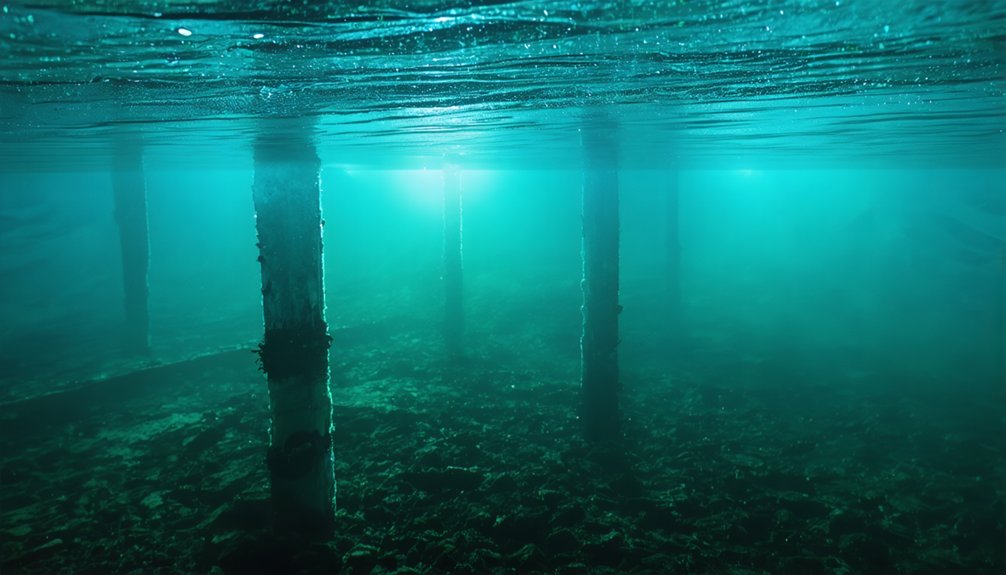
Beneath Michigan’s waterways, three distinct geological and hydrological mechanisms have preserved archaeological materials through fundamentally different processes.
In Lake Huron, frigid temperatures create Pompeii-like conditions where ancient pathways and stone hunting blinds remain undisturbed on underwater ridges. Stone flakes from spear point repairs indicate tool-making sites dating to the Great Lakes’ oldest known occupation.
Underwater tools and artifacts maintain their original positions due to pristine water chemistry.
The Middle Island sinkhole demonstrates chemical preservation through groundwater-delivered calcium, iron, and sulfur that creates oxygen-free conditions. Sediment layers seal organic materials while microbial mats protect oxygen-sensitive metals.
Rising lake levels expose a third mechanism: erosion-driven burial redistribution. Water scours shoreline bluffs, releasing centuries-old materials into contemporary sediment layers, fundamentally altering their archaeological context.
Historic Markers and Preserved Memories
While geological processes determine how materials survive underwater, human intervention determines whether their stories persist above the surface. Michigan’s Historical Commission erected markers documenting Singapore (1958) and Rawsonville (1983), establishing public access points where you’ll find factual records of submersion events. Singapore’s marker stands at Saugatuck City Hall, while Rawsonville’s occupies McDonald’s property on Rawsonville Road.
These installations serve dual functions: commemorating lost settlements and educating visitors about displacement mechanisms. The Saugatuck-Douglas History Museum houses recovered artifacts including Singapore bank notes and photographs, supplementing Native legends and folklore traditions with physical evidence.
Sand’s preservative qualities maintain structural integrity beneath dunes, creating intact time capsules awaiting documentation. Several Singapore buildings were relocated to Saugatuck via the frozen Kalamazoo River, where they remain integrated into the existing community landscape.
Diving and Exploring Michigan’s Submerged History
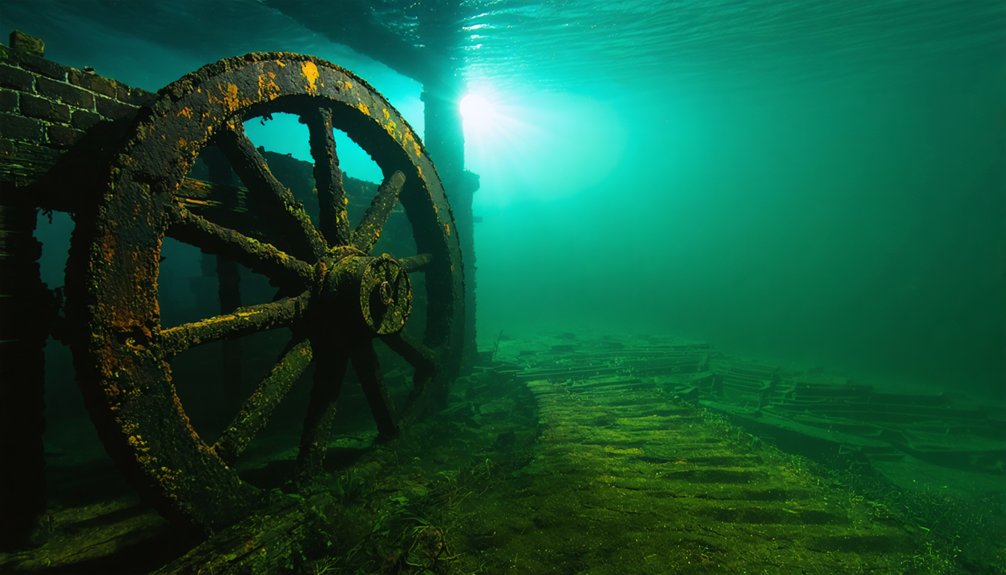
Michigan’s submerged historical sites divide into four distinct categories based on formation mechanisms: deliberate underwater installations, flooded mining operations, dam-created reservoirs, and sand-buried settlements.
You’ll find marine archaeology opportunities at Clark Lake‘s 15-27 foot boat graveyard, where underwater photography captures jet skis and platforms 60 yards offshore.
Lime Lake’s marlstone mining formations create Atlantis-like pillars at 27-foot depths, though you’ll encounter snapping turtles during exploration.
Belleville Lake conceals Rawsonville’s 19th-century structures beneath dam-flooded waters.
Singapore differs—it’s entombed under Lake Michigan dunes rather than submerged.
Professional divers maintain Clark Lake’s accessibility by removing debris.
You’re free to explore these sites with cameras, documenting structures that bridge Michigan’s industrial, maritime, and settlement history through direct observation and photographic evidence.
Frequently Asked Questions
Are There Other Underwater Ghost Towns in Michigan Besides These Three?
Based on documented evidence, you won’t find other confirmed underwater ghost towns in Michigan beyond Rawsonville. Historic preservation records and underwater archaeology surveys haven’t identified additional submerged villages with intact structures, though undocumented sites may exist independently.
Can You Legally Salvage Artifacts From Singapore’s Buried Remains?
Legal salvage from Singapore’s ruins exists in a gray area—you’ll find no explicit artifact rights protections documented, though Michigan’s historic preservation laws likely apply. Proceed cautiously; formal permissions remain undefined, making unrestricted recovery questionable despite informal precedents.
What Water Visibility Conditions Are Best for Diving Clark Lake’s Graveyard?
You’ll find ideal underwater visibility for diving safety at Clark Lake’s graveyard during summer months, May through September. Professional divers recommend bringing an underwater camera, as conditions vary seasonally. Always verify current visibility before your descent into freedom.
Did Any Residents Refuse to Leave Singapore or Rawsonville Before Submersion?
You’ll find minimal evidence of residents refusing to leave either town. Singapore had one documented holdout until sand reached their roof, while Rawsonville’s population had already dwindled before submersion. No haunted legends or preservation efforts emerged from resistance.
Are There Maps Showing Exact Locations of Submerged Rawsonville Structures?
No detailed maps exist—only Ben Owen’s memory-drawn sketch survives in historical photos. You’ll find underwater exploration reveals just sand and silt, no preserved structures. Historical preservation efforts focus on the McDonald’s marker, not precise submerged layouts.
References
- https://www.thepernateam.com/blog/singapore-michigan-the-ghost-town-buried-beneath-lake-michigans-sand/
- https://www.clickondetroit.com/features/2024/06/01/did-you-know-theres-a-michigan-city-thats-actually-underneath-a-lake/
- https://wmmq.com/the-underwater-ghost-village-of-clark-lake/
- https://99wfmk.com/singapore-buried-ghost-town/
- https://www.youtube.com/watch?v=aCFmBsgJfAM
- https://www.youtube.com/watch?v=l2YULk6MhbI
- https://environmentalcouncil.org/discover-post/from-a-sand-covered-ghost-town-michigans-dune-story-rises/
- https://saugatuck.com/buried-in-time/
- https://bridgemi.com/outdoors-life/a-michigan-town-disappeared-150-years-ago-a-cruise-can-take-you-back/
- https://www.awesomestories.com/pdf/make/130050