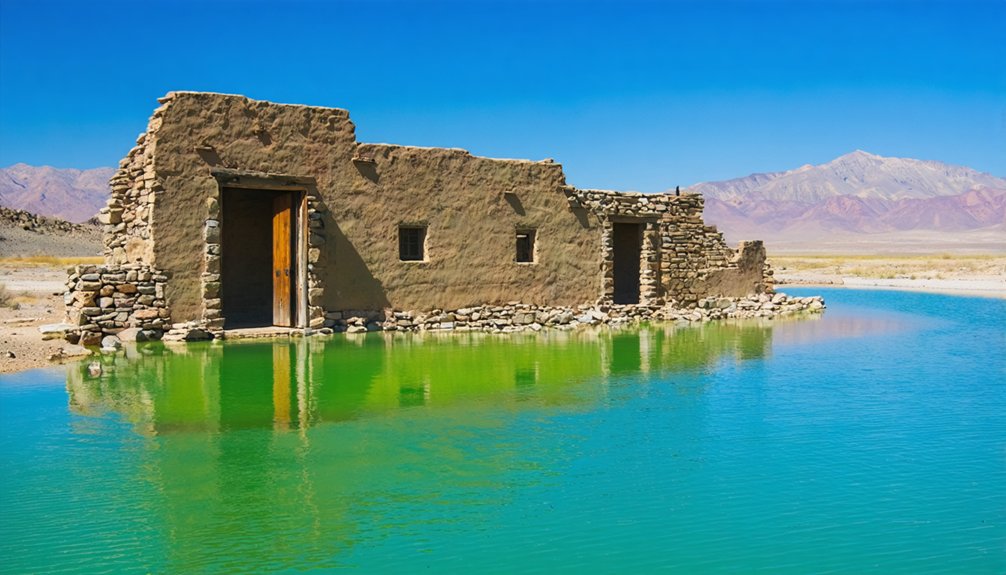
You’ll discover New Mexico’s most fascinating ghost towns beneath its reservoir surfaces, where 20th-century dam construction submerged entire communities. Bonito Lake conceals an 1870s gold rush camp with saloon foundations and burial grounds, while Navajo Lake—created by the 1960s dam—flooded Rosa, Los Arboles, and Los Martinez, displacing 200 families and burying railroad infrastructure under 10 feet of sediment. Elephant Butte Reservoir swallowed New Alamosa (established 1867) when the dam flooded 42,000 acres. These preservation sites reveal themselves during seasonal drawdowns, offering glimpses into the region’s sacrificed heritage and engineering history.
Key Takeaways
- Navajo Lake submerged towns Rosa, Los Arboles, and Los Martinez in 1961, displacing 200 families when Navajo Dam was built.
- Elephant Butte Reservoir flooded New Alamosa (established 1867) and 42,000 acres starting in 1906 with dam construction.
- Bonito Lake conceals a 1870s gold rush camp with dugout foundations, log cabins, and saloon remnants beneath its waters.
- Submerged railroad infrastructure from early 1900s remains visible during low water levels, including track indentations and water tanks.
- Low-oxygen sediments preserve artifacts like metal remnants and foundations, creating unintended archaeological records of displacement.
Bonito City: From Wild West Settlement to Submerged Cemetery
While the name “Bonito City” evokes images of 19th-century frontier life, the settlement’s true history extends far deeper into North America’s past.
You’re looking at ancient ruins spanning 828-1126 AD, where Ancestral Puebloans constructed a D-shaped complex of 499-800 rooms reaching five stories high.
Between 828-1126 AD, Ancestral Puebloans engineered a massive D-shaped complex of up to 800 rooms soaring five stories high.
These archaeological sites reveal sophisticated engineering: walls nearly one meter thick, precise solar and lunar alignments, and kivas for ceremonial gatherings.
The complex functioned as a regional hub connecting 150+ outlying structures through an extensive road network.
By 1130 AD, deforestation collapsed the water table, forcing complete abandonment.
Lt. James Simpson rediscovered the site in 1849, initiating federal preservation efforts by 1904.
Excavation efforts began in 1896, with comprehensive archaeological work completed in 1927.
Archaeological investigations uncovered 190 rooms along with artifacts including wooden flutes, vessels, and ceramic incense burners.
Today it’s protected within Chaco Culture National Historical Park.
The Haunting of Pete Nelson at Bonito Lake
Though Bonito Lake appears as a peaceful mountain reservoir at 7,300 feet elevation in Lincoln National Forest, its waters conceal a violent 1885 tragedy that historians like Lynda Sanchez have documented as one of the region’s worst atrocities.
You’ll find legends and folklore surrounding miner Martin Nelson’s massacre of the Mayberry family, saloon owner Pete Nelson, and grocer Herman Beck on May 5th.
Historical mysteries persist about Nelson’s burial—some accounts claim he was interred headfirst on a hillside, others suggest his grave lies submerged or relocated east of Angus Cemetery. Unlike the victims relocated to higher ground before the 1930 flooding, Nelson’s remains weren’t moved. Unconsecrated land outside the original city cemetery marked his final resting place, reflecting the community’s judgment of his crimes.
Before the massacre, Bonito City thrived as a mining settlement with log cabins along Bonito Canyon, a saloon, general store, and boarding house serving the growing community.
As the town flourished, families began to establish roots, creating a vibrant community that attracted a variety of visitors seeking adventure. Today, Bonito City is not only remembered for its rich history but also as a gateway to dogfriendly spots in Oregon, where families can enjoy the outdoors with their pets. The picturesque landscapes and welcoming atmosphere continue to draw those looking for a peaceful retreat.
Visitors report apparitions in period clothing, faces floating beneath the surface, and disembodied children’s voices along the shoreline, suggesting unfinished business from that bloody night.
Just forty miles northwest of Bonito Lake’s spectral waters, another New Mexico reservoir conceals remnants of transportation history rather than tales of frontier violence. Navajo Lake buried an essential Denver and Rio Grande Western water stop beneath its surface during 1960s water reservoir construction.
The site’s railroad engineering achievements included:
- One-of-a-kind water tank fashioned from scrapped Class M-75 tender cistern
- Horseshoe bypass curve maintaining constant grade above Piedra River
- Strategic placement between Chama and Durango on San Juan Extension
- Stabilized trackbed using cinders and ashes instead of unstable river rock
- Connection linking Los Arboles to Silverton’s mining operations
When Bureau of Reclamation officials arrived in 1958, they condemned properties for Navajo Dam construction. The lake’s formation deposited approximately 10 feet of sediment at the reservoir bottom, dramatically altering the original river course and landscape.
You’ll find the relocated water tank above current lake levels, while silt covers the original grade—occasionally exposed when reservoir levels drop. Meanwhile, approximately 25 miles west of Farmington, the Navajo Mine Railroad continues operating as a dedicated coal transportation line with no connection to other rail networks.
When drought conditions lower Navajo Lake’s water levels, you’ll encounter preserved remnants of both railroad and residential infrastructure dating to the early 1900s.
Railroad ties, tie plates, and rip rap from the San Juan Extension line remain embedded in lake sediment.
Meanwhile, church foundations—including one particularly narrow, elongated structure below Arbolese Point—become visible near former town sites.
These submerged archaeological resources exist in varying states of preservation, with sediment deposits obscuring many structures in slack water areas while exposing others during seasonal drawdowns.
The reservoir initially filled in 1961, submerging the communities of Rosa and Los Arboles beneath what would become Navajo Lake.
The displacement affected nearly 200 families, some of whom had resided in these communities for 80 to 90 years before the dam’s completion.
Visible Railroad Infrastructure Remnants
Below Navajo Lake’s surface lies a preserved timeline of narrow gauge railroad construction, where the Denver & Rio Grande Western’s San Juan Extension roadbed remains largely intact despite decades of submersion since the 1960s.
When water levels drop during drought conditions, you’ll discover extensive railroad grade remnants revealing construction methods and engineering solutions from this historic route between Chama and Durango.
Physical Evidence of the Submerged Railway:
- Indentations from rotted wooden ties mark original track placement
- Tie plates remain positioned along the grade, indicating narrow gauge specifications
- River rock riprap stabilizes the roadbed above built-up dirt and cinder fill
- Water tank history includes relocation from its original underwater site
- Horseshoe curve alignment shows 1960s government-built bypass replacing flooded sections
These remnants document infrastructure that once connected Alamosa to Silverton. Modern railroads in the region continue serving communities, with BNSF providing long-haul transportation for essential water deliveries to nearby Navajo Nation families facing severe water shortages. The rail system allows water to be shipped from Mississippi and Missouri to Thoreau, where it’s transferred into trucks for home delivery.
Submerged Structures and Artifacts
Since Navajo Dam’s completion in 1962, lake waters have concealed the physical remains of Rosa, Los Arboles, and Los Martinez—communities where 85 structures were either relocated, demolished, or left to flood.
Today, submerged house foundations rest beneath silt layers in slack water zones, while underwater artifacts like tie plates from the old county highway bridge remain preserved in low-oxygen sediments. You’ll find wooden ties have rotted away, leaving only indentations and metal remnants.
Church foundations lie buried downstream under accumulated silt deposits. During drought-induced low pools, these relics reemerge temporarily, exposing what bureaucratic necessity concealed.
The sediment deposition varies by location—thickest where the San Juan River bends create low-energy environments. These preservation conditions have maintained artifacts since the 1960s, creating an unintended archaeological record of displacement.
Other Ghost Towns Lost to New Mexico’s Reservoirs
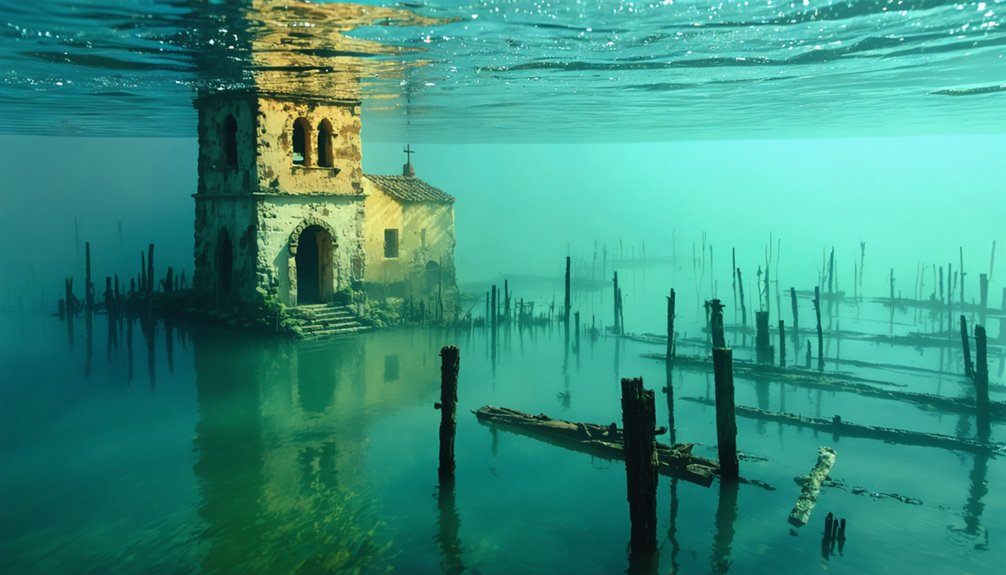
Beyond Navajo Lake, you’ll find Elephant Butte Reservoir concealing New Alamosa, a settlement established in 1867 and abandoned in 1880 after the Rio Grande shifted course.
The reservoir’s construction submerged not only this Sierra County town site but also the ranches that briefly persisted after abandonment.
Railway water stops and scattered mining camps across New Mexico met similar fates, their foundations now buried under reservoir silt alongside the infrastructure that once sustained them.
Towns Beneath Elephant Butte
When contracts were finalized on June 27, 1906, for Elephant Butte Dam’s construction, three Rio Grande Valley towns faced inevitable submersion beneath what would become the world’s largest impoundment reservoir. The dam’s water management priorities—resolving scarcity issues affecting Mesilla Valley, El Paso, and Juárez—required flooding 42,000 acres when filled to capacity.
Impact on Communities and Environment:
- San Marcial’s 1929 flood displaced over 60 families (nearly 500 people) to Belen, Albuquerque, and El Paso.
- Three towns remain permanently submerged, accessible only through scuba diving.
- Peak downstream flows declined 75 percent, triggering significant ecological changes.
- A machine shop in Hospital Canyon survives underwater as construction-era infrastructure.
- Annual springtime floods ceased, while sediment accumulation increased downstream flooding risk.
These submerged communities represent freedom sacrificed for regional development.
Submerged Railway Water Stops
Railroad expansion across New Mexico’s arid territories created dozens of water stops that enabled steam locomotives to traverse otherwise impassable desert stretches.
Yet these same communities—engineered specifically to solve water scarcity—met their demise through inundation when reservoir projects transformed regional hydrology.
You’ll find Gato’s submerged infrastructure beneath Navajo Lake, where intact roadbed and water tank structures remain visible underwater since the 1960s.
The Denver and Rio Grande Western narrow gauge railroad left tracks in place here, unlike removed sections elsewhere.
This railroad history site along the San Juan River preserves tangible evidence of engineering solutions to desert transit challenges.
The reservoir’s filling transformed these operational water stops into archaeological sites, where submerged infrastructure documents the technological requirements of steam-era transportation through New Mexico’s challenging terrain.
Mining Camps Under Reservoirs
New Mexico’s reservoir construction projects flooded entire mining settlements, creating underwater archaeological sites that preserve distinct chapters of territorial resource extraction.
Bonito Lake conceals a 1870s gold rush camp that evolved from tent settlements to established log cabins before its violent end and subsequent dismantlement. The aquatic archaeology beneath these waters includes:
- Pete Nelson’s saloon site where seven shooting victims were laid out
- Original burial grounds relocated except Nelson’s remains
- Log cabin foundations from 1882 settlement structures
- Evidence of 45-year mining operation before submergence
- Underwater preservation of violent theft incident location
You’ll find similar sites at Elephant Butte Reservoir, which submerged an 1880s settlement abandoned after Rio Grande course changes.
These flooded communities represent tangible connections to territorial mining heritage, preserved beneath controlled waters rather than scattered across accessible public lands.
Visiting New Mexico’s Underwater Historical Sites
Although scattered across diverse geological formations, New Mexico’s underwater historical sites present distinct access parameters that visitors must understand before planning their excursions.
Blue Hole offers unrestricted scuba diving Monday through Saturday at 1085 Blue Hole Rd. However, sealed underwater cave systems since 1976 prevent exploration beyond 81 feet. You’ll need high-altitude dive tables at 4,616 feet elevation.
Montezuma Well prohibits diving despite its archaeological significance. You can only view ancient petroglyphs and cliff dwellings from established trails.
Water Canyon remains closed on EMRTC lands, protecting its Paleoindian artifacts.
Blackwater Draw provides surface access through its museum at 508 NM-467, but offers no underwater opportunities.
Each location enforces specific preservation protocols that balance public engagement with artifact protection requirements.
Frequently Asked Questions
Can Divers Legally Explore the Underwater Ghost Town Ruins in New Mexico?
You’ll need permits from reservoir authorities and must comply with historical preservation laws before diving. Regulations vary by site—federal reservoirs require Bureau of Reclamation approval, while diving regulations prohibit disturbing artifacts without proper authorization protecting these submerged cultural resources.
What Artifacts Have Been Recovered From Submerged Towns in New Mexico Reservoirs?
No documented artifacts have been recovered from New Mexico’s submerged towns. Underwater archaeology faces preservation challenges there—you’ll find no official excavations recorded. The state prioritizes site protection over retrieval, restricting your access to these historical resources.
Are There Plans to Drain Any Reservoirs to Reveal the Ghost Towns?
No official draining plans exist for New Mexico’s reservoirs. You’ll find ghost towns occasionally exposed through drought-induced water level drops rather than deliberate reservoir management decisions. Current conditions prioritize water conservation over archaeological revelation, preserving your recreational access.
How Many Ghost Towns Are Currently Underwater in New Mexico?
You’ll find no precise count exists—interestingly, just as historical preservation records lack underwater ghost town data, wildlife impact assessments don’t track submerged sites either. Evidence suggests several barren sites face water coverage, but exact numbers remain undocumented in official sources.
Do Water Levels Ever Drop Low Enough to See the Submerged Structures?
Yes, you’ll see structures when drought strikes. Navajo Lake dropped seventy feet, exposing bridges, outhouses, and railroad beds. However, historical documentation remains limited, and ecological impact from such exposure hasn’t been thoroughly studied for preservation purposes.
References
- https://usghostadventures.com/haunted-stories/americas-most-haunted-west/bonito-lake-new-mexicos-haunted-atlantis/
- https://www.youtube.com/watch?v=nzH4F3k8ZiM
- https://newmexicotravelguy.com/new-mexico-ghost-towns/
- https://www.newmexico.org/places-to-visit/ghost-towns/
- https://www.youtube.com/watch?v=I5abnMrTgVY
- https://en.wikipedia.org/wiki/List_of_ghost_towns_in_New_Mexico
- https://www.blm.gov/visit/lake-valley-historic-townsite
- https://newmexiconomad.com/kingston/
- https://amazingbibletimeline.com/blog/pueblo-bonito-in-chaco-canyon-national-park-new-mexico/
- https://www.labrujulaverde.com/en/2024/01/pueblo-bonito-the-enigmatic-anasazi-city-abandoned-in-the-12th-century/