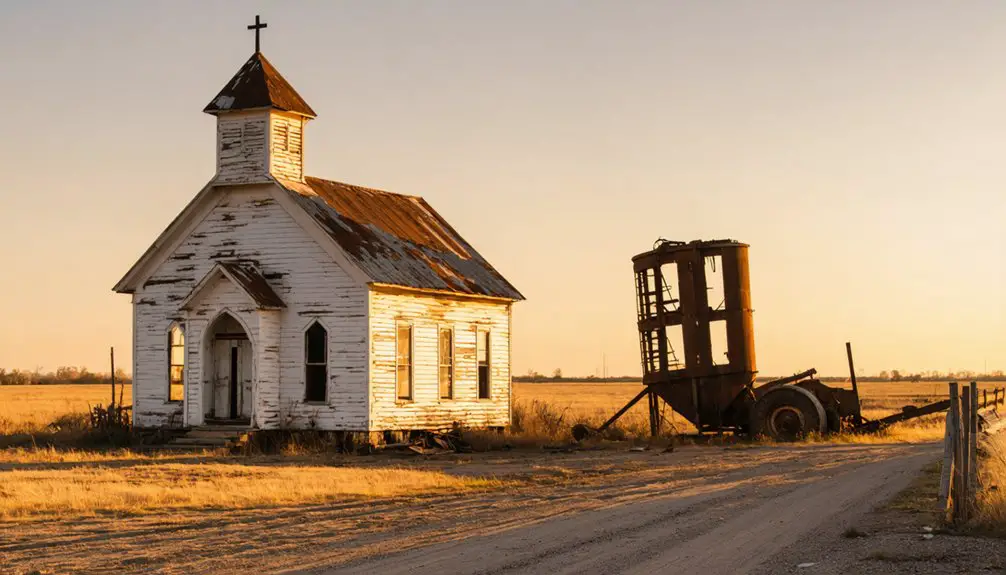
You’ll find over 200 submerged communities beneath Oklahoma’s man-made reservoirs, deliberately flooded during 20th-century dam construction projects. North Fork Town, Lugert, and Lake Texoma’s border settlements like Aylesworth now rest underwater, their foundations and gravestones re-emerging during drought conditions. These infrastructure projects, including Lake Eufaula (1964) and Denison Dam (1944), prioritized flood control and hydroelectric generation over preservation, permanently altering Oklahoma’s hydrological landscape. Displaced residents maintain cultural memory through reunions and memorial practices, while archaeological remnants provide tangible evidence of these lost settlements’ historical significance and spatial distribution patterns.
Key Takeaways
- Multiple Oklahoma towns like North Fork Town, Lugert, and Aylesworth now lie submerged beneath reservoirs created by dam construction projects.
- Over 200 reservoirs were built during the Dust Bowl era for flood control, water supply, and hydroelectricity generation purposes.
- Towns were displaced by major dams including Denison Dam (1944) and Lake Eufaula (1964), transforming Oklahoma’s flat, naturally lake-less terrain.
- During droughts, remnants like foundations, gravestones, and sidewalks from submerged towns resurface, enabling archaeological research and cultural memory.
- Displaced communities maintain connections through reunions and memorials, preserving history despite limited official recognition of these submerged towns.
The Creation of Man-Made Lakes and Vanished Communities
Because Oklahoma’s flat terrain lacks the glacial or tectonic origins that created natural lakes in other regions, the state’s landscape contained only small, seasonal oxbow lakes before the 20th century.
You’ll find that early settlers confronted severe droughts and water shortages, with existing rivers proving insufficient for agriculture and industry. The devastating Dust Bowl era prompted federal intervention through the Works Progress Administration and U.S. Army Corps of Engineers, resulting in over 200 constructed reservoirs.
These projects prioritized flood control, water supply, hydroelectric power, and aquatic ecosystems development. However, this transformation came at significant cost to archaeological preservation. Lake Eufaula alone submerged Standing Rock’s Spanish carvings, the Battle of Honey Springs Civil War site, portions of the 1830s Texas Road, and North Fork Town—erasing irreplaceable historical landmarks beneath 102,200 surface acres. The dam’s three turbines now generate 90 megawatts of low-cost power for the region through federal distribution. President Lyndon Johnson dedicated Lake Eufaula on September 25, 1964, marking the completion of Oklahoma’s largest-capacity reservoir at 3,798,000 acre-feet.
North Fork Town: Trading Post at the Creek Nation Crossroads
At the confluence of two critical transportation corridors—the north-south Texas Road and the Fort Smith road paralleling the Arkansas River’s southern bank—North Fork Town emerged as a strategically positioned Creek Nation settlement.
You’ll find this 1836 tribal center now submerged beneath Lake Eufaula’s waters, where fishing industry operations replaced historical trade routes. The settlement’s mercantile establishments, including Catlett J. Atkins’s well-stocked 1849 store, served Creek emigrants and California-bound prospectors requiring ferry passage across the Canadian River. The reservoir was carved from Muscogee land in the 1960s through damming for flood control, fundamentally transforming the landscape.
When federal authorities exercised eminent domain for dam construction, boat navigation supplanted wagon thoroughfares. The U.S. Post Office operated here from 1853 to 1886, documenting the community’s significance before the 1872 railroad diminished its prominence and ultimately, reservoir development erased this crossroads entirely. Methodists constructed the Asbury Mission school in 1849, which opened the following year with 100 students before fire destroyed the facility several years later.
Lugert: The Town That Welcomed Its Own Drowning
When Frank Lugert, a German immigrant who’d arrived in America in 1883, filed his land claim on October 3, 1901, he established more than a rural townsite—he created a settlement that would eventually embrace its own inundation.
A German immigrant’s 1901 land claim unknowingly set the stage for a town destined to vanish beneath reservoir waters.
The mountain settlement peaked with commercial infrastructure: dual hotels, banking facilities, and a general store generating $500-$600 daily. However, an April 27, 1912 tornado destroyed 41 of 42 structures, killing two and wounding sixty-four.
This catastrophic flood impact demonstrated remarkable community resilience—residents remained, though rebuilding stalled.
Frank Lugert himself advocated for the dam project Altus approved in 1926. He relocated his operations before the 1947-1948 dam completion submerged his namesake town under ten feet of water.
The $5 million reservoir served irrigation needs, proving that sometimes progress requires sacrifice. The dam across North Fork of the Red River created the lake that fulfilled the city’s water supply requirements. Today, the lake formed between mountains features exceptionally clear water that appears tea-stained and brownish but remains transparent, distinguishing it from typical muddy Oklahoma lakes.
Lake Texoma’s Border Communities Lost to Progress
While Frank Lugert’s community chose submersion voluntarily, the communities surrounding Lake Texoma faced displacement through federal mandate. When Denison Dam’s completion in 1944 created this reservoir, you’ll find that environmental impacts extended beyond hydrology—entire settlements like Aylesworth, Woodville, Preston, and Hagerman vanished beneath 89,000 acres of impounded water.
Historical preservation efforts proved inadequate. Archaeological sites at the Washita-Red River confluence received minimal excavation despite containing potsherds, stone tools, and burial evidence. The region, known as the Henrietta Focus, was strategic for ancient trade routes connecting southwestern and southeastern aboriginal civilizations. You’d discover that compensation disparities amplified losses: Texas landowners received sufficient payments for relocation, while Oklahoma farmers—stripped of land sovereignty—couldn’t purchase comparable acreage elsewhere.
The 2011 drought exposed Cedar Mills’ gravestones, revealing how federal infrastructure projects prioritized flood control over individual property rights and cultural continuity. Finchtown was quickly forgotten when Lake Texoma was completed, with very little remaining recognition of its existence.
Remembering the Submerged: Reunions and Reclaimed Memories
Though federal impoundment projects eliminated settlements through engineered submersion, you’ll observe that displaced communities maintained social cohesion through organized reunions and commemorative practices.
Uncas residents continue gathering despite 1976 abandonment, focusing on community nostalgia for their farming settlement established in 1886. Lake administrative offices systematically assist inquiries regarding burial locations and former property boundaries, demonstrating institutional support for historical preservation efforts.
You’ll find drought conditions periodically expose archaeological remnants—Lugert’s sidewalks and foundations emerge beneath Lake Altus, while 2011’s unprecedented low water revealed Woodville gravestones in Lake Texoma. Cedar Mills gravestones similarly reappeared during the 2011 drought, providing additional evidence of communities lost to reservoir development. The original streets of towns remain visible beneath Kaw Lake’s surface, providing tangible evidence of the communities that once existed above water.
Former Washunga residents documented their town’s demolition, describing it as “a funeral without a casket.” These commemoration mechanisms enable displaced populations to maintain territorial connections and collective identity despite permanent geographical erasure through hydraulic infrastructure development.
Frequently Asked Questions
Can You Legally Dive or Explore These Underwater Ghost Towns in Oklahoma?
You can legally dive Oklahoma’s submerged ghost towns with proper scuba certification and standard recreational permits. However, legal restrictions prohibit artifact removal under federal antiquities laws. Exploration permits aren’t required for recreational diving in designated areas, respecting your autonomy.
In addition to diving, ghost town attractions in Oklahoma offer a unique glimpse into the past, presenting opportunities for photography and history enthusiasts alike. Visitors can wander through the remnants of abandoned buildings and explore the stories that shaped these once-thriving communities. Each site provides an eerie yet captivating experience that connects you with the rich history of the region.
What Happened to Pets and Livestock When Towns Were Evacuated?
You’ll find no documentation about pets and livestock in historical preservation records. Residents independently relocated their animals before evacuation deadlines, though environmental impact assessments from that era didn’t systematically track livestock displacement or animal welfare outcomes.
Are There Any Health Risks From Visiting Exposed Underwater Town Sites?
You’ll face environmental hazards from heavy metal contamination if you visit exposed Tar Creek sites. Water contamination with lead, cadmium, and arsenic persists despite remediation. Windblown dust and contaminated sediments present ongoing exposure risks requiring protective measures.
How Much Compensation Did Displaced Residents Receive From the Government?
You won’t find documented resident payouts from Oklahoma’s reservoir displacements. Compensation policies allowed property sales or relocation assistance through the Army Corps of Engineers, but specific dollar amounts paid to individual displaced residents remain unrecorded in available sources.
Were Any Native American Sacred Sites Submerged Beneath These Lakes?
Yes, you’ll find burial sites and ceremonial grounds were submerged. Lake Texoma’s pre-flooding surveys documented burial evidence and artifacts, but limited archaeological excavations created significant data gaps in Native American heritage and sacred site preservation documentation.
References
- https://www.porchesandpastures.com/history-of-the-lake-eufaula-area/
- https://okmag.com/blog/atlantis_in_oklahoma/
- https://cedarbayoumarina.com/four-ghost-towns-under-lake-texoma/
- https://www.lakeeufaula.com/news–travel–Is-There-A-Ghost-Town-Under-Lake-Eufaula/7265
- https://z94.com/lost-oklahoma-towns-underwater/
- https://www.redriverhistorian.com/post/lost-lake-texoma-woodville-aylesworth-archaeology
- https://www.youtube.com/watch?v=8DriVuw8tDM
- https://www.youtube.com/watch?v=y4IC2qw_QzU
- https://www.youtube.com/watch?v=KXnC5DHIKbI
- https://www.okhistory.org/publications/enc/entry?entry=LA007