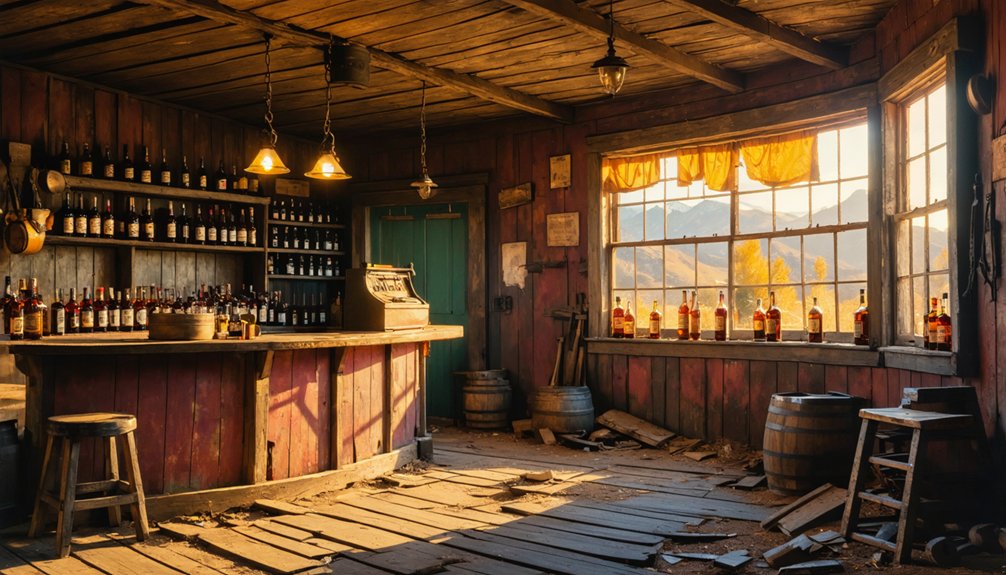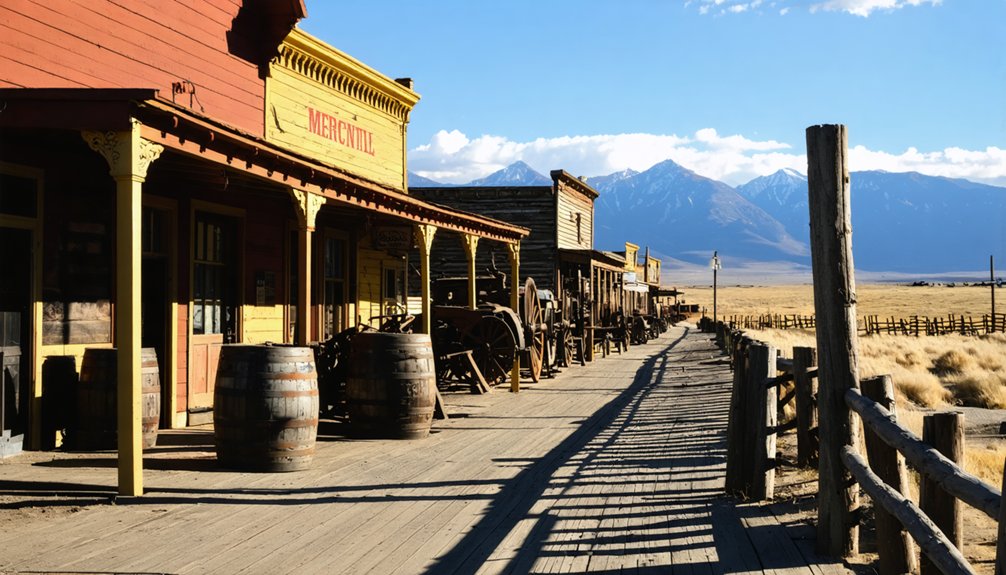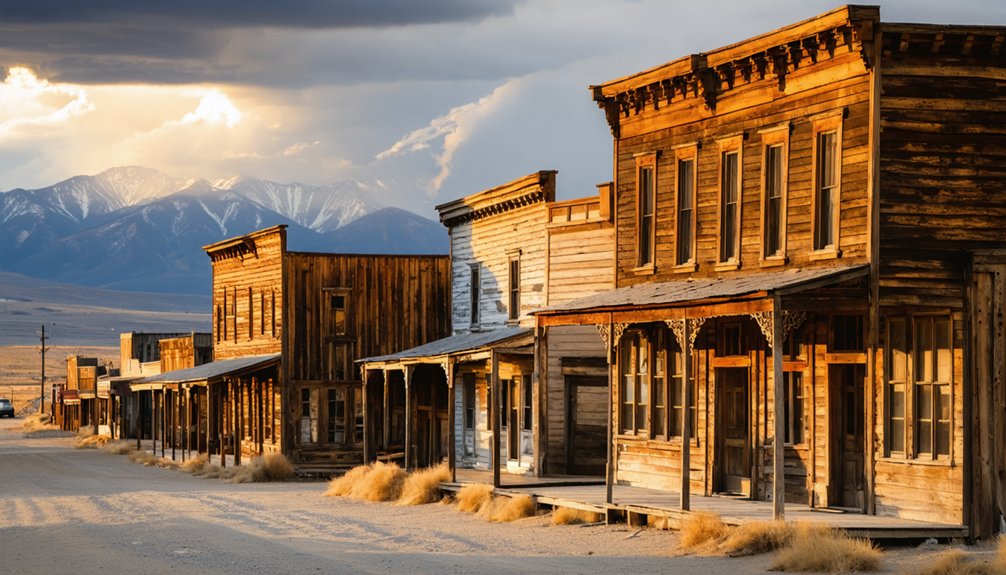
California’s ghost towns offer production-ready Western sets with authentic 1880s infrastructure. You’ll find Pioneertown’s 32,000-acre desert landscape with period buildings, Paramount Ranch’s 2,700-acre backlot featuring complete Western Town facades, and Calico’s restored silver mining structures three miles north of Interstate 15. Bodie preserves 110 original buildings through “arrested decay” at 8,379 feet elevation, while Silver City showcases relocated historic structures with weathered authenticity. Columbia, Jamestown, and Sonora maintain gold rush-era storefronts and brick buildings—each location provides distinct filming logistics, access considerations, and period-specific features worth exploring further.
Key Takeaways
- Pioneertown, established in 1946, features 1880s infrastructure and has hosted over 50 films and TV series on its Western set.
- Paramount Ranch’s 2,700-acre backlot includes Western Town facades used in over 130 films and HBO’s *Westworld*.
- Calico Ghost Town offers restored 1880s structures with mining tours, railroad operations, and campgrounds for extended film production stays.
- Bodie preserves 110 original buildings through “arrested decay,” maintaining authentic interiors at 8,379 feet elevation in Sierra Nevada.
- Silver City features 20+ relocated historic structures with weathered authenticity, original artifacts, and period-appropriate interiors for filming.
Pioneertown: Roy Rogers’ Western Movie Set Turned Desert Destination
Over 50 films and multiple TV series like *The Cisco Kid* utilized this smog-free production zone, with cast arriving via the dirt runway at Roy Rogers Airport.
Though financial troubles led to an $80,400 auction in 1954, Pioneertown survived as an Authentic Western Experience.
It attracted 500 residents and maintained its 1880s infrastructure for modern productions.
The town’s rocky desert landscape and abundant Joshua trees provided ideal backdrops for Western filming, drawing producer Philip N. Krasne to establish a permanent sound stage on Mane Street for interior scenes.
Original investors included Gene Autry, Roy Rogers, and the Sons of the Pioneers, who helped establish the 32,000-acre filming location in 1946.
Paramount Ranch: Agoura Hills’ Free Filming Location and Hiking Haven
Paramount Pictures transformed 2,700 acres of Agoura Hills terrain into a production powerhouse in 1927. They created a versatile backlot that would host over 130 films before the studio sold the property in 1943.
From 1927 to 1943, Paramount’s 2,700-acre Agoura Hills backlot served as the filming location for over 130 major motion pictures.
William Hertz expanded the filming infrastructure in 1953, constructing Western Town facades that attracted television productions.
You’ll find diverse wildlife habitats across landscapes that doubled for Africa and Europe in productions like *The Island of Lost Souls* and *Sullivan’s Travels*.
The National Park Service acquired the ranch in 1980, integrating it into Santa Monica Mountains National Recreation Area. The ranch operated under a public access arrangement, welcoming visitors to explore the historic sets whenever filming wasn’t taking place. The Western town’s main street features authentic period buildings including a saloon, jail, train station, and the iconic church constructed for HBO’s *Westworld*.
Despite the devastating 2018 Woolsey Fire, you can access this National Register site at 2903 Cornell Road for free hiking and explore where *Dr. Quinn, Medicine Woman* and HBO’s *Westworld* filmed their iconic scenes.
Calico Ghost Town: California’s Restored Silver Rush Landmark
When prospectors struck silver on April 6, 1881, in the mountains near present-day Yermo, they launched Calico into a twelve-year boom that would produce over $20 million in ore from 500 active mines.
You’ll find that Walter Knott’s 1951 purchase transformed this abandoned settlement into California’s premier example of historical preservation, with restoration expert Paul von Klieben rebuilding structures using 1880s photographs as reference.
For film location considerations, you’re working with authentic wood construction and weathered architecture across restored buildings like Lil’s Saloon and the Lane House.
The site is located three miles north of Interstate 15, positioned between Barstow and Yermo for convenient access to production crews and visitors alike.
The park operates 9 AM to 5 PM daily at 36600 Ghost Town Road, offering production-friendly infrastructure including mine tours and narrow-gauge railroad operations. Governor Schwarzenegger officially designated the site as California’s Silver Rush Ghost Town in 2005, cementing its status as a state landmark.
Since becoming a county regional park in 1966, it’s maintained period-accurate aesthetics while providing modern accessibility.
Bodie Ghost Town: Preserved Mining Camp in the Eastern Sierras
You’ll find Bodie’s authentic 1880s boomtown atmosphere frozen in time through its “arrested decay” preservation method, where 110 original buildings stand with their contents intact since mining operations ceased in 1942.
The ghost town reached its peak population during the gold rush era, supporting 2,000 structures including operational saloons, hotels, and a bustling Chinatown before fires in 1892 and 1932 reduced it to less than 10% of its original footprint.
This preservation approach maintains structural stability without alterations, giving your production crews access to genuine period interiors complete with original furniture, equipment, and goods left behind during abandonment. Located at 8,379 feet elevation in the Sierra Nevada Mountains, the site sits 7 miles south of Bridgeport, California. Notable structures include the Methodist Church built in 1882, the Miners Union Hall from 1878, and the IOOF building constructed between 1879-1880.
Peak Population and History
Following a major gold discovery in 1875 and the Standard Company’s profitable vein strike in 1876, Bodie exploded from an isolated mining camp into one of California’s most significant boomtowns.
During the gold rush peak between 1878 and 1881, you’d have found yourself among 7,000 to 10,000 residents in a town sprawling across 2,000 buildings.
The mining district operated 30 mines producing $3 million annually, supported by 65 saloons and over 400 businesses serving the workforce.
The population decline hit hard after 1881.
By 1890, only 779 residents remained—an 85.6% drop.
The 1920 census recorded just 120 people.
Following a devastating 1932 fire, the town emptied completely by 1950, leaving behind authentic structures that now attract film productions seeking genuine Western authenticity.
The boom period’s thriving community supported cultural activities including concerts, plays, dress balls, and 4th of July parades before the economic collapse of the early 1880s.
Today, the place name appears in various historical references and guides, serving as a significant example of California’s mining heritage and ghost town preservation efforts.
Arrested Decay Preservation
Since the California Department of Parks and Recreation acquired Bodie in 1962, the site has operated under a preservation philosophy called “arrested decay”—a methodology that maintains the town’s 110 surviving structures exactly as residents left them.
Unlike urban renewal projects that modernize historical sites, you’ll find original furniture, mattresses, jars, and cans positioned precisely where abandonment froze them in time.
Repairs prevent further deterioration without improvements or alterations.
Year-round rangers and Bodie Foundation crews handle stabilization work, though challenging access and high costs complicate maintenance logistics.
This authentic approach attracts 200,000 annual visitors for modern tourism, with accessible buildings like the Miner’s Union Hall museum offering production-ready period authenticity.
State law prohibits artifact removal, ensuring every china shard and square nail remains undisturbed.
Silver City: a Composite Museum Town With Haunted Legends
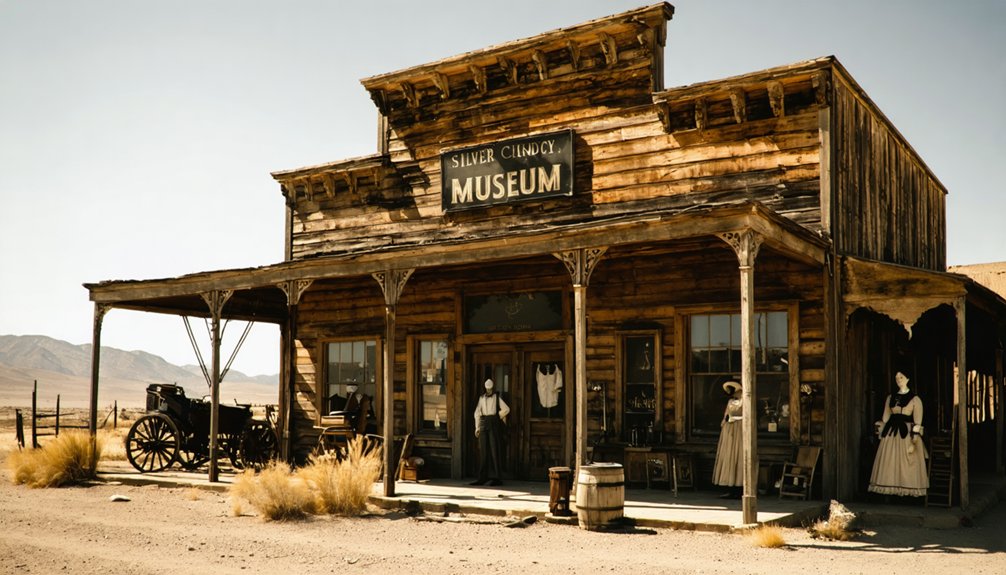
Unlike Bodie’s in-situ preservation, Silver City presents you with over 20 relocated 1850s structures—rescued from flooding and demolition across seven mining camp sites—that the Corlew family maintained in arrested decay after purchasing the collection in 1988-1990.
You’ll find production-ready elements including the original Isabella jail where gunslinger Newt Walker was imprisoned, the hand-hewn Apalatea House (the valley’s oldest structure), and Wells Fargo offices filled with authentic mining artifacts and period mannequins.
The site’s listing in the National Directory of Haunted Places adds atmospheric value, with reported paranormal activity centered in the town jail that could enhance genre-specific shoots.
Rescued Historic Building Collection
When location scouts need authentic 1850s-era structures without the liability of unstable ruins, Silver City Ghost Town in Bodfish delivers over 20 rescued buildings from Kern River Valley’s genuine mining camps.
You’ll find hand-hewn lumber buildings with square nails salvaged from abandoned settlements like Keyesville, Whiskey Flat, and Claraville before demolition crews arrived.
The Corlew family’s preservation techniques maintain “arrested decay”—structures stabilized enough for filming but retaining weathered authenticity that production designers can’t fake.
You’re working with actual Wells Fargo offices, mining camps, and that notorious Isabella jail where urban legends claim gunslinger spirits still linger.
Since reopening in 1992, the site’s been logged in the National Directory of Haunted Places, adding atmospheric value for horror productions seeking genuine locations with documented paranormal backstories rather than manufactured Hollywood sets.
Museum Artifacts and Displays
Silver City operates as a composite museum where thousands of mining-era artifacts occupy over 20 authenticated structures rescued from Kern Valley settlements.
You’ll find stamp mill components, water pipes, and an ore cart from Keyes Mine positioned throughout the outdoor museum complex.
The artifact preservation method employs arrested decay—items remain weathered and unpolished, capturing genuine mining camp atmosphere for film production authenticity.
Walk through miners’ cabins displaying lanterns and mine bell code charts, explore jail cells with original Isabella town shackles, and examine the weathered piano inside the rustic church.
The general store showcases period details like an old violin.
Over 20,000 restoration hours have stabilized these buildings from Keyesville, Whiskey Flat, Claraville, and Miracle into accessible filming locations with functional boardwalks connecting dust-covered displays.
Reported Paranormal Activity
Beyond the tangible artifacts and weathered structures, film crews working overnight shoots at Silver City encounter phenomena that challenge rational explanation.
The relocated Isabella jail, housing gunslinger Newt Walker’s cell from 1905, generates consistent reports of spiritual phenomena—buckets and bottles launching across rooms mid-take, violin strings plucking without contact.
These haunted structures earned Silver City a National Directory of Haunted Places listing, raising practical production considerations you’ll need to address.
Current owner testimonies document airborne objects and apparitions photographed as orbs by location scouts.
The prevailing theory suggests spirits transferred with the buildings themselves during relocation from flooded Kern Valley sites.
Whether you’re skeptical or intrigued, the persistent reports from multiple caretakers since the 1992 reopening add atmospheric authenticity that enhances horror and western productions.
Columbia, Jamestown, and Sonora: Living Ghost Towns of Gold Country
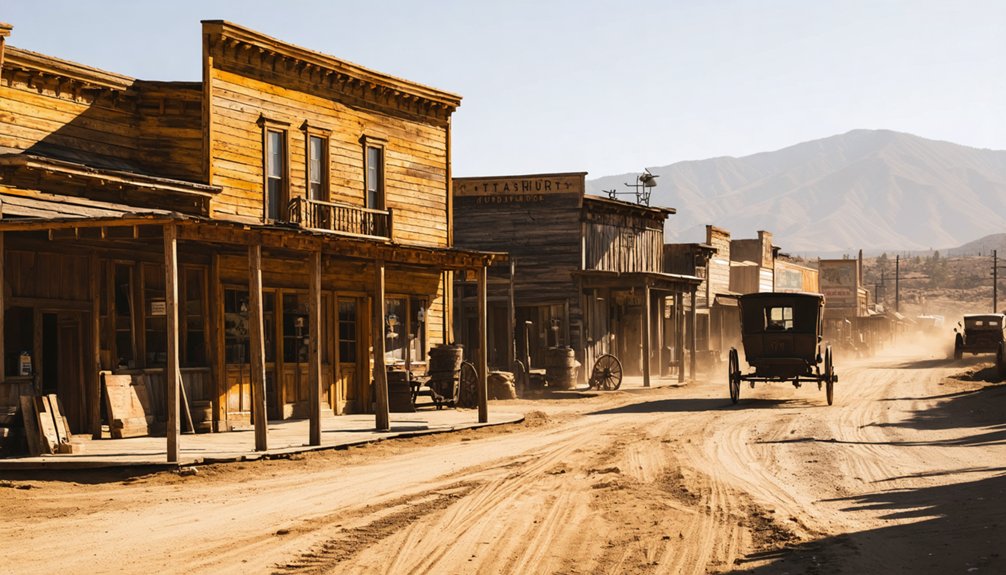
Along Highway 49’s winding route through the Sierra Nevada foothills, three Gold Country settlements—Columbia, Jamestown, and Sonora—offer filmmakers remarkably preserved 1850s architecture without the abandonment typical of true ghost towns.
Columbia maintains 40 brick and 10 wooden structures from its gold rush peak, when 4,000-5,000 miners extracted $67 million in gold between 1850-1870. Historic preservation efforts transformed deteriorating buildings into California’s largest collection of period-accurate storefronts and saloons.
Columbia’s 50 preserved Gold Rush structures represent California’s finest collection of period-accurate 1850s-1870s storefronts, worth $67 million in extracted gold.
Jamestown’s operational Methodist Church dates to 1861, while its main street hosted Back to the Future Part III production crews.
You’ll find stagecoach rides in Columbia and authentic wooden sidewalks throughout both towns—practical amenities that double as production value. These living communities maintain their 19th-century character while welcoming film permits, offering controlled access to Gold Country authenticity.
Planning Your Visit to California’s Historic Movie Filming Sites
Planning your visit to California’s ghost town filming locations requires understanding each site’s distinct accessibility and infrastructure. Paramount Ranch offers free exploration with hiking trails accessible via wooden bridge.
In addition to Paramount Ranch, visitors can explore other ghost towns submerged in California, each revealing unique stories of the past. The remnants of these towns provide fascinating insights into the state’s history and the impact of development on its landscapes. Be sure to check local guides for the best routes to access these hidden treasures.
While Pioneertown’s restored 1880s structures now serve tourists with local cuisine and vintage clothing shops.
Calico provides extensive amenities for extended stays.
Consider these practical factors:
- Parking availability – Paramount Ranch features large dirt lots; Calico offers 259 campground sites
- Filming schedules – Paramount remains open during active productions
- Seasonal events – Calico hosts Ghost Haunts, bluegrass festivals, and Civil War re-enactments
- Walking conditions – Expect dirt streets and desert terrain requiring sturdy footwear
- Accommodation options – Calico’s bunkhouses sleep 6-20 people for overnight production needs
Each location supports different production scales and crew requirements.
Frequently Asked Questions
Can You Still Film Personal Projects at These Ghost Town Locations?
You can film personal projects at most locations, but you’ll need permits respecting historical preservation guidelines. Check each site’s regulations beforehand, as local community impact concerns and production insurance requirements vary considerably between state parks and county facilities.
Which Ghost Towns Allow Overnight Camping or Accommodation on Site?
Looking for overnight freedom at filming sites? Unfortunately, none of these ghost towns officially permit camping due to historical preservation requirements. You’ll need local community engagement to arrange nearby accommodations while scouting your production locations during daylight hours.
Are the Movie Sets Wheelchair Accessible for Visitors With Mobility Issues?
Accessibility enhancements vary notably across sites. You’ll find mobility accommodations like specialized wheelchairs at Bodie, but Calico and fire-damaged Paramount Ranch present substantial barriers. Corriganville lacks detailed accessibility information, so you should contact them directly before visiting.
Do Any Ghost Towns Offer Guided Tours With Information About Filming History?
You won’t find dedicated filming trivia tours at these locations—they prioritize historic preservation of mining heritage over Hollywood history. You’ll explore independently, discovering production sites through self-guided wandering along weathered boardwalks and abandoned structures where cameras once rolled.
What’s the Best Time of Year to Avoid Crowds at These Locations?
Visit mid-January through February on weekday mornings before 10 AM to dodge seasonal crowds and peak visiting times. You’ll find empty film sets, uncrowded trails, and solitary exploration opportunities when tour buses and weekend photographers stay home.
References
- https://www.timeout.com/los-angeles/travel/ghost-towns-near-los-angeles
- https://californiathroughmylens.com/paramount-ranch-old-movie-town/
- https://en.wikipedia.org/wiki/List_of_films_and_television_shows_shot_in_Northern_California
- https://www.mammothmountain.com/about/film-locations
- https://www.youtube.com/watch?v=VR-t5w9wSeU
- https://parks.sbcounty.gov/park/calico-ghost-town-regional-park/
- https://www.inthemoodmagazine.com/issue-5/marin-sonoma-counties-horror-cinema
- https://www.youtube.com/watch?v=tZmA_VF6cm8
- https://www.moviesites.org/pioneertown.htm
- https://www.pioneertown-motel.com/pioneertown-history