You’ll find Arkansas’s most atmospheric filming locations in its abandoned spaces rather than true ghost towns. The McCartney Hotel in Texarkana—closed since the early 1970s—served as both hotel and theater in *The Town That Dreaded Sundown*, its marble lobbies and gold trim creating authentic decay on screen. The former Arkansas National Guard Armory at 601 Locust Street transformed from military facility to film backdrop, while 1940s-era Fort Chaffee buildings provided period-accurate settings for *A Soldier’s Story*, proving these forgotten structures offer filmmakers genuine abandonment without reconstruction.
Key Takeaways
- McCartney Hotel in Texarkana served as a filming location for “The Town That Dreaded Sundown” after closing in the early 1970s.
- The abandoned McCartney Hotel is now referenced as a haunted site and remains unused since its closure.
- Arkansas National Guard Armory at 601 Locust Street was transformed into a film set for “The Town That Dreaded Sundown.”
- Fort Chaffee’s 1940s-era military buildings have been repurposed as filming locations, including for “A Soldier’s Story.”
- I-30 Speedway became defunct after sale to Copart, Inc., ending its use as an active racing venue.
The Abandoned McCartney Hotel in Town That Dreaded Sundown
Rising ten stories above downtown Texarkana, the McCartney Hotel stood as the city’s tallest building when it opened in 1929. It was named after prominent citizen W.A. McCartney, Sr.
The hotel architecture featured opulent details—gold and silver trim, marble wainscoting, a curved marble staircase, and a rooftop garden beneath a skylight. The prestigious hotel hosted visitors arriving by train and many soldiers during wartime.
Listed on the National Register of Historic Places, it served railroad travelers until closing in the early 1970s. By 1976, the vacant McCartney Hotel was transformed into a filming location for “The Town That Dreaded Sundown,” disguised as both an active hotel and movie theater for scenes that were shot but ultimately cut from the final film.
Texarkana’s Forgotten Memorial Gardens Cemetery Location
Established in 1952 by East Funeral Home, Memorial Gardens Cemetery sits approximately one mile northeast of central Texarkana in Miller County, Arkansas.
You’ll find over 7,000 interments here, though only 20% of headstones appear in documented listings. This gap presents urgent historical preservation challenges as burial records fade into obscurity.
The cemetery’s connection to East Funeral Home—founded in 1899 by Elias C. East—links it to Texarkana’s pioneer heritage. East originally operated from 214 Vine Street on the Arkansas side before the business evolved through multiple ownerships and locations.
Without proper cemetery restoration efforts, you’re looking at thousands of unmarked graves losing their stories forever.
Military veterans like Carl Lester Sutton (1895-1966) rest here alongside families who built this bi-state region. Early settlers such as Eli Harrison Moores, who died March 10, 1885, helped establish Texarkana’s west side development through extensive land donations for churches and civic growth.
The northeast quadrant location made it accessible for South Central USA communities seeking burial grounds beyond crowded historic sites like State Line and Ringwood cemeteries.
Former Arkansas National Guard Armory Transformed for Film
While Memorial Gardens Cemetery provided exterior atmosphere for *The Town That Dreaded Sundown*, the former Arkansas National Guard armory at 601 Locust Street delivered the indoor spectacle director Charles B. Pierce needed for his prom sequence. This military structure’s transformation into a film set exemplifies urban redevelopment without historical preservation considerations.
The armory’s cinematic journey reveals:
- You’ll find teenagers dancing moments before fictional terror strikes—a stark contrast to its military origins.
- Pierce himself appears as patrolman A.C. Benson within these same walls.
- The building now stores restaurant equipment, its Hollywood moment forgotten.
- You can still locate it via street view, unlike demolished contemporaries from 2002-2004.
The warehouse stands today, bearing witness to Texarkana’s dual-state legacy where military functionality yielded to commercial pragmatism. Pierce’s low-budget horror film *The Legend of Boggy Creek* earned around $25 million, demonstrating his ability to transform Arkansas locations into profitable cinema before tackling *The Town That Dreaded Sundown*. Fort Chaffee’s 1940s-era structures similarly attracted filmmakers seeking authentic military backdrops, hosting productions from *A Soldier’s Story* to *Biloxi Blues*.
Garry’s Sling Blade Drive-In: A Benton Relic
How does a modest dairy bar at 619 Cox Street in Benton transform into pilgrimage territory for cinema devotees? When Billy Bob Thornton filmed Sling Blade here in 1995, Garry’s Drive-In (formerly Gary’s Whopper Burger) became an iconic location.
You’ll recognize Karl’s “french fried potaters” scene with John Ritter immediately upon entering.
The checkboard flooring, bar seating, and booths remain unchanged. Photos of the actors are taped to the window of the central booth where the scene was filmed. Movie posters and an authentic sling blade decorate the walls. You’re free to explore the local menu: ¼ to ½-pound burgers, fried catfish, patty melts, and those famous sidewinders. Don’t skip the thick-cut, beer-battered onion rings that have become a customer favorite.
Operating Monday-Saturday 11 a.m.-8 p.m. (Sunday until 7 p.m.), you’ll reach them at (501) 776-8484. The Benton Chamber provides a complete driving tour of every filming location across Saline County.
Mississippi River Island Near Eudora in Mud
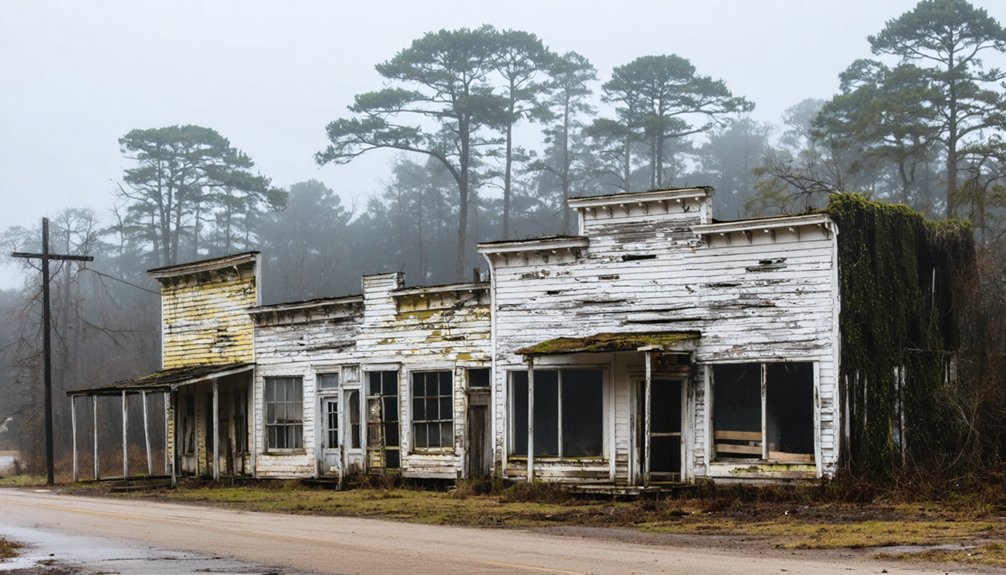
You’ll find the island setting for *Mud* (2012) three miles west of Eudora via AR 38, where a real Mississippi River island served as the remote hideout for Matthew McConaughey’s fugitive character.
The island’s abandoned boat lodged in a tree became the film’s central visual element—discovered by young Ellis and Neckbone in scenes that captured the raw, unpolished beauty of southeast Arkansas’s river landscape. The film explores themes of loyalty and love alongside the complexities that define adult relationships.
Director Jeff Nichols filmed here from September to November 2011, with cast and crew camping directly on the island to achieve authentic depictions of river rat culture against the Mississippi’s powerful currents. The production employed over 100 crew members and 400 extras, making it the largest film production in Arkansas history.
Remote Island Film Setting
Director Jeff Nichols preserved the island’s authentic river ecology by minimizing Hollywood intervention.
Cast members camped directly on location, eliminating makeup trailers and embracing natural environmental exposure. The production’s island preservation approach captured unfiltered soundscapes—cicadas, crickets, birds, and rustling willows—creating raw visual authenticity.
You’ll notice four distinctive elements that defined this remote production:
- Over 400 local extras navigated Mississippi River waterways to reach set
- Natural sweating replaced controlled studio lighting
- Abandoned boat discovery drove the fugitive narrative
- Southeastern Arkansas locations from Dumas to Stuttgart expanded the regional framework
Natural Arkansas River Landscape
Where the Mississippi River carves through southeastern Arkansas near Eudora, a distinctive island landscape emerges from the Delta’s flat alluvial plain.
River erosion constantly reshapes this terrain, creating oxbow lakes and cutoffs that form isolated landmasses rising from muddy floodwaters.
You’ll find natural levees built from centuries of sediment deposits, with the river surface sometimes elevated above surrounding flatlands.
The Delta wetlands stretch for miles, featuring remnant channels like Grand Lake just four miles southeast.
These islands sit 135 feet above sea level on ridges that tower 25 feet over the floodplain—high enough to escape the worst deluges.
Rich black alluvial soil, eroded from distant Appalachian and Rocky Mountain ranges, blankets everything in this remote filming location where water defines the landscape.
Boat Discovery Scene Location
Against this water-sculpted backdrop, a specific Mississippi River island near Eudora became the stage for one of *Mud*’s most memorable sequences. You’ll find this uninhabited refuge three miles west of Eudora via AR 38, where Ellis and Neckbone discovered their tree-bound vessel.
The production embraced raw authenticity—cast camping on-site, minimal makeup, local wildlife sounds saturating takes.
This pivotal discovery scene demanded:
- Positioning an entire boat atop a tree to symbolize Mud’s escape route
- Capturing cicadas, crickets, and bird calls for unfiltered Delta atmosphere
- Filming actors in genuine sweat and grime without Hollywood polish
- Preserving the fugitive’s boat maintenance plan as plot foundation
Director Jeff Nichols transformed this remote island into Mud’s hideout, where Matthew McConaughey’s character negotiated food for future ownership—a sanctuary beyond civilization’s reach.
Old Mill: North Little Rock’s 1930s Replica Setting
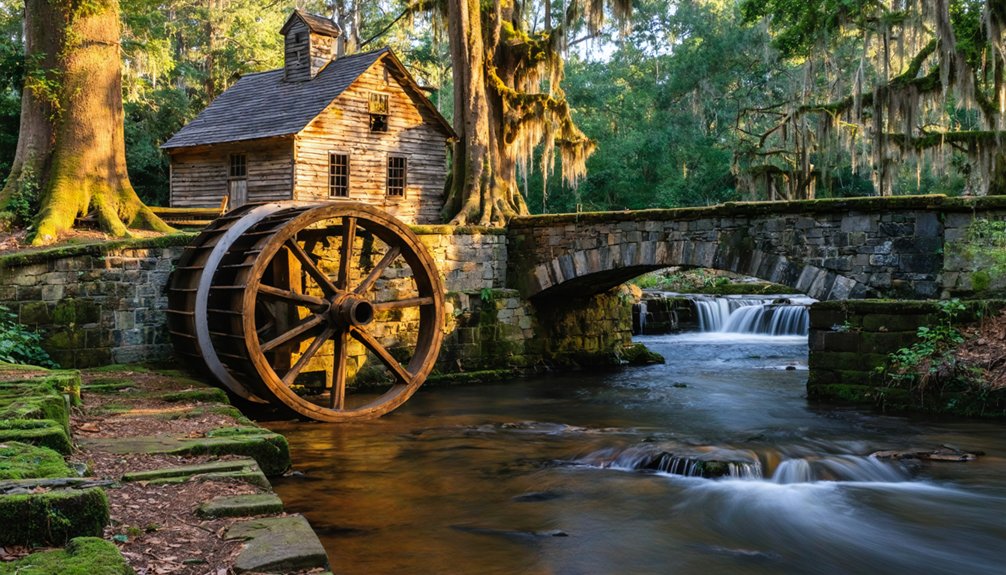
Nestled within T.R. Pugh Memorial Park, you’ll find the Old Mill—a deliberate 1930s construction masquerading as an abandoned nineteenth-century gristmill. Built between 1931-1933 by developer Justin Matthews and sculptor Dionicio Rodriguez, this windowless stone structure deceived Hollywood enough to open Gone with the Wind’s 1939 credits.
Its authenticity stems from genuine artifacts: 1828 Cagle family millstones, 1840s picking-dated seats, and Tom Knoble plantation cornerstones. Rodriguez’s five-ton water wheel and faux bois concrete bridges create convincing rustic heritage despite the site’s Depression-era origins.
Listed on the National Register since 1986, it represents historic preservation through theatrical reconstruction rather than actual ruins. You’re exploring what’s believed to be the film’s last surviving structure—though it predated Sherman’s march by a century.
Piggott’s Matilda and Karl Pfeiffer Museum Estate
You’ll find the Matilda and Karl Pfeiffer Museum Estate eleven acres north of the original Pfeiffer homestead in Piggott.
This location features a five-thousand-square-foot Tudor Revival residence that served as a filming location for 1956’s “A Face in the Crowd” starring Andy Griffith.
The production crew transformed the property’s pool area into key scenes. The pool itself was later converted into a pond following Karl’s death in 1981.
Since opening as a public museum in 2004, you can tour the dark red brick estate with its steep gables and slate roof.
While exploring, you can also visit collections of Native American artifacts, minerals, and botanical gardens across the grounds.
Transformed for Film Production
When Elia Kazan and his production crew arrived in Piggott during August 1956 to film *A Face in the Crowd*, they transformed the Tudor Revival mansion of Matilda and Karl Pfeiffer into the opulent estate of Lonesome Rhodes, the film’s protagonist. The production company installed a swimming pool specifically for estate scenes, enhancing the portrayal of Rhodes’ newfound wealth and power.
Community involvement extended beyond the mansion, with residents serving as extras throughout Piggott’s transformed locations.
Key production transformations included:
- The high school football field hosting drum majorette sequences with local marching bands
- Clay County Courthouse and old jail converted into authentic small-town Arkansas settings
- Radio station KDRS in Paragould sketched and recreated in New York studios
- Historical preservation of the Pfeiffer family’s connection to Ernest Hemingway attracting Kazan’s attention
Museum Open to Visitors
Following the 1956 film production, the Tudor Revival mansion shifted into the Matilda and Karl Pfeiffer Museum and Study Center. Visitors can now explore the same opulent interiors that portrayed Lonesome Rhodes’ estate on screen.
You’ll find the historic architecture preserved in its 1933 form, reflecting the Pfeiffer family’s prominence in Clay County.
Inside, Matilda’s personal mineral collection dominates—over 1,400 specimens from worldwide sources that she gathered throughout her lifetime.
The museum operates alongside Piggott’s other Pfeiffer properties, including the Hemingway-Pfeiffer Museum and restored Cotton Belt depot.
You can access this educational site independently, walking through rooms where Hollywood cameras once rolled while examining geological displays that reveal one woman’s scientific passion.
The estate remains open for self-guided exploration.
I-30 Speedway: Alexander’s Defunct Racing Track
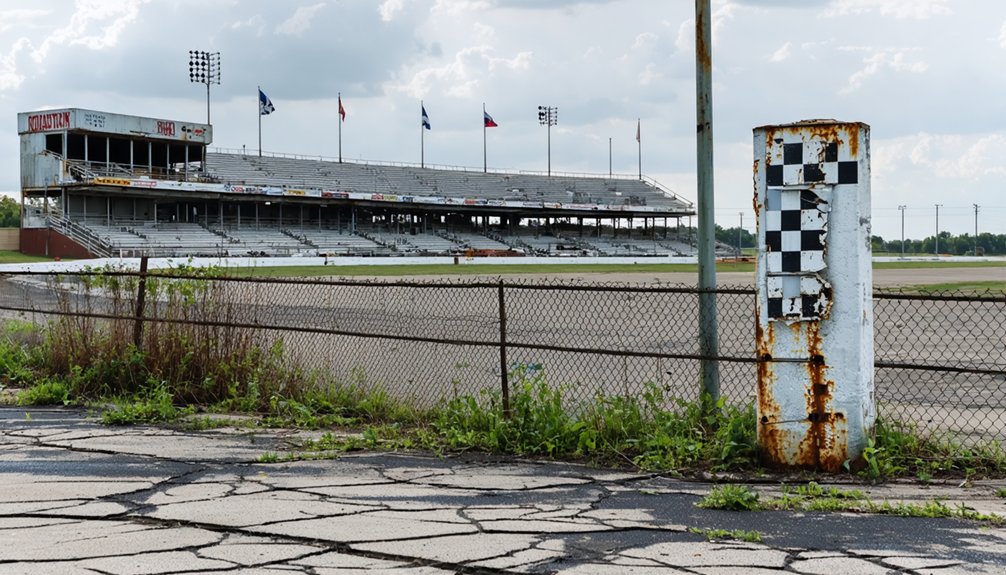
The final race on October 1, 2022, drew competitors nationwide:
- 60 drivers traveled from 14 states and Ontario.
- $15,041 prize pool competed for during 35th Annual COMP Cams Short Track Nationals.
- Pandemic economic troubles forced the sale to Copart, Inc.
- Free admission welcomed children under 12 to preliminary events.
Arkansas Department of Correction Prison Near Grady
Located five miles southeast of Grady in Lincoln County, the Arkansas Department of Correction’s maximum-security prison sprawls across 16,600 acres of former plantation land. You’ll find America’s largest working prison farm occupying what was once Cummins and Maple Grove plantations, purchased in 1902 for $140,000.
The prison history reveals a disturbing evolution from the convict-lease system. Established in 1897, it initially housed Black convicts before expanding to all adult prisoners by the 1930s.
Inmate labor cultivates crops and raises livestock across these fields, continuing traditions from its plantation origins.
Federal courts declared conditions unconstitutionally cruel in the 1970s, citing electrical torture devices and trusty-guard brutality. Despite reforms ending whippings and racial segregation, this compound remains Arkansas’s primary death penalty facility—a stark reminder of institutional power over individual freedom.
Frequently Asked Questions
What Permits Are Required to Film at Abandoned Locations in Arkansas?
You’ll need permits from local jurisdictions and the Arkansas Film Commission for state property, meeting insurance requirements with proof of coverage. Legal restrictions vary by location, so contact property owners and verify historical site protections before filming.
Are Any of These Ghost Town Filming Locations Currently Accessible to Visitors?
You’ll find most Arkansas ghost town filming locations wildly overgrown and crumbling, accessible through public roads but lacking infrastructure. Haunted legends attract adventurous visitors, though preservation efforts remain minimal. Always verify current land ownership and trespassing laws before exploring these decaying cinematic landmarks independently.
How Do Filmmakers Ensure Safety When Shooting at Abandoned Arkansas Sites?
You’ll need thorough hazard assessments before filming begins, identifying structural weaknesses and environmental dangers. Safety protocols include PPE requirements, emergency evacuation routes, debris clearing, and on-site monitors who’ll ensure you’re protected throughout production.
What Tax Incentives Does Arkansas Offer for Filming at Historical Locations?
Arkansas offers you 25-30% base incentives plus 5% bonuses for productions in underserved counties where ghost towns exist. You’ll support historical preservation while capturing authentic backdrops, potentially boosting film tourism and opening up to 35% total incentives with stacked bonuses.
Which Abandoned Arkansas Locations Are Scheduled for Future Film Productions?
No abandoned Arkansas locations are currently scheduled for future film productions. However, you’ll find filmmakers increasingly targeting ghost towns for historical preservation projects and tourism development, creating opportunities where cinematic storytelling meets authentic architectural narratives and economic revitalization.
References
- https://www.youtube.com/watch?v=NXIiDSXsXz8
- https://www.springdalecdjr.com/blogs/7490/six-famous-film-locations-in-arkansas
- https://giggster.com/guide/movie-location/where-was-mud-filmed
- https://www.arkansasheritage.com/old-state-house-museum/exhibits/past-exhibits/lights!-camera!-arkansas!
- http://www.thennowmovielocations.com/2020/01/the-town-that-dreaded-sundown-1976.html
- https://www.arkansas.com/things-to-do/points-interest/filming-locations
- https://grahmsguide.com/town-that-dreaded-sundown-1976
- https://kkyr.com/the-town-that-dreaded-sundown-where-it-was-shot-texarkana/
- https://kkyr.com/eerie-glimpse-inside-texarkanas-abandoned-mccartney-hotel/
- https://www.myershousenc.com/onsetcinema