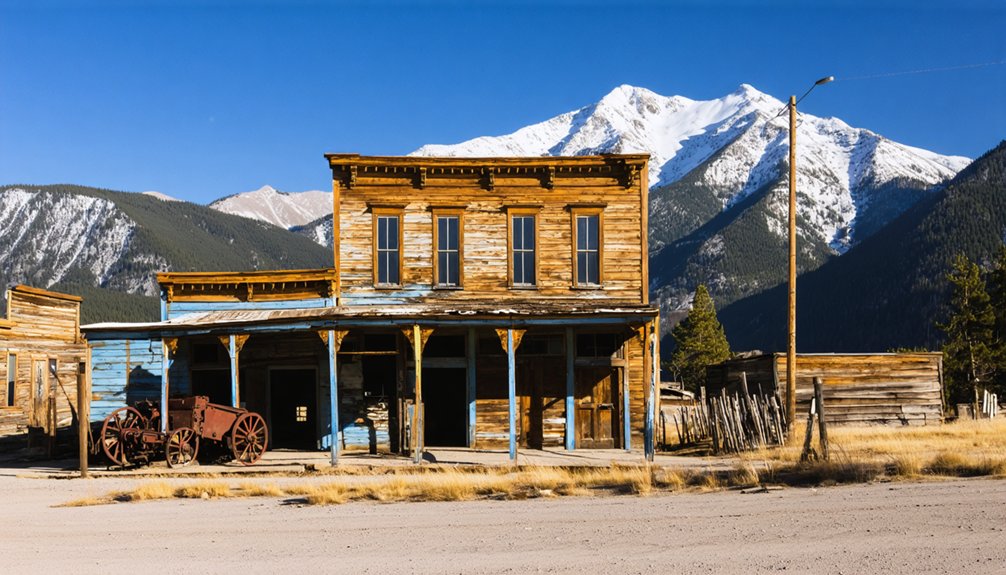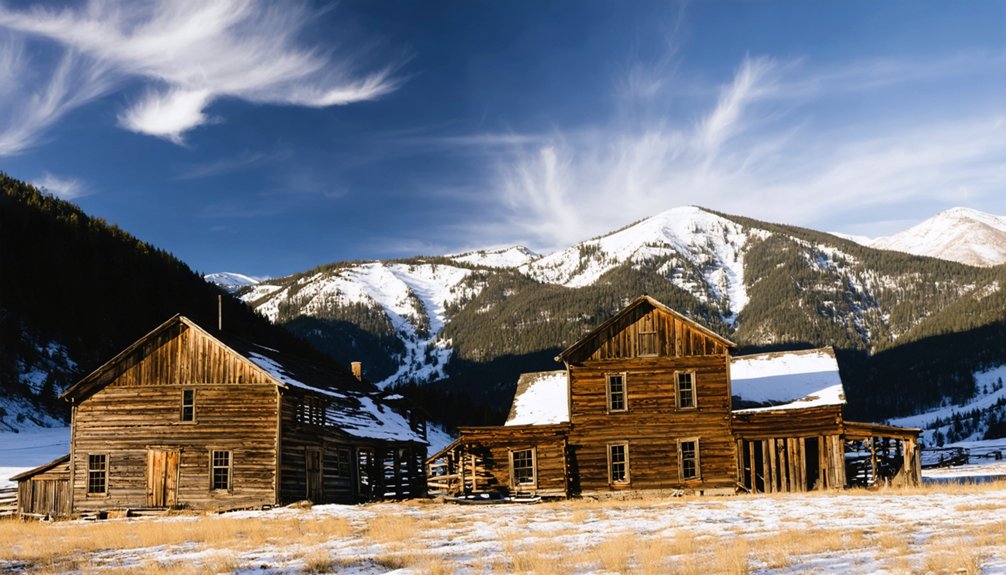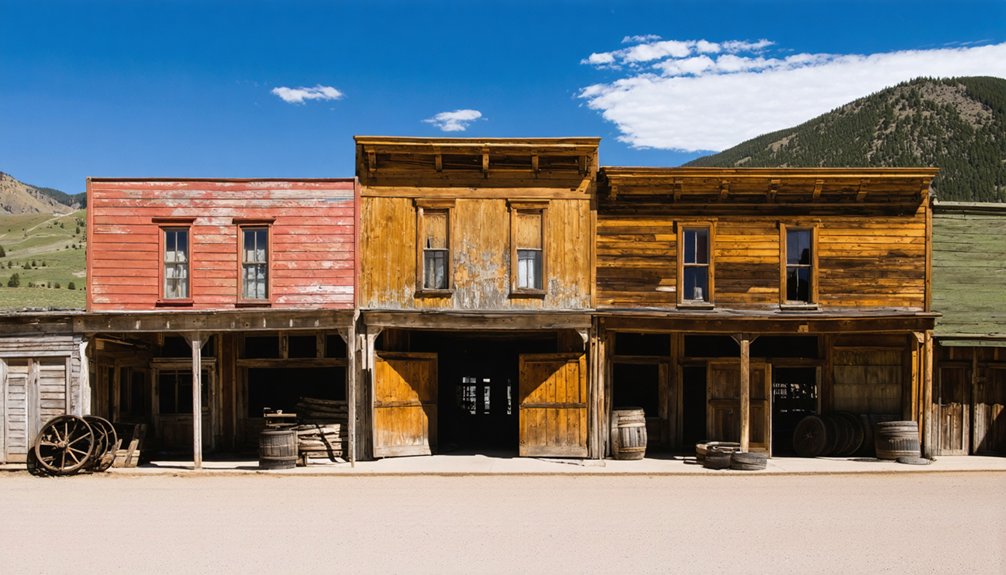
You’ll find Colorado’s most filmed ghost towns include Animas Forks at 11,200 feet—with its Duncan House and Gold Prince Mill ruins—and St. Elmo’s preserved 1880s storefronts near Buena Vista. South Park City’s 40 reconstructed buildings and the Durango & Silverton Railroad’s 45-mile narrow-gauge route through San Juan canyons have hosted countless Western productions. Remote sites like Carson, Vicksburg, and Gothic‘s 70 log structures require 4WD or ATV access but deliver unmatched authenticity. The guide below maps specific structures, elevation challenges, and seasonal access routes.
Key Takeaways
- South Park City offers over 40 historic buildings and 60,000 artifacts along authentic streets, perfect for immersive Western film scenes.
- Buckskin Joe features recreated pioneer structures including original stores, specifically designed and built as a Western film location.
- Animas Forks at 11,200 feet is Colorado’s most photographed ghost town with preserved structures like Duncan House and Gold Prince Mill.
- St. Elmo near Buena Vista maintains well-preserved 1880s storefronts and buildings, making it ideal for accessible period film settings.
- Durango & Silverton Railroad provides 45 miles of narrow gauge route through canyons, used for authentic Western train robbery scenes.
Historic Mining Towns That Became Western Film Sets
When Hollywood scouts search for authentic Western backdrops, Colorado’s abandoned mining towns deliver weathered wooden structures and mountain vistas that digital effects can’t replicate. You’ll find South Park City in Fairplay standing as a complete preserved mining settlement with 40+ historic buildings that’ve hosted numerous Wild West productions.
The curator’s claim about unmatched quality among Colorado ghost towns holds weight when you’re walking through operational 19th-century exhibits. Buckskin Joe offers different authenticity—Metro-Goldwyn-Mayer constructed this 1957 film set using actual pioneer structures, including Tabor’s original general store.
These mining relics provide directors with ready-made sets where film nostalgia meets genuine frontier architecture. Independence near Aspen serves as an archaeological preserve at 10,900 feet elevation, where remnants of stables and a general store provide atmospheric filming opportunities. Gilman’s rugged decay along Bachelor Loop Drive attracted Under Siege 2’s production team, proving railroad access and commanding mine ruins create ideal filming logistics. The Durango & Silverton Railroad featured prominently in Butch Cassidy and the Sundance Kid’s train scenes, showcasing how Colorado’s historic transportation infrastructure enhances Western authenticity.
Animas Forks: The Crown Jewel of Colorado Ghost Town Filming
Among Colorado’s filming locations, Animas Forks stands 11,200 feet high in the San Juan Mountains as the state’s most photographed ghost town.
Perched at 11,200 feet in the San Juans, Animas Forks reigns as Colorado’s most iconic and photographed ghost town destination.
You’ll reach this authentic 1870s mining camp via the 65-mile Alpine Loop—a rugged unpaved route demanding high-clearance 4WD vehicles and genuine backcountry skills.
The ghost town architecture remains remarkably intact: Duncan House’s distinctive two-story bay window, the 1882 jail, and Gold Prince Mill foundations create ready-made Western film sets.
Mining relics scattered throughout the alpine meadow require no Hollywood fabrication.
You can explore freely—the Bureau of Land Management maintains stabilized structures without restrictive regulations.
The town once supported 450 residents at its 1883 peak, complete with a local newspaper called the Animas Forks Pioneer.
A devastating 1891 fire destroyed the hotel and 14 buildings, prompting many residents to abandon the town permanently.
Access runs summer-only when snow clears, but that’s when film crews arrive.
From Silverton, it’s 12.3 miles on County Road 2.
Bring your own vehicle or rent locally; you’re driving into untamed territory.
St. Elmo’s Preserved Storefronts and Main Street Appeal
Unlike Animas Forks‘ extreme elevation and technical access requirements, St. Elmo sits at 10,000 feet with regular car access just 20 miles southwest of Buena Vista.
You’ll find America’s best-preserved ghost town along Chalk Creek, where wooden storefronts like the 1881 Cash Chris building and 1885 Pusher building line a dusty Main Street that resembles a movie set frozen in time.
The town’s arts preservation efforts have maintained historic structures including a functioning general store and hotel.
This tourism promotion strategy keeps St. Elmo accessible year-round, with video monitoring balancing security against remote-location freedom.
The 1979-designated National Register district features fire-scarred buildings and maintained roads that filmmakers can navigate without specialized vehicles, making it Colorado’s most production-ready ghost town location. Founded in 1880, St. Elmo experienced rapid growth as mining prospects attracted thousands of prospectors seeking gold and silver fortunes.
During summer months, the historic schoolhouse and original hotels open to visitors, providing authentic period architecture that enhances the town’s cinematic atmosphere.
South Park City: A Living Museum for Period Productions
While St. Elmo captures frontier decay, South Park City delivers production-ready authenticity through meticulous reconstruction.
You’ll find 43 furnished buildings relocated from actual South Park settlements, arranged along boardwalks that create convincing 1880s street scenes.
The museum’s 60,000 authentic artifacts aren’t roped off—they’re positioned exactly as miners used them, from blacksmith tools to saloon furnishings.
For filmmakers, this means immediate visual credibility without extensive set dressing.
You can shoot inside functioning structures: the brewery, doctor’s office, general store, and operational mine replica.
Everything’s accessible, documented, and historically verified since its 1959 opening.
The immersive recreations extend beyond facades—cabins contain period furniture you can touch, pianos you can play, environments that translate seamlessly to camera.
The narrow gauge train and transportation exhibits provide additional options for depicting frontier movement and commerce.
The church and schoolhouse add authentic community institutions essential to depicting complete frontier settlements on film.
It’s Colorado’s most thorough filming resource for Western period pieces.
The Durango & Silverton Railroad’s Role in Classic Westerns
You’ll find one of Hollywood’s most authentic Western settings along the 45-mile narrow gauge track connecting Durango to the ghost town of Silverton, where filmmakers have staged train robberies since 1925.
The railroad’s most famous sequence came during *Butch Cassidy and the Sundance Kid* (1969), when a dynamite explosion demolished an actual baggage car and scattered prop money across the tracks 10 miles east of the Durango depot—a scene commemorated by a plaque at the site.
The surviving 3-foot gauge track, winding through San Juan Mountain canyons with preserved coal-fired locomotives, delivers the period-correct aesthetic that drew nearly 30 films to this operational 1882 railroad. The route passes through Red Mountain Pass, notorious for its steep cliffs, narrow lanes, and hairpin curves that have provided dramatic backdrops for numerous Western films. Travelers filming at this location typically fly into Durango–La Plata County Airport, situated approximately 38 miles from the historic Durango station.
Historic Train Explosion Sequence
When Hollywood needed authentic narrow gauge locomotives for spectacular destruction, the Durango & Silverton Railroad delivered engines #319 and #345 to a collision site in July 1951. These aging 2-8-0 consolidation engines became expendable stars in Denver & Rio Grande’s climactic head-on crash sequence.
You’ll find no modern train safety protocols here—directors prioritized raw spectacle over preservation, orchestrating maximum visual carnage along Colorado’s narrow gauge corridors.
The production team selected these specific locomotives because their operational days had passed, making them prime candidates for destruction. Film crews positioned cameras strategically to capture explosion effects from multiple angles as steam, metal, and timber collided at speed.
This calculated sacrifice delivered the authentic Western action audiences craved while ironically generating revenue that helped preserve the very railroad infrastructure being destroyed on screen.
Narrow Gauge Cinematic Appeal
The Durango & Silverton Narrow Gauge Railroad’s 45-mile route through the San Juan Mountains delivers what directors can’t replicate on soundstages—coal-fired locomotives pulling vintage passenger cars along cliff-hugging tracks through Animas River Canyon‘s 3,000-foot granite walls.
Since 1880, you’ll find ghost town architecture at abandoned mining settlements like Rockwood and Needleton, providing authentic Western backdrops that propelled the line’s film role evolution from *Denver and Rio Grande* (1952) to *Butch Cassidy and the Sundance Kid* (1969).
The narrow gauge track itself became the star—authentic 19th-century engineering unchanged since miners rode these rails.
You can board at 479 Main Avenue’s depot, following the same route filmmakers have used across 30+ productions, experiencing the operational railroad that transforms period pieces into genuine time capsules.
Southeastern Colorado’s Stark Landscapes in Badlands
Terrence Malick’s 1973 debut *Badlands* transformed southeastern Colorado’s austere plains and forgotten settlements into stand-ins for South Dakota and Montana, establishing a visual language of American emptiness that influenced generations of filmmakers.
You’ll find Las Animas on Highway 50 doubling for Fort Dupree, where Kit collected trash in authentic alleyways. Holly’s house still stands at 505 Locust Avenue’s southwest corner.
Along County Road 24.5 near Swink, the Arkansas River provided their card-playing hideout. The crumbling Delhi Store on Route 350—35 miles southwest of La Junta—served as Kit’s fateful gas stop, its ruins the only structure remaining along the historic Santa Fe Trail corridor.
Desert landscapes and rock formations of the twin Spanish Peaks became Saskatchewan’s mountains, their dramatic silhouettes marking the fugitives’ westward flight through increasingly barren territory.
Gothic’s Research Station and 1879 Mining Camp Structures
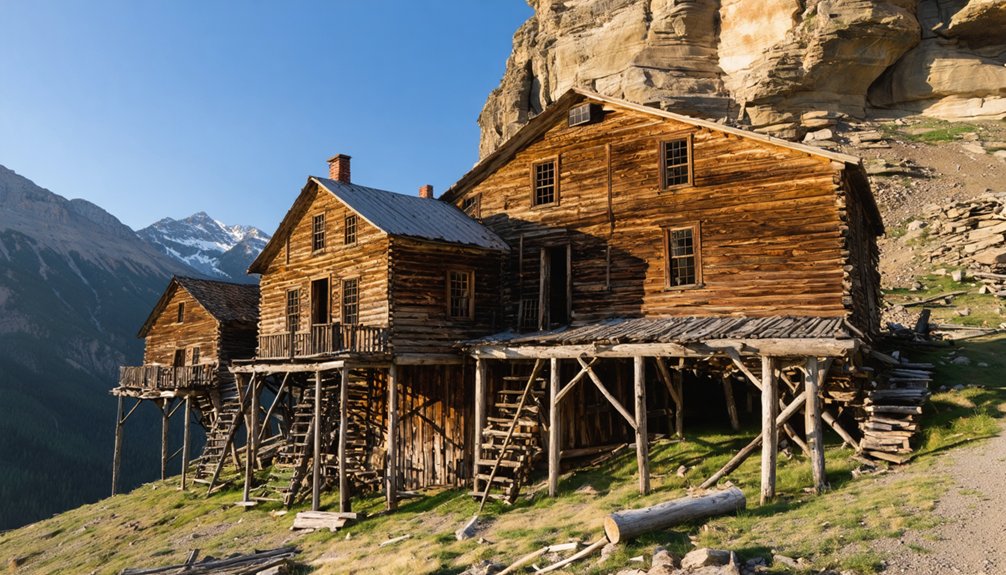
Perched at 9,500 feet in Gothic Valley, this 1879 silver mining settlement retains over 70 original log structures that now house the Rocky Mountain Biological Laboratory‘s research operations.
You’ll find 45,000 square feet of research station architecture spread across authentic mining-era buildings, where scientists conduct high-altitude ecological studies in structures dating to the late 1800s.
Historic building preservation efforts maintain the Gothic Town Hall as youth programming headquarters, while relocated log cabins accommodate visiting researchers during summer field seasons.
The Weldon and Rosalie Weekley Visitor’s Center operates from the former Johnson Laboratory building, offering free daily tours June through September.
This preserved ghost town provides unrestricted access to documented mining infrastructure while supporting one of the world’s most extensive collections of long-term environmental research in pristine wilderness conditions.
Mountain Locations That Heightened Film Tension and Drama
You’ll find Colorado’s ghost towns delivered natural cinematic tension through their San Juan Mountains settings, where narrow canyon walls and 12,000-foot peaks created physical claustrophobia that directors exploited for suspense.
Exploring the landscape reveals abandoned Colorado towns submerged in water, remnants of a bygone era that evoke a haunting beauty. These submerged sites, once bustling with life, now lie silent beneath the surface, offering a stark reminder of nature’s power and humanity’s fragility. As the waters rise and fall, the stories of these towns become even more captivating, drawing in adventurers and historians alike.
St. Elmo’s single-access route through a tight mountain corridor forced characters into unavoidable confrontations.
While Animas Forks’ remote alpine meadow location—reachable only by four-wheel drive—isolated actors in harsh, unpredictable weather conditions.
Near Glenwood Springs, Independence’s windswept ruins at extreme elevation provided directors with exposed, treacherous terrain that amplified action sequences through genuine environmental danger.
San Juan Mountains Claustrophobia
When filmmakers needed landscapes that could visually trap their characters, Colorado’s San Juan Mountains delivered narrow passes, encircling peaks, and weather extremes that transformed outdoor settings into pressure cookers of tension.
Three locations where geography became the antagonist:
1. Owl Creek Pass (True Grit, 1969) – Courthouse Mountain and Chimney Rock boxed in John Wayne’s final shootout at Deb’s Meadow, 13 miles from Highway 550.
Golden aspens replaced the book’s winter but maintained the suffocating confrontation.
2. Telluride wilderness (The Hateful Eight, 2015) – Fourteeners and -20°F blizzards trapped bounty hunters in mountain solitude.
Where canyon echoes amplified paranoia inside a Victorian-era cabin.
3. Engineer Mountain (Across the Wide Missouri, 1951) – Jagged peaks and Molas Lake’s alpine isolation confined 1830s fur trappers, intensifying cultural clashes through high-elevation entrapment.
Glenwood Springs Action Sequences
Unlike the narrow confines of the San Juan passes, Glenwood Canyon’s 12.5-mile corridor along I-70 offered filmmakers a rare combination: vertical red limestone walls soaring 1,300 feet above the Colorado River, parallel railroad tracks hugging the north bank, and accessible exit points like No Name (Exit 119) that could transform from scenic overlook to tactical escape route within a single camera setup.
You’ll find this geography drove stunt coordination in Mr. & Mrs.. Smith’s 2005 rock-climbing pursuit, where camera techniques captured Pitt and Jolie scaling sheer drops near Hanging Lake.
Vanishing Point exploited the same terrain for Kowalski’s roadblock evasion sequences.
Steven Seagal’s Under Siege 2 and the 1926 Tom Mix feature The Great K&A Train Robbery utilized railway alignments for hijacking scenes, proving Glenwood’s topography consistently amplified cinematic tension across eight decades.
Accessing Remote Ghost Town Film Locations by ATV
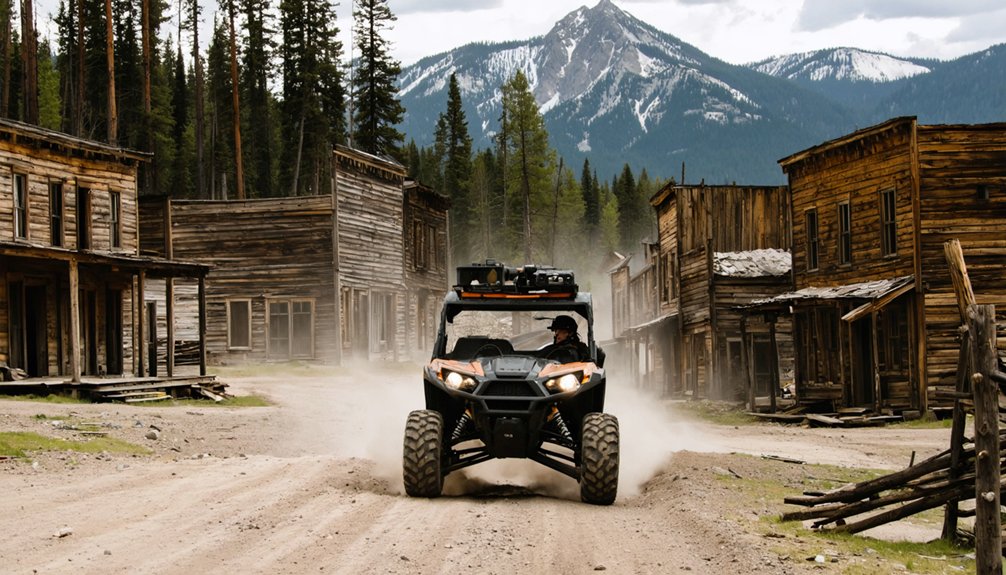
Colorado’s most photogenic ghost towns cling to elevations between 11,000 and 12,000 feet, where paved roads give way to rocky trails that demand ATVs or serious four-wheel-drive capability.
ATV adventures facilitate these filming backdrops:
- Animas Forks sits at 11,200 feet along the Alpine Loop, accessible via rented ATVs from Silverton. You’ll navigate to Duncan House’s distinctive bay window, where alpine meadows frame well-preserved structures.
- Carson crowns the Continental Divide at 12,000 feet, requiring Wager Gulch Road traversal. This remote exploration rewards you with undisturbed buildings and Continental views.
- Imogene Pass challenges experienced riders at Colorado’s second-highest pass, where Tomboy mine remnants emerge one mile from Smuggler. The 4/5 difficulty rating demands respect on these steep San Juan approaches.
Each location doubles as both historical site and cinematic landscape.
Vicksburg and Winfield’s Audio-Guided Mining Heritage Sites
You’ll find Vicksburg’s 1880s hand-hewn log structures standing 9 miles up County Road 390 from Highway 24.
Here, audio guide stations explain the forge, burro shed, and cabins used by hundreds of gold and silver miners.
The outdoor heritage trail connects you to original mining equipment and water ditches carved from Vicksburg Creek, with interpretive markers identifying each building’s specific function during the boom years.
Three miles beyond, on the same 2WD road, Winfield’s remnants offer additional audio-guided stops showcasing Clear Creek Canyon’s four interconnected ghost town locations.
Historic 1800s Mining Structures
Deep in Clear Creek Canyon, Vicksburg’s weathered mining structures stand as tangible records of Colorado’s 1867 gold rush origins. Seven cabins have survived a century of abandonment, their logs and timbers defying mountain winters at coordinates 38°59′55″N 106°22′34″W.
You’ll find authentic mining equipment scattered throughout the settlement, preserved exactly where miners left them.
The Chaffee County Historical Society‘s historic preservation efforts since 1971 maintain these structures as working museums:
- Shepherd Tavern displays 1880s miner artifacts and photographs from Vicksburg’s 600-resident peak
- Original cabins function as seasonal hunting camps, continuously occupied since construction
- Balm of Gilead trees planted by miners still line the street alongside hand-dug water ditches
You’ll reach this National Register site via 9 miles of graded County Road 390—accessible by standard passenger vehicles seeking unfiltered frontier history.
Outdoor Audio Guide Features
Beyond examining the structures themselves, modern visitors can uncover layers of frontier history through specialized outdoor audio guides at both Vicksburg and Winfield ghost towns. You’ll explore at your own pace, discovering how prospectors lined streets with poplars and hauled logs without power tools in these 1800s mining camps.
Mining preservation efforts shine through detailed narration about daily operations, stagecoach routes charging 50 cents, and burro-packed supplies reaching remote claims.
Heritage storytelling comes alive as you walk between Winfield’s four intact log structures, including the Ball Cabin museum displaying authentic photographs and miner artifacts.
The self-guided format lets you venture from schoolhouses to abandoned fish hatcheries, connecting natural features like water ditches with human perseverance.
Both National Register sites operate accessible tours year-round, transforming solitary structures into immersive experiences.
Clear Creek Canyon Access
Tucked between Leadville and Buena Vista along Highway 24, Clear Creek Canyon opens into a network of mining settlements you’ll reach via County Road 390—a 2WD-accessible route that climbs 9 miles to Vicksburg and continues another 3 miles to Winfield.
Your seasonal access window (spring through fall) reveals:
- Vicksburg’s 40 original structures from 1880, where continuously occupied cabins anchor a National Register site housing blacksmith shops, hotels, and saloons that once served 700 residents.
- Winfield’s preserved 1881 township layout featuring a schoolhouse-turned-museum operated by Clear Creek Canyon Historical Society, plus the Ball cabin mining museum.
- Four interconnected ghost towns—including Rockdale and Beaver City—linked by water ditches and century-old Balm-of-Gilead trees.
Access vehicle requirements remain minimal, though weather dictates your exploration timeline.
Frequently Asked Questions
Do Filmmakers Need Special Permits to Shoot in Colorado Ghost Towns?
You’ll absolutely need filming permits for Colorado’s ghost towns. Ghost town regulations require federal approvals for BLM lands, local permissions for preserved sites, landowner consent for private properties, and insurance proof—but freedom awaits once you’ve navigated the necessary paperwork.
What Months Offer the Best Weather for Filming in Mountain Locations?
July through September offer your most reliable filming windows, balancing accessible trails with temperate conditions. However, seasonal considerations demand flexibility—mountain weather variability brings sudden afternoon thunderstorms and unpredictable snowfall even during summer months, requiring contingency planning.
Are There Lodging Options Near Remote Ghost Town Filming Sites?
Like Old West stagecoach routes, you’ll find lodging networks connecting remote sites. Historic preservation meets visitor accessibility through Silverton’s hotels, Fairplay’s modern accommodations, and Aspen’s resorts—all supporting your filming expeditions with practical basecamp options near authentic locations.
How Much Does It Cost to Rent Equipment for Location Scouting?
Location scouting equipment rentals typically cost $200–$800 daily, depending on your needs. You’ll find vintage gear like Polaroid cameras and light meters affordable, while GPS units and drones for mapping remote Colorado ghost towns increase your budget considerably.
Which Ghost Towns Allow Overnight Camping for Film Production Crews?
None of these ghost towns explicitly permit overnight camping for your film crews. You’ll need to contact local authorities directly about historical preservation regulations and tourist access restrictions before planning any extended production stays at these sites.
References
- https://www.longmontleader.com/colorado/explore/12-must-see-movies-filmed-in-colorado-and-their-iconic-locations-10133721
- https://movie-locations.com/movies/v/Vanishing-Point.php
- https://www.colorado.com/articles/colorado-ghost-towns
- https://www.youtube.com/watch?v=mruKTR63txI
- https://www.uncovercolorado.com/movies-filmed-in-colorado/
- https://www.mountainliving.com/3-historic-mountain-ghost-towns-in-colorado/
- https://www.4cornersfilmoffice.org/explore-the-area
- https://www.colorado.com/articles/movies-colorado-film-locations-across-state
- https://www.themoviewaffler.com/2015/09/5-iconic-filming-locations-in-american.html
- https://en.wikipedia.org/wiki/Buckskin_Joe