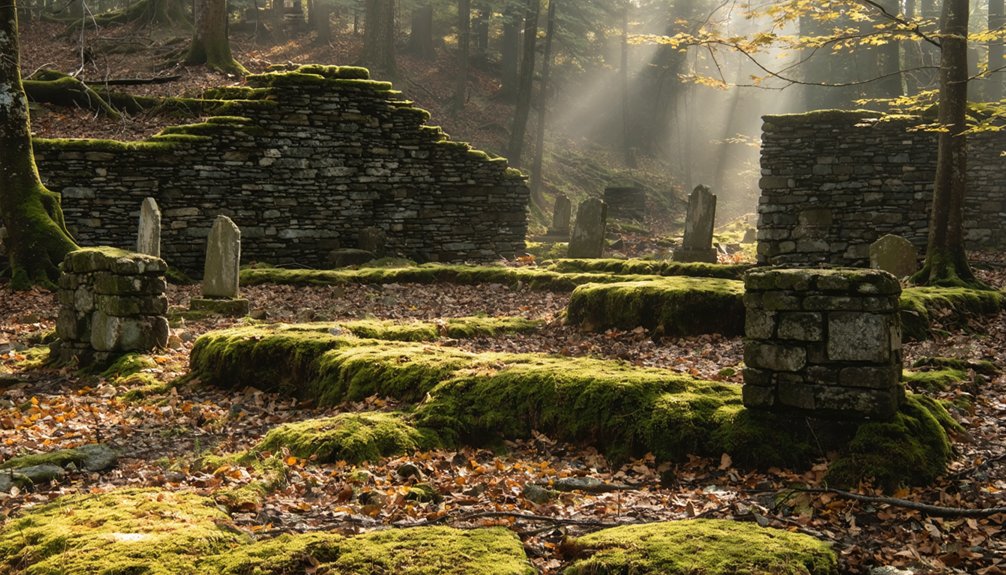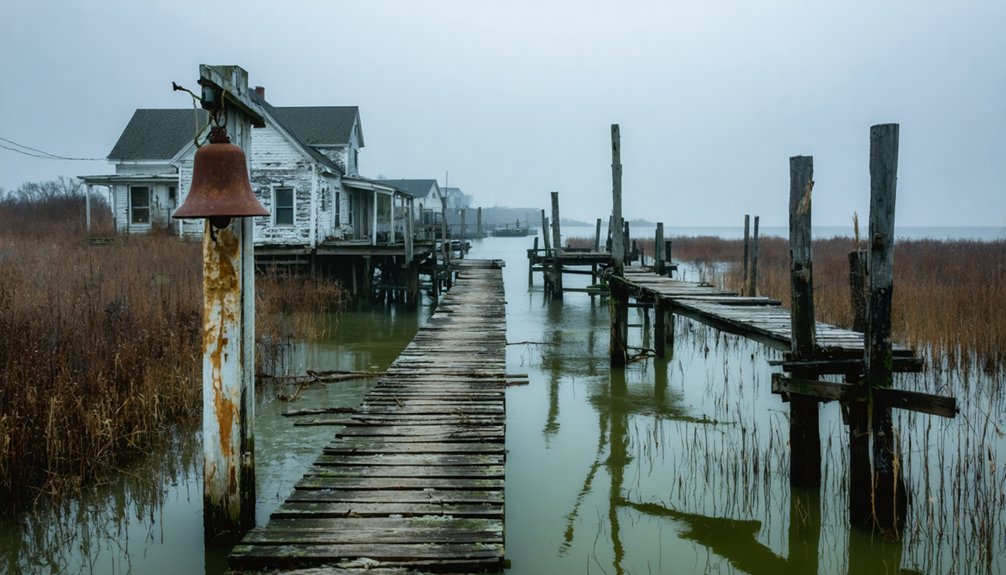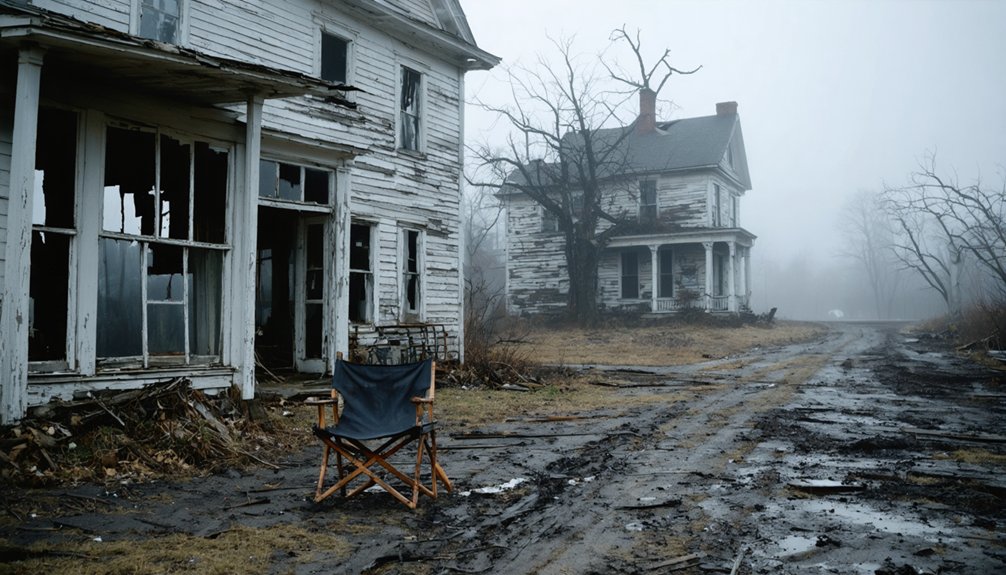
You’ll find Connecticut’s most cinematic ghost town at Johnsonville Village—62 acres of abandoned Victorian-era buildings that filmmakers favor for their authentic decay. The state’s Old Town Mill beneath I-95 and abandoned sites like Cedarcrest Hospital offer naturally weathered surfaces with peeling paint, overgrowth, and crumbling structures that horror productions prefer over artificial sets. Over 30% of Connecticut’s rural structures predate 1950, providing genuine atmospheric backdrops. The following sections reveal specific filming techniques and additional locations that transform these forgotten spaces into compelling cinematic settings.
Key Takeaways
- Johnsonville Village, a 62-acre Victorian-era ghost town, is Connecticut’s most photogenic abandoned site for cinematic filming and exploration.
- Connecticut’s authentic decaying structures offer natural weathering, peeling paint, and organic decay that enhance horror and supernatural film atmospheres.
- Over 30% of Connecticut structures predate 1950, providing period-accurate settings without requiring artificial aging or extensive set construction.
- Abandoned sites like Old Saybrook’s Victorian home were used in *Let’s Scare Jessica to Death*, showcasing genuine weathered authenticity.
- Rural ghost towns and abandoned farmsteads provide filmmakers with realistic New England backdrops, eliminating location-hopping while ensuring visual continuity.
Canterbury Farmhouse: The Perfect Horror Setting for Dead Souls
Nestled along a secluded stream in rural Canterbury, Connecticut, the red Georgian-style farmhouse built between 1785-1790 served as the primary filming location for Colin Theys’ 2012 horror film “Dead Souls.”
This 18th-century Connecticut farmhouse’s remote location along an isolated stream provided the perfect atmospheric backdrop for supernatural horror filmmaking.
Lieutenant James Adams, an American Revolution veteran, originally constructed the five-bay structure on fieldstone foundations after purchasing the land. He created a property that would remain in his family until 1859.
The farmhouse featured a central five-light transom above the entrance, exemplifying Federal-style architectural elements common to the period.
Property ownership changed hands multiple times before Synthetic Cinema selected it in April 2012. The director initially scouted separate Windham County locations but discovered this site’s barn and house combination eliminated logistical challenges.
The barn’s weathered, unpainted exterior required zero farmhouse renovations for authentic horror aesthetics.
Production teams carved cult symbols into floors and positioned props throughout—intentionally abandoned post-filming.
The film aired on Chiller TV, bringing the Canterbury location’s eerie atmosphere to horror audiences nationwide.
The small bridge crossing the stream enabled fluid tracking shots between structures, maximizing the isolated setting‘s cinematic potential.
Why Windham County’s Quiet Corner Became a Filmmaker’s Dream
You’ll find Windham County’s Quiet Corner offers filmmakers a rare combination: picturesque country roads that lead directly to 18th-century homesteads with authentic decay still intact.
The region’s forested isolation creates natural tension in every frame, while weathered barns positioned near deteriorating houses eliminate the need for multiple filming locations.
Property owners, viewing these structures as unsalvageable, permit film crews to use the sites for income—transforming endangered resources into profitable shooting opportunities.
These Cape Cod-style farmhouses, many built circa 1790, exemplify the architectural heritage of rural Connecticut while providing filmmakers with historically authentic settings that would be impossible to replicate on studio lots.
The area’s theatrical legacy includes the Capitol Theater, operational since 1926, where ghostly legends add atmospheric depth to Windham’s already cinematic landscape.
Perfect Rural Isolation Factor
When filmmakers scout locations for authentic ghost town atmospherics, they’re searching for visible decay markers that digital effects can’t replicate—and Windham County delivers these elements in measurable quantities.
You’ll find over 30% of structures predating 1950, creating period-accurate backdrops without set construction.
The 8.7% rental vacancy rate means accessible properties for production crews, while 166 foreclosures in 2014 left exploitable abandoned buildings.
Population maintenance has failed here—116,503 residents spread across rural townships ensure you won’t battle crowds during shoots.
Unlike urban renewal projects that sanitize decay, these towns preserve their deterioration naturally.
The median age of 41.2 years and ongoing 0.132% population decline guarantee filmmakers authentic depopulation aesthetics.
Production designers particularly value the predominant single-family housing stock, which provides consistent visual continuity across establishing shots without jarring architectural mismatches.
The 6.2% unemployment rate creates visible economic stagnation that cameras capture without artificial staging.
You’re fundamentally renting pre-dressed sets where economic distress performs the art direction.
Natural Decay Authenticity
Authentic decay sells the illusion better than any production designer’s weathering technique—which explains why Dead Souls director Colin Theys drove past dozens of Connecticut properties before finding Canterbury’s circa-1790 farmhouse. The red structure’s seasonal decay provided exactly what horror cinematography demands: cracks you can’t fake, peeling paint patterns shaped by decades of New England winters, and wood grain exposed through genuine abandonment rather than artificial distressing.
The barn’s unpainted finish—what Theys called his “Goldilocks” discovery—demonstrated structural authenticity impossible to replicate on soundstages.
Windham County’s Quiet Corner offered this filmmaker advantage repeatedly: properties like Bara-Hack’s stone foundations and deserted mill villages where forest reclamation created natural shadows and textures. These abandoned or partially abandoned settlements across Connecticut reflect the state’s shifting demographic and economic history, providing filmmakers with ready-made sets that carry the weight of authentic decline. Johnsonville’s colonial-style wooden buildings, once a thriving 19th-century mill village, stand silent after failed revitalization attempts—the kind of preserved abandonment that transforms a $800,000 property into invaluable cinematic real estate.
When you’re shooting supernatural thrillers, real deterioration communicates something CGI never captures—the visual proof that time itself has condemned these places.
The Goldilocks Discovery: House and Barn in One Location
Finding a single property that checks every box for a horror film rarely happens, yet the production team of Dead Souls struck gold in Canterbury. Director Colin Theys called this 1790s farmstead their “Goldilocks” find—perfectly weathered barn positioned just feet from the main house, enabling fluid tracking shots between structures.
You’ll appreciate how this eliminated the typical location-hopping that fragments visual continuity. The unpainted barn’s natural decay matched the dilapidated farmhouse without requiring artificial aging, while the proximity created seamless action flow. The property’s historic district buildings from the 1700s-1800s provided the authentic period atmosphere that modern constructions simply cannot replicate. Connecticut’s shadowy forests and old mansions create the quintessential horror ambiance that filmmakers seek for atmospheric productions.
Unlike urban sets with alleyway secrets and rooftop vistas requiring multiple permits, this secluded property offered everything in one package. The team had assumed they’d need separate locations, but Canterbury’s isolated farm delivered both authenticity and logistical efficiency for their supernatural narrative.
Natural Decay vs. Movie Magic: Authenticity in Horror Filming
The Canterbury farmhouse’s decades of genuine weathering delivered something no set designer could replicate in weeks—authentic structural deterioration with unpredictable visual depth.
You’ll notice the production team rejected artificial tricks, instead capturing:
- Peeling paint layers revealing decades of color changes and moisture damage
- Warped floorboards creating genuine hazard zones actors navigated carefully
- Stream-weathered bridge showing natural moss growth and wood rot patterns
- Barn’s collapsed sections exposing structural bones without staged destruction
This approach demolished restoration myths common in polished productions. The filmmakers left props behind post-filming, blending seamlessly with organic decay.
While Hallmark films depend on restored, controllable locations, “Dead Souls” embraced Connecticut’s rural abandonment. You’re witnessing horror cinema that trusts reality over fabrication—no expedited aging, no constructed sets, just unscripted deterioration serving authentic terror.
Old Saybrook’s Abandoned Home and Its Hollywood Connection
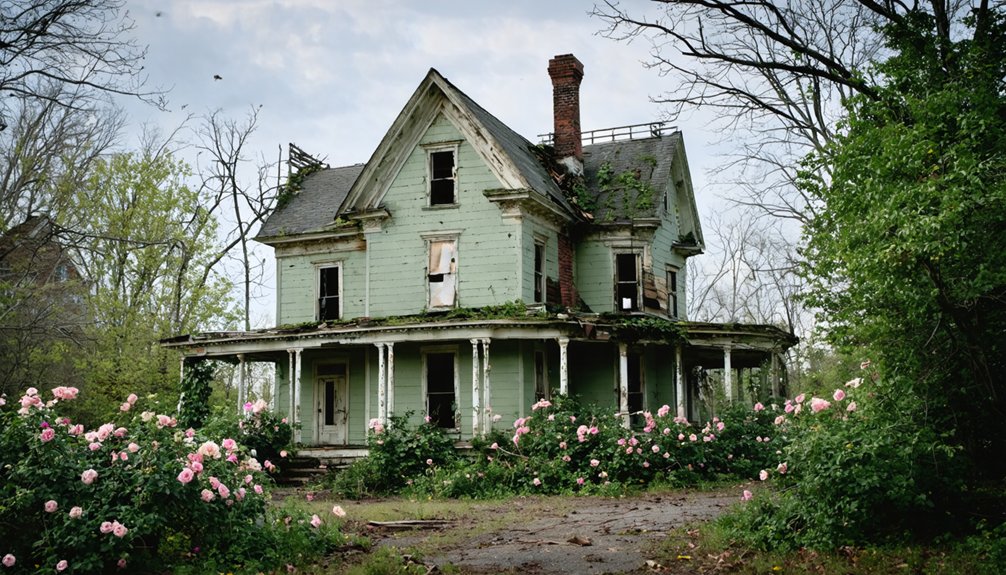
You’ll spot the decaying Victorian tower at 230 Middlesex Turnpike rising above the tree line, its yellow paint faded everywhere except the distinctive Gothic spire that marked it as the exterior for 1971’s “Let’s Scare Jessica to Death.”
The property’s authentic deterioration—overgrown vegetation, crumbling outbuildings, and fog-prone location near Long Island Sound—provided director John D. Hancock with natural horror atmosphere that required minimal set dressing.
TikTok explorers now document the No Trespassing signs and monitored perimeter from the adjacent car dealership lot, capturing the same eerie angles that appeared in the film’s exterior shots over fifty years ago.
1970s Horror Film Production
When director John D. Hancock scouted Connecticut in autumn 1970, he transformed the Old Bishop House into one of New England’s most compelling haunted landmarks. The production captured authentic rural decay that would fuel urban legends for decades.
Key filming elements at 230 Middlesex Turnpike:
- Natural fog rolled across open fields surrounding the Victorian tower, creating atmospheric exteriors without artificial effects.
- Yellow-painted tower provided the film’s iconic visual centerpiece, standing distinct against Connecticut’s autumn landscape.
- Isolated location in Old Saybrook offered genuine remoteness, enhancing the psychological horror premise.
- Practical interiors were shot separately at E.E. Dickinson Mansion in Essex, while exteriors remained at the deteriorating farmhouse.
The production’s location choices established Connecticut’s reputation for folk horror authenticity, drawing location enthusiasts to these preserved filming sites.
TikTok Exploration and Discovery
From Interstate 95’s exit ramp, you can spot the disease-yellow Victorian tower rising above Middlesex Turnpike’s shoulder—though overgrown vegetation and the property’s elevated positioning obscure most structural details from passing traffic.
TikTok creators transformed this abandoned 124-acre property into viral content, tagging posts with #abandonedplaces and #horrormovie after discovering its connection to 1971’s “Let’s Scare Jessica to Death.”
You’ll find the farmhouse at 220-230 Middlesex Turnpike, where exterior shots captured the film’s unsettling atmosphere—interior scenes were filmed separately at Essex’s E.E. Dickinson Mansion.
The property’s Historical Significance sparked digital interest among developers and urban explorers, though Modern Restoration remained unlikely when J.J. Manning Auctioneers scheduled its June 4 auction.
The Pointkowski family’s century-long ownership ended with commercial development proposals replacing preservation plans.
Authentic New England Atmosphere
The location’s cultural preservation value extends beyond horror film history:
- Overgrown vegetation conceals the structure from casual observers, maintaining isolation despite adjacent commercial development.
- 124-acre Pointkowski family tract surrounds the property, preventing encroaching urbanization.
- Original 1889 reservoir dam remains intact, anchoring the ghost town aesthetic.
- Neighbors actively monitor for trespassers, demonstrating community engagement in protecting this filming landmark.
Tax maps show green-designated land preserving this $6-million time capsule.
Connecticut’s Abundance of Atmospheric Abandoned Properties
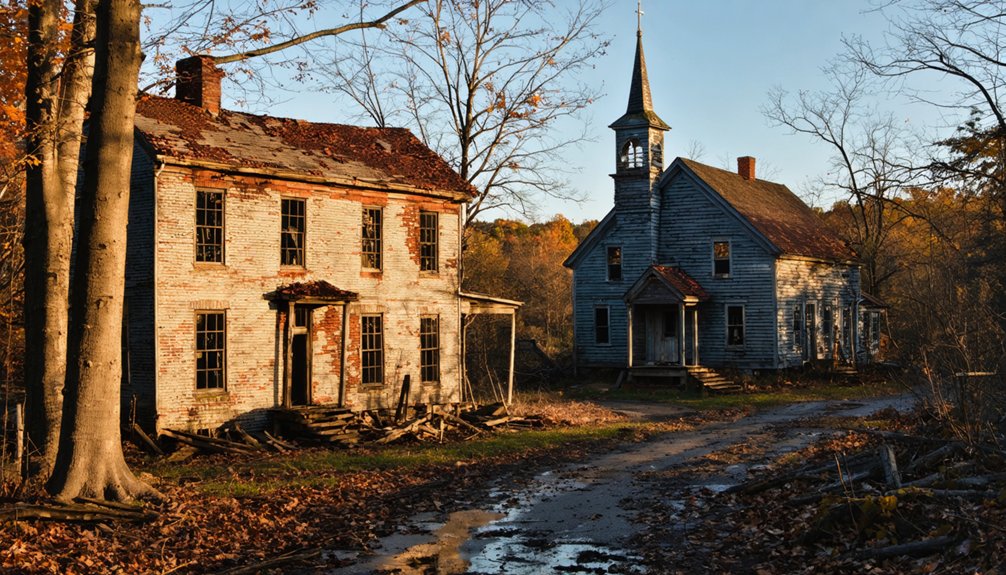
Connecticut harbors an extensive collection of abandoned properties that span industrial complexes, historic villages, and forgotten recreational sites across its 5,543 square miles. You’ll find everything from Johnsonville’s 62-acre Victorian mill town to the massive Aerosol Techniques Factory in Milford, now serving as an unintentional graffiti gallery.
Industrial decay characterizes Cedar Hill Rail Yard‘s railroad remnants and Union Pond Mill’s Victorian-era structures. The state’s preservation challenges become evident when you consider properties like Stamford’s Miniature Ghost Town, now buried under roadway construction, or Hearthstone Castle hidden in Danbury’s woods.
Military history surfaces at Nike Missile Site HA-26 in Glastonbury, while recreational nostalgia persists at Sherwood Forest Zoo’s intact animal enclosures and Sunrise Resort’s 146-acre property reclaimed by nature.
Each location offers distinct visual textures and historical narratives.
How Film Productions Preserve Forgotten Farmsteads
Film crews arriving at Connecticut’s abandoned farmsteads face immediate structural challenges—rotting floorboards, unstable roofing, and vegetation-choked interiors that threaten both safety and visual continuity.
Production teams implement targeted preservation techniques to stabilize these locations without compromising their weathered authenticity.
Essential restoration practices include:
- Structural reinforcement – Installing temporary support beams beneath compromised floors and roofing frameworks to prevent collapse during equipment movement.
- Controlled vegetation management – Selective clearing of invasive growth while maintaining atmospheric exterior overgrowth for visual impact.
- Moisture mitigation – Establishing drainage systems and temporary weatherproofing to halt active deterioration throughout filming schedules.
- Documentation protocols – Creating detailed photographic records of existing conditions before any intervention, preserving historical accuracy for future reference.
You’ll find these interventions maintain each location’s character while ensuring crew accessibility.
From Ghost Towns to Holiday Cheer: Connecticut’s Diverse Filming Locations
While horror productions exploit Connecticut’s decaying structures for atmospheric dread, holiday filmmakers transform these same rural landscapes into nostalgic winter wonderlands—demonstrating the state’s remarkable location versatility.
You’ll find Wethersfield’s historic district hosting 22+ Hallmark productions, converting Comstock Ferre’s 1811 seed company into picturesque backdrops for *Christmas on Honeysuckle Lane*.
The same state harboring modern urban legends like Dudleytown’s redacted police reports and haunted folklore investigations provides quaint town squares for Instagram-worthy Christmas content.
From Old Saybrook’s 1971 horror farmhouse to Hartford’s Bushnell Park Carousel in *Ghost of Christmas Always*, Connecticut’s Film Office leverages everything—abandoned psychiatric facilities, weathered barns, Greenwich estates.
This geographic flexibility attracts Academy Award-nominated productions seeking authentic New England character without Hollywood restrictions, proving ghost towns and gingerbread aesthetics occupy surprisingly adjacent real estate.
Urban Explorers and the Appeal of Connecticut’s Eerie Infrastructure
Beyond the sanitized film sets and holiday backdrops, a different breed of visitor prowls Connecticut’s forgotten infrastructure—armed with cameras, flashlights, and an appetite for authentic decay.
You’ll find them documenting sites that resist modern renovation:
- Johnsonville Village’s 62-acre Victorian complex – Connecticut’s most photogenic ghost town where mill workers’ urban legends haunt colonial buildings frozen in eerie silence
- Cedarcrest Hospital’s tuberculosis ward – overgrown medical ruins nestled incongruously within Newington’s modern neighborhood
- Glastonbury’s Nike Missile Site HA-26 – Cold War remnants buried in state forest, accessible to those who know the trails
- Old Town Mill beneath I-95 – New London’s stark industrial decay juxtaposed against highway overpasses
These explorers follow strict ethics: take nothing but pictures, leave nothing but footprints. They’re drawn to graffiti-covered interiors and forest-reclaimed foundations, capturing photogenic deterioration before nature completes its reclamation.
Frequently Asked Questions
Are the Canterbury and Old Saybrook Filming Locations Accessible to the Public?
You’ll find Connecticut’s “historical preservation” means keeping film locations privately locked away from your curious eyes. The Canterbury farmhouse isn’t welcoming local tourism, and there’s no public access information for Old Saybrook’s site either—freedom’s overrated anyway.
What Other Horror Films Have Been Shot at Connecticut Abandoned Properties?
Beyond documented films, you’ll find Connecticut’s abandoned properties attract urban exploration enthusiasts and paranormal investigations teams rather than major productions. Most horror shoots use private locations under strict access agreements, limiting your freedom to explore independently.
Do Filmmakers Need Special Permits to Film at Abandoned Connecticut Sites?
Opening Connecticut’s decaying doors requires no special abandoned-site permits—you’ll need only property owner consent. However, you should verify historical preservation restrictions and secure liability insurance, as crumbling structures pose risks that standard location agreements must address before cameras roll.
How Do Property Owners Benefit Financially From Allowing Film Productions Access?
You’ll earn direct rental income through leasing agreements for location access, plus potential property tax incentives. Productions pay for using structures, land, and facilities—turning abandoned assets into revenue without repairs, maintenance costs, or traditional development restrictions.
What Safety Precautions Do Film Crews Take When Shooting at Decaying Structures?
You’ll navigate crumbling floors like tightrope walkers—crews conduct thorough hazard assessments before shooting, deploy safety equipment strategically, limit time in unstable zones, and maintain fluid movement between structures. They’re balancing atmospheric decay against keeping everyone breathing.
References
- https://ghostofnewengland.com/dead-but-not-forgotten-preserving-the-soul-of-an-abandoned-farm-through-film/
- https://www.wbur.org/news/2025/12/25/hallmark-holiday-movie-locations-connecticut
- https://i95rock.com/uncover-the-haunting-secrets-of-this-abandoned-connecticut-home/
- https://www.youtube.com/watch?v=GaZwPwWkz5g
- https://ctvisit.com/articles/famous-movies-filmed-connecticut
- https://i95rock.com/look-inside-neglected-ct-home-do-you-see-a-cult-symbol-on-the-floor/
- https://buildingsofnewengland.com/tag/connecticut-farmhouse/
- https://www.youtube.com/watch?v=YP3td56sFww
- https://www.cthauntedhouses.com/real-haunts/
- https://en.wikipedia.org/wiki/List_of_ghost_towns_in_Connecticut