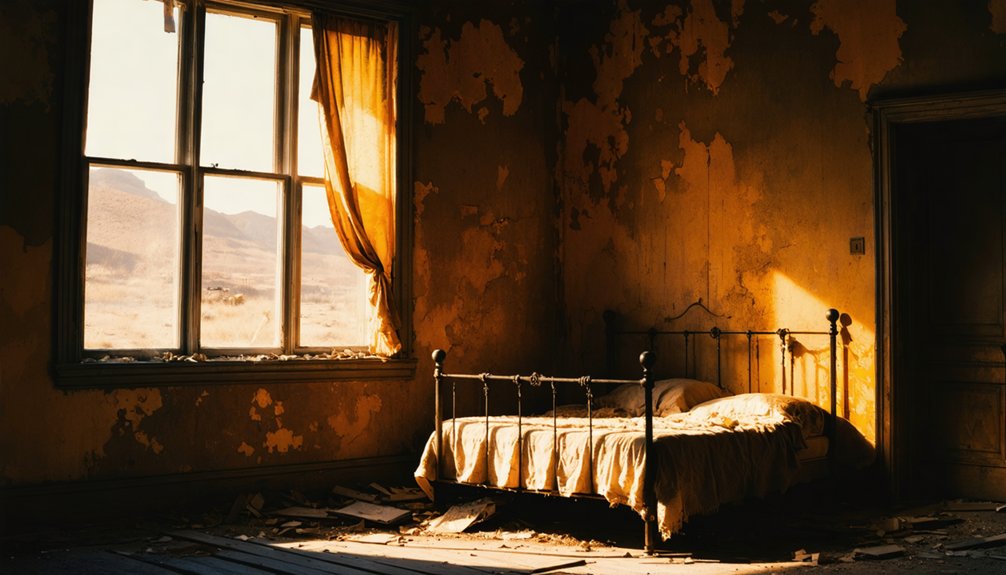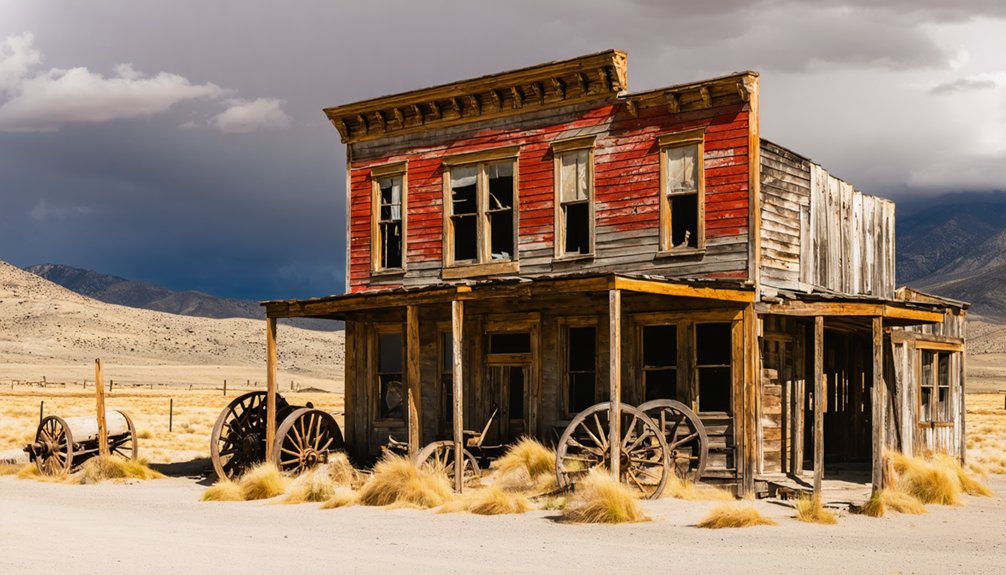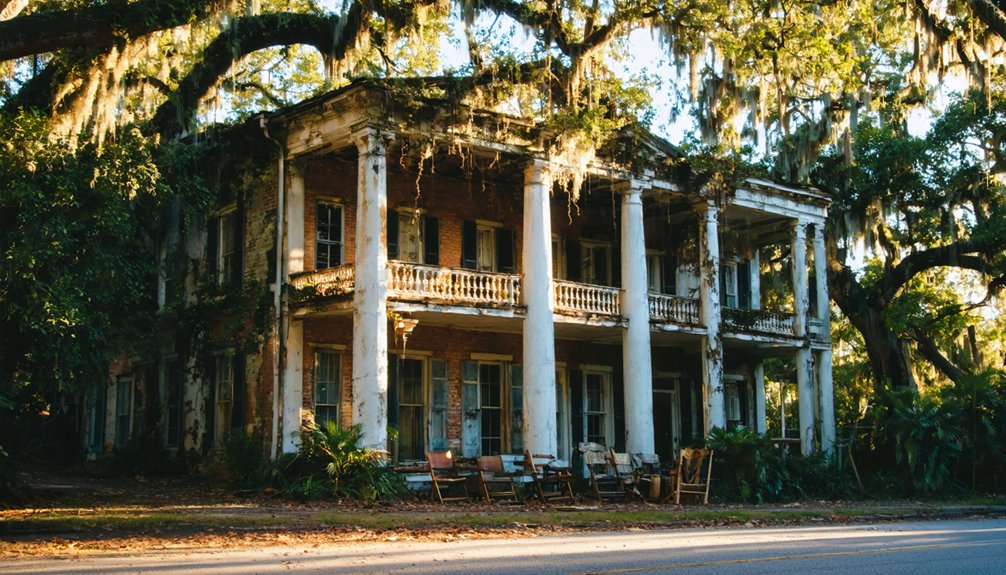
You’ll find authentic abandoned communities across the Deep South serving as film locations, including Henry River Mill Village’s 20 cottages transformed into District 12 for *The Hunger Games*, Waverly Hills Sanatorium’s decaying hospital wings featured in horror productions, and Senoia’s intact storefronts hosting *The Walking Dead*. These sites offer weathered architecture, natural overgrowth, and atmospheric decay that eliminate costly set construction while providing genuine historical backdrops. Remote access points and private land arrangements guarantee filming security, with many locations charging minimal entry fees and welcoming visitors between productions for those curious about their cinematic transformations.
Key Takeaways
- Henry River Mill Village, NC, served as District 12 in *The Hunger Games*, featuring 20 abandoned cottages since 1970.
- Spectre set on Jackson Lake Island, built for *Big Fish*, now operates as a deteriorating tourist attraction.
- Senoia, GA, transformed into a zombie apocalypse setting for *The Walking Dead* using intact historic storefronts.
- Waverly Hills Sanatorium, KY, and Babcock Building, SC, provide authentic institutional backdrops for horror and period films.
- Oak Alley Plantation, LA, offers Gothic atmospheres with live oaks and Spanish moss for films like *Interview with the Vampire*.
Henry River Mill Village: The Hunger Games District 12 Setting
When you turn off Interstate 40 at exit 119 and follow the winding two-lane Henry River Road into Burke County’s steep wooded slopes, you’ll find the weathered remains of Henry River Mill Village—the abandoned textile community that transformed into Panem’s District 12 for the 2012 film adaptation of *The Hunger Games*.
Twenty cottages still stand among 72 acres of urban decay, their tin roofs and weathered wood frames frozen since the mill’s 1970 closure.
Seventy-two acres of frozen history where twenty weathered cottages have stood untouched since 1970, preserving District 12’s authentic decay.
The 1905 concrete dam where Katniss crossed to reach the “electric fence” remains intact.
Preservation efforts have revived the ghost town: house #12 now operates as overnight lodging, guided tours run regularly, and plans include a museum and restaurant. The nine-day filming production crew used the Company Store as Mellarks Bakery and sacrificed one mill house in an explosion scene.
Some interiors for Katniss’s home were filmed inside millhouses, adding authentic texture to the dystopian setting.
You can explore independently via henryrivermillvillage.com or call (828) 471-4768 for private tours.
Waverly Hills Sanatorium: Horror Film Haven in Kentucky
Since Major Thomas H. Hays purchased this Jefferson County land in 1883, the site’s evolved from schoolhouse to America’s most filmed abandoned sanatorium.
You’ll find a five-story Tudor Gothic structure where 400 tuberculosis patients once sought open-air treatment on windswept porches.
After streptomycin eliminated the “White Plague” by 1961, the building deteriorated through its troubled geriatric center phase until state-ordered closure in 1980.
Haunted histories now attract filmmakers seeking authentic decay: double-occupancy patient rooms, the infamous death tunnel for body removal, and children’s pavilions provide ready-made horror sets.
The 2006 horror film “Death Tunnel” used the sanatorium’s deteriorating corridors and patient wards as its primary filming location.
The Waverly Hills Historical Society, established after Tina and Charlie Mattingly purchased the property in 2001, now conducts tours and hosts annual haunted house events to fund ongoing restoration efforts.
Preservation challenges persist as moisture damages D.X. Murphy’s 1926 brick-and-concrete design, yet paranormal investigators and production crews continue accessing these architecturally significant ruins for supernatural storytelling.
Historic Architecture Preserved for Cinema
- South Carolina’s Babcock Building (1857-1885) provided Gary Oldman’s Chattahoochee with crumbling asylum authenticity.
- Beaufort’s Tidalholm Mansion (1853) hosted The Big Chill and recently underwent restoration for ongoing productions.
- Fairhope’s isolated estate delivered Get Out’s disconnected Southern horror.
- Senoia’s downtown transformed into The Walking Dead’s zombie-ravaged backdrop.
- Jackson Lake Island’s Spectre set, built for Big Fish in 2003, now serves as a deteriorating attraction maintained by roaming goats.
- Oak Alley Plantation’s sweeping live oaks and Spanish moss created the gothic aesthetic for Interview with the Vampire.
These architectural survivors offer filmmakers ready-made atmospheres without Hollywood construction costs.
How Abandoned Communities Transform Into Ready-Made Sets
When you scout abandoned communities for film production, you’ll find structures like Spectre’s weathered church and Babcock Building’s crumbling patient wards eliminate costly set construction while delivering authentic period architecture.
These remote locations—from Louisiana marshlands hosting Salem’s 17th-century village to Six Flags New Orleans’ overgrown rides—offer closed perimeters that prevent public interference and maintain tight production security.
The pre-existing decay, whether fire-damaged storefronts grazed by livestock or asylum corridors darkened by decades of abandonment, provides atmospheric depth that production designers can’t replicate with paint and plaster alone. Former institutions like the South Carolina State Hospital Babcock Building, which operated until 1990, bring genuine historical weight to scenes depicting mental health facilities or period medical settings. Similarly, Georgia’s Sac-o-Suds convenience store continues operating commercially while serving as a recognizable filming landmark along State Road 16.
Authentic Architecture Saves Production Costs
Ghost towns deliver immediate financial advantages to film productions by eliminating the costliest phase of set design: building structures from scratch. You’ll find pre-existing architecture that requires minimal intervention, bypassing modern renovations and local regulations that typically burden traditional filming locations.
Production teams capitalize on these cost-saving elements:
- Period-authentic facades in places like Senoia, GA, where unaltered storefronts doubled for *The Walking Dead* without construction crews
- Natural decay effects in abandoned mining towns that Western productions used instead of expensive aging techniques
- Reversible modifications like Jekyll Island’s boardwalks for *Glory*, avoiding permanent alterations
- Operational fixtures at Brent’s Drugs in Jackson, where the working soda fountain served *The Help* as-is
- Reusable infrastructure at Cerro Gordo, hosting productions from 1920s Westerns to modern blockbusters
Charleston’s historic landmarks eliminate reconstruction budgets entirely, with locations like the American Theater and Mount Pleasant Old Village providing ready-made period settings for productions including *The Notebook* and the streaming series *Outer Banks*. Wilmington’s EUE Screen Gems Studios has supported over 400 projects by offering the East Coast’s largest facility, combining ghost town authenticity with professional production infrastructure.
Remote Locations Provide Filming Privacy
Beyond the dollar savings, production teams gain something money can’t easily buy elsewhere: complete operational secrecy.
You’ll find these abandoned Deep South communities surrounded by secluded landscapes that naturally block external views—dense forests, untraveled rural roads, and miles of empty terrain creating impenetrable privacy barriers.
Discreet access through single entry points lets you control perimeters without expensive security armies.
There’s no paparazzi lurking when the nearest populated zone sits thirty miles away, no local media broadcasting your set preparations, no curious crowds disrupting takes.
You can film around the clock without complaints, implement temporary roadblocks without pushback, and leave zero trace afterward.
These ghost towns don’t attract tourists post-production, ensuring your plot details vanish with dismantled sets.
Nature reclaims modified structures quickly, erasing evidence your crew ever existed.
Historical Atmosphere Enhances Cinematic Realism
Because authentic decay can’t be convincingly replicated on soundstages, production designers scout Deep South ghost towns where time has already performed the heavy lifting. You’ll find directors capitalizing on urban decay that eliminates artificial aging requirements while delivering atmosphere enhancement through genuine deterioration.
Strategic location selections transform abandoned communities into cinematic gold:
- Spectre’s empty shell houses create Burton’s fairy tale backdrop without constructed facades
- Byrnes Lake’s natural decay provides Friday the 13th’s horror realism sans additional set dressing
- Tidalhom Mansion’s 19th-century crumbling authenticates Southern community neglect for dramatic depth
- Tennessee State Prison’s institutional abandonment heightens The Green Mile’s tension through shadowy confinement
- Pre-existing deterioration streamlines production efficiency while maintaining visual authenticity
These locations deliver freedom from studio constraints, offering filmmakers ready-made atmospheric authenticity.
Behind the Scenes: Filming in Authentic Ghost Town Locations
When production crews scout authentic ghost towns for filming, they’re maneuvering a complex web of property access, structural safety assessments, and logistical challenges that typical sound stages never present.
You’ll find that Alabama’s film office sweetened *Big Fish*’s production through tax incentives, enabling Burton’s team to construct Spectre on Jackson Lake Island‘s remote terrain.
At Henry River Mill Village, *The Hunger Games* crew worked within partially collapsed structures, capturing urban decay against North Carolina’s scenic landscapes.
The Babcock Building required careful navigation of abandoned asylum wings, while *Get Out*’s Fairhope location demanded securing private property access.
Today, Spectre operates as an RV camp charging $3 entry—you’ll need to phone ahead for gate codes, demonstrating how these sites balance preservation with accessibility.
Visiting These Famous Movie Locations Today
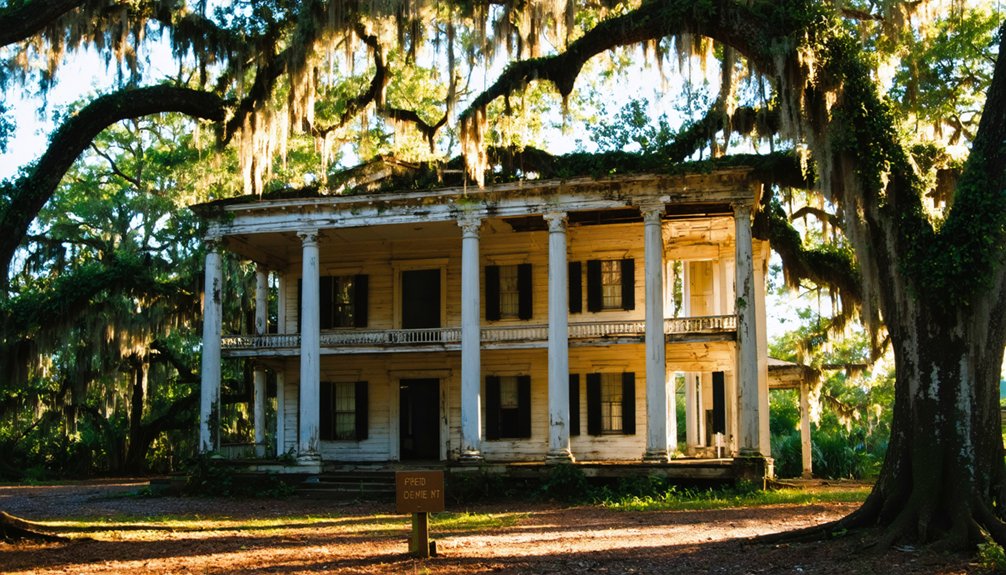
For visitors seeking tangible connections to *Big Fish*’s enchanting imagery, Spectre stands on Jackson Lake Island in Millbrook, Alabama, though fire has claimed several structures since Burton wrapped production in 2003. You’ll need to call ahead for the gate code, but access offers remarkable cost savings compared to typical tourist attractions.
What awaits your exploration:
- $3 entry fee grants unlimited wandering through surviving structures
- The ominous church at Old Spectre Road’s terminus, showcasing atmospheric urban decay
- Overnight camping at $10 per night on this historic film property
- RV facilities and event space maintained by dedicated local owners
- Goat-grazed grounds where deteriorating facades merge with pastoral Alabama landscapes
This accessible destination delivers authentic behind-the-scenes experiences without corporate restrictions or guided tour limitations.
Other Southern Ghost Towns With Film Potential
Beyond the five ghost towns already featured in major productions, you’ll find dozens of abandoned Southern settlements with untapped cinematic potential—
Crumbling textile mills in Georgia’s backcountry,
Forgotten mining camps in Arkansas’s Ozarks,
And decaying plantation outbuildings throughout Mississippi’s Delta region.
These undiscovered locations offer production crews authentic period architecture without the wear patterns from previous filming, maintaining structural integrity that’s been naturally weathered rather than artificially distressed.
You can scout these sites through state film commissions and historical preservation societies, which maintain databases of abandoned properties whose owners might grant filming permits for locations that haven’t yet appeared on screen.
Undiscovered Southern Filming Locations
While major studios scout the same familiar locations, several Southern ghost towns remain hidden gems for filmmakers seeking authentic decay and atmosphere.
Filming locations in Alabama ghost towns often provide a unique backdrop that captures the eerie charm of forgotten history. These towns offer filmmakers the chance to tell stories steeped in mystery, with landscapes that resonate with the whispers of the past. As production crews explore these sites, they can tap into the rich narratives that each ghost town conveys, enriching their cinematic storytelling.
Undiscovered sites offering abandoned charm include:
- Thurmond, West Virginia – Preserved building facades within New River Gorge National Park provide ready-made period drama backdrops without extensive set construction.
- Henry River Mill Village, North Carolina – The 1905 gold-panning settlement’s crumbling structures deliver genuine urban decay for dystopian or rural narratives.
- Spectre, Alabama – Overgrown houses and chapel on private land offer mythical, Southern Gothic aesthetics with complete location control.
- West Virginia coal towns – Abandoned hillside homes near the depot create shadowy, authentic eerie atmospheres.
- North Carolina mill villages – Multiple forgotten settlements provide filmmakers diverse architectural options without typical location fees or filming restrictions.
Preserving Authenticity for Production
Production teams preserving genuine Southern atmosphere should examine how existing ghost town film locations maintain their authentic decay while accommodating crew logistics. Spectre’s overgrown structures and Babcock Building’s 19th-century asylum interiors demonstrate how natural deterioration creates cost effective strategies—minimal set dressing required.
Henry River Mill Village’s 1905 architecture provided *The Hunger Games* with ready-made District 12 authenticity, eliminating construction expenses. During location scouting, you’ll find sites like Rhyolite offer versatile restored facades alongside original ruins, balancing safety with atmospheric decay.
These locations succeed because they’re situated on accessible private land or maintained properties, allowing equipment transport while preserving Southern Gothic character. You’re securing production value through structures that’ve aged naturally, avoiding artificial distressing costs while capturing the region’s haunting architectural heritage.
Frequently Asked Questions
Do Filmmakers Need Special Permits to Shoot in Abandoned Ghost Towns?
You’ll absolutely need permits—mountains of paperwork await! Historical preservation boards and local regulations govern abandoned sites fiercely. You’re steering federal, state, and private landowner approvals, plus insurance requirements. Expect $500-$5,000 daily fees and environmental assessments before you’re free to shoot.
How Much Does It Cost to Rent a Ghost Town Location?
You’ll find Deep South ghost town rentals aren’t publicly listed, but access fees run $3-10 per person. Location accessibility and historical preservation requirements mean you’ll negotiate rates directly with property owners for production use.
Are the Ghost Town Buildings Structurally Safe for Film Crews?
You’ll find zero guarantees of building stability at Spectre—deteriorating foam trees sprout metal pipes like rusty daggers, and fire-scarred lots offer questionable structural integrity. No inspections exist, so you’re gambling crew safety against picturesque decay without official clearance.
What Insurance Requirements Exist When Filming in Abandoned Locations?
You’ll need exhaustive insurance policies including workers’ compensation, general liability coverage starting at $1,000,000, and equipment protection. You must also secure permits, document pre-existing damage thoroughly, and provide certificates to property owners before filming begins.
Can the Public Visit During Active Filming at These Sites?
No, you can’t visit during active filming—public access halts completely. Filming restrictions close sites like Henry River Mill Village entirely, with permits mandating security perimeters and trespassing fines protecting crews, equipment, and liability concerns throughout production.
References
- https://pinintheatlas.com/travel-blogs/randsburg-ghost-town/
- https://www.themoviewaffler.com/2015/09/5-iconic-filming-locations-in-american.html
- https://www.youtube.com/watch?v=tZmA_VF6cm8
- https://www.youtube.com/watch?v=6lbcHrWIPr0
- https://gardenandgun.com/articles/visit-10-iconic-oscar-winning-film-locations-in-the-south/
- https://www.youtube.com/watch?v=VR-t5w9wSeU
- https://farandwide.com/s/abandoned-film-locations/
- https://www.romanticasheville.com/henry-river
- https://www.artofabandonment.com/2022/03/henry-river-mill-village-the-hunger-games-district-12-hickory-nc/
- https://thehungergames.fandom.com/wiki/Filming_locations