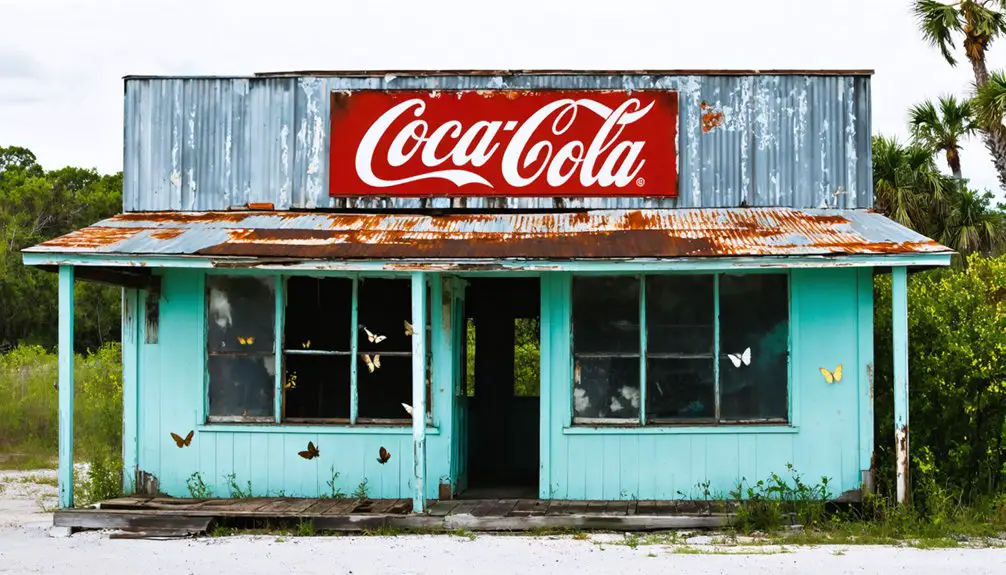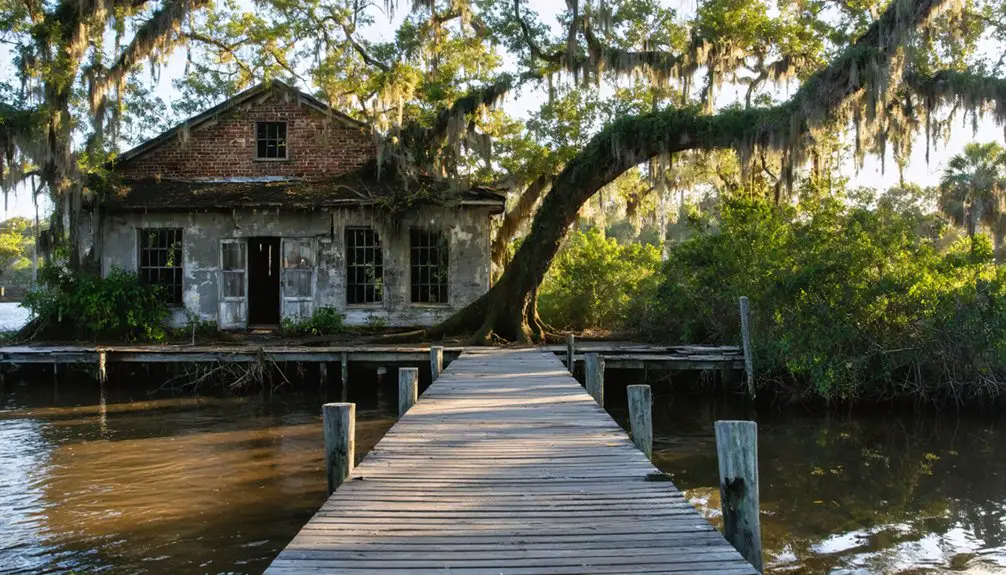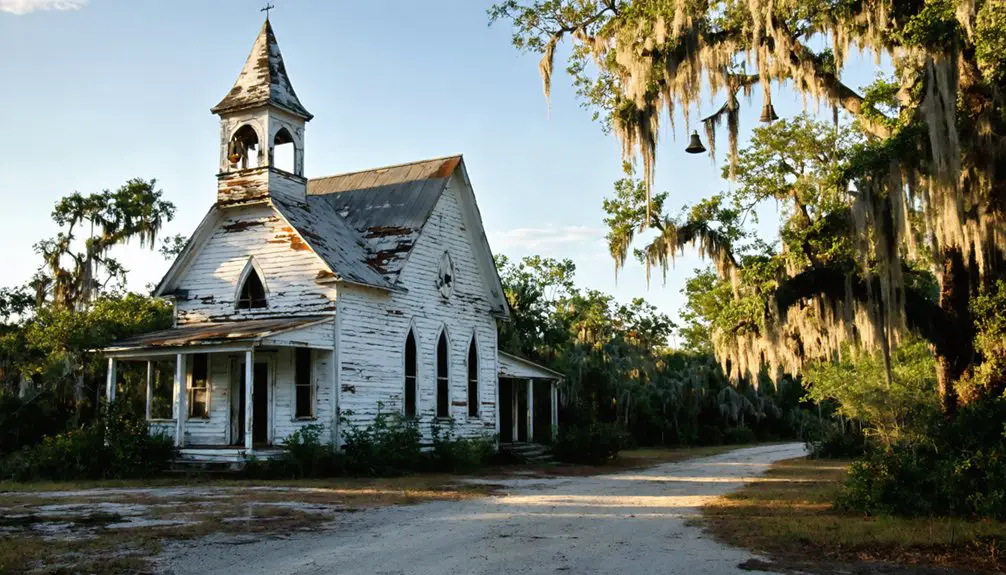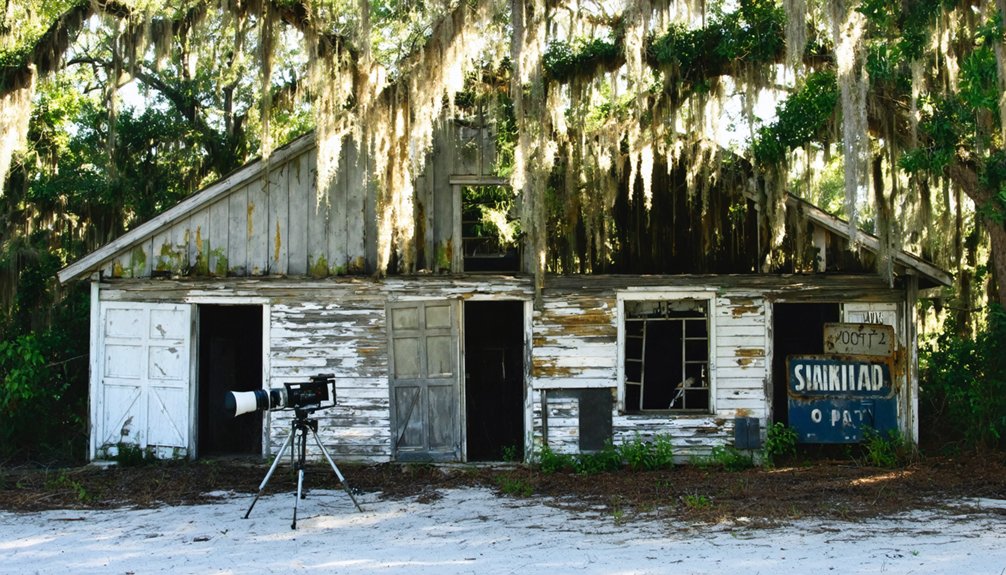
You’ll find Florida’s ghost towns doubling as film sets, most especially the burned-down St. James Church at 3602 SW 110th Avenue in Dunnellon, which served as the Creeper’s lair in *Jeepers Creepers* with its authentic 1800s cemetery and decayed architecture. The demolished White’s Meat Packing Plant at 315 NE 14th St. in Ocala provided industrial horror backdrops with blood-stained floors and rusted hooks, while Lake Panasoffkee Diner at 4629 FL-44 remains operational after its film appearance. The outline below explores how these abandoned sites transformed into cinematic nightmares.
Key Takeaways
- St. James Church at 3602 SW 110th Avenue served as the Creeper’s lair in Jeepers Creepers before burning down in 2003.
- White’s Meat Packing Plant in Ocala appeared as a horror filming exterior but was demolished by 2006 and replaced.
- Lake Panasoffkee Diner at 4629 FL-44 remains operational after appearing as “Opper’s Diner” in Jeepers Creepers, now offering airboat rentals.
- Tiger Trail (SW 180th Avenue) in Marion County provided the primary road scenes for Jeepers Creepers’ driving and chase sequences.
- Port Mayaca’s Hurricane Cemetery and abandoned theater offer atmospheric decay but have no confirmed final film production uses documented.
The Abandoned St. James Church: Creeper’s Lair in Dunnellon
The abandoned St. James Church at 3602 SW 110th Avenue served as the Creeper’s sinister lair in 2001’s *Jeepers Creepers*. You’ll find this location between Dunnellon and Ocala off Highway 200, though nothing remains today.
The church’s authentic abandoned architecture—complete with an adjacent cemetery featuring 1800s headstones—created the perfect desolate atmosphere for filming those iconic drain pipe scenes where siblings spotted the Creeper dumping bloody body bags.
The crumbling church ruins and weathered 1800s gravestones provided an authentically eerie backdrop for the film’s most chilling scenes.
Haunted folklore surrounded the site even before filming, with reports of mysterious fog, scratching sounds, and moaning echoing through the rural setting. Local legend tells of three children’s ghosts appearing at the intersection of Tiger Trail and the nearby high school road.
After the film’s release, horror fans flocked here, sparking local complaints. The church mysteriously burned down around 2003 under suspected arson circumstances, erasing this piece of old Florida’s ghost town landscape forever. Some speculation linked the church’s destruction to George Steinbrenner, adding another layer of intrigue to the site’s controversial end.
Tiger Trail and SW 180th Avenue: Iconic Driving Sequences
You’ll find Tiger Trail—officially SW 180th Avenue—cutting through Marion County’s phosphate mining territory where overhanging trees create the film’s signature tunnel effect.
The straight, north-south stretch earned its nickname from the 2000 production that shot nearly every driving sequence here, including the opening scene with the Impala approaching camera and the fateful roadside stop.
Local legend claims child spirits haunt the nearby intersection, adding genuine unease to a location already steeped in Dunnellon’s 1890s mining-town decline.
The area sits approximately 25 miles west of Ocala, serving as a backdrop that blends small-town history with the isolated roadways that define the film’s atmosphere.
The road’s haunted reputation stems from local ghost stories that circulated long before cameras arrived, making it a natural fit for the production’s unsettling tone.
Historic Tiger Trail Route
Located northeast of Dunnellon in Marion County, SW 180th Avenue—known locally as Tiger Trail—stretches north-south through dense Florida woods that formed the atmospheric backbone of *Jeepers Creepers*’ most iconic sequences.
This historic route runs through former phosphate mining territory, where operations like Tiger Rag Mine once dominated the area before nature reclaimed the area. You’ll find the road flanked by old-growth trees creating natural canopies, while wildlife habitats flourish in the surrounding underbrush.
The straight stretches that made it perfect for filming high-speed chase scenes remain drivable today, though road maintenance has modernized some sections. The film’s opening sequence utilized the road’s distinctive curve, which appears in multiple chase scenes as the Creeper’s truck pursues the protagonists. Near SW County Highway 484, the production filmed the dramatic moment where the Creeper runs the siblings off the road.
Ancient trees still overhang the asphalt where the Creeper’s truck terrorized its victims, and specific pull-off spots used for pivotal scenes remain identifiable despite decades of environmental changes.
Local Ghost Children Legend
Beyond the documented history and filming credentials, whispers of supernatural activity have occasionally surfaced around SW 180th Avenue.
Though no established legend of ghost children directly connects to this specific stretch of road.
Historical ghost tales in the broader region trace back to Crystal River’s prehistoric burial mounds, where pre-Columbian Native American remains rest in mysterious earthen structures.
These ancient sites, just miles from Jeepers Creepers’ filming locations, provide atmospheric context rather than concrete rural legend connections to the avenue itself.
You’ll find Florida’s documented hauntings cluster elsewhere—St. Augustine’s lighthouse, northern Florida’s Bellamy Bridge—leaving SW 180th Avenue’s eerie reputation built primarily on cinematic achievement rather than supernatural folklore. The oldest lighthouse in America, St. Augustine’s beacon stands as one of the most haunted structures in the state, drawing paranormal investigators and ghost tour enthusiasts year-round.
The road’s isolation creates naturally unsettling conditions without requiring paranormal embellishment. Key West’s historic landmarks, including the Ernest Hemingway Home, have also appeared in films such as The Leisure Seeker, showcasing Florida’s diverse filming locations beyond rural ghost roads.
Filming Techniques and Atmosphere
When director Victor Salva scouted SW 180th Avenue in 2000, he prioritized one specific visual element: the dense canopy of oak and pine branches arching over the asphalt to create a natural tunnel effect. This natural framing allowed lighting techniques to exploit dappled sunlight filtering through leaves, creating shadow patterns that heightened isolation.
The production team captured nearly all driving sequences on this single stretch, positioning cameras to emphasize the road’s straight-line vulnerability. Sound design incorporated actual environmental audio—rustling underbrush, wind through branches, and gravel crunching beneath tires—to build authentic dread.
The Creeper’s truck was driven through original locations during filming, with operators timing approaches around the edge of overhanging trees. The film’s use of Dunnellon’s remote roads in 2001 contributed to the town’s contemporary identity, which now celebrates its history through the annual Boomtown Day Festival each spring. These technical choices transformed Tiger Trail’s desolate landscape into visceral horror, preserving its wooded character for location recreations.
White’s Meat Packing Plant: Demolished Horror Movie Climax Site
The climactic scenes of Jeepers Creepers unfolded at White’s Meat Packing Plant, located at 315 NE 14th St in Ocala. The abandoned slaughterhouse’s blood-stained concrete floors and rusted overhead hooks created an authentic industrial nightmare.
You can’t visit this location today—the building was demolished within two years of the 2001 filming, and by 2006, the iGlobal Logistics & Technology Center replaced the decaying structure.
The former meat processing facility, which ceased operations in the early 1980s, provided filmmakers with genuine atmospheric decay that set design couldn’t replicate: peeling paint, broken windows, and the lingering aura of a working-class industry left to rot. The industry had long been characterized by high dangers for workers, including risks from sharp equipment and hazardous working conditions that made these facilities particularly menacing settings.
Jeepers Creepers Finale Setting
Nestled in Ocala’s industrial district at 315 NE 14th St., White’s Meat Packing Plant provided the haunting backdrop for Jeepers Creepers’ climactic finale—a decrepit slaughterhouse that transformed into the Creeper’s grotesque lair.
You’ll find filmmakers captured both exterior shots of the dilapidated industrial structure and interior scenes showcasing the eerie meat processing areas after the facility’s early 1980s closure.
The abandoned structure delivered three essential filming elements:
- Authentic decay from years of disuse in Florida’s humid climate
- Industrial architecture featuring exposed metal hooks and processing equipment
- Isolated location away from residential development
The meat industry’s regional decline left countless abandoned structures perfect for horror cinematography.
White’s facility met its final end through demolition within two years post-filming, eventually replaced by the iGlobal Logistics & Technology Center in 2006.
Current Site Redevelopment Status
Following the plant’s demolition in 2003, the 315 NE 14th St. property underwent complete redevelopment that erased all traces of the horror film location. You’ll find the site transformed through urban renewal initiatives that prioritized commercial construction over industrial preservation.
Concrete foundations where Victor Salva filmed the climactic showdown now support modern mixed-use buildings, with zero remnants of the original slaughterhouse structure visible. The surrounding block underwent simultaneous redevelopment, eliminating adjacent warehouses that provided the desolate atmosphere filmmakers sought.
Today’s streetscape bears no resemblance to the 2001 filming environment—updated sidewalks, LED streetlights, and landscaped medians replaced the crumbling infrastructure that created cinematic tension. You won’t discover historical markers acknowledging the location’s role in *Jeepers Creepers*, as developers focused exclusively on forward-looking construction rather than commemorating the site’s brief entertainment industry significance.
Industrial Location Horror Appeal
Horror filmmakers gravitate toward abandoned industrial sites for their inherent atmospheric dread, yet White’s Meat Packing Plant—despite widespread online claims—never served as a filming location for any documented horror production. You’ll find no archival evidence linking this Atlanta facility to cinematic history, though its demolished structures would’ve offered compelling visuals.
Meatpacking facilities attract horror speculation due to:
- Processing architecture: Blood-stained concrete floors, rusted hooks, and cramped corridors create naturally menacing environments
- Urban decay aesthetics: Deteriorating industrial relics evoke isolation and danger without set construction
- Psychological associations: Slaughter history triggers visceral responses in audiences seeking authentic terror
The confusion likely stems from general fascination with abandoned industrial sites as film backdrops, amplified by unverified internet narratives conflating Georgia’s White Provision Company with nonexistent Florida counterparts.
Lake Panasoffkee Diner: Still-Standing Film Location
At 4629 FL-44 in Lake Panasoffkee, you’ll find the still-standing diner that served as “Opper’s Diner” in the 2001 horror film *Jeepers Creepers*. The production team secured filming permits for this abandoned building, adding the prominent diner signage specifically for exterior and interior shots.
Named after producer Barry Opper, the location captured the pivotal scene where Trish and Darry confront their mounting fears. The diner architecture remains intact despite Route 44’s expansion from two-lane to four-lane highway. Unlike demolished sites such as St. James Church, this structure survived post-production changes.
You can access it eight minutes from Wildwood off Interstate 75, now repurposed for airboat rentals. The building still evokes that exact shot of the siblings pulling in, offering unrestricted exploration for horror enthusiasts tracking northern Florida’s filming history.
Port Mayaca’s Hurricane Cemetery and Paranormal Activity
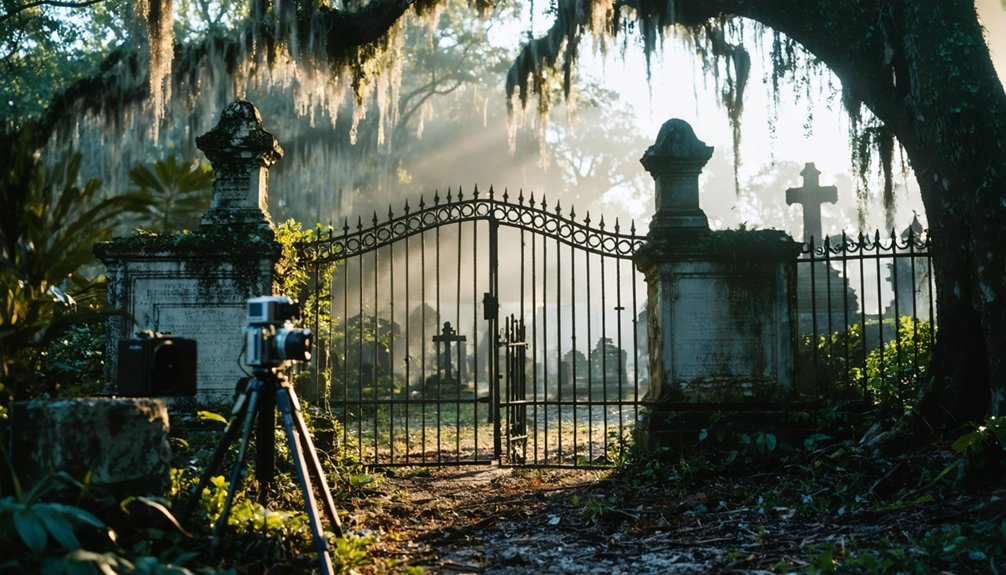
While most ghost town film locations center on abandoned structures, Port Mayaca Memorial Gardens offers a different perspective—a cemetery born from tragedy that paradoxically lacks the paranormal reputation you’d expect. Despite housing 1600 victims from the catastrophic 1928 hurricane, no ghost sightings have been documented here.
A cemetery of 1600 hurricane victims remains eerily quiet—no ghosts haunt these hallowed grounds despite unimaginable tragedy.
The site’s historical preservation efforts focus on factual commemoration:
- State historical marker placed in 2003 for the storm’s 75th anniversary
- Louise Henderson Memorial Chapel constructed in 1993 with substantial community involvement
- National Register recognition for related West Palm Beach burial site in 2002
Located 8.0 miles west of Route 710 on Route 76, this serene memorial emphasizes dignity over supernatural speculation, maintaining respectful grounds through Arthur Ivester’s direction and Henderson family endowments.
The Forgotten Movie Theater of Port Mayaca
Though overshadowed by the nearby memorial cemetery, Port Mayaca’s abandoned movie theater stands as a proof to the region’s broader economic decline along Lake Okeechobee’s northern shore.
You’ll find this forsaken structure along the main thoroughfare near Pahokee’s water tower, its forgotten arches framing what once hosted community gatherings. Silent screenings ended decades ago, leaving decay you can glimpse through crumbling doorways.
Urban explorers document its eerie, untouched interior—peeling walls and collapsed seating create haunting compositions. Tampa Jay’s 2024 YouTube walkthrough circles the property, revealing structural deterioration mirroring nearby abandoned Burger King and Taco Bell locations.
While no confirmed film productions have utilized this site, Atmosphere Drones offers cinematic aerial services for potential projects seeking authentic ghost town atmospheres.
Chuluota Tower: Matching The Blackwell Ghost Flyover
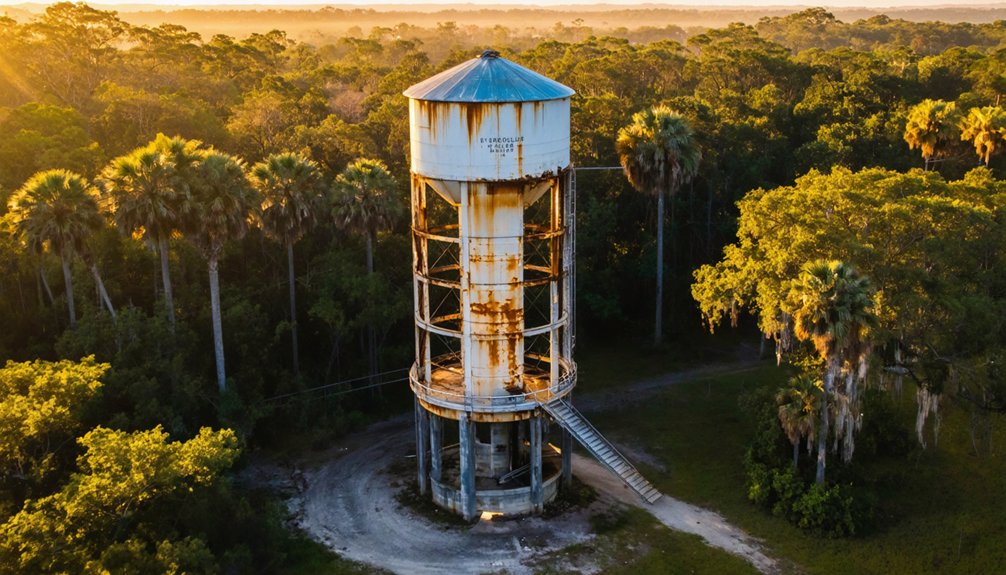
- Structural identification uncertainty – Multiple towers exist throughout Seminole County’s rural areas, making precise matching difficult without filmmaker confirmation.
- Filming logistics ambiguity – Independent productions often utilize locations without permits or public disclosure, protecting shooting sites from attention.
- Aerial perspective limitations – Flyover footage compresses geographic details, obscuring distinctive landmarks that would enable definitive identification.
You’ll need to compare water tower profiles, surrounding vegetation patterns, and road configurations visible in the film’s brief aerial sequences.
Without production records or crew testimony, matching Chuluota’s infrastructure to those fleeting frames remains speculative territory for location scouts.
Ocala National Forest Backwoods: Enhancing Cinematic Atmosphere
Ocala National Forest’s 430,000 acres deliver the raw backwoods aesthetic that transforms ordinary horror and thriller productions into visceral wilderness experiences.
Raw backwoods terrain transforms ordinary productions into visceral wilderness experiences through 430,000 acres of untamed forest atmosphere.
You’ll find *The Yearling’s* (1946) Academy Award-winning settings along Yearling Trail, where Long Homestead’s authentic structures frame your shots beneath dense forest canopy. Juniper Prairie Wilderness and Alexander Springs Wilderness offer 7,941 trackless acres where primeval landscapes meet crystal-clear 72°F springs, creating jungle-like visuals that rival nearby Tarzan filming locations.
Kerr City ghost town on County Road 316, abandoned after 1894-1895 freezes, provides eerie historical depth. Wildlife habitats teeming with alligators and rare birds enhance your atmospheric tension.
Meanwhile, Pinecastle Bombing Range‘s low-flying F/A-18 Hornets—dropping nearly 20,000 ordnances yearly—inject unexpected action over remote swamps and Big Scrub terrain.
Ghost Stories of Tiger Trail: Local Legends Meet Film History
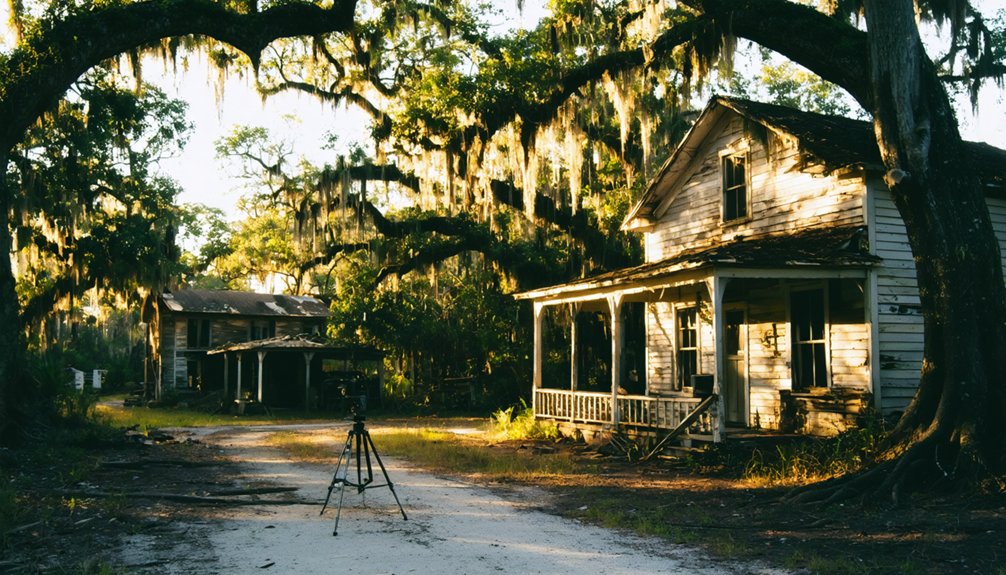
Along Tiger Trail Road’s winding curves through Ocala National Forest, you’ll encounter Dunnellon’s most documented paranormal hotspot—where three child apparitions reportedly materialize at 3 a.m. holding hands before dissolving into dust-like swirls beneath vehicle headlights.
These haunted legends attract filmmakers seeking authentic atmospheric locations.
Eerie sightings documented along this stretch include:
- The Dark Man—a shadowy figure in trench coat and hat who rapidly climbs trees with eyeless features
- White Lady Julia—a bright white full-body apparition whose screams pierce the dense forest
- The Vengeful Coyote Woman—whose cries transform into animal howls near specific trail sections
You’ll also find reports of phantom gunshots, mysterious orbs, and disembodied whispers.
Filmmakers capitalize on these genuine local legends, transforming Tiger Trail into ready-made horror backdrops requiring minimal set dressing.
Frequently Asked Questions
Can Visitors Still Explore Any Original Jeepers Creepers Filming Locations Today?
Time flies—most original structures are gone, but you’ll find hidden secrets along SW 180th Avenue’s iconic stretches. Urban decay claimed the church and school, though you can freely explore these public roads capturing authentic highway scenes today.
Are There Guided Tours Available for Florida Horror Movie Locations?
No dedicated guided tours exist for Florida horror movie locations. You’ll need to explore independently, researching haunted folklore connections yourself. Prioritize tour safety by visiting public state parks like Eden Gardens during operating hours rather than abandoned private properties.
What Safety Precautions Should Visitors Take When Exploring Abandoned Film Sites?
Like steering through a minefield, you’ll need hazard awareness of unstable structures and mold exposure. Respect trespassing risks by securing property permissions first. Wear protective boots, bring first-aid supplies, stay hydrated, and never explore alone or after dark.
Were Any Other Horror Films Shot in These Same Locations?
The locations primarily feature MPV documentaries rather than traditional horror films. You’ll find these sites showcase haunted history through paranormal investigations instead of fictional movies. Their urban decay and authentic supernatural reputations attract documentary filmmakers seeking real, unexplored phenomena.
How Do Local Residents Feel About Tourists Visiting These Filming Locations?
You’ll find contradictory local resident sentiments unavailable in current research—tourism impacts remain undocumented. While filming locations attract freedom-seeking explorers, residents’ actual perspectives require surveys, interviews, and community testimonies that don’t exist in available sources yet.
References
- https://movie-locations.com/movies/j/Jeepers-Creepers.php
- https://roadtrippers.com/magazine/filming-locations-along-floridas-overseas-highway/
- https://jennmoslekwordpress.wordpress.com/2021/11/20/florida-horror/
- https://www.youtube.com/watch?v=kXK-FGVEjpc
- https://www.youtube.com/watch?v=OklHmdIYYPo
- https://www.youtube.com/watch?v=fxZWE6Iyr1s
- http://www.thennowmovielocations.com/2018/06/jeepers-creepers.html
- https://trippingonlegends.com/2020/06/16/floridas-jeepers-creepers-curse/
- https://www.realqueenofhorror.com/2013/02/jeepers-creepers-old-church-location.html
- https://www.peerspace.com/resources/where-was-jeepers-creepers-filmed/