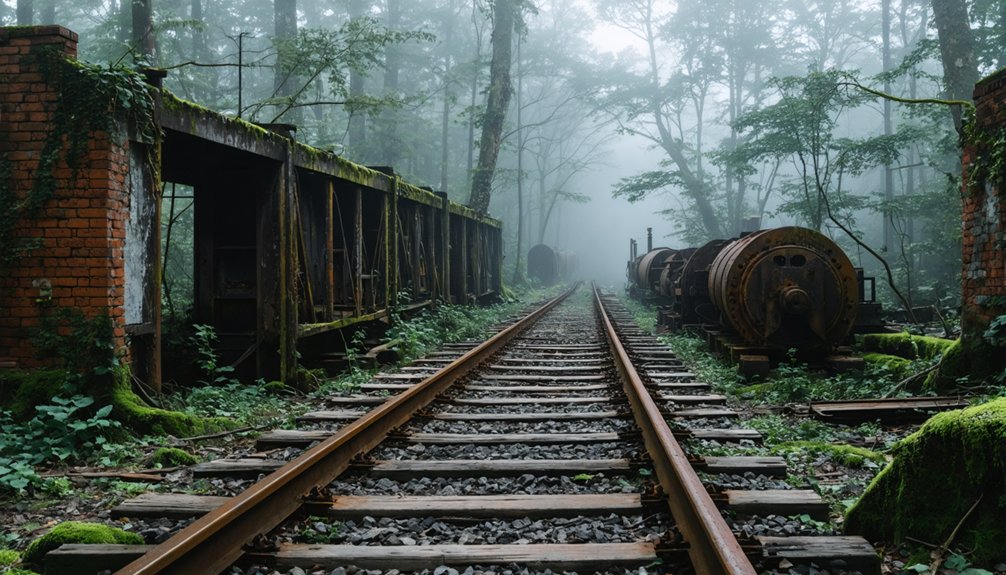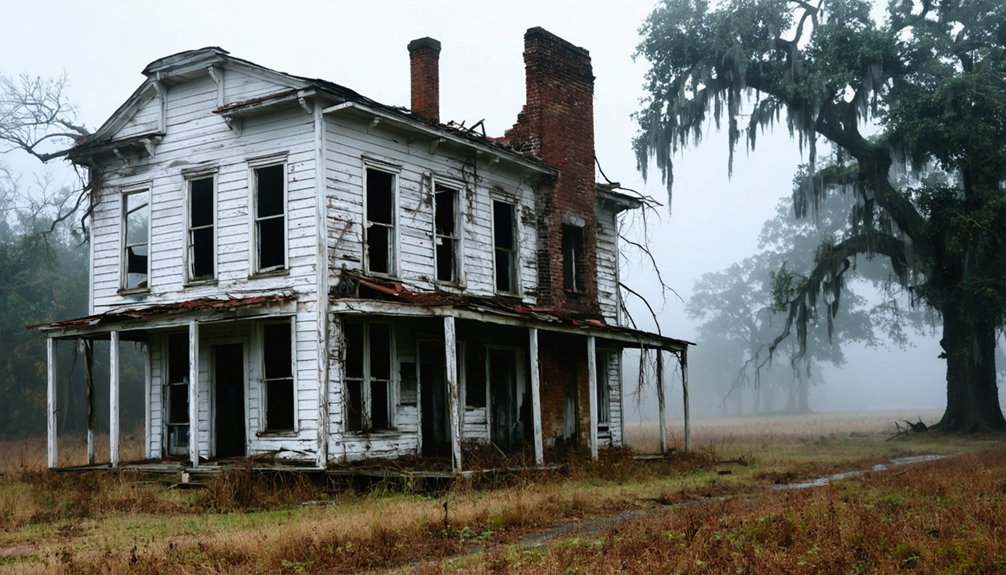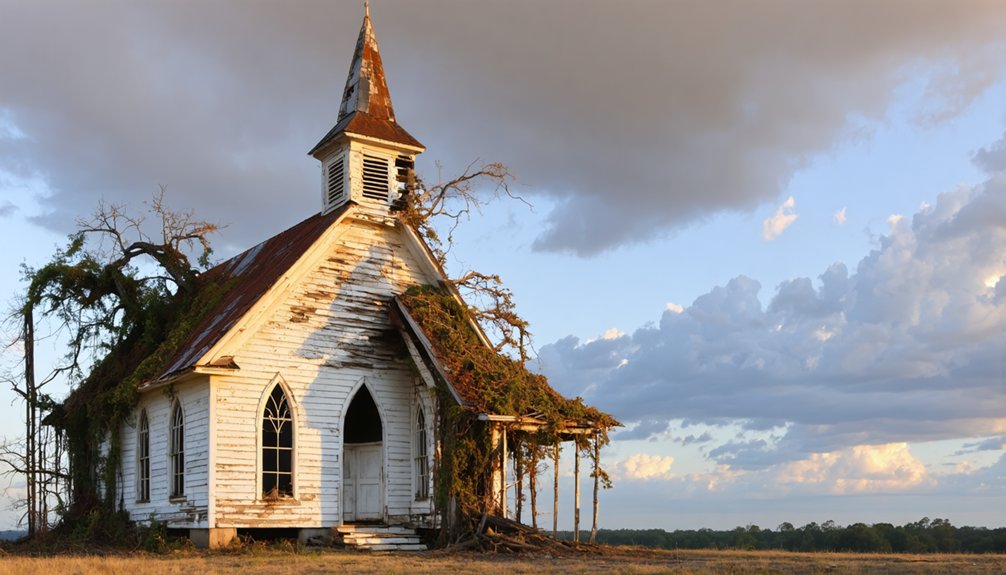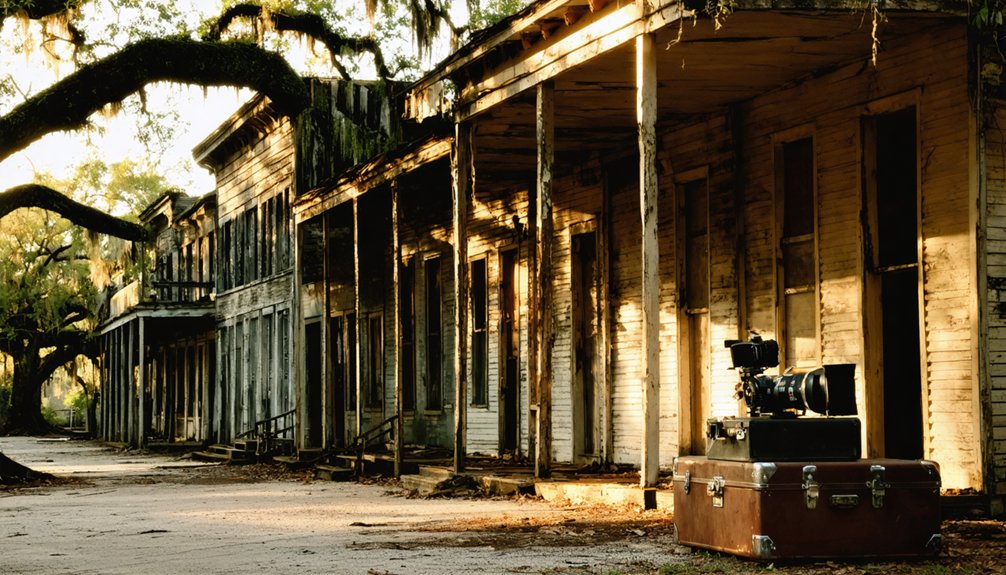
You’ll find Georgia’s ghost towns like Senoia, Covington, and Sparta serving as authentic filming locations due to their preserved vernacular architecture from the 1880s-1920s. Senoia’s transformation through *The Walking Dead* (2010-2022) exemplifies adaptive reuse, while Covington’s Newton County Courthouse anchored *The Vampire Diaries* production for eight seasons. These sites eliminate set construction costs through intact storefronts, antebellum residences, and industrial remnants. Georgia’s 20-30% tax credits combined with minimal restoration requirements create fiscally advantageous filming environments. The documentation below reveals how architectural preservation intersects with contemporary production logistics.
Key Takeaways
- Ghost towns like Haralson and Covington preserve authentic vernacular architecture, reducing production costs for period-appropriate films and series.
- Senoia transformed into a tourism hub after hosting *The Walking Dead*, attracting 15,000 annual visitors and increasing property values.
- Georgia offers 20-30% tax credits and minimal permitting complexity, making ghost town filming economically advantageous for productions.
- Covington served as *Vampire Diaries* filming location since 2009, with preserved structures like Newton County Courthouse anchoring cinematic tourism.
- Panola Mountain and High Falls State Parks provide minimally disturbed natural backdrops with historic industrial remnants for immersive filming.
Haralson: Where Hollywood Meets Forgotten Southern Architecture
While most Georgian settlements experienced steady demographic decline throughout the twentieth century, Haralson presents a unique archival case study: a bi-county municipality straddling Coweta and Meriwether counties that’s transformed its architectural abandonment into sustained cinematic infrastructure.
You’ll find a settlement where historical preservation occurs through documentation rather than restoration—28 film productions have catalogued its decay since incorporation in 1907. The population contracted from 166 (2010) to 172 (2020), yet this stagnation enables architectural authenticity that production designers can’t replicate on constructed sets. First settled in the 1820s, the town maintained its farming community character for over a century before cinema discovered its photogenic deterioration.
Located 40 miles from Atlanta’s metropolitan corridor, Haralson’s abandoned storefronts and deteriorating cotton mill facilities provide unrestricted filming environments. Productions including *The Walking Dead*, *Fried Green Tomatoes*, and *Driving Miss Daisy* have utilized these structures precisely because they’re ungoverned by contemporary commercial demands or regulatory constraints. The Esco Mill served as the backdrop for pivotal confrontation scenes, including Merle’s final encounter with the Governor and subsequent reunion with Daryl.
Senoia’s Transformation Through The Walking Dead Legacy
You’ll observe Senoia’s economic restructuring through location-based tourism, where approximately 15,000 annual visitors have catalyzed downtown commercial revitalization since 2014.
The town’s adaptive reuse of historic storefronts—transforming Georgia Mercantile Company and Steve’s Pharmacy into franchise pilgrimage sites—demonstrates how serialized television production creates sustained heritage tourism infrastructure. Guided tours operate at price points between $25 and $70, with operators like Georgia Tour Company offering two-hour walking experiences that blend character-costumed interpretation with celebrity encounter narratives.
This production-to-tourism pipeline has attracted subsequent Marvel projects, establishing Senoia as a satellite studio hub where real estate valuations near filming locations now start at $700,000. The town’s prominence within The Walking Dead fan community is reinforced through dedicated web resources like TWDLOCATIONS.COM, which archives filming sites and provides educational content for visitors planning their pilgrimage to this Georgia filming hub.
Downtown Revival Through Tourism
Since The Walking Dead began filming in 2010, Senoia’s downtown corridor has undergone a documented transformation from regional obscurity to destination tourism hub, with empirical evidence demonstrating sustained economic significance tied directly to the show’s production legacy.
You’ll observe urban renewal manifested through adaptive reuse of commercial structures—Georgia Mercantile Company now serves dual functions as retail space and Oceanside filming location.
Historic preservation efforts align with tourism infrastructure development, including visitor centers distributing self-guided walking tour maps and walk-of-fame plaques cataloging the town’s cinematic portfolio from *Fried Green Tomatoes* to *Sweet Home Alabama*.
Real estate valuation near Alexandria set locations starts at $700,000, reflecting market-driven demand.
Tourism operators report 15,000 annual participants, with international visitors constituting regular demographic segments, confirming sustainable economic diversification beyond traditional small-town revenue streams. The series’ 12-13 year production span generated extensive location reuse, embedding Senoia into the show’s visual identity across multiple seasons and storylines. The town’s studio satellite and backlot infrastructure supports continued production activities, maintaining Senoia’s role as an active filming destination beyond the original series.
Marvel Productions Post-Walking Dead
Following The Walking Dead’s production conclusion in 2022, Senoia’s filming infrastructure pivoted toward diversified entertainment tourism models that leverage existing backlot assets alongside expanded cinematic offerings. You’ll find Southern Hollywood Film Tour now integrates Marvel fan sites with established zombie locations, creating hybrid experiences that maximize the town’s studio satellite legacy.
This shift demonstrates how production spaces maintain economic viability post-primary filming through character development narratives spanning multiple franchises. The Alexandria set’s 15-foot corrugated metal perimeter and downtown Woodbury locations provide adaptable environments for costume design requirements across genres. The Walking Dead Museum preserves original show props including costumes and memorabilia for visitor exploration.
Georgia Tour Company’s 15,000 annual visitors explore gift shop walking maps connecting TWD episode-specific action spots with emerging Marvel-related filming sites, transforming Senoia’s 3,300-population Coweta County footprint into Georgia’s premier cinematic heritage destination.
Covington Square: The Town That Became Mystic Falls
When The Vampire Diaries production team selected Covington, Georgia, as the physical manifestation of fictional Mystic Falls in 2009, they transformed a working Southern town into one of television’s most recognizable filming locations. You’ll find the 1884 Newton County Courthouse clock tower at 1124 Clark Street SW serving as the series’ narrative anchor point.
The production utilized residential exteriors on Floyd Street and Conyers Street for principal characters’ homes, though interiors remained soundstage-bound. The Lockwood Mansion exterior at 2129 East Street SE hosted pivotal sequences including the masquerade ball and Miss Mystic Falls pageant, though the private residence restricts access beyond front gate photography. Fans frequently share their Covington visits through #VampireDiaries hashtags and social media posts documenting their experience in the fictional town.
Cultural preservation efforts materialized through the Covington Welcome Center’s archival mapping systems and the Pop-Up TV and Film Museum’s exhibition spaces. Community impact extended beyond passive tourism—Vampire Stalkers established dedicated tour operations, while the Mystic Grill restaurant opened at 1116 Clark Street SW in 2014, monetizing the show’s exterior filming location into permanent commercial infrastructure.
Sparta’s Role in Preserving Decaying Americana on Film
The television series “In the Heat of the Night” (1988-1995) established Covington, Georgia, as fictional Sparta through systematic location doubling across its first four seasons, creating an inadvertent preservation archive of small-town Southern architecture before documented decay trajectories altered the built environment.
Television inadvertently preserved 1980s Covington architecture through location shooting, creating temporal records before structural decay reshaped the Southern built environment.
You’ll find structures like City Hall (1174 Monticello St.) and Sparta Methodist Church (1135 Floyd St., demolished by 2025) captured during their operational phases, now serving as temporal benchmarks. The Ware Mansion and Gray House demonstrate period-specific architectural integrity before urban decay accelerated.
These filming locations document Hancock County’s 600 historic sites, providing comparative analysis between romanticized cotton-era aesthetics and current abandonment patterns.
Preservation efforts focus on structures like “Her Majesty” courthouse, while photographic documentation (2022-2025) tracks deterioration rates across residential and commercial properties. The production’s relocation to Covington after Season 1 in Hammond, Louisiana, established consistent visual continuity across municipal buildings, residential streets, and commercial districts that defined the series’ authentic Southern atmosphere.
Panola Mountain State Park’s Hidden Filming Heritage
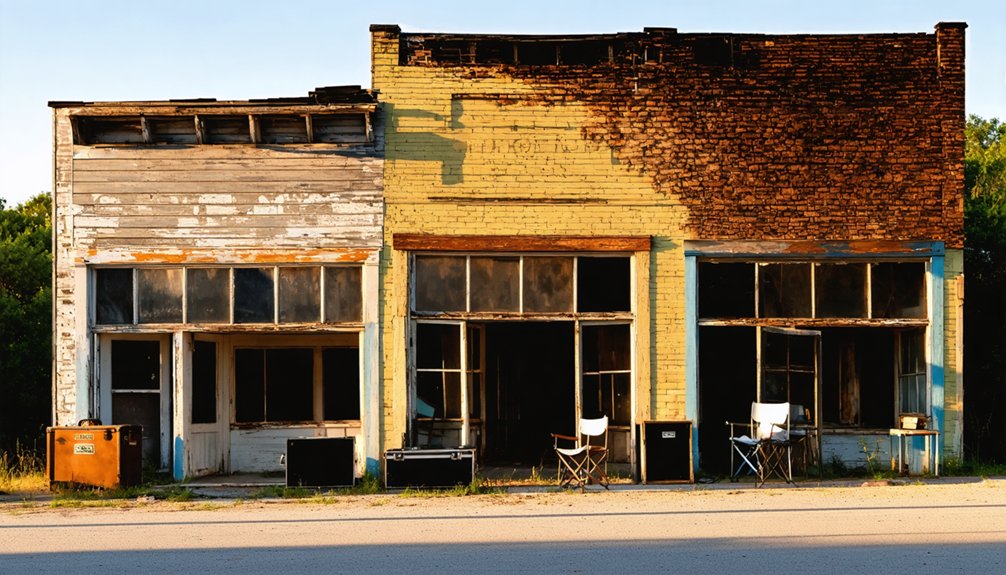
Unlike Covington’s systematic location doubling, Panola Mountain State Park’s filming heritage emerged through selective environmental extraction, where productions leveraged specific topographical features—granite outcrops, historic agrarian structures, and hydrological elements—rather than extensive geographic substitution.
Netflix’s “Cobra Kai” utilized the park’s 100-acre granite outcrop for training sequences, while “The Vampire Diaries” transformed Alexander Lake into Mystic Falls‘ aquatic scenes across eight seasons.
HBO’s “The Outsider” centered on Vaughters’ Barn, a dairy farm remnant requiring $200,000 in historical preservation funding. This 1800s-era structure represents strategic secret filming infrastructure—preserved specifically to prevent urban sprawl while maintaining cinematic utility.
You’ll access these locations through three trailheads, though professional photography demands commercial permits. The park’s conservation-focused management restricts granite mountain access to ranger-led expeditions, protecting both rare species and location authenticity.
High Falls State Park: Natural Scenery for Classic Productions
The production’s location scouts prioritized the park’s 4.5-mile trail network threading through wildlife habitats and forest landscapes.
Where accessible ruins of cotton gins and blacksmith operations provided unregulated visual textures.
You’ll find these abandoned industrial footprints throughout the riparian corridor, offering cinematographic flexibility without contemporary intrusions—essential for period-accurate productions seeking unencumbered natural backdrops.
Why Georgia’s Abandoned Towns Attract Major Film Studios
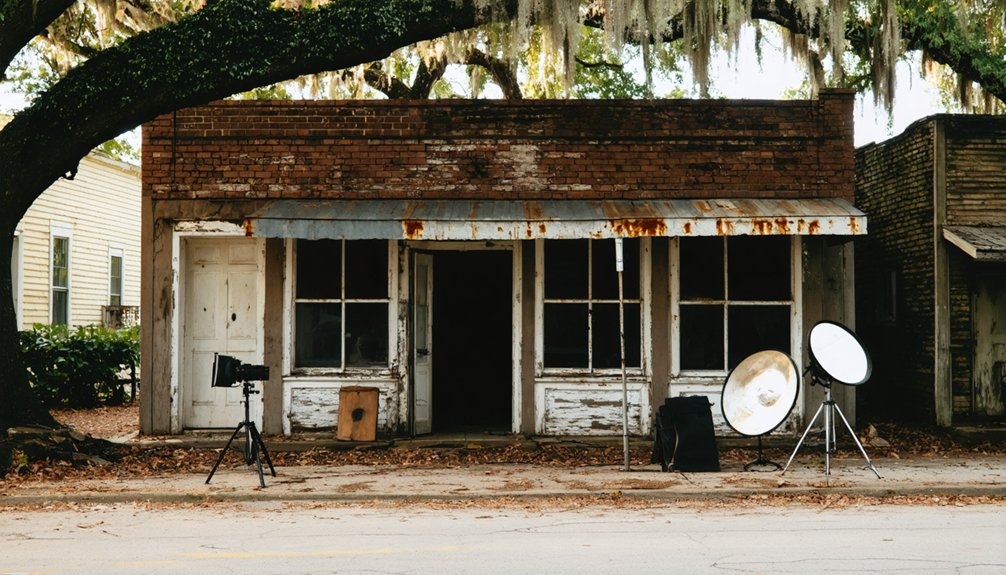
You’ll find that Georgia’s abandoned mill towns preserve vernacular architecture from specific historical periods, eliminating the need for costly façade construction or digital set extensions.
These locations offer production companies significant budgetary advantages through reduced art department expenditures and minimal permitting complications in low-population municipalities.
The absence of residential density and commercial activity enables crews to secure total site control without coordinating extensive traffic management or civilian displacement protocols.
Authentic Period Architecture Remains
When production designers scout locations for period films, Georgia’s abandoned settlements offer structurally intact vernacular architecture that eliminates costly set construction. You’ll find genuine architectural preservation in towns like Haralson, where the Hutcherson and McGee Mercantile’s original 1800s facade survived lightning fires without modern alterations.
Historical authenticity emerges through:
- Covington’s 1883 Masonic lodge providing unmodified 19th-century interiors with intact stained glass
- Senoia’s weathered storefronts requiring zero dressing for post-apocalyptic scenarios
- Savannah’s antebellum structures featuring Spanish moss-draped exteriors and period-correct ornamental details
- State park ruins at Sweetwater Creek offering distressed industrial remnants
These sites grant filmmakers access to genuine material culture—original brickwork, authentic fenestration patterns, and undisturbed spatial configurations—that computer-generated imagery can’t replicate convincingly.
Lower Production Costs
Beyond aesthetic considerations, Georgia’s ghost towns deliver quantifiable cost reductions that fundamentally alter production budget allocations. You’ll access 20-30% transferable tax credits, plus an additional 10% uplift when filming in economically distressed areas—reducing effective costs by 40%.
Historical preservation requirements remain minimal in abandoned sites, eliminating restoration expenses. Filming permits in towns like Grantville (population 327) cost substantially less than urban jurisdictions, while sparse populations eliminate crowd control overhead.
You’re within one hour of Atlanta’s equipment hubs and a 10,000-strong crew base, cutting logistics expenses without sacrificing talent access. Tyler Perry Studios’ proximity enables soundstage integration with on-location shoots.
Local vendors provide services at rates 50% below metropolitan averages, while payroll rebates cover 20% of Georgia-sourced labor—the formula that saved Marvel millions.
Flexible Filming Without Crowds
Production logistics dictate that crowd management often constitutes 15-20% of location shooting budgets in metropolitan environments—a cost structure Georgia’s depopulated municipalities fundamentally eliminate. When you’re operating in Senoia, Sharpsburg, or Grantville, logistical planning simplifies dramatically. These townships grant production teams autonomous control over shooting environments without bureaucratic constraints or crowd control expenditures.
Consider the operational advantages:
- Uninterrupted production schedules free from pedestrian interference
- Minimal permitting complexity in cooperative small-town jurisdictions
- Authentic post-apocalyptic transformation of abandoned infrastructure without displacement concerns
- Extended shooting windows without rush-hour or commercial district limitations
*The Walking Dead* demonstrated this principle across multiple seasons—abandoned streets became dystopian landscapes while crews maintained complete environmental authority. You’re securing creative autonomy while eliminating metropolitan overhead.
Frequently Asked Questions
Can Tourists Visit These Filming Locations Year-Round or Are Some Restricted?
You’ll find most filming locations accessible year-round without significant access restrictions. Seasonal visitors can freely explore abandoned storefronts, state parks, and downtown squares. However, active production schedules may temporarily limit entry to specific sites during shoots.
Do Film Productions Pay Fees to These Small Georgia Towns?
You’ll find productions become golden tickets for municipalities. Film incentive programs generate location fees and infrastructure investments, while town revitalization efforts leverage entertainment-sector capital flows. Georgia’s documentary evidence confirms productions compensate towns through permit structures and economic development partnerships.
How Do Local Residents React to Major Film Crews Disrupting Daily Life?
You’ll find residents tolerate noise and traffic disruptions while maintaining autonomy over their environment. Local community engagement remains minimal—they’ve strategically preserved farming traditions and rejected development, accepting film revenue without surrendering their preferred quiet, independent lifestyle.
What Permits Are Required for Filming in Georgia’s Historic Ghost Towns?
You’ll need municipal permits from the county liaison ten business days prior, addressing filming logistics like equipment placement and traffic control. While costume authenticity isn’t regulated, you must submit insurance documentation, location photos, and coordinate state agency access for historic properties.
Are Original Props or Sets From Famous Productions Still Visible Today?
You won’t find original props preserved on-site, as productions typically remove all elements post-filming. However, historical preservation efforts maintain architectural integrity, while local economic impact drives communities to sustain authentic period structures for recurring production opportunities.
References
- https://www.youtube.com/watch?v=azlG4Y7pn8Y
- https://www.weirdsouth.com/post/where-did-they-shoot-that
- https://destinationfilmguide.com/georgia-filming-locations/
- https://www.youtube.com/watch?v=-9fLOIsaz6M
- https://www.youtube.com/watch?v=dgdjBMdq3-g
- https://nextstopadventures.com/haunted-and-filming-locations-in-georgia
- https://exploregeorgia.org/article/iconic-filming-locations-in-georgia
- https://www.thisismysouth.com/walking-dead-sets-locations/
- https://www.youtube.com/watch?v=FdH2GYU8VQI
- https://www.youtube.com/watch?v=1iA6fDnCq5w