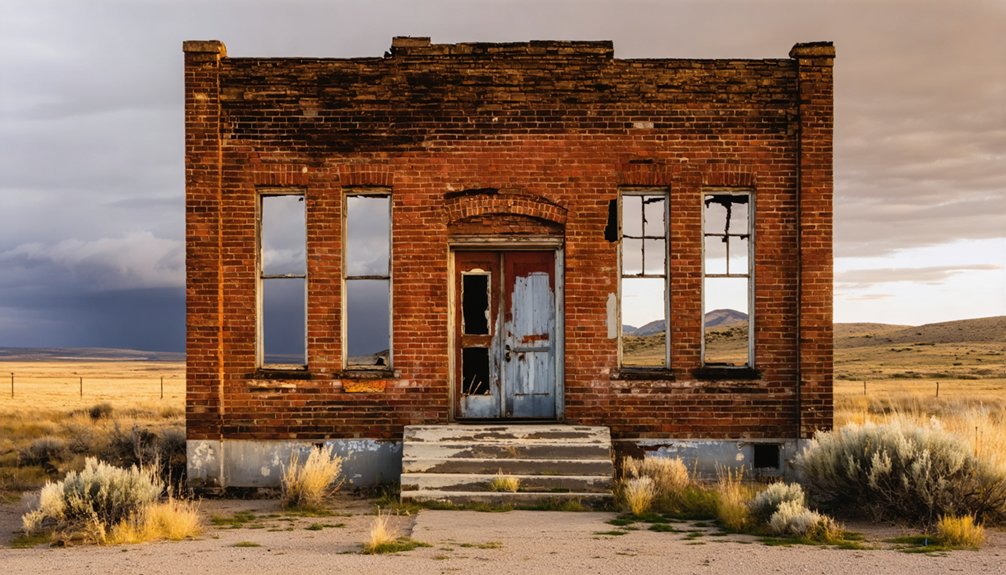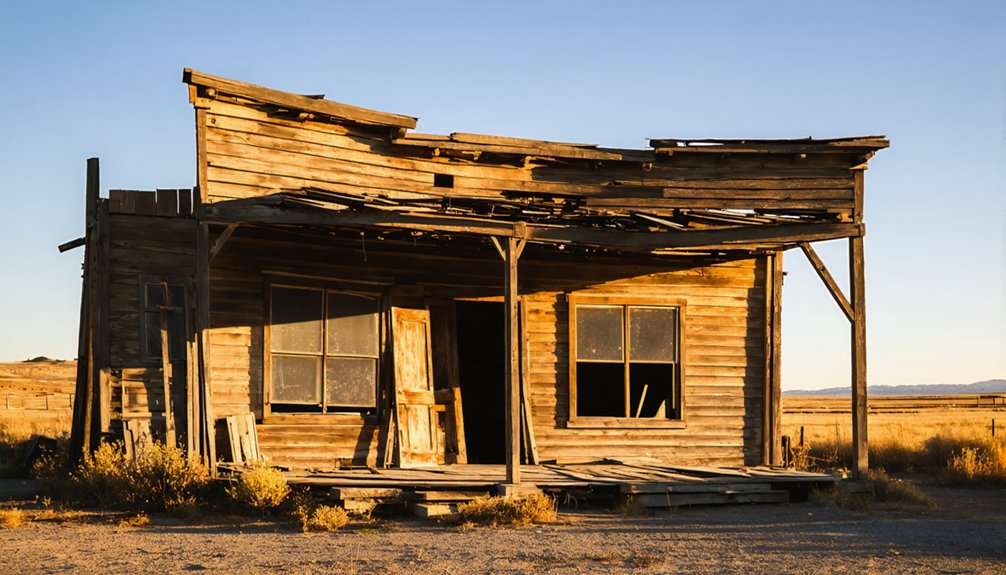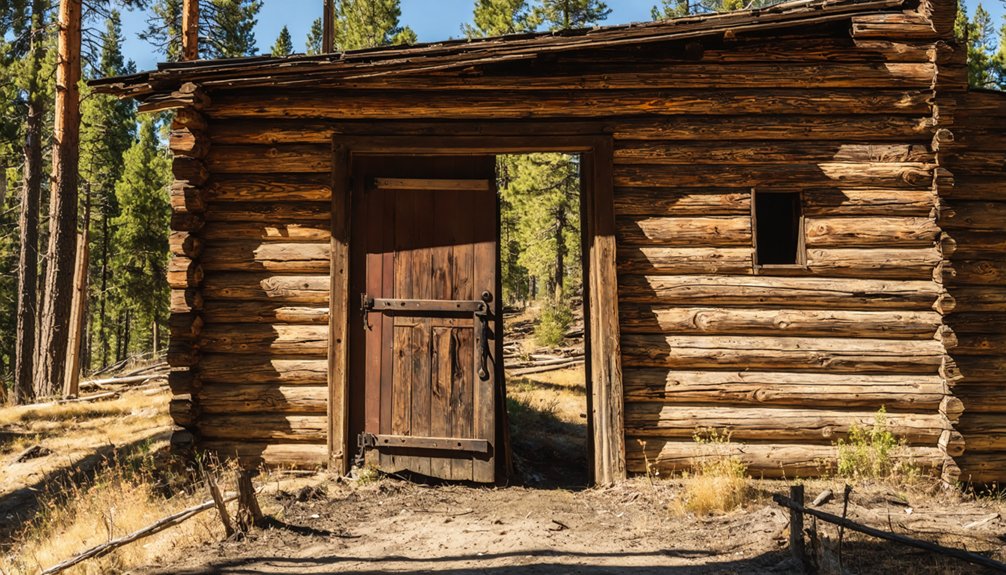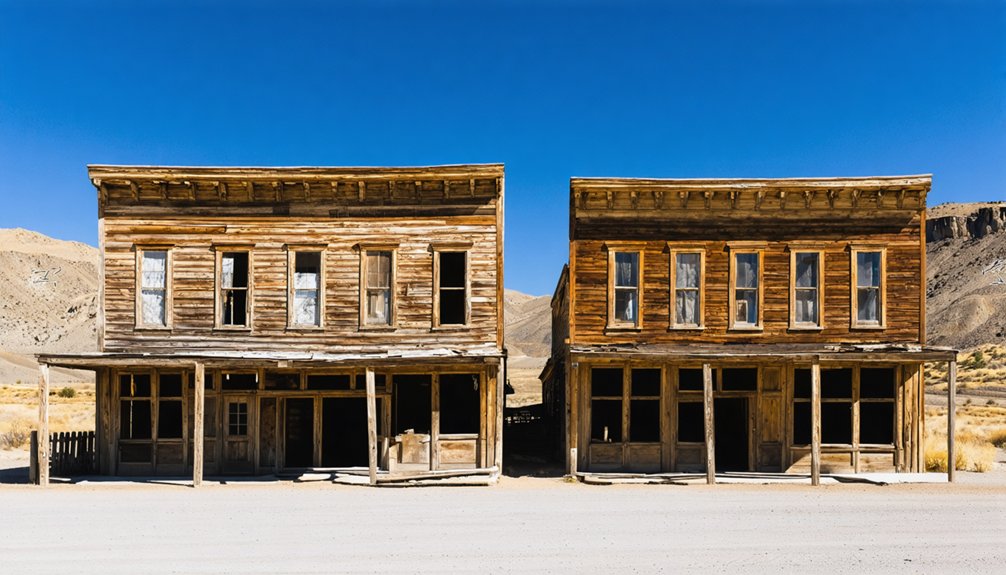
You’ll find Idaho’s ghost towns serving as authentic film sets, most especially Silverton’s weathered structures for Pierce Brosnan’s *Dante’s Peak* helicopter scenes, and Wallace’s preserved Victorian downtown on Cedar Street. Bonanza offers unrestored 1870s miners’ cabins along Yankee Fork, while Custer provides interpretive tours through its 29-acre historic district. The Sawtooth Mountains backed Clint Eastwood’s *Pale Rider*, where crews built LaHood, California amid jagged peaks. These locations deliver genuine Western atmospheres without costly set construction, their natural decay and remote mountain backdrops creating compelling cinematic environments that reveal deeper stories.
Key Takeaways
- Silverton served as the main filming location for Pierce Brosnan’s helicopter scene in *Dante’s Peak* (1996), utilizing its natural decay.
- Wallace’s preserved Victorian-era mining town architecture on Cedar Street provided authentic scenery for *Dante’s Peak* without requiring modifications.
- Bonanza offers weathered 1870s-1880s miners’ cabins and mill buildings, providing genuine wilderness backdrops for frontier-themed productions.
- Remote Sawtooth locations feature original late-19th-century structures with striking geological formations, ideal for authentic Old West filmmaking.
- Idaho’s ghost towns provide cost-effective filming with weathered facades, mountain scenery, and authentic late-1800s settings without modern disruptions.
Silverton: The Eerie Backdrop of Dante’s Peak
Nestled west of Wallace in Idaho’s rugged Panhandle, Silverton stands as a decayed monument to the state’s mining heritage—a ghost town where weathered wooden frames and crumbling foundations pierce through encroaching forest growth. During 1996’s principal photography for *Dante’s Peak*, you’ll find this desolate settlement served a vital function: capturing Pierce Brosnan’s helicopter arrival in the fictional volcanic disaster zone.
The Silverton ambiance—isolated, foreboding, authentically abandoned—provided precisely what digital effects couldn’t replicate: genuine decay and remoteness. Filming logistics stayed remarkably simple. A cement square in the town’s center became the landing pad, requiring zero set construction. The helicopter scene was shot at Mount St. Helens, with volcanic activity depicted to enhance the disaster narrative.
The production team exploited natural deterioration, shooting quickly mere miles from Wallace’s main locations. Wallace’s entire town earned its place on the National Register of Historic Places, making it a uniquely authentic filming backdrop. Limited access roads and overgrown structures amplified the vulnerable, cut-off atmosphere essential to the film’s Pacific Northwest disaster narrative.
Wallace: A Historic Mining Town Transformed for the Silver Screen
While Silverton offered raw abandonment for *Dante’s Peak*’s disaster scenes, the production’s primary operations centered seven miles east in Wallace—a remarkably preserved Victorian-era mining town.
Every brick building and False-fronted storefront served the film’s 1990s Pacific Northwest setting without requiring period alterations. You’ll find Wallace’s entire downtown listed on the National Register of Historic Places, a designation that delayed Interstate 90 construction for seventeen years while prioritizing cultural preservation over federal highway schedules.
This protected status became Wallace’s cinematic asset: production crews filmed extensively along Cedar Street’s intact 1890s architecture, utilizing the Wallace District Mining Museum and operational storefronts as ready-made sets.
The film’s economic development impact introduced tourism revenue streams beyond Wallace’s remaining Lucky Friday Mine operations, diversifying income after the 1981 Bunker Hill smelter closure devastated employment.
Bonanza: Authentic Abandoned Structures in the Sawtooth Wilderness
You’ll find Bonanza ghost town along the Yankee Fork of the Salmon River, where weathered wooden structures stand unrestored against the Sawtooth Wilderness backdrop.
The site’s deteriorating miners’ cabins, mill buildings, and equipment retain their authentic 1870s-1880s character without Hollywood facades or reconstruction.
This remote location—accessible via rough gravel roads through forested mountain terrain—offers filmmakers genuine period mining architecture in a landscape isolated enough to avoid modern intrusions in wide shots. Similar to historic filming sites that transitioned from Hollywood productions to public spaces, the ghost town provides visitors access to authentic Western settings. The authentic Western ranch visuals and preserved historical structures provide the same immersive experience that made locations like the Ponderosa Ranch near Lake Tahoe compelling for depicting 1860s frontier life.
Unrestored Mining Town Character
Deep in the Sawtooth National Recreation Area along Yankee Fork, Bonanza sprawls as a genuine unrestored ghost town where falling-down shacks and structures in shambles dot the landscape exactly as abandonment left them.
You’ll find no ghost town preservation efforts here—just authentic deterioration from the 1880s mining heyday. The abandoned architecture remains untouched: residences behind the old saloon site with shingled roofs barely clinging to warped frames, scattered debris making navigation treacherous, and original buildings collapsing under Idaho’s harsh elements.
Unlike nearby Custer’s restored facades, Bonanza’s private ownership status since 2005 has prevented any intervention. Warning signs mark the boundaries, though only gravesites receive minimal maintenance. Visitors should exercise caution due to broken glass fragments along paths and unmaintained roads throughout the ghost town area.
The tailings mounds from dredge operations and crumbling structures create an unmanicured snapshot of genuine western abandonment. Historic signage throughout the site offers insight into Bonanza’s past as a gold mining hub, providing context to the deteriorating structures.
Yankee Fork Historical Significance
Bonanza’s crumbling structures tell the story of Yankee Fork’s explosive 1879 gold rush, when thousands of miners transformed a struggling creek into one of Idaho’s most productive mining districts.
You’ll explore authentic buildings spanning 1877-1911, preserved within the 521-acre Land of the Yankee Fork State Park. The industrial archaeology reveals a mile-long settlement pattern alongside neighboring Custer, where 300 residents once processed ore from the Custer Mill.
Unlike sanitized historic sites, these structures remain unrestored—weathered wood, collapsed roofs, and rusted equipment document real mining operations that extracted millions before exhaustion shuttered operations in 1911.
Preservation techniques focus on stabilization rather than reconstruction, letting you witness genuine decay. The interpretive center features a working stamp mill model that demonstrates the ore-processing technology once employed throughout the district.
The Yankee Fork Dredge, weighing 988 tons and equipped with 72 buckets, operated from 1939 to 1952 and now offers summer tours as a preserved piece of mining history. Self-guided access means you’re free to photograph, explore, and interpret this Sawtooth ghost town without restrictions.
Remote Sawtooth Location Appeal
Perched 60 miles northwest of Sun Valley, Bonanza ghost town delivers filmmakers an unrestored mining settlement backdrop within the Sawtooth National Recreation Area‘s jagged peaks.
You’ll find original late-19th-century structures standing untouched, offering authentic period details without costly set construction. The gravel road access balances production logistics with genuine isolation—your crew reaches the location while maintaining the remote wilderness aesthetic essential for convincing frontier storytelling.
The surrounding geological formations create dramatic visual depth, with sharp mountain ridges framing weathered buildings that once housed thousands during the silver boom.
Wildlife habitats merge seamlessly with crumbling architecture, adding unpredictable natural elements to shots. This isn’t manufactured nostalgia—it’s preserved abandonment where authentic mining artifacts remain visible, giving you ready-made film sets that capture untamed territorial atmosphere without artifice.
Custer: A Restored Ghost Town Preserving Pioneer Heritage
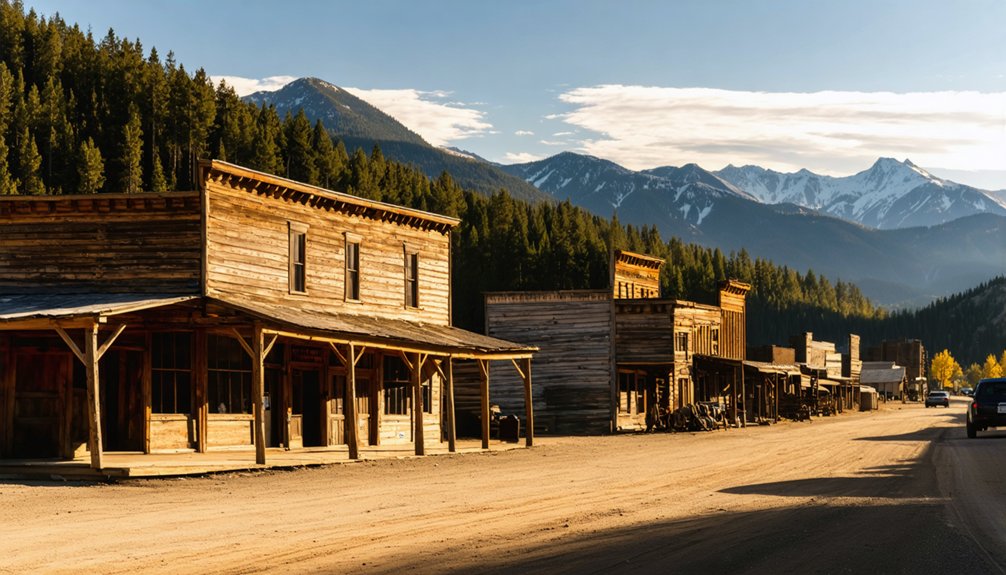
You’ll find free guided and self-guided walking tours operating from Memorial Day through Labor Day, where volunteers stationed at the general store provide maps and historical context as you explore pathways connecting over a dozen preserved structures.
The interpretive signs positioned throughout the site detail the gold dredging operations that churned through Yankee Fork’s low-grade placers from 1939 to 1951, leaving visible scars across the valley landscape that filmmakers often incorporate into Western productions.
Inside the restored cabins, you can examine artifacts like ballot boxes and period furniture while guides explain how the dredge’s massive floating platform consumed riverside terrain long after the original mines closed in 1904.
Summer Tours and Guides
The restored ghost town of Custer operates free walking tours from Memorial Day through Labor Day, welcoming visitors to explore over a dozen preserved structures scattered across its 29-acre historic district at 6,470 feet elevation.
You’ll start at the historic schoolhouse museum, where knowledgeable docents provide context about pioneer life and mining operations.
Informational signs guide you independently through the Empire Saloon-turned-gift-shop, assay office, and transportation buildings displaying original equipment.
The mountain valley setting offers opportunities to spot local wildlife while wandering between weathered cabins maintained in 19th-century condition.
You won’t pay entrance fees, and you’re free to photograph the original wallpaper remnants and mining artifacts.
Seasonal events occasionally enhance the experience.
Camping’s available throughout the valley, with Stanley’s lodging 21 miles away.
Gold Dredging Historical Impact
Gold prospectors founded Custer in early 1879, and within two decades the settlement had expanded into a proper mining town of 600 residents supported by the Lucky Boy and Black mines.
By 1911, the gold rush had ended, transforming Custer into a ghost town. You’ll find the dredging operations that began in 1939 arrived too late to revive the economy but left lasting scars across the Yankee Fork River valley.
The massive Yankee Fork Dredge, operating until 1951, carved through the landscape in pursuit of low-grade placer deposits.
Today you can explore this mining heritage firsthand—the preserved dredge stands as a monument to both industrial ambition and environmental consequence.
Restoration projects continue addressing the destruction while maintaining authentic structures that captured filmmakers’ attention for authentic Western backdrops.
Sawtooth National Recreation Area: Filming Ground for Western Epics
When Clint Eastwood’s production crew scouted locations for *Pale Rider* in 1984, they found their ideal Western backdrop in Idaho’s Sawtooth National Recreation Area—a vast expanse of rugged peaks and pristine valleys that would anchor one of the decade’s most successful films.
You’ll discover the production concentrated shooting in the Boulder Mountains north of Sun Valley, where mountain ecology provided authentic, smog-free landscapes California couldn’t match.
The crew constructed a complete Western town set from scratch in just one month, naming it LaHood, California, though wilderness conservation regulations kept the build miles from primary filming sites.
Opening credits showcased the jagged Sawtooth Mountains south of Stanley, delivering the visual feast that made *Pale Rider* the highest-grossing Western of the 1980s and cementing Idaho’s cinematic reputation.
Additional Idaho Filming Locations Beyond Ghost Towns
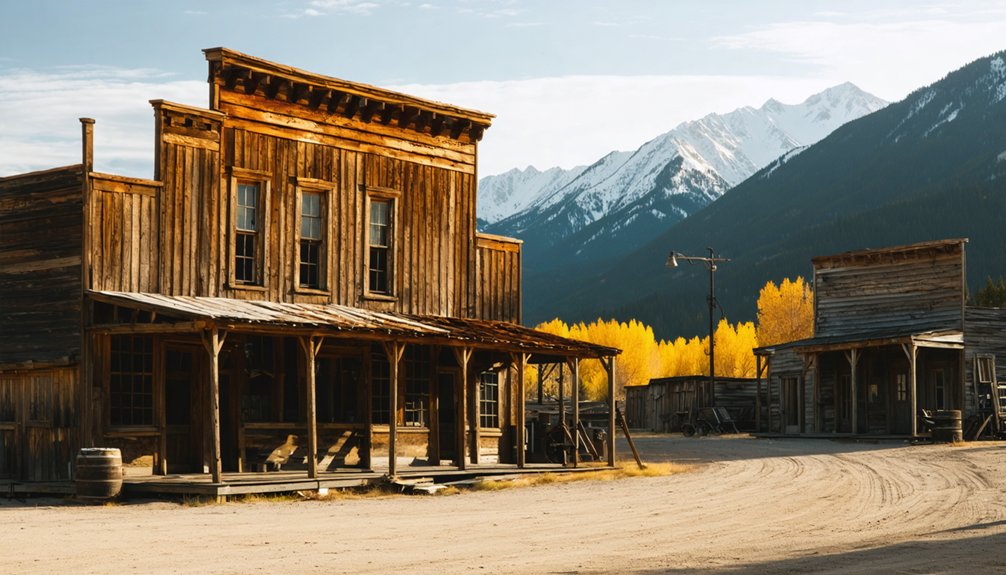
Beyond ghost towns and wilderness sets, Idaho’s urban centers and small communities have served production crews seeking diverse backdrops ranging from penitentiaries to high schools.
Preston’s High School became Napoleon Dynamite‘s most recognizable location, helping the 2004 cult classic gross over $100 million while maintaining its small-town authenticity. You’ll find filming logistics have evolved—Boise now requires permits since January 2023, with fees handled case-by-case through the City Clerk’s Office.
Historical preservation meets cinematic versatility across these locations:
- Old State Penitentiary’s castle-like structure from the late 1800s provides adaptable period settings.
- Downtown Boise’s skyscrapers against mountain backdrops double for various metropolitan scenes.
- State Capitol Building mimics DC architecture from distance shots.
Ketchum hosted Marilyn Monroe’s Bus Stop (1956), while Wallace stood in for Washington in Dante’s Peak—proving Idaho’s geographic flexibility for location scouts.
The Cinematic Appeal of Idaho’s Abandoned Mining Communities
Idaho’s abandoned mining communities deliver production value through deteriorating facades, mountain backdrops, and streets frozen in late-1800s layouts—eliminating costly set construction. You’ll find Silverton’s desolate positioning in the Coeur d’Alene Mountains provided Dante’s Peak with isolation that studio backlots can’t replicate.
Crumbling mining towns offer filmmakers century-old authenticity and dramatic mountain isolation at a fraction of traditional set construction costs.
Wallace’s preserved downtown offered filmmakers authentic streetscapes without modern intrusions. In the Sawtooth National Recreation Area, Custer and Bonanza present contrasting options—partially restored versus untouched decay.
These sites function like ancient ruins, telling stories through weathered timber and collapsed structures. Pale Rider capitalized on this authenticity, filming prospector camps along genuine mountain streams.
Modern tourism hasn’t erased the mining heritage that makes these locations compelling. You’re accessing real history without permits for demolition or period-accurate construction expenses.
Frequently Asked Questions
Can Tourists Visit the Exact Filming Locations Used in Dante’s Peak?
You can visit most Dante’s Peak locations around Wallace, Idaho. Historical preservation maintains the town’s authentic character, though filming logistics required some sites like the bridge to be shot 20+ miles away for dramatic effect.
Are Any Idaho Ghost Towns Still Used for Modern Film Productions?
No modern productions have used Idaho’s ghost towns since 1997’s Dante’s Peak at Silverton. You’ll find these sites now prioritize historical preservation and tourist attractions over filming, maintaining their authentic rugged character for visitors seeking adventure.
What Permits Are Required to Film at Idaho’s Ghost Town Locations?
Filming permits depend on your ghost town’s jurisdiction—you’ll need commercial permits for state parks ($100 fee) or federal lands, while unincorporated areas require county authorization. Location restrictions vary considerably, so contact relevant land management agencies before shooting.
How Do Filmmakers Preserve Ghost Towns During Production Activities?
You’ll find filmmakers employ strict historical preservation protocols and conservation practices by avoiding structural alterations, capturing natural decay as-is, limiting crew access to fragile sites, and relying on authentic architecture rather than constructing invasive sets that compromise integrity.
Which Idaho Ghost Town Offers the Best Accessibility for Visitors?
Wallace offers you the best accessibility with established visitor infrastructure, paved roads, and maintained historical preservation. You’ll find authentic mining-town streets, operating businesses, and tour facilities—perfect freedom to explore without remote-location challenges that limit other ghost towns.
References
- http://oreateai.com/blog/exploring-the-filming-locations-of-dantes-peak/665bb841ad22bc7b99dac1eb6e1867fe
- https://giggster.com/guide/movie-location/where-was-pale-rider-filmed
- https://www.tripadvisor.com/Attraction_Review-g28933-d1775240-Reviews-Bonanza_and_Custer_Ghost_Town-Idaho.html
- https://greatamericanwest.co.nz/top-3-movies-that-will-bring-idaho-to-you/
- https://kezj.com/ranking-the-best-movies-filmed-in-idaho/
- https://www.youtube.com/watch?v=ZFXPJ6y3gxM
- https://www.youtube.com/watch?v=iducKnxH2WA
- https://www.onlyinyourstate.com/state-pride/idaho/movie-filming-small-town-id
- https://www.youtube.com/watch?v=h5pcsjlE9wk
- https://movie-locations.com/movies/d/Dantes-Peak.php