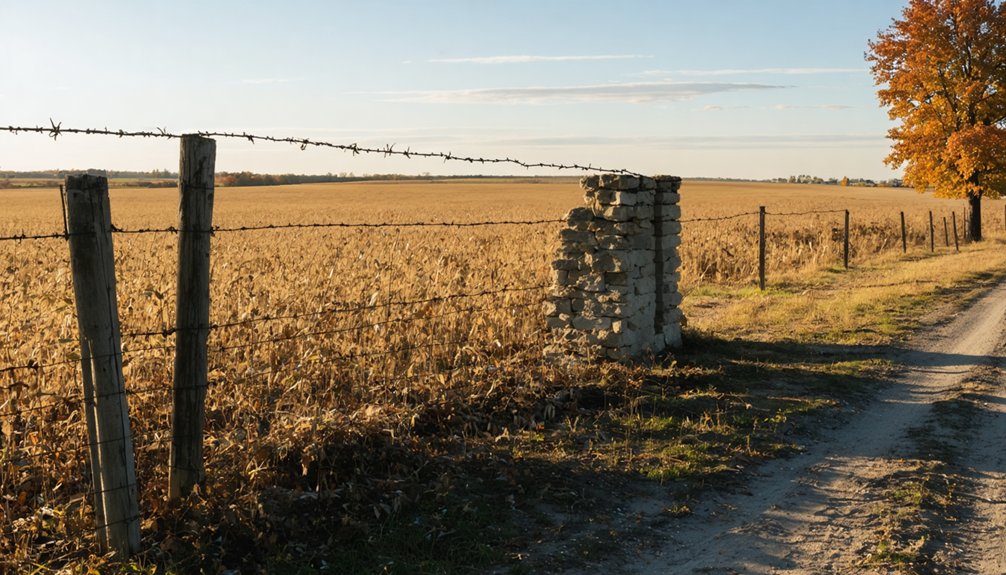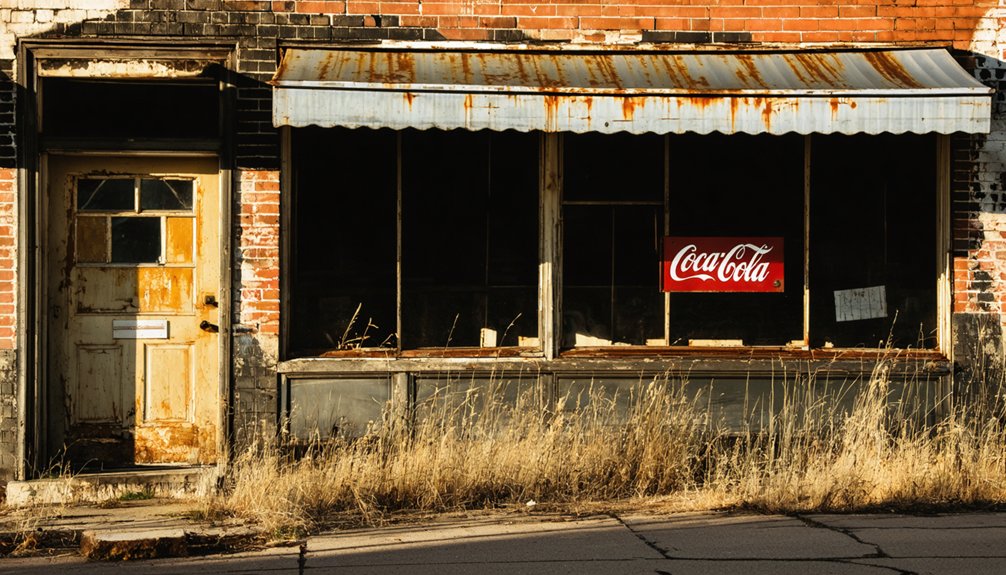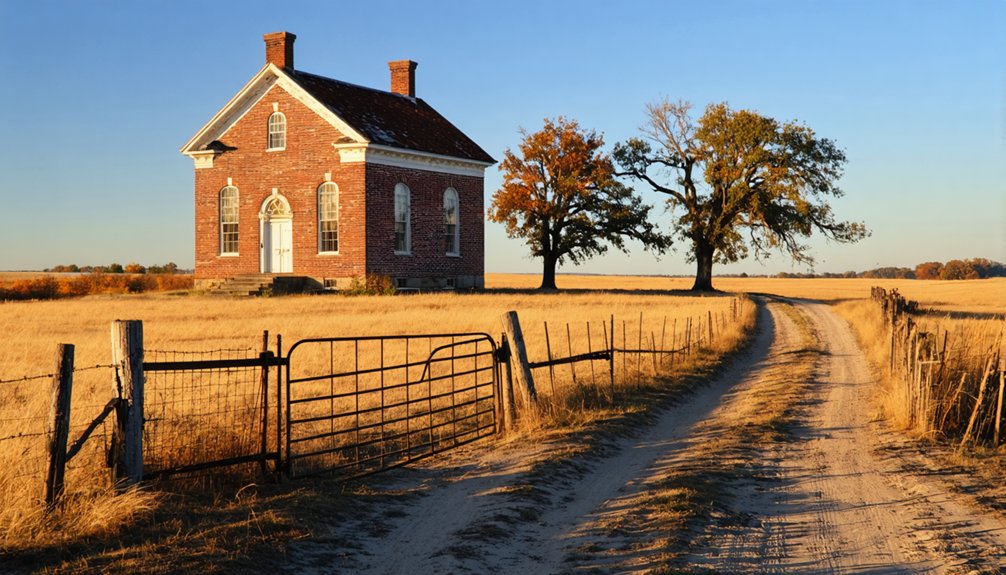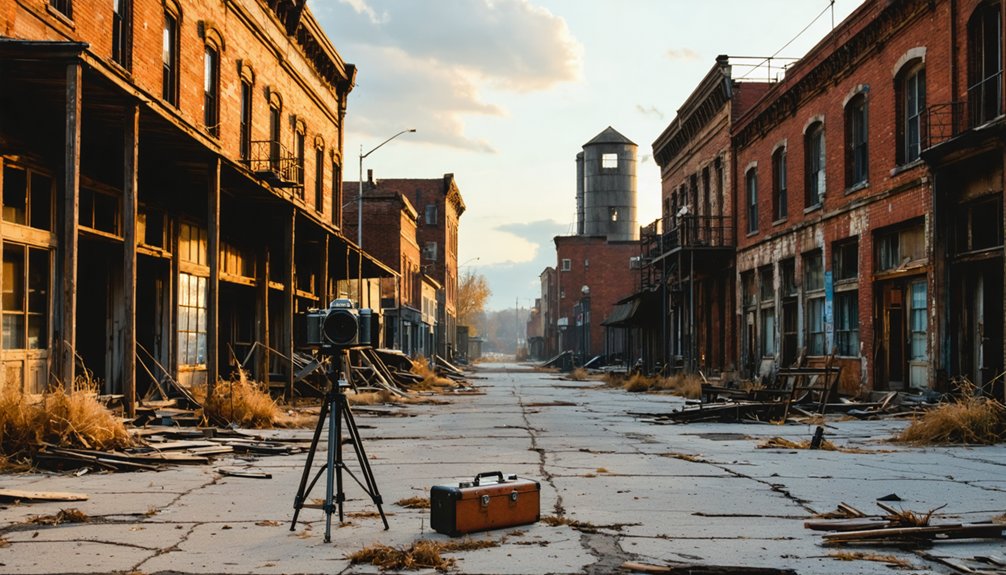
You’ll find Illinois’s most cinematic abandoned locations at Ashmore Estates, a decommissioned psychiatric hospital where 100 documented deaths created paranormal activity perfect for horror shoots, and Damen Silos, whose 35 weathered grain structures along the Sanitary and Ship Canal provide authentic industrial decay since 1977. Bachelor’s Grove Cemetery offers overgrown headstones and the famous “White Lady” apparition, while Old Joliet Prison‘s limestone walls hosted *Prison Break* and *The Blues Brothers*. These locations reveal how institutional abandonment transforms into atmospheric filming opportunities.
Key Takeaways
- Damen Silos spans 23.4 acres featuring 49 decommissioned industrial structures, providing authentic urban decay settings without requiring set construction.
- Old Joliet Prison’s 16-acre limestone campus served as filming location for *Prison Break*, *The Blues Brothers*, and *Public Enemies*.
- Ashmore Estates, a former psychiatric hospital, operates as both paranormal investigation site and filming location with authentic institutional decay.
- Bachelor’s Grove Cemetery offers isolated, overgrown atmosphere 24 miles south of Chicago, popular for ghost-themed filming and paranormal documentation.
- Chicago’s abandoned Cabrini-Green housing and Wabash Avenue toy factory provided decayed urban settings for horror films like *Candyman*.
Salem and Antioch: Amityville Horror’s Midwestern Transformation
When the 2005 *Amityville Horror* remake required a Victorian mansion sinister enough to embody one of America’s most notorious haunted houses, production scouts turned to Oakwood Manor at 27618 Silver Lake Road in Salem, Wisconsin. The 1880 Queen Anne structure‘s lakeside positioning and century-old authenticity provided ideal Midwestern architecture for transformation.
Production crews invested $60,000 constructing a facade replicating the original property’s quarter-moon “evil eye” windows, built an on-site boathouse, and artificially aged exterior paint. Following production, the facade was removed but the quarter moon eye windows were sold in 2017 and now remain on display locally. Filming logistics extended across multiple locations—St. Peter Catholic Church in Antioch, Illinois sat eleven minutes away for additional scenes, while Chicago, Buffalo Grove, and Fox Lake hosted supporting shots. The property has since gained recognition within horror and paranormal communities for its role in bringing the infamous story to screen.
You’ll find no studio work here; every frame captured authentic spaces, with both interior and exterior sequences utilizing the Wisconsin manor‘s Victorian bones.
Chicago’s Urban Landscape in Classic Horror Cinema
While Victorian mansions in Wisconsin townships offered architectural menace for suburban horror narratives, Chicago’s concrete density provided an altogether different canvas for terror. You’ll find Candyman’s haunted streets centered on Cabrini-Green’s urban decay, where Virginia Madsen summoned a hook-handed spirit at Division and Clybourn.
Chicago’s crumbling towers and forgotten housing projects transformed urban decay into visceral horror, no gothic facades required.
The Field Museum became The Relic’s hunting ground as creatures stalked exhibits at 1400 S. Lake Shore Drive. Child’s Play transformed Lakeview and Lincoln Park neighborhoods into Chucky’s playground, with Wabash Avenue’s toy factory hosting killer doll sequences.
Poltergeist III elevated terror to the John Hancock Center’s high-rise apartments. These films exploited Chicago’s architectural extremes—from public housing projects to downtown towers—proving urban environments needed no gothic embellishment.
The city’s existing infrastructure supplied authentic dread through abandoned chapels, museum corridors, and Marina City’s modernist geometry. Damien: Omen II used Chicago City Hall as the facade for Thorn Industries, bringing apocalyptic evil into the heart of civic architecture. Flatliners utilized the Museum of Science and Industry as the Taft Building, where medical students explored death’s boundaries in a structure already steeped in Gothic Revival mystique.
Ashmore Estates: From Psychiatric Hospital to Paranormal Hotspot
You’ll find Ashmore Estates operates as both a working paranormal investigation site and filming location. A dual purpose stemming from its 1959-1986 run as a private psychiatric hospital.
The facility’s documented reports—shadows moving through corridors, disembodied voices calling visitors’ names, and objects shifting without explanation—have attracted production crews since owner Scott Kelley opened it for commercial haunted house operations in 2006.
Today, you can book overnight investigation sessions in the same rooms where 49 psychiatric residents lived during the facility’s 1968 peak, with flashlight tour proceeds funding the ongoing restoration of the 1916 almshouse structure. The original building replaced an outdated structure that had been condemned in 1911 for vermin-infested walls, rough floors, and poor ventilation that created dangerous living conditions for residents. Visitors have reported being touched by unseen entities and chased up stairs during their paranormal encounters at the site.
Decades of Psychiatric Operations
The original almshouse rose from Coles County soil in 1916, its Neo-Georgian facade presenting three stories of red brick and limestone trim above a functional basement level.
You’ll find the psychiatric history began when Ashmore Estates, Inc. transformed this poor farm into a private psychiatric hospital in 1959, though financial instability forced closure by 1964.
The facility reopened as a public institution in 1965, housing overflow patients from dismantled state asylums—part of the broader deinstitutionalization movement.
By 1968, forty-nine residents occupied the building, including ten with epilepsy.
New owners invested over $200,000 in modernization during the late 1970s, but licensing delays and mounting losses—exceeding $1.5 million—sealed its fate.
The doors closed permanently in April 1986, beginning decades of institutional decay.
Barbara Jean Clark assumed the director position in 1981, overseeing operations during the facility’s final years of attempting modernization and improvement.
After years of abandonment, paranormal investigators began documenting unexplained phenomena including shadow figures, disembodied voices, and full-body apparitions throughout the deteriorating structure.
Documented Paranormal Activity Stories
Since Ashmore Estates closed its doors in 1986, investigators have catalogued dozens of encounters with spirits tied to the building’s institutional past. During paranormal research sessions, you’ll find Elva Skinner’s ghost tugging visitors’ shirts—she died from burns ten days before her fifth birthday in 1880.
Joe Bloxom haunts the boiler room where visitors report being shoved across rooms by unseen forces.
Two female patient spirits occupy an upstairs room, responding to reading with voices and EMF spikes.
You’ll witness boards flying unprompted, experience cold spots in summer heat, and hear footsteps echoing through empty corridors. The estate’s paranormal reputation earned features on Travel Channel’s Ghost Adventures and other prominent paranormal investigation programs.
These ghostly encounters stem from approximately 100 documented deaths within these walls, transforming Ashmore into one of Illinois’s most active paranormal locations. The property’s 250-acre grounds include a Poor Farm cemetery located 1.5 miles away containing at least 80 graves.
Tours and Filming Opportunities
After Scott Kelley purchased the deteriorating property in August 2006 from Arthur Colclasure, he transformed Ashmore Estates into a dual-purpose destination for paranormal enthusiasts and filmmakers. He funded renovations through flashlight tours, launching a haunted house on October 13, 2006.
You’ll find overnight stays available during off-season periods, allowing unrestricted exploration of spaces where urban legends originated—including the boiler room with aggressive energy and hallways where Elva’s child ghost reportedly tugs visitors’ clothes.
Dakota Laden filmed his 2023 documentary here in 2015, conducting a five-night investigation that captured unexplained voices and shadow figures. Unlike abandoned factories that deteriorate into obscurity, Ashmore maintains accessibility for TV productions, books, and real-life horror experiments.
The meticulously restored structure continues attracting investigators seeking documented death sites and institutional history spanning seven decades.
Bachelor’s Grove Cemetery: A Filmmaker’s Haunted Paradise
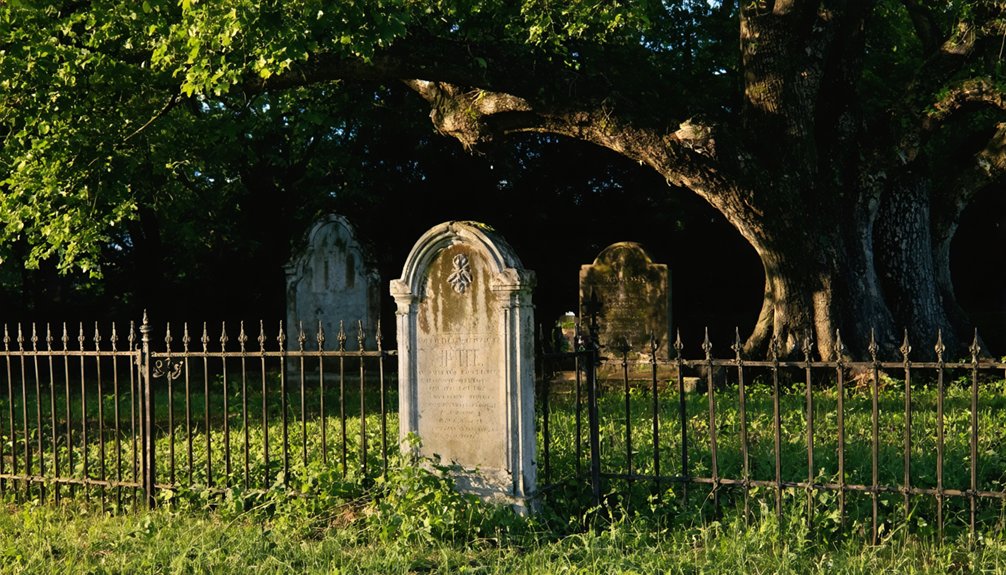
You’ll find Bachelor’s Grove Cemetery 24 miles south of Chicago in Bremen Township, where its trapezoid-shaped acre of land sits isolated between Rubio Woods Forest Preserve and a murky quarry pond.
The location’s documented paranormal activity since the 1950s—combined with scattered headstones among overgrown vegetation and chain-link fencing—creates an authentically eerie atmosphere that filmmakers can’t replicate on soundstages.
This remote swampland setting, accessible only via the remnants of Midlothian Turnpike, offers production crews natural fog, dense forest coverage, and approximately 200 graves that establish immediate visual dread.
Documented Paranormal Phenomena
Spectral apparitions dominate the site’s paranormal catalog, led by the White Lady captured in Judy Huff-Felz’s 1991 photograph—published in the Chicago Sun-Times—showing a hooded figure near the cemetery’s edge.
You’ll find reports of physical contact incidents where spirits allegedly grip visitors’ arms, documented on video evidence.
Light anomalies include blue orbs observed throughout the 1970s-80s and multi-colored streaks dancing above pathways.
These manifestations reportedly react to human presence, shrinking and vanishing as observers approach.
The phantom farmhouse appears repeatedly at varying locations, its white structure complete with porch swing dissolving upon approach—never materializing where historical records indicate buildings actually stood.
Remote Swampland Setting Appeal
Tucked within Rubio Woods Forest Preserve in Chicago’s southwest suburbs, Bachelor’s Grove Cemetery occupies a single acre that filmmakers prize for its theatrical isolation.
You’ll navigate an overgrown gravel track off Midlothian Turnpike, blocked by chains and concrete dividers, before hiking half a mile through dense timber to reach this secluded location.
The swampy backdrops create an authentic wilderness atmosphere despite the urban sprawl beyond.
A murky quarry pond sits northwest of the grounds, while thick forest shadows envelope the site from all directions.
You’ll find abandoned relics scattered throughout—dented “No Trespassing” signs, chain-link fence remnants, and weathered infant grave toys among sparse headstones.
This remote setting delivers the forbidden, otherworldly aesthetic that Ghost Adventures showcased in 2012, making it Illinois’s most visually compelling haunted location.
Buffalo Grove and Fox Lake: Rural Serenity Meets Cinematic Terror
Before its complete demolition in October 2022, Buffalo Grove Town Center stood as a hollowed-out shell of suburban commerce, its corridors stripped bare and its storefronts gaping open like vacant eye sockets. You’d find skid steer tracks carved through demolished interiors where Sushi Grove and Georgian Baker once operated.
Vacant storefronts gaped like eye sockets through stripped corridors, skid steer tracks carving through demolished spaces where businesses once thrived.
These local landmarks provided ready-made decay for urban exploration footage—torn coolers, scattered microwaves, debris-strewn floors creating authentic desolation.
Fox Lake offers contrasting abandoned architecture: rural lakefront structures surrounded by water and wilderness. While no major productions officially utilized these locations, you’ll recognize their potential immediately.
The abandoned mall delivered claustrophobic urban terror before its complete razing, while Fox Lake’s isolated waterfront setting provides open-air dread. Both sites attracted explorers documenting Illinois’s commercial decline, though Buffalo Grove now exists only in archived footage.
Damen Silos: Industrial Decay as Atmospheric Backdrop
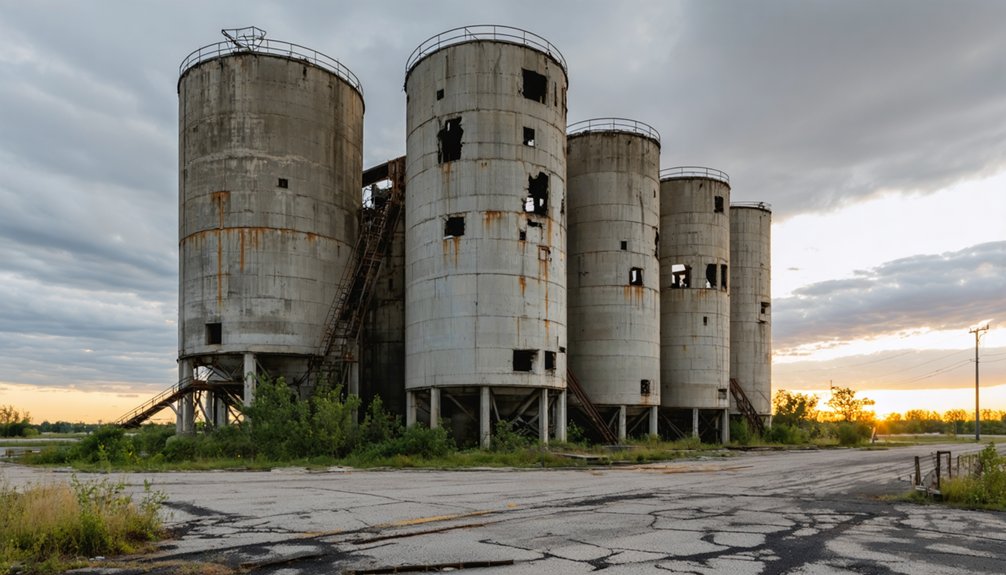
While suburban malls and lakefront properties offer filmmakers contained spaces for terror scenarios, Chicago’s Damen Silos deliver something grander—120 years of industrial history calcified into towering concrete columns.
You’ll find these industrial relics sprawling across 23.4 acres along the Sanitary and Ship Canal, visible from I-55 and the Orange Line. After grain operations ceased following a 1977 explosion, filmmakers discovered the location’s cinematic potential.
What makes Damen Silos irreplaceable for atmospheric filmmaking:
- Thirty-five original silos plus fourteen reinforced concrete additions create dystopian vertical landscapes.
- Graffiti-layered surfaces and structural decay provide authentic urban decay without set construction.
- Railroad infrastructure and powerhouse remnants offer multiple shooting angles within one location.
The 2024 demolition permits mark the end of this accessible backdrop, eliminating opportunities you’d otherwise exploit for gritty, unrestricted visual storytelling.
Old Joliet Prison: Where True Crime Meets Horror Fiction
Standing 25 feet tall with limestone walls that taper from 6-foot bases to 2-foot tops, Old Joliet Prison transformed from Illinois’s first maximum-security facility into one of cinema’s most versatile filming locations.
The prison architecture housed John Dillinger before his 1933 wooden-gun escape and serial killer Richard Speck, lending authenticity to productions like *Prison Break*, which filmed inside actual cell blocks and basketball courts.
*The Blues Brothers* captured Jake’s release in the opening sequence, while *Public Enemies* and *White Heat* utilized the forbidding exteriors.
The four-level cell blocks—closed after multiple suicides—now welcome photographers with tripods during guided tours.
Decommissioned in 2002 and listed on the National Register in 2023, this 16-acre campus at 1125 Collins Street blends inmate stories with Hollywood fiction.
Woodstock’s Historic Architecture in Period Film Productions
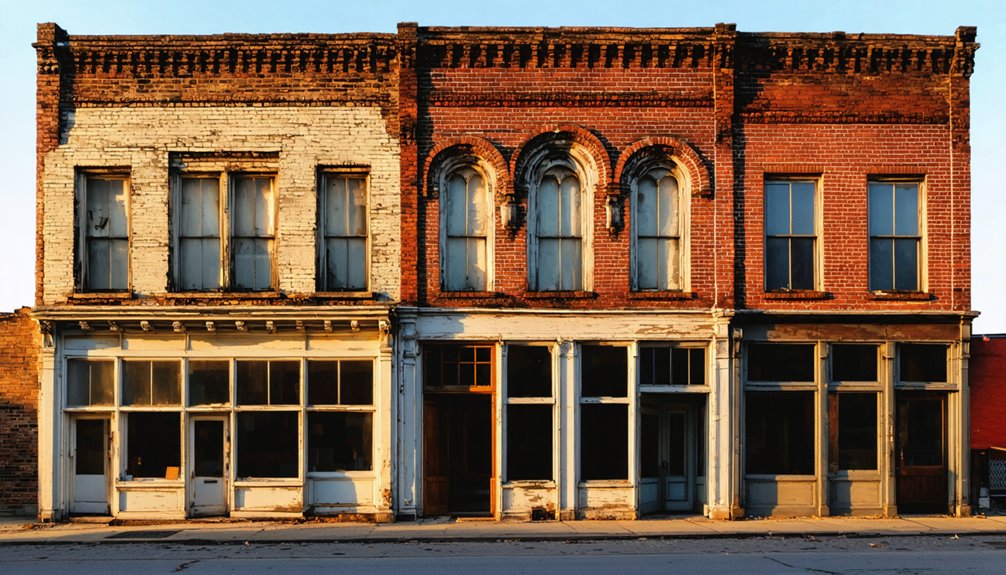
Anchored by its 1889 Romanesque Opera House and 1857 Greek Revival courthouse, Woodstock Square Historic District preserves a 19th-century Midwestern town center that’s doubled as Punxsutawney, Pennsylvania and generic “Smalltown, U.S.A.” since the 1950s.
You’ll find timeless Victorian brick storefronts surrounding a public park with brick-paved one-way streets—unchanged since filmmakers discovered its authentic period character.
Why Woodstock’s Preservation Attracts Productions:
- Unaltered streetscape: The 1982 National Register designation protected architectural integrity directors need for period authenticity.
- Multi-purpose Opera House: The original 1889 community gathering space still functions as a performance venue and filming location.
- Proven track record: From 1950s television’s first soap opera to 1993’s *Groundhog Day*, the district’s maintained its historic preservation standards while welcoming crews.
The restoration efforts—including replicated firehouse doors—ensure you’re exploring genuine 19th-century infrastructure, not Hollywood facades.
Northwestern Memorial Hospital and Medical Horror Settings
Despite its title suggesting medical horror, the Northwestern Memorial Hospital and Medical Horror Settings reveals Northwestern Memorial Hospital’s role in romantic comedies and dramas rather than genre thrillers.
Northwestern Memorial Hospital defies its ominous name, serving as backdrop for love stories and family dramas instead of medical thrillers.
You’ll find this Chicago landmark featured in “While You Were Sleeping,” where production teams rebuilt hospital sets off-site for three weeks of intensive filming. The evolution of hospital architecture influenced “Nothing in Common’s” authentic interior shots with Tom Hanks and Jackie Gleason.
“The Fugitive” positioned the hospital within its medical thriller framework, though dramatic tension overshadowed horror elements.
The impact of filming restrictions shaped production logistics—you’d encounter academic blackout periods during reading week and limited access requiring strategic scheduling.
Illinois tax incentives drove location managers toward Northwestern’s classical structures, balancing authenticity with practical constraints that favored reconstructed sets over disrupting hospital operations.
Frequently Asked Questions
What Permits Are Required to Film at Abandoned Illinois Locations?
You’ll need standard film permits plus property liability insurance and potentially historical preservation clearances. Since abandoned sites often have unclear ownership, you must verify legal access rights and secure proper permissions before filming.
How Much Does It Cost to Rent These Illinois Filming Locations?
You’ll find incredibly varied pricing—cost breakdowns range from $100-$500 hourly for public lands to $250-$1000 daily permits. Location availability depends on site negotiations, though Woodstock’s square offers clearest rates. Industrial conversions complicate Buffalo Grove’s accessibility considerably.
Are Professional Ghost Tours Available at All Featured Illinois Sites?
No, professional ghost tours aren’t available everywhere. Tour operators offer guided experiences at Ashmore Estates and Old Joliet Prison, where you’ll explore haunted legends firsthand. Bachelor’s Grove and Woodstock’s Groundhog Day locations lack organized paranormal tours currently.
Which Illinois Ghost Town Locations Allow Overnight Filming Access?
Ashmore Estates explicitly allows overnight stays, making it ideal for your extended filming needs. While historical preservation guides access at other sites, you’ll find Ashmore’s community engagement policies support creative freedom for overnight production schedules.
What Safety Precautions Exist When Filming at Abandoned Illinois Structures?
You’ll need thorough hazard assessment before shooting, identifying structural weaknesses and environmental dangers. Required safety gear includes hard hats, respirators, and steel-toed boots. Most productions can’t access abandoned Illinois sites without proper permits and liability coverage first.
References
- https://www.ilikeillinois.com/home/did-you-know/1727-bone-chilling-movies-filmed-in-illinois
- https://giggster.com/guide/movie-location/where-was-the-amityville-horror-filmed
- https://wkdq.com/fascinating-abandoned-buildings-illinois/
- https://www.atlasobscura.com/things-to-do/illinois/film-locations
- https://www.wisconsinfrights.com/amityville-horror-house/
- https://en.wikipedia.org/wiki/The_Amityville_Horror_(2005_film)
- https://thegaijinghost.com/blog/amityville-ringu-evil-eyes-three-houses-one-cabin
- https://reelchicago.com/article/top-10-horror-movies-set-or-filmed-in-chicago/
- https://ftp.nfi.edu/chicago-filming-locations/
- https://www.illinoisedc.org/news/five-classic-horror-movies-filmed-in-illinois/