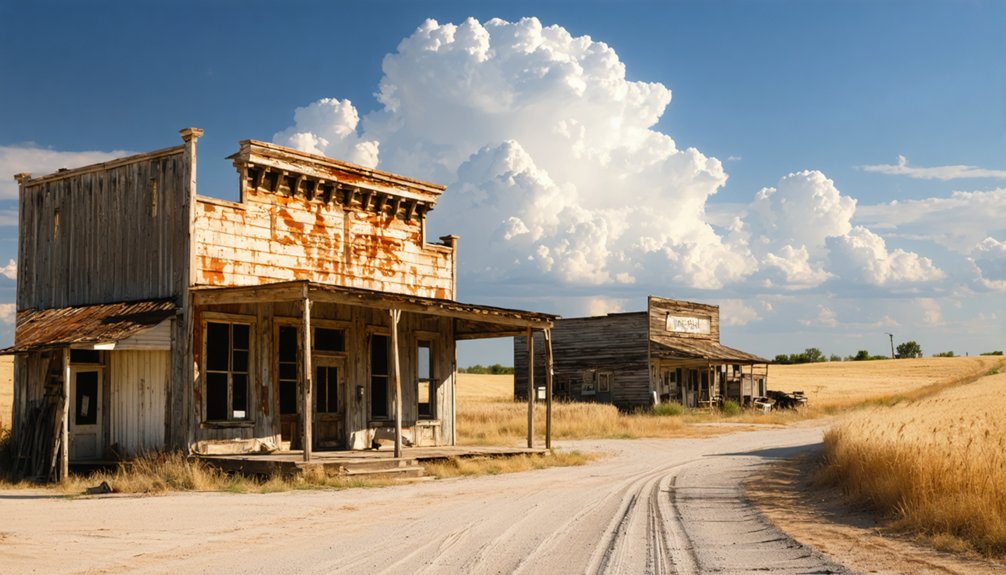
You’ll find Kansas’s most famous ghost town filming locations in Wilson, where “Paper Moon” captured Depression-era authenticity through preserved limestone storefronts and the Midland Railroad Hotel, and Castleton, transformed into 1905 “Sevillinois” for “Wait Till the Sun Shines, Nellie.” Holcomb’s actual Clutter farmhouse served as the haunting set for “In Cold Blood,” while Gorham’s now-demolished train station provided period-perfect infrastructure. These locations traded economic decline for cinematic immortality, offering you authentic architecture that Hollywood couldn’t replicate on studio lots—and there’s considerably more to their transformation stories.
Key Takeaways
- Castleton became “Sevillinois” in 1952 when Twentieth Century-Fox built period facades around its depot for “Wait Till the Sun Shines, Nellie.”
- Wilson’s preserved limestone storefronts and Midland Railroad Hotel provided authentic Depression-era settings for “Paper Moon” in 1972.
- Holcomb served as the actual crime scene location for “In Cold Blood,” with filming inside the Clutter farmhouse in 1967.
- Economic decline preserved Wilson’s historic architecture, allowing filmmakers to shoot without modern modifications or extensive set dressing.
- The Gorham train station used in “Paper Moon” was demolished post-filming, reflecting decades of small-town deterioration across Kansas.
Castleton: From Thriving Railroad Town to “Wait Till the Sun Shines, Nellie” Film Set
When W.E. and Clinton C. Hutchinson platted Castleton in 1872, they established a crucial railroad stop that peaked at 450 residents.
Two railroad entrepreneurs founded a Kansas prairie settlement that would grow into a 450-person community anchored by the Santa Fe Railway.
You’ll find this Reno County settlement northeast of Pretty Prairie, where the Atchison, Topeka and Santa Fe Railway once drove prosperity.
By 1952, Hollywood crews transformed the declining town into “Sevillinois, Illinois” for “Wait Till the Sun Shines, Nellie.”
Over two weeks, they built period-accurate structures around the existing depot and post office.
This community impact brought temporary vitality before the high school closed in 1954 and the post office shuttered in 1957.
Today’s remnants include Mid Kansas Cooperative elevators and scattered homes.
Historical preservation efforts relocated the original post office to Barton County Historical Society Museum in 1971, documenting this unique intersection of railroad heritage and Hollywood production.
The film depicted Castleton’s small-town atmosphere, while Hutchinson stood in for larger town scenes requiring more developed settings.
Castleton represents one of multiple Kansas locations sharing the name with other communities across the United States.
The Transformation of Castleton Into 1905 Sevillinois, Illinois
Twentieth Century-Fox crews arrived in Castleton during 1951 with blueprints for Sevillinois, Illinois—a fictional turn-of-the-century Midwest town that needed authentic railroad architecture.
You’ll find they constructed period-accurate facades around the existing Santa Fe depot and post office: a fire station, barber shop, and livery stable that transformed the declining hamlet into 1905 Illinois.
The production’s historical accuracy demanded period wardrobes stored at Castleton High School, where a seamstress altered clothing for local extras.
Community impact rippled through two weeks of filming as grade-school children became background performers in this time-traveling spectacle.
You’re witnessing practical movie magic—temporary structures built to convince audiences they’d stepped backward forty years, using real railroad bones as foundation for cinematic fiction.
Wilson: The Star of “Paper Moon” and Its Historic Midland Railroad Hotel
Twenty-one years after Castleton’s transformation, Wilson became Paper Moon’s architectural backbone—you’ll recognize its limestone-fronted Avenue E in nearly every Depression-era frame. Eight locations survived director Peter Bogdanovich’s camera angles from fall 1972, including the Soukup Grain Office’s haggling scene and the gas station’s familiar brick wall backdrop.
The Midland Railroad Hotel doubles as both filming centerpiece and living archive. You’ll find framed actor photos and the original poster in its parlor, while cast and crew actually rested between takes in these same rooms. The McCracken Historical Museum, restored in an 1901 limestone jail, houses additional memorabilia including props, photographs, and an unopened NeHi Root Beer bottle from the production.
During 2023’s 50th anniversary festival, you could book these celebrity lore-filled spaces (785-658-2284) and trace Tatum O’Neal’s footsteps through preserved storefronts. Cinematographer László Kovács employed deep focus techniques to capture Wilson’s authentic streetscapes with extended takes that enhanced the film’s nostalgic visual tone. Wilson’s authentic 1936-era buildings still anchor Depression-era road trip itineraries across Kansas.
How Wilson’s Authentic Architecture Captured Depression-Era Kansas
Wilson’s limestone storefronts and brick facades gave Peter Bogdanovich exactly what he needed—authentic 1930s architecture that required virtually no set dressing.
You’ll find buildings here that escaped urban renewal projects, preserving Depression-era construction details other towns demolished decades ago.
The Midland Railroad Hotel became your production headquarters without modern adaptations—its original parlor, exterior lines, and period details filmed as-is.
This cost-effective approach let Bogdanovich shoot genuine 1936 America rather than constructing elaborate sets.
You’re looking at structures that survived because Wilson’s economic stagnation ironically protected its architectural heritage.
Black-and-white cinematography enhanced these authentic textures, turning limestone blocks and weathered brick into documentary-style backdrops.
The town’s resistance to modernization became its cinematic asset. Production also utilized Sunflower Coal buildings for key scenes, with crews filming inside the historic hotel structure.
The flat Kansas landscape surrounding Wilson provided that uniform regional atmosphere essential to capturing the film’s 1930s Midwest authenticity.
Holcomb: The Haunting Reality of “In Cold Blood”
Unlike typical film productions that recreate crime scenes on soundstages, you’ll find “In Cold Blood” was shot inside the actual Clutter farmhouse at 611 Oak Ave where the 1959 murders occurred.
Director Richard Brooks deployed documentary-style techniques across Holcomb’s authentic locations—from Hartman’s Cafe on Main Street to the railroad tracks where the killers arrived—transforming the small Kansas town into a preserved crime narrative.
The production also filmed investigative scenes along W River Rd where police searched the river for crime evidence.
You’re witnessing how a film production became an inadvertent historical archive, capturing exact intersections, storefronts, and landmarks that anchor one of America’s most infamous true crime stories to its geographic reality.
The town’s landscape, dominated by grain elevators and water towers rising against the flat wheat plains, provided the stark visual backdrop that reinforced the isolation central to both Capote’s book and Brooks’ cinematic vision.
Actual Murder Scene Filming
When director Richard Brooks decided to adapt Truman Capote’s “In Cold Blood” for film in 1967, he made a bold choice that would define the production’s chilling authenticity: he’d shoot at the actual murder site.
The cast and crew spent four weeks at 611 Oak Ave in Holcomb, where the Clutter family was brutally killed in 1959. Crime reenactments unfolded in the very rooms where tragedy struck, with original family photos appearing in final shots. This commitment to factual accuracy extended beyond the farmhouse—Hartman’s Cafe at 305 N Main St captured Dick and Perry’s arrival, while Garden City’s courthouse at 425 N 8th St provided trial scenes.
The documentary-style approach earned four Academy Award nominations and established a haunting precedent few productions would dare replicate.
Documentary-Style Production Techniques
Richard Brooks transformed “In Cold Blood” into a visceral experience by deploying documentary-style cinematography across Holcomb’s stark landscape. You’ll witness eye-of-god narration panning over desolate wheat plains, capturing grain elevators rising like Greek temples against endless horizons.
This authentic approach earned four Academy Award nominations and established the film’s cultural significance in American cinema.
The production’s preservation challenges demanded meticulous attention:
- Four-week immersion at actual Clutter farmhouse with cast and crew
- Original family photographs integrated directly into final scenes
- Precise location matching along killers’ exact travel routes
- Real crime scene elements woven into cinematography
You’re experiencing raw documentary realism—hot, brown, level Kansas terrain with steam rising from power plants, water towers punctuating horizons, and authentic period details preserved in every frame.
Preserving Kansas Crime History
The Clutter family farmhouse stands seven miles outside Holcomb, where four shotgun blasts on November 15, 1959, transformed Herbert (48), Bonnie (45), Nancy (16), and Kenyon Clutter (15) into America’s most documented murder victims.
You’ll find preservation challenges complicate commemorating this property—private ownership creates legal implications that prevent public access, while documentation efforts clash with residents’ desire to move beyond sensationalized tragedy. Truman Capote’s *In Cold Blood* immortalized the location where Richard Hickock and Perry Smith executed their victims for roughly $50, binoculars, and a transistor radio.
The 1993 documentary *Holcomb: The Death of Innocence* captured community resistance to crime tourism. Kansas authorities maintain investigative records at Finney County Courthouse, balancing historical preservation against survivors’ privacy rights in this rural crossroads forever marked by calculated violence.
Filming at the Actual Clutter Farmhouse: Documentary-Style Cinema
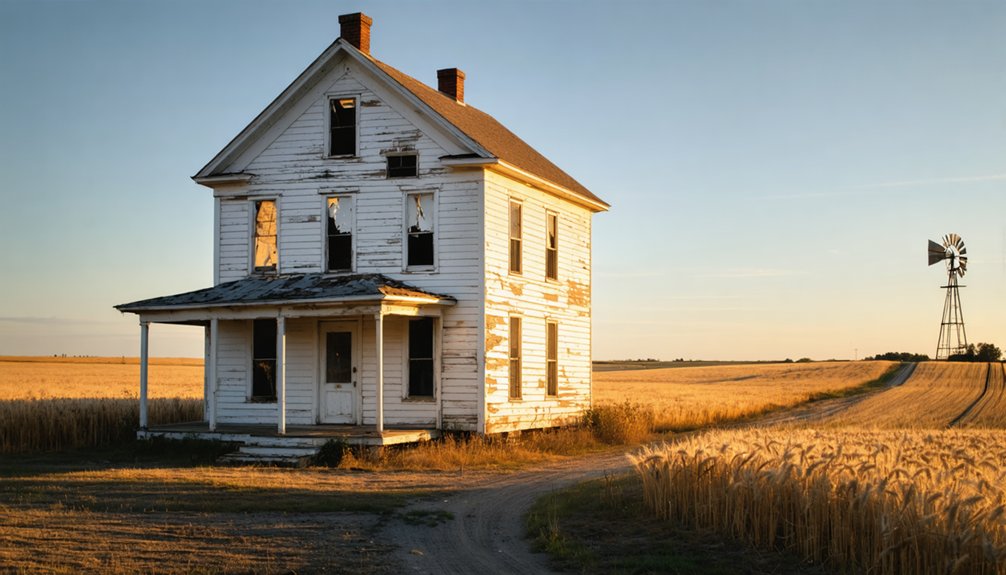
Breaking with Hollywood convention, director Richard Brooks chose to film the entire 1967 adaptation of “In Cold Blood” at 611 Oak Ave in Holcomb, Kansas—the actual two-story blond brick farmhouse where the Clutter family murders occurred on November 15, 1959.
This authentic filming approach created unprecedented documentary-style realism at the crime scene:
- Actual family photographs displayed throughout rooms instead of props
- Nancy Clutter’s horse, Babe, appeared in scenes for historical accuracy
- Six original trial jurors served as courtroom extras
- Crime scene photographs guided set placement and camera angles
You’ll find the farmhouse featured distinctive Chinese elm trees lining its driveway and an unusually large basement where Herb Clutter died.
Brooks distributed scripts incrementally, believing the location’s gravity would shake actors into genuine emotional responses rather than manufactured performances.
Garden City’s Role in Bringing Truman Capote’s Story to Screen
You’ll find Garden City served as the primary filming hub for the 1967 *In Cold Blood* adaptation, with its Finney County Courthouse hosting trial scenes.
The Sinclair station recreating the killers’ final movements is also part of this filming location.
The town’s physical infrastructure supported director Richard Brooks’s documentary approach—actual arrest locations, burial sites at Valley View Cemetery, and surrounding wheatfields anchored the narrative in forensic reality.
These preserved locations now connect visitors to both Capote’s investigative process and the film’s commitment to geographical authenticity.
Documentary-Style Filming Locations
When Richard Brooks adapted Truman Capote’s “In Cold Blood” for the screen in 1967, he anchored his production in Garden City, Kansas—transforming this western Kansas hub into the operational center for one of cinema’s most unflinching exercises in documentary-style realism.
You’ll find authentic locations throughout Garden City that served Brooks’ vision:
- Finney County Courthouse (425 N 8th Street) hosted trial scenes at the actual prosecution site
- Hartman’s Cafe (407 E Kansas Ave) appears multiple times throughout the film
- Valley View Cemetery provided the final burial scene location
- Sinclair service station captured the killers’ arrival sequence
The production’s historic preservation through location shooting created lasting community engagement.
Brooks spent four weeks filming at the actual Clutter farmhouse in nearby Holcomb, incorporating original family photographs into his footage—a commitment to authenticity that earned four Academy Award nominations.
Supporting Holcomb’s Authentic Narrative
The authenticity of Brooks’ cinematic achievement rested fundamentally on Truman Capote’s exhaustive five-year immersion in Finney County following the November 1959 murders. You’ll find historical accuracy preserved through Capote’s meticulous research at the actual Clutter farmhouse and his retention of local lawyer Clifford Hope Jr. throughout filming.
The production’s commitment to touristic appeal remains evident at Valley View Cemetery and tree-lined Oak Avenue—both authentic locations now accessible to visitors seeking the story’s real backdrop.
Garden City’s Finney County Historical Museum reinforces this legacy with Perry Smith’s boot and Judge Roland Tate’s trial artifacts.
Locals transformed “In Cold Blood” into essential reading, recognizing how Capote’s Kansas wheatfield documentation created ghostly realism that continues drawing freedom-seeking travelers to Holcomb’s preserved narrative.
Finney County Historical Preservation
Garden City’s Finney County Courthouse at 425 N 8th St anchored Richard Brooks’ 1967 adaptation by serving double duty—it’s where the actual trial of Richard Hickock and Perry Smith unfolded, and where Brooks filmed the prosecution scenes that earned his documentary-style production four Academy Award nominations.
You’ll find preservation efforts thriving at the Finney County Historical Museum (403 S Fourth Street), where a 525-square-foot True Crime Exhibit displays forensic evidence linking both killers to the scene:
- Perry Smith’s boot print casting
- Judge Roland Tate’s robe and chair from the trial
- Over 20 artifacts and 36 photographs
- Eight Fleagle Gang firearms
These historical landmarks remain accessible since 1964, letting you trace Truman Capote’s six-year investigation alongside Harper Lee through unchanged filming locations near 102 N Main St.
McCracken’s Nickel Cemetery: Opening Scene of a Classic Film
Southwest of Liebenthal in Rush County’s Hargrave area, you’ll find the Nickel family cemetery where Paper Moon’s iconic opening scene was filmed in 1973. The graveside sequence featuring Ryan and Tatum O’Neal captured this authentic rural setting, complete with its distinctive hand water pump—which still stands exactly where Peter Bogdanovich positioned it fifty years ago.
You can visit this family cemetery independently, as it’s maintained by Nickel descendants in virtually the same condition as on the filming day. The vintage hand pumps remain functional, offering photographers and film enthusiasts an unchanged backdrop.
Family cemeteries like this one provided Bogdanovich’s production with the genuine Depression-era atmosphere he needed.
Combine your visit with McCracken’s Historical Museum, housed in a 1901 limestone jail, where Paper Moon exhibits display original props from the production.
Gorham Train Station: a Lost Landmark From “Paper Moon”
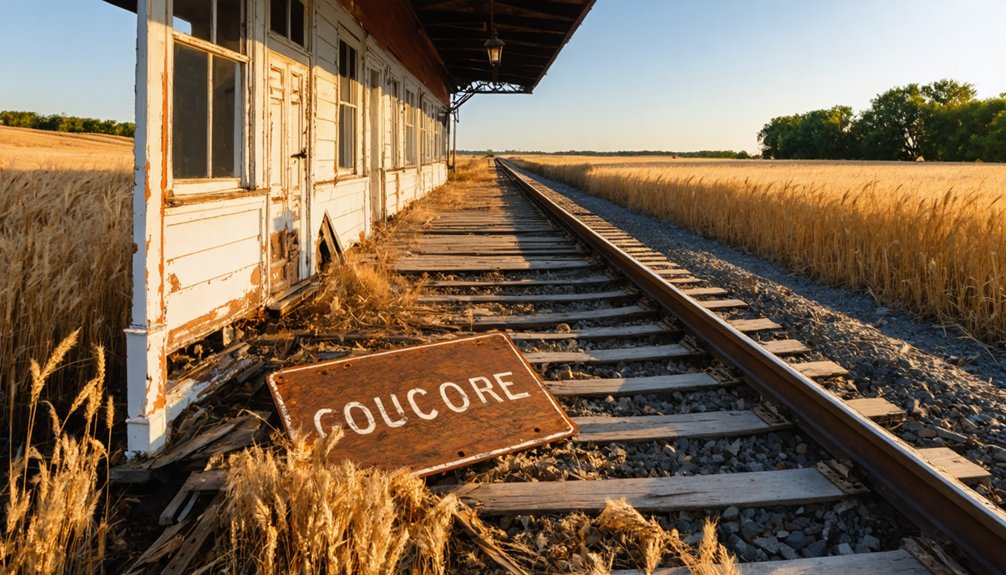
You’ll find the Gorham train station’s former location at coordinates 38.881302, -99.022518. The structure itself was demolished after filming wrapped in 1972.
The station served as the backdrop for a pivotal scene between Ryan and Tatum O’Neal’s characters, with its weathered Depression-era authenticity requiring minimal alterations from the production crew.
Today, only the coordinates mark where this landmark once stood, making it one of several *Paper Moon* filming sites lost to time in this town of fewer than 400 residents.
Station’s Role in Film
When Peter Bogdanovich scouted locations for “Paper Moon” in 1972, the Gorham train station at coordinates 38.881302, -99.022518 stood as an authentic Depression-era relic requiring virtually no modification for filming.
The structure’s architectural significance eliminated costly set construction, while its remote Kansas location provided production independence from studio interference.
The station delivered essential filming logistics advantages:
- Authentic 1936 infrastructure – Original early 20th-century railroad architecture needed minimal alteration
- Black and white cinematography enhancement – Period-appropriate design amplified Depression-era atmosphere
- Isolated small-town setting – Gorham’s population under 400 ensured production control
- Cost-effective backdrop – Real location replaced expensive soundstage construction
You’ll find the O’Neals’ con artist characters departing this genuine Kansas rail hub, capturing America’s transportation heritage before the station’s eventual demolition erased this cinematic landmark forever.
What Remains Today
The Gorham train station that anchored those pivotal “Paper Moon” sequences has vanished from the Kansas landscape. You’ll find nothing at coordinates 38.881302, -99.022518 except empty ground where Depression-era filmmaking once captured history.
Urban decay claimed both the station and grain elevator office after production wrapped, reflecting five decades of small-town attrition across Kansas.
You can still visit Gorham’s surviving structures, including the post office building at Chicago and Market streets. The town maintains nearly 400 residents and welcomes film pilgrims retracing the movie’s path.
While preservation efforts saved some locations—Wilson’s Soukup Grain Office endures—Gorham’s losses mirror widespread demolition in neighboring communities like McCracken.
Street views reveal how vegetation and changing infrastructure have completely obscured the filming era‘s appearance, leaving only documented coordinates as breadcrumbs.
Visiting These Historic Kansas Film Locations Today
Film enthusiasts exploring Kansas’s western plains can still walk the same dusty streets and weathered landmarks that appear in classic Hollywood productions. These locations require minimal imagination—the authentic rural landscapes haven’t changed substantially since cameras rolled decades ago.
Step into Kansas’s timeless landscapes where Hollywood’s golden age remains frozen in authentic small-town settings and endless prairie horizons.
Essential visitor information:
- Wilson’s Midland Railroad Hotel displays original “Paper Moon” posters and filming photographs in its parlor, offering overnight stays where cast members once lodged.
- McCracken’s Nickel Cemetery remains accessible at Rush County Road 160 and Avenue East via K-4. This cemetery preserves the setting of the “Paper Moon” funeral scene.
- Gorham’s former train station site sits at Old US Highway 40 and Chicago Street. Active railway lines and historic silos maintain period authenticity at this location.
- Local dining options and photography tips are available through Finney County Historical Museum resources.
You’ll discover these sites welcome independent exploration without commercialized restrictions.
Frequently Asked Questions
Are Any of the Original Movie Sets Still Standing Today?
You’ll find the Midland Railroad Hotel still standing in Wilson with original movie posters displayed. Historical preservation efforts maintain visitor access to filming locations, though Gorham’s train station was demolished. The Clutter farmhouse remains documented for independent exploration.
Can Tourists Visit the Actual Clutter Farmhouse From “In Cold Blood”?
The farmhouse stands privately owned since 1964, so you can’t tour inside without permission. Historical preservation wasn’t prioritized here—filming regulations didn’t require public access. You’ll spot the blond brick exterior from the road, respecting current residents’ privacy.
Were Local Residents Compensated for Appearing as Extras in These Films?
Local resident compensation varied by production. You’ll find The Learning Tree paid Fort Scott extras for their appearance fees, while other Kansas films lack documented payment records. Paper Moon and In Cold Blood don’t specify extra compensation details.
What Other Movies Have Been Filmed in Kansas Ghost Towns?
Beyond those mentioned, Kansas ghost town filming details remain scarce. You’ll find filming location tourism focuses on Wilson and Castleton’s preserved sites, though ghost town preservation efforts haven’t documented many additional productions worth visiting today.
How Did Filming Impact the Local Economies of These Small Towns?
Film productions sparked immediate economic development through hiring locals as extras and crew, utilizing businesses for lodging and services. They’ve delivered lasting tourism boosts, with historic sites attracting visitors who explore filming locations decades later.
References
- https://www.worldatlas.com/cities/4-kansas-towns-where-famous-movies-were-filmed.html
- http://kansasghosttowns.blogspot.com/2010/12/castleton-ks.html
- https://giggster.com/guide/movie-location/where-was-paper-moon-filmed
- https://www.youtube.com/watch?v=Td_gmiDMfI4
- https://www.washburn.edu/reference/cks/mapping/movies/mapfilmed/index.html
- https://www.visitkc.com/articles/self-guided-tour/
- https://en.wikipedia.org/wiki/List_of_films_set_in_Kansas
- https://kids.kiddle.co/Castleton
- https://legendsofkansas.com/reno-county-extinct-towns/
- https://sites.rootsweb.com/~ksrenohp/histories/townships.html