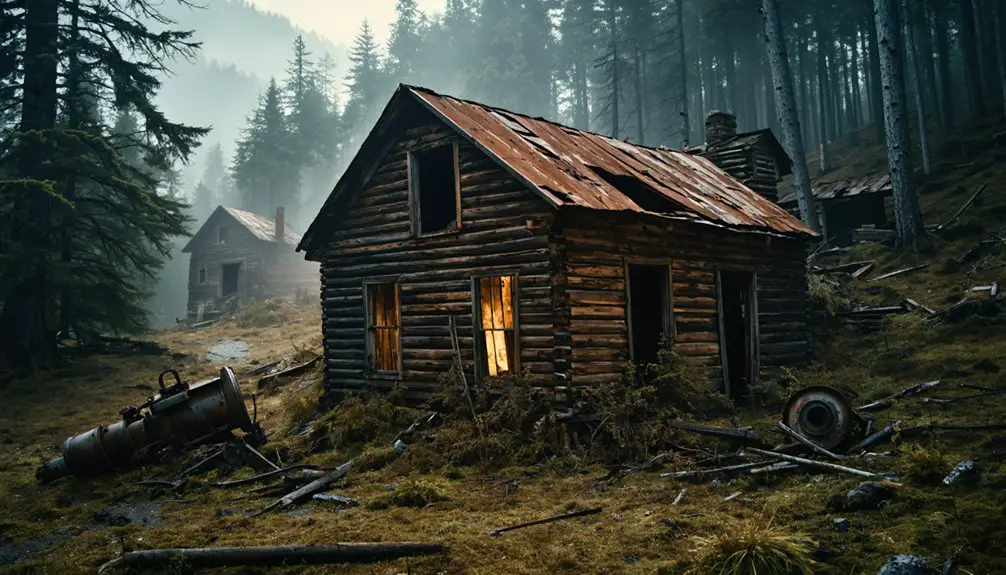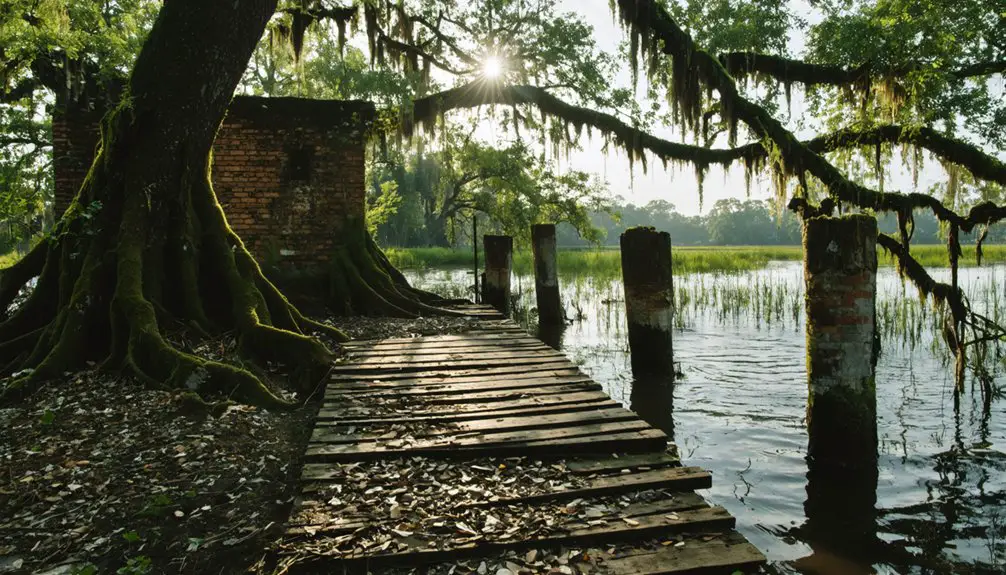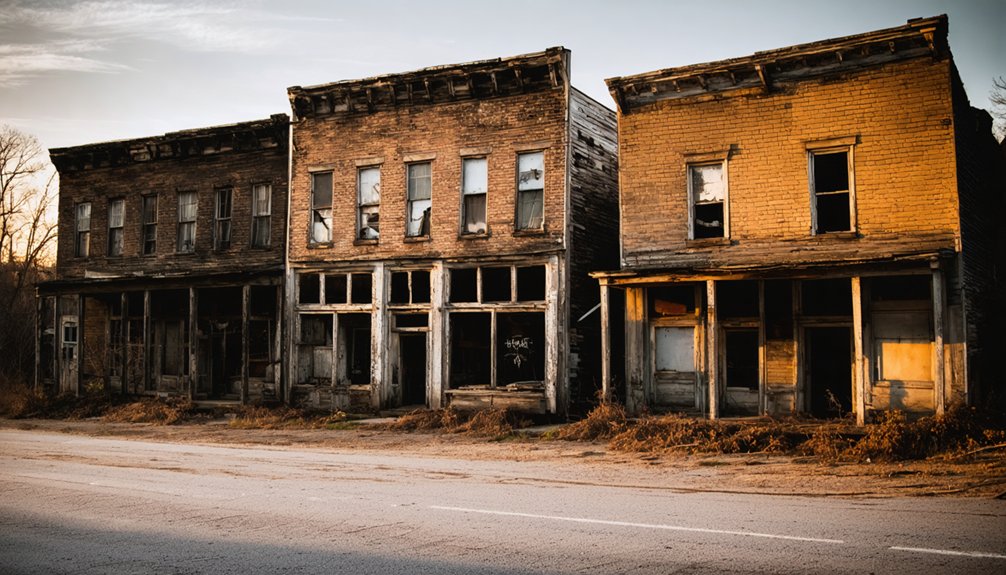
You’ll find Maryland’s most famous “ghost town” filming location in Burkittsville, where *The Blair Witch Project* shot its iconic scenes at the 1800s Union Cemetery and abandoned church—though it’s technically still inhabited by 200 residents. The actual Griggs House, built circa 1850 in Patapsco Valley State Park, served as the film’s climactic finale location before its 1999 demolition. Seneca Creek State Park‘s 6,300 acres provided the dense woodland scenes, including Coffin Rock and the fishermen’s bridge, while historic sites retain their atmospheric appeal for exploring Maryland’s cinematic heritage.
Key Takeaways
- Burkittsville, founded in 1824, served as the primary ghost town filming location for *The Blair Witch Project* in 1998.
- The town’s Union Cemetery and abandoned church provided authentic paranormal settings for the horror film’s key scenes.
- Burkittsville’s Civil War history and supernatural legends, including the Snallygaster creature, enhanced its haunted film appeal.
- The town declined sequel filming to preserve its historic character and prevent further ghost hunter disturbances.
- Post-filming vandalism and increased paranormal tourism prompted a 1999 exorcism at the town’s abandoned church basement.
Burkittsville: The Iconic Blair Witch Project Town
When railway worker Joshua Harley discovered the old Blair site in 1823, he set in motion the creation of what would become one of America’s most infamous ghost towns.
By 1824, Peter Branwell Burkitt surveyed and named Burkittsville, where German farmers built a thriving village.
Peter Branwell Burkitt surveyed the land in 1824, establishing the foundations for what German settlers would transform into a prosperous farming community.
The Civil War transformed it into a paranormal hotspot—soldiers died in the tannery-turned-hospital, creating lasting hauntings.
You’ll find spectral boot prints on cars parked there today.
The town’s supernatural reputation dates back to 1875 when the Snallygaster creature reportedly attacked residents, described as a half-reptile, half-bird monster with a metallic beak.
Urban legends intensified when filmmakers chose Burkittsville for The Blair Witch Project in 1994, featuring Union Cemetery and an abandoned church.
The 1999 release brought ghost hunters and vandals who overwhelmed the town.
An exorcism in October 1999 involved prayers and holy water in the church basement to cleanse alleged evil spirits.
Locals declined sequel filming, preferring their 180-year-old townscape remain undisturbed despite ongoing paranormal encounters.
Seneca Creek State Park: Where Horror Came to Life
While Burkittsville provided the opening scenes and cemetery shots that established The Blair Witch Project‘s unsettling atmosphere, the film’s true terror unfolded 25 miles west in Seneca Creek State Park‘s 6,300 acres of dense woodland.
You’ll find the majority of footage shot here in October 1997, where Montgomery County native Eduardo Sánchez transformed familiar jogging trails into cinematic nightmare fuel.
The Black Rock Mill sub-unit contains specific locations: the red shed, fishermen’s bridge interview, and Coffin Rock—accessible via Seneca Ridge Trail’s unofficial fisherman’s path.
Trail accessibility remains straightforward, with parking coordinates readily available on Google Maps.
The park’s soundscape analysis reveals why filmmakers chose this location: rustling trees and shadowy paths create naturally eerie ambiance.
Maryland State Parks now offers ranger-led tours annually, connecting recreational hikers with horror history.
Among the historic structures within the park stands the abandoned 1815 grist mill at Black Rock, featuring partial ruins and interpretive signs for visitors to explore.
Shot on a budget of $60,000, the independent production would go on to gross over $240 million worldwide, making it one of the most profitable films ever made.
Griggs House: A 200-Year-Old Backdrop in Patapsco Valley
Deep in Patapsco Valley State Park, you’ll find the remains of the Griggs House, a Federal-style structure built around 1850 that served as the climactic setting for *The Blair Witch Project’s* terrifying finale.
The two-story stucco-faced building, located on Hernwood Road near the old Nike missile radar base, provided filmmakers with an authentically decayed interior—vandals had already stripped its details by 1984, leaving bare walls and darkened rooms perfect for horror. The house was constructed on a strong stone foundation, utilizing materials from the nearby granite quarry that gave Granite, Maryland its name.
Its isolated position in the Patapsco Forest, accessible only via trails past bridge ruins, created the disorienting remoteness that made those final scenes so viscerally unsettling. Despite funds being raised to preserve the structure after the film’s success and state assurances it would be spared, the house was demolished without announcement in 1999.
Historic Structure’s Film Role
The Griggs House stood as a Federal-style structure on Hernwood Road in Granite, Maryland, its stucco-faced post and beam construction rising two stories from a stone foundation.
Built around 1850, you’d have found it marked on the 1877 Baltimore County Atlas near the town’s namesake quarry.
By 1984, vandals had stripped its interior details, leaving the abandoned shell deteriorating on state parkland.
When filmmakers chose it for The Blair Witch Project‘s climactic scenes in 1999, they’d found an authentic horror backdrop requiring no artificial aging.
The film utilized raw footage to blur the lines between fictional narrative and reality, emphasizing unadorned, authentic visuals rather than traditional storytelling.
The interior featured decomposing wallpaper and wall markings that enhanced the house’s eerie atmosphere for the production.
The film’s success sparked debates about architectural preservation and film location ethics.
Despite fans raising funds to save it, Maryland demolished the structure without notice, prompting visitors to claim whatever remnants they could salvage.
Eerie Atmosphere and Setting
Nestled within Patapsco Valley State Park‘s dense woodland, the Griggs House occupied a remote tract at 39°20′44″N 76°51′31″W where few visitors ventured without deliberate intent. The two-story Federal-style structure‘s stucco façade and stone foundation created an atmosphere perfect for supernatural legends, while decades of abandonment amplified its abandoned charm through broken windows and stripped interiors.
What made this location cinematically compelling:
- Isolation factor – Positioned behind an old Nike missile radar base near Granite quarry, accessible only through off-trail exploration.
- Authentic decay – Vandalized interior rooms and deteriorating post-and-beam construction provided genuine atmospheric tension.
- Historical depth – Mid-19th century origins (circa 1850) visible on 1877 Baltimore County Atlas, establishing legitimate architectural heritage.
You’d find yourself surrounded by Patapsco Forest’s shadows, where this forsaken dwelling stood among foundations and forgotten structures.
Stup’s Market: The Unchanged Interview Location
At 5550 Mountville Road in Adamstown, Maryland, Stup’s Market stands as one of The Blair Witch Project’s most accessible filming locations. You’ll find this local shop approximately one hour from either Washington D.C. or Baltimore, positioned in Adamstown’s central village area.
The building’s red-painted walls and white trim remain unchanged since the 1998 production, when it operated as Adamstown Village Market. Here, filmmakers captured the memorable interview with an elderly resident recounting the Rustin Parr tale—a pivotal folklore moment in the found-footage narrative. The interviewee, Susie Gooch, later claimed her interview was improvised during filming.
The location’s filming continuity is remarkable. Comparing 2019 photographs with original footage reveals virtually identical exterior features. The shop still maintains its historic appearance, allowing visitors to step back into the film’s era.
You’re free to visit and photograph the site yourself, experiencing firsthand how Daniel Myrick and Eduardo Sánchez utilized authentic Maryland settings during their eight-day shoot.
Colony Supply Center: A Transformed Filming Spot
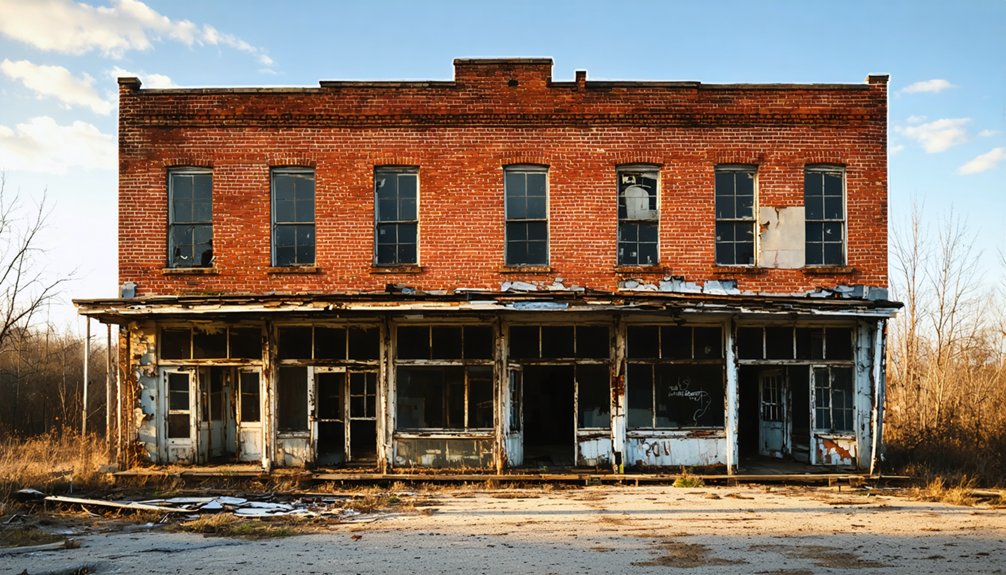
Unlike Stup’s Market’s preservation, another Blair Witch filming location has undergone dramatic changes since 1998. Colony Supply Center Inc. at 19800 Darnestown Rd in Beallsville filmed the interview scene featuring Sandra Sanchez (director Eduardo Sanchez’s sister) as a waitress.
Today’s modern renovations have completely erased the original atmosphere you’d recognize from the film.
What You’ll Find at Colony Supply Center Today:
- Complete reconstruction – The current building bears no resemblance to the 1998 diner setting.
- Zero filming preservation – No props, decorations, or markers acknowledge its Blair Witch history.
- Accessible location – Just 50 minutes from Washington D.C. via River Rd and MD-28 W/Darnestown Rd.
You can still visit this functioning business to explore Blair Witch history, though you’ll need imagination to connect it with the film’s rustic aesthetic.
Frederick County’s Hidden Film History Sites
You’ll find Frederick County’s most famous film connection in Burkittsville, the nominal setting for *The Blair Witch Project*.
Though the production crew actually shot the woods scenes 30 miles away in Seneca Creek State Park. The filmmakers did capture early preparation sequences at authentic Frederick County locations before moving to Montgomery County for principal photography.
Beyond this horror landmark, the county’s 18th and 19th-century structures—including the Old South Mountain Inn at 6132 Old National Pike and Winchester Hall‘s Civil War-era architecture—offer atmospheric backdrops that blend historic authenticity with the shadowy aesthetic filmmakers seek.
Blair Witch Filming Locations
You’ll find the actual filming concentrated in three primary zones:
- Seneca Creek State Park’s Greenway Trail (Montgomery County) – where most footage was captured during the eight-day October 1997 shoot.
- Burkittsville – providing authentic small-town atmosphere in opening sequences, though later urban renewal shifted some locations.
- Griggs House at Patapsco Valley State Park – the 150-year-old structure hosting climactic scenes.
Unlike extraterrestrial encounters requiring elaborate sets, this production thrived on Maryland’s naturally isolated wilderness.
It transformed 20 hours of raw footage into a cultural phenomenon.
Historic Structures in Film
While Blair Witch capitalized on Maryland’s wild forests, Frederick County’s structured film history centers on architectural landmarks preserved across generations. You’ll find Gods and Generals filmed outside City Hall’s front doors, where the 40-block historic district’s nationally renowned architecture provided authentic Civil War-era backdrops.
The Maryland School for the Deaf’s Hessian Barracks served Boomtown productions, connecting Francis Scott Key interpretive sites through wayfinding markers. Mt. Olivet Cemetery anchored Home of the Brave, documenting War of 1812 veterans alongside Frederick’s gravesite heritage.
These restoration projects support 6,676 tourism jobs while drawing 1.9 million annual visitors who explore the architectural significance you won’t find replicated on soundstages.
The City’s Economic Development Department streamlines permits, letting filmmakers access Roger Brooke Taney House and Civil War Medicine Museum locations without bureaucratic delays.
Frequently Asked Questions
Are There Other Maryland Ghost Towns Besides Burkittsville Used for Filming?
No, you won’t find other Maryland ghost towns used for filming beyond Burkittsville. Ironically, historical preservation keeps most locations active rather than abandoned, though Blair Witch’s success boosted film tourism throughout Frederick County’s visually-stunning rural landscapes and historic sites.
Can Visitors Camp Overnight at Blair Witch Project Filming Locations?
You can’t camp overnight at most Blair Witch filming locations due to campground regulations and overnight permissions restrictions. Burkittsville prohibits it, while state parks like Seneca Creek require you’ll stay only in designated campgrounds, not wilderness filming sites.
Were Any Actual Abandoned Buildings Demolished During the Movie Production?
No abandoned buildings met the wrecking ball during filming. You’ll find preservation efforts protected Maryland’s historic structures—the weathered Griggs House, Burkittsville’s century-old cemetery, and Seneca Creek’s untouched woodlands all survived intact for your exploration today.
Do Local Ghost Town Tours Include Behind-The-Scenes Filming Stories?
Yes, you’ll find local tour guides in Burkittsville sharing filming anecdotes about The Blair Witch Project’s production. They’ll recount spontaneous resident interviews, forest shooting locations, and authentic 19th-century structures that created the movie’s eerie documentary atmosphere.
Which Other Horror Films Were Shot in Maryland Ghost Towns?
Beyond *Blair Witch Project*, you won’t find documented horror films shot in Maryland’s actual ghost towns. The spectral landscapes and abandoned structures around Patapsco Valley’s Griggs House remain unique to that production’s eerie, isolated aesthetic.
References
- https://giggster.com/guide/movie-location/where-was-the-blair-witch-project-filmed
- https://www.worldatlas.com/cities/5-maryland-towns-where-famous-movies-were-filmed.html
- https://www.frostburg.edu/personal-arduncan/frederick-county-in-general.php
- https://www.youtube.com/watch?v=ES3ucam2LGk
- https://www.youtube.com/watch?v=u-WXkqn9aZc
- https://www.scaryforkids.com/burkittsville/
- https://www.youtube.com/watch?v=W2LjySjN9q0
- https://www.uncomfortablydark.com/post/01-17-2026-haunted-locations-burkittsville-md-moll-dyer-and-the-connection-to-the-blair-witch-pr
- https://blairwitch.fandom.com/wiki/Burkittsville
- https://www.oddthingsiveseen.com/2007/09/burkittsville-md.html