You won’t find Michigan’s ghost towns prominently featured in Hollywood productions, despite their atmospheric mining ruins and historical depth. Remote Upper Peninsula sites like Central Mine and Winona face severe accessibility challenges—harsh winters averaging 390 inches of snowfall, lack of filming infrastructure, and preservation restrictions that discourage production crews. Even *The Evil Dead*, conceived by Detroit-born Sam Raimi, ultimately filmed in Tennessee’s more accessible forests. Michigan’s abandoned mining communities remain largely undiscovered by filmmakers, though their cinematic potential continues attracting documentary creators and heritage tourism initiatives exploring these forgotten landscapes.
Key Takeaways
- Michigan ghost towns like Central Mine, Freda, and Winona offer authentic historical settings but face significant accessibility and infrastructure challenges.
- *The Evil Dead* scouted Michigan locations but filmed in Tennessee due to weather, lack of professional scouts, and easier permits.
- Remote Upper Peninsula sites require multi-day equipment logistics, with harsh winters bringing up to 390 inches of annual snowfall.
- Historical preservation restrictions and open mineshafts limit filming access at protected sites within Keweenaw National Historical Park.
- Filming could boost local economies through location fees and tourism while utilizing atmospheric ruins and period architecture.
The Disconnect Between Michigan’s Ghost Towns and Hollywood Productions
Meanwhile, Keweenaw’s Central Mine and Winona remain untouched by Hollywood despite their cinematic copper-era ruins.
The *rural remoteness* that makes these sites compelling for explorers creates insurmountable barriers for film crews hauling equipment across uneven terrain.
Even *The Evil Dead’s* Michigan-based team abandoned state scouting after finding no suitable cabins, ultimately filming in Tennessee where accessibility trumped authenticity. Director Sam Raimi and star Bruce Campbell, both from Royal Oak, Michigan, opted for a Tennessee location that could accommodate electrical hookups and crew logistics.
Similarly, *Somewhere In Time* bypassed mainland ghost towns in favor of Mackinac Island’s Grand Hotel, where the historic venue’s established infrastructure supported complex period filming requirements.
Why Keweenaw Peninsula Ghost Towns Haven’t Attracted Film Crews
Though Keweenaw Peninsula’s copper-era ruins rival any Hollywood backlot in atmospheric decay, the region’s extreme isolation creates a logistical nightmare for film productions. You’ll find zero filming infrastructure in ghost towns like Freda—no grocery stores, crew accommodations, or equipment resources within a 10-hour drive from southern Michigan.
The peninsula’s 300+ waterfalls and 12,000 miles of rivers make equipment transport nearly impossible on cracked gravel roads. “No Trespassing” signs protect historically significant 1840s mining sites, while Lake Superior’s harsh weather creates unpredictable shooting conditions. Deteriorated structures and open mineshafts pose additional safety hazards that would require extensive liability management for any film crew.
Local community awareness remains focused on tourism and historical preservation rather than media production. The region’s 390.4 inches record snowfall would halt production for months during winter, when communities shrink to skeleton populations and roads become impassable. Without basic amenities or production support systems, these authentically desolate locations stay off Hollywood’s radar despite their cinematic potential.
Central Ghost Town: Historical Significance Without Cinematic Recognition
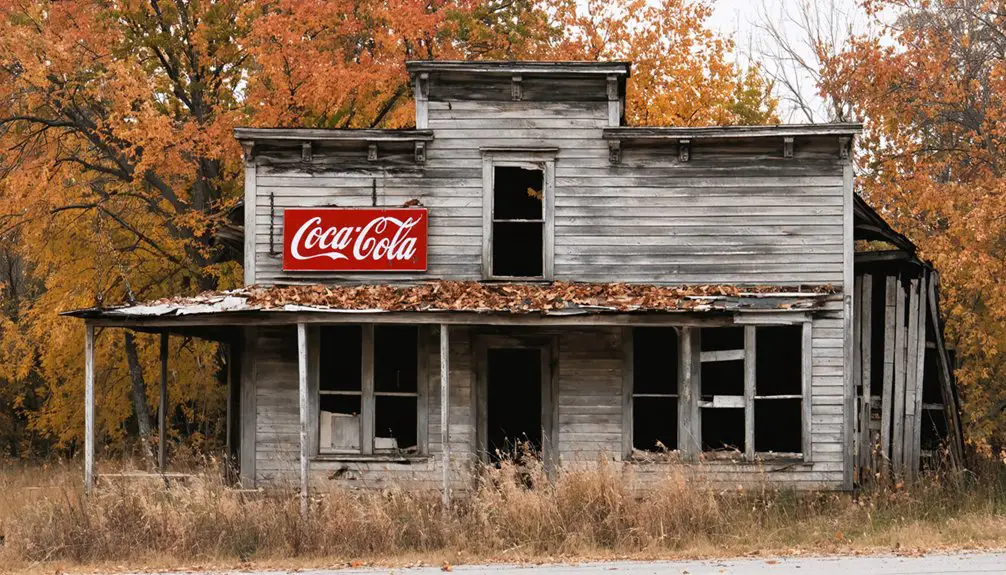
While most Keweenaw ghost towns languish in obscurity, Central Mining Company’s settlement stands apart as a preserved historical site that’s never seen a camera crew.
Despite its dramatic 1872 shaft disaster that killed 10-13 Cornish miners and peak population of 1,200 residents, filmmakers haven’t discovered its authentic structures.
What makes Central cinematically unused yet historically valuable:
- 13 original houses and 1868 Methodist church remain on 38 accessible acres
- Keweenaw County Historical Society maintains restored miners’ homes with period antiques
- Summer operations run 9 a.m.-5 p.m. daily for unrestricted exploration
- Annual July gathering draws descendants whose great-great-grandparents worked the shafts
- Part of Keweenaw National Historical Park system north of Calumet
Historical preservation and community engagement sustain Central’s authenticity—ironically making it perfect for filming yet perpetually overlooked. The church generates maintenance revenue through wedding rentals, periodic inspections, and serves as the focal point for reunions each last Sunday of July. The town sits between Calumet and Copper Harbor on US-41, making it accessible for visitors exploring the Keweenaw Peninsula’s mining heritage.
Winona’s Abandoned Structures and Their Untapped Film Potential
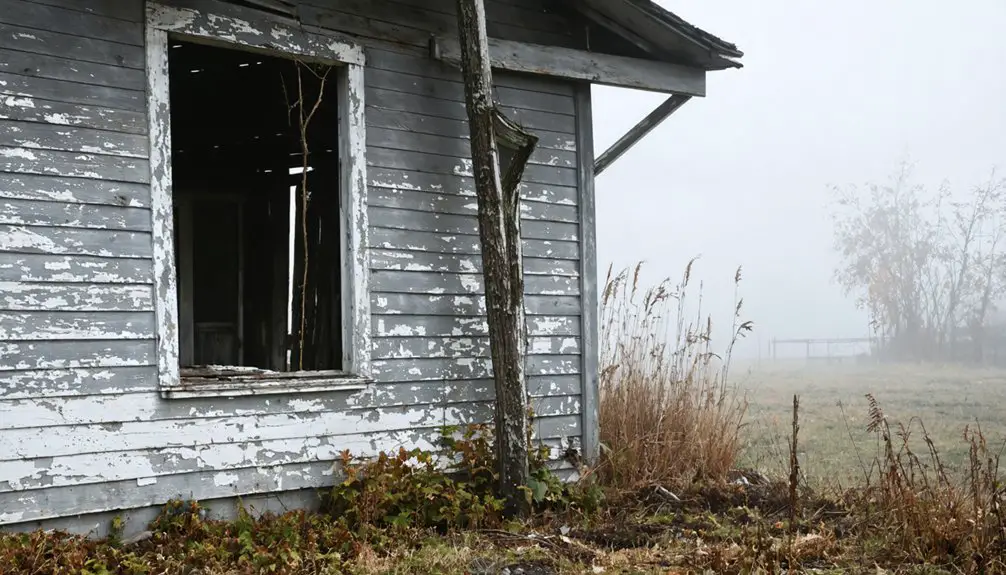
You’ll find Winona’s film potential embedded in its layered archaeological landscape—concrete foundations from 24-30 demolished houses, scattered open mine shafts, and deteriorating structures with intact period details like window frames and curtain fragments.
The woodland encroachment creates natural atmospheric staging, with trees replacing former roadside buildings and forest growth obscuring pathways to generate the eerie presence documented in Dr. Michael Loukinen’s “Winona: A Copper Mining Ghost Town.”
These visually distinct elements—stamp sand deposits, power plant infrastructure remnants, and buildings in progressive states of collapse—offer production designers ready-made sets requiring minimal modification for period films spanning 1906 through the 1940s mining era. The site’s authentic infrastructure includes remnants of fire hydrants and electricity systems that once served this modern mining community, providing genuine historical details for productions. The extensive railroad and trolley infrastructure that once connected mines to smelting and shipping ports provides authentic transportation corridors for historical productions.
Remaining Foundations and Structures
Standing among the scattered remnants of Winona’s central district, you’ll find at least 24—possibly 30—house foundations that mark where a thriving mining community once housed over 1,000 residents. These uniform concrete structures reveal early 1900s construction methods, complete with evidence of electricity hookups and fire hydrant systems.
Despite restoration challenges posed by decades of neglect, these ruins present remarkable tourism opportunities for filmmakers seeking authentic period settings. The town’s prosperity was driven by copper mining success until the mine’s closure in 1923 marked the beginning of its decline. The community once featured amenities reflecting its prosperity, including a Finnish Temperance Hall that showcased the ethnic heritage of its residents.
Explorable structural elements include:
- Open mine holes and deteriorating buildings scattered throughout wooded areas
- Abandoned homes with curtain fragments still clinging to windows, tree limbs piercing through frames
- The 1906 Elm River schoolhouse featuring gymnasium and stage, maintaining original appearance
- Champion Mill’s imposing smokestack rising above foundation clusters
- Hidden miners’ cabins nestled among overgrown forest paths
Natural Reclamation as Backdrop
As nature reclaims Winona’s abandoned structures, the forest creates an atmospheric filming environment that money can’t replicate on constructed sets. You’ll find trees closing in on former house sites where at least 24-30 foundations mark what once thrived.
The natural backdrop offers genuine decay—broken-down homes, open mine holes, and vanished garages now replaced by wild plant fragrances and progressive forest growth.
This scenic contrast between human abandonment and nature’s persistence delivers ready-made visuals for horror or post-apocalyptic narratives. Located 33 miles south of Houghton, Winona’s woods provide eerie wilderness scenes without artificial construction costs.
The landscape’s authentic transformation from 1,000 residents to 13 creates dramatic set pieces that capture genuine desolation—the kind independent filmmakers seeking unrestricted creative environments can exploit immediately.
The Evil Dead’s Michigan Roots and Why It Filmed Elsewhere
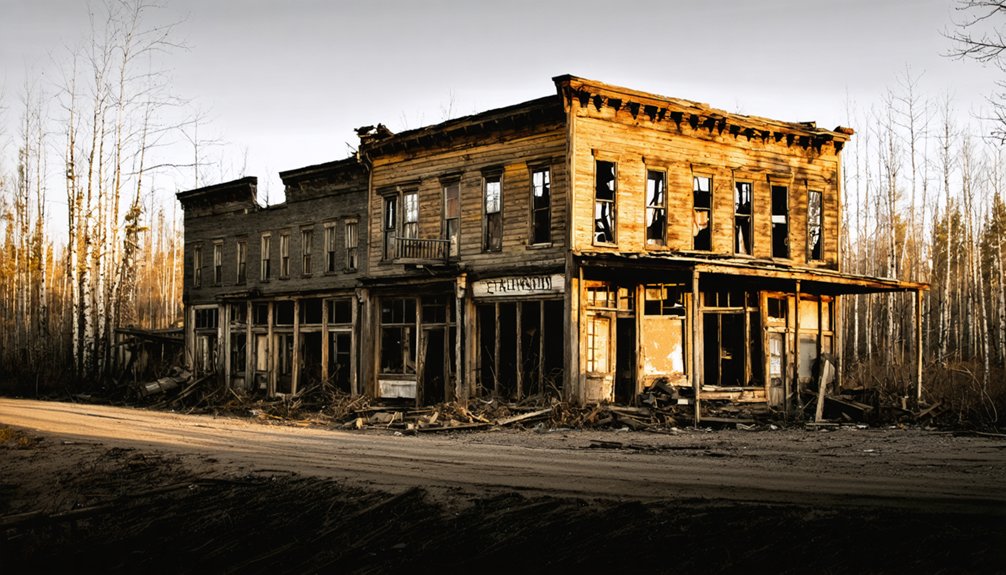
You’d expect Sam Raimi’s feature debut *The Evil Dead* to shoot in his Royal Oak, Michigan hometown, but approaching winter in 1979 forced the crew to scout southern states instead. Tennessee won the location hunt with its warmer weather, rolling hills, and isolated cabins near Morristown.
Ironically, once cameras rolled from November 1979 to January 1980, it delivered the coldest winter in decades.
The production completed 90% of principal photography in that remote Tennessee cabin before returning to Michigan for reshoots at Bruce Campbell’s family cabin in Gladwin and a Marshall farmhouse through late 1980.
Michigan Scouting Fell Short
The crew’s self-scouting efforts around Detroit revealed critical shortcomings:
- Michigan’s Film Commission lacked experience guiding feature productions toward suitable remote locations.
- No professional location scouts assisted in finding the necessary rustic backwoods cabin setting.
- Royal Oak and Detroit’s urban decay offered industrial remnants but no isolated forest environments.
- Winter weather threatened exterior shooting schedules as scouting extended into late fall.
- The commission provided zero guidance for securing the remote, atmospheric cabin the script demanded.
Seasonal timing and inadequate institutional support ultimately forced production elsewhere, though Michigan would later host reshoots.
Tennessee Became Filming Location
After exhausting Detroit-area options without success, Sam Raimi and producer Rob Tapert shifted their search 600 miles south to Tennessee’s Cumberland Plateau.
You’ll find the actual cabin near Morristown, surrounded by dense hardwood forests that provided the isolated atmosphere Michigan couldn’t deliver within budget constraints.
Film location myths often credit Michigan as The Evil Dead’s setting, yet Tennessee’s Tate Springs and Tazewell areas offered cheaper permits, accessible wilderness, and cooperative local authorities.
The Michigan influence remained purely conceptual—Raimi’s Detroit upbringing shaped the film’s aesthetic, but Tennessee’s rugged terrain became the canvas.
You can still visit Bridgeport’s remote valleys where the crew filmed exterior shots, proving that creative vision often trumps geographic loyalty when production realities demand practical solutions.
Michigan Cities That Have Successfully Hosted Major Film Productions
- Highland Park’s cultural preservation captured immigrant narratives in *Gran Torino* and *Blue Collar*.
- Flint’s documented decline in *Roger & Me* showcased unfiltered industrial collapse.
- Grand Rapids’ Monroe Center served multiple action sequences in 50 Cent’s crime thrillers.
- East Lansing’s MSU campus doubled as Lex Luthor’s mansion in *Batman v Superman*.
- Detroit’s Woodward Avenue featured high-speed sequences in *Need for Speed*.
These cities provide unrestricted creative canvases without Hollywood’s regulatory constraints.
Challenges of Filming in Remote Upper Peninsula Ghost Town Locations
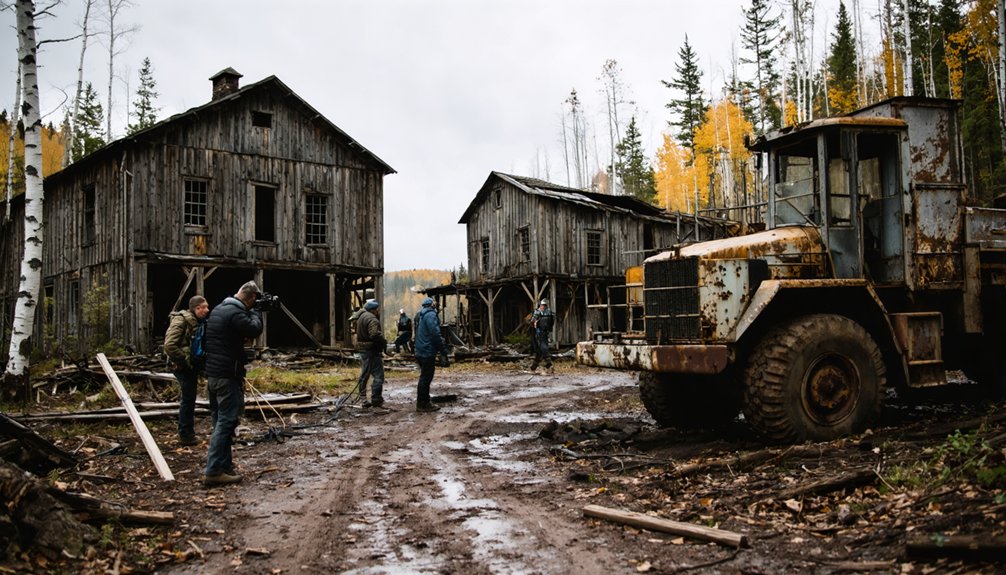
When production crews venture into Upper Peninsula ghost towns, they encounter accessibility obstacles that immediately separate these locations from Michigan’s urban filming hubs. You’ll face 24-mile rural drives to sites like Big Bay Point Lighthouse, where wayfinding after dark becomes treacherous without GPS.
Delaware’s 390-inch annual snowfall creates equipment transport nightmares through rugged terrain 12 miles south of Copper Harbor. Local guides become essential when charting overgrown trails concealing Donken’s abandoned structures along M26’s backroads.
Drone photography offers solutions for surveying Central Mine’s powder house and Fayette’s blast furnaces before committing crew resources.
You’ll contend with structural instability in skeletal mining remains, while multi-day logistics coordinate shoots across Calumet to Eagle Harbor. Winter isolation amplifies delays, and absent modern utilities challenge even experienced production teams seeking these hauntingly authentic backdrops.
Accessibility and Preservation Concerns at Keweenaw National Historical Park Sites
Production planning requires addressing:
- Site accessibility ratings ranging from 1 (Gay Stamp Sands Park—no facilities) to 3 (Brockway Mountain Drive—most guidelines met).
- Weather and limited cell service impacting crew logistics.
- Federal standards compliance through park SETP requirements.
- Virtual tour pre-planning via Able Eyes covering 15 destinations.
- Partner site variability requiring advance coordination calls.
Comparing Michigan Ghost Towns to Ghost Town Film Locations in Other States
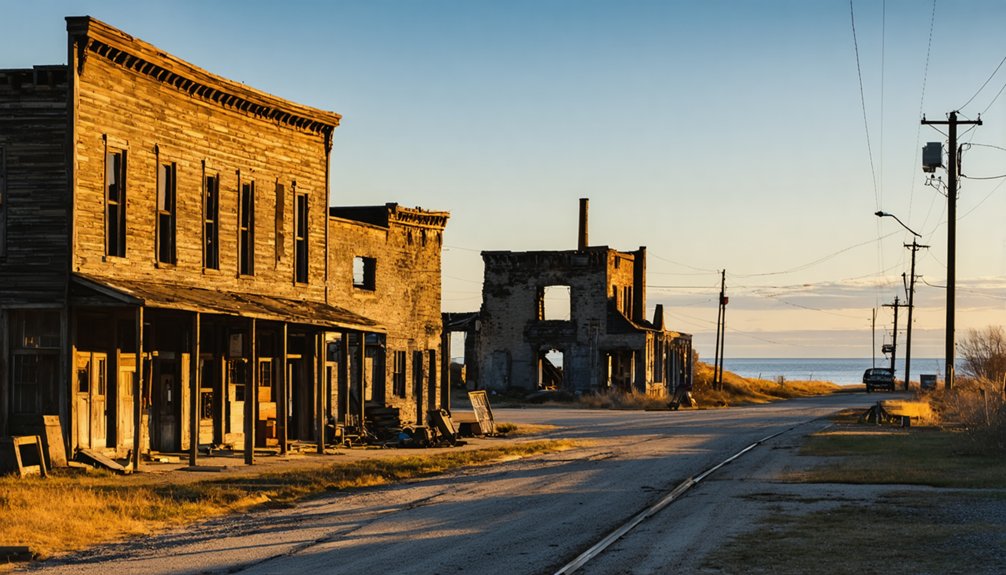
While Michigan’s Keweenaw ghost towns offer authentic copper-era ruins comparable to Nevada’s Rhyolite or Colorado’s St. Elmo, they haven’t attracted filmmakers due to restrictive access policies. You’ll find California’s Bodie operates as a state park, enabling controlled filming for productions like Eraserhead.
Michigan’s Keweenaw ghost towns remain unexplored by filmmakers while California’s Bodie welcomes controlled productions through accessible state park management.
Michigan’s sites require DNR contact and emphasize private property caution. Nevada ghost towns draw tours freely, contrasting sharply with Keweenaw’s limitations.
Despite Winona’s 24-30 identical house foundations and Evergreen Cemetery’s wildflower restoration creating visual appeal, no film records exist.
Tourism development remains minimal compared to New Mexico’s Madrid, featured in Wild Hogs.
Tennessee’s Morristown cabin ultimately replaced Michigan’s wilderness for Evil Dead, highlighting how accessibility determines filming viability over authenticity.
Future Opportunities for Showcasing Michigan’s Abandoned Mining Communities on Screen
You’ll find Michigan’s Keweenaw Peninsula offers unmatched cinematic potential with its 300 waterfalls, standing mine shafts equipped with antique trains, and 1860s mining architecture clustered across dozens of accessible sites.
Film productions at locations like Delaware Mine and Fayette Historic Townsite could generate tourism revenue while creating permanent visual documentation that aids preservation efforts led by the National Park Service.
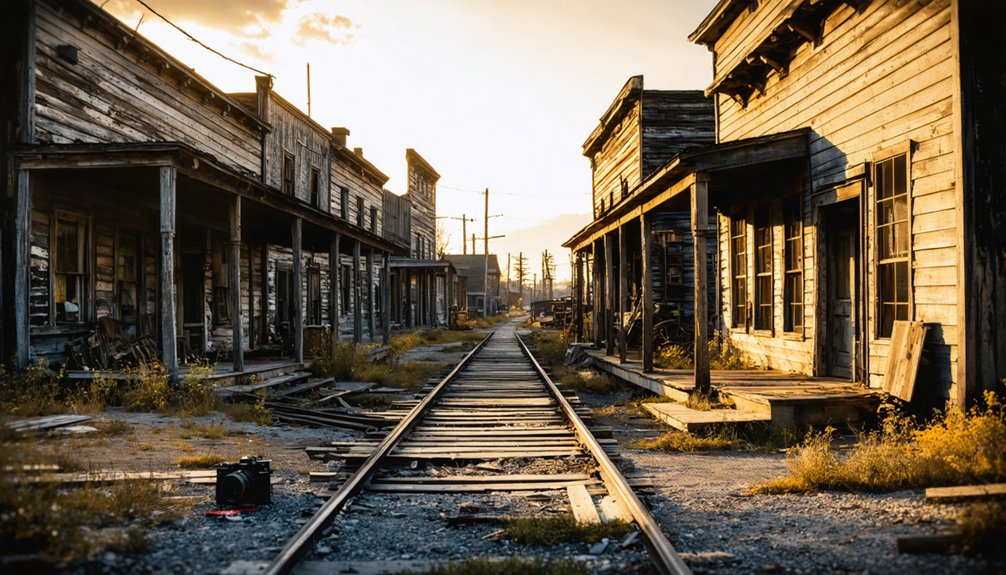
The region’s authentic industrial decay—from Central Mine’s 1840s ruins to Freda’s abandoned streets—provides ready-made post-apocalyptic and period-specific backdrops that rival established ghost town filming destinations in other states.
Keweenaw’s Cinematic Visual Potential
The Keweenaw Peninsula’s abandoned copper mining communities offer filmmakers an unmatched collection of authentic 19th-century industrial ruins spanning nearly 100 ghost towns from the 1800s boom era. You’ll find deserted landscapes where dilapidated structures contrast with pristine wilderness across three lake coastlines.
Rustic atmospheres permeate locations like Central Mine’s restored boomtown exhibits and Cliff Cemetery’s gothic iron grave markers shadowed by pines.
Prime filming assets include:
- Informal trail systems threading through mine shafts and tailings piles invisible from roads
- Abandoned stamp mills and dredgers at water’s edge providing industrial relic close-ups
- Self-guided walking tours at Central Mine enabling authentic period recreations
- Clustered village sites around Calumet, Eagle River, and Copper Harbor for diverse angles
- Native copper artifacts adding prehistoric mining dimensions to storylines
These accessible ruins deliver cinematic decay without Hollywood fabrication.
Economic Benefits for Communities
When production crews arrive at Michigan’s copper mining ghost towns, they inject immediate capital into Upper Peninsula economies through location fees, equipment rentals, and crew expenditures across communities where 300,000 residents occupy vast stretches of remote terrain.
You’ll find cultural heritage sites like Central Mine and Cliff Mine transforming from decaying structures into revenue generators that fund preservation efforts—blacksmith shops restored, trails cleared, signage installed.
Film-induced tourism creates year-round maintenance positions at over 100 ghost town locations, while seasonal guides manage June-to-October visitor surges.
Detroit’s Michigan Central Station demonstrates this multiplier effect: Batman v Superman filming catalyzed its conversion into a 30-acre tech hub.
Local restaurants, lodging providers, and supply vendors near Grand Rapids and Holland filming sites capture dollars from both production teams and subsequent location tourists.
Preservation Through Film Documentation
Michigan’s abandoned copper mining communities present untapped cinematic potential as documentary subjects and dramatic backdrops, particularly across the Keweenaw Peninsula where nearly 100 ghost town sites from the 1800s boom era preserve tangible mining heritage.
You’ll find historical preservation expanding through YouTube series documenting locations like Freda, Cliff, and Central, creating visual archives before deterioration erases evidence. Film documentation accelerates community revitalization by attracting tourism revenue while capturing structural details, oral histories, and landscape contexts.
Key filming opportunities include:
- Delaware Mine’s accessible shaft tours and preserved surface buildings with antique equipment
- Central Mine’s museum complex supporting overnight stays for extended shoots
- Port Oneida’s 2,000-acre National Rural Historic District with permit infrastructure
- Old Victoria’s restored log cabins showcasing authentic mining village layouts
- Prospector’s Paradise offering contextual artifacts from ancient copper cultures
Frequently Asked Questions
What Permits Are Required to Film at Michigan Ghost Town Locations?
You’ll need local permits from the governing municipality, plus DNR approval if it’s state land. Historical preservation requirements and environmental concerns may apply. Contact MFDMO at (800) 477-3456 for specific ghost town location guidance.
Have Any Independent or Student Films Been Shot at Keweenaw Ghost Towns?
Documentation of independent or student films at Keweenaw ghost towns remains limited. You’ll find filmmakers must balance creative freedom with historical preservation requirements and environmental impact considerations when scouting these remote, fragile locations for potential productions.
Which Michigan Ghost Towns Have the Best Cell Phone Reception for Crews?
Ghost town connectivity presents cell reception challenges across Keweenaw sites. You’ll find Winona offers your best odds—it’s closest to Houghton’s towers. Central Mine near Calumet provides potential spillover coverage, while Freda and Cliff remain isolated with minimal signals.
Are There Local Film Commissions That Help Scout Upper Peninsula Locations?
Your location scouting compass points to MFDMO’s 6,000-site database and Upper Midwest Film Office, who’ll guide you through UP’s terrain while steering through historic preservation requirements and wildlife conservation protocols—essential freedom for capturing authentic ghost town atmospheres.
What Liability Insurance Is Needed When Filming at Abandoned Mine Sites?
You’ll need general liability coverage at £5-10 million minimum, plus workers’ compensation for crew safety. Insurance requirements also include specialized mine subsidence coverage and equipment protection, ensuring you’re protected from property damage at hazardous abandoned sites.
References
- https://99wfmk.com/evil-dead-shooting-locations/
- https://www.worldatlas.com/cities/6-michigan-towns-where-famous-movies-were-filmed.html
- https://gandernewsroom.com/community/on-the-big-screen-michigans-16-must-see-tv-moments-2/
- https://www.visitkeweenaw.com/blog/post/our-top-7-keweenaw-ghost-towns-to-explore/
- https://www.youtube.com/watch?v=qYIQMWW2m5c
- https://www.visitkeweenaw.com/things-to-do/museums-history/ghost-towns/
- https://www.youtube.com/watch?v=7-vjuqiGWJU
- https://enjoyer.com/discovering-the-ghost-towns-of-the-keweenaw/
- https://exploringthenorth.com/ghost/towns.html
- https://www.michigan.org/article/trip-idea/incredibly-haunted-places-upper-peninsula