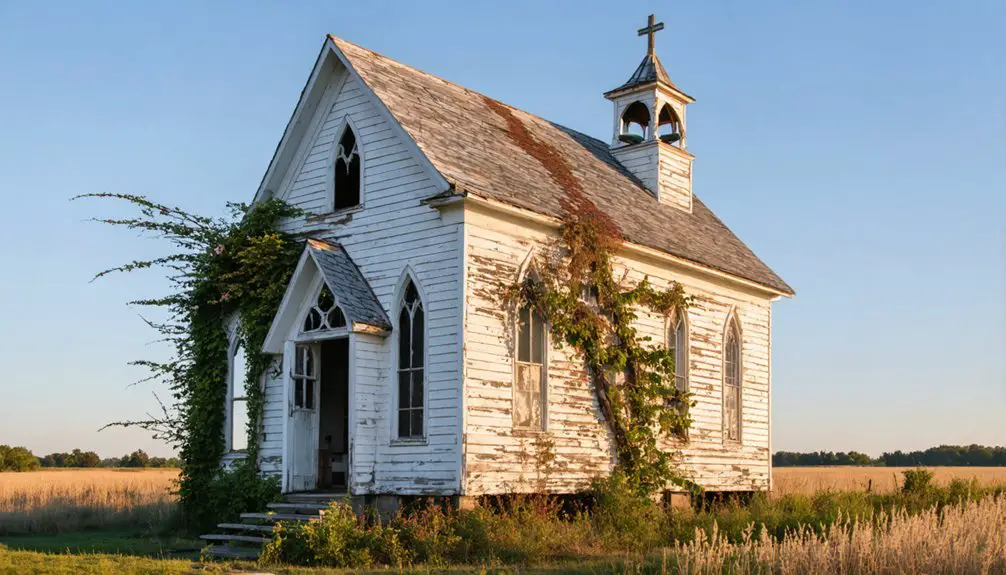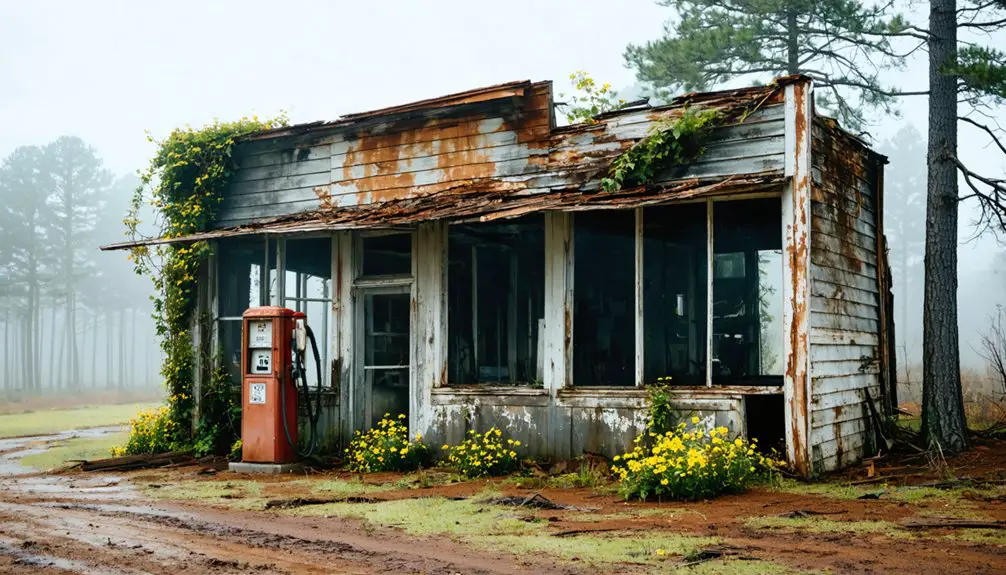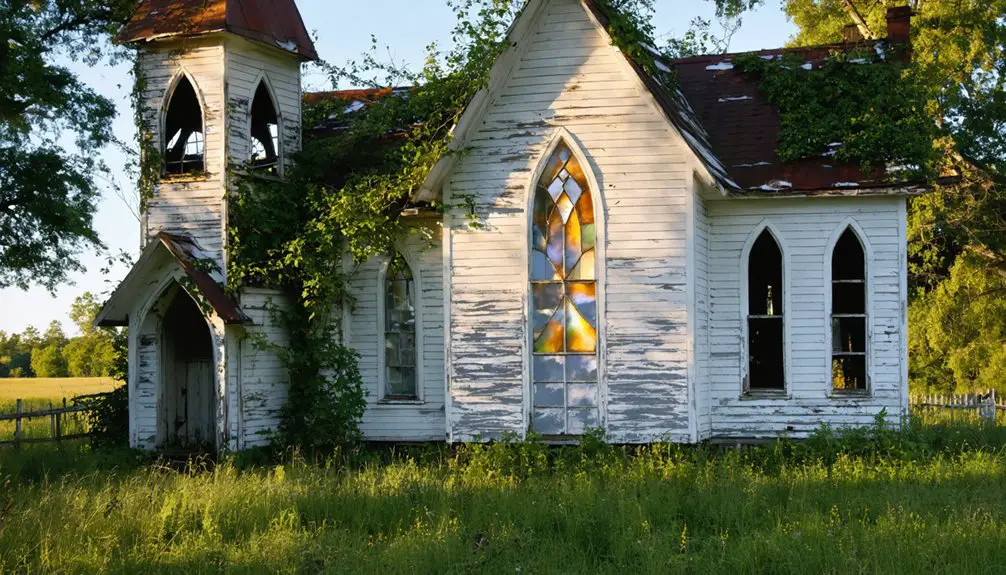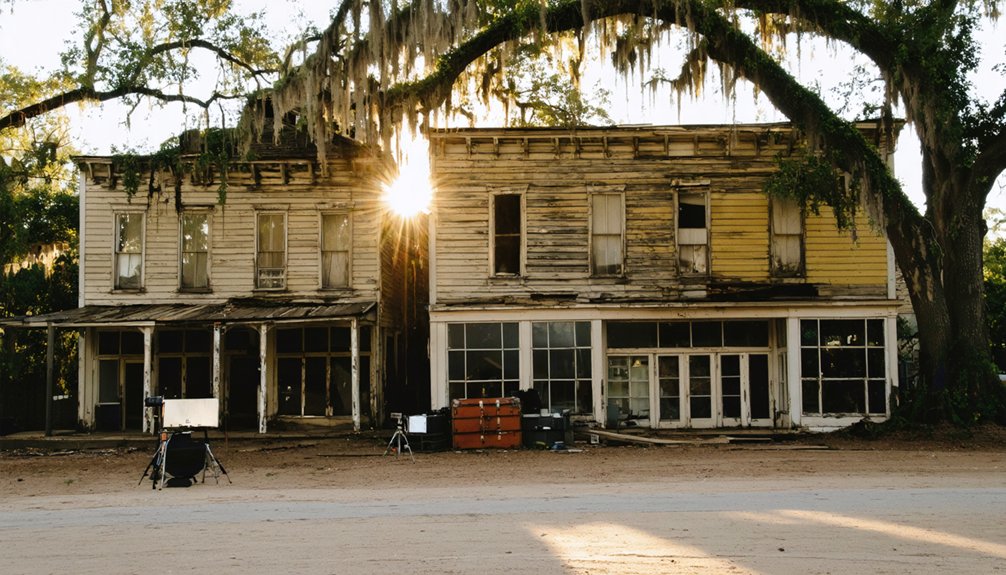
You’ll find Mississippi’s most filmed ghost town at Windsor Ruins near Port Gibson, where 23 towering Corinthian columns have appeared in “Raintree County” and countless music videos since the 1861 mansion burned. Rodney’s abandoned riverfront streets attract independent filmmakers seeking authentic decay, while Natchez’s historic plantations and Under-the-Hill district provided backdrops for 1980s productions. The Delta’s empty blues joints in Clarksdale offer directors atmospheric settings of Southern decline. Explore these locations to discover how Mississippi’s forgotten spaces continue shaping cinematic storytelling.
Key Takeaways
- Mississippi ghost towns provide authentic historical backdrops for Western and period films, enhancing cinematic realism with abandoned settings.
- These locations offer visually striking atmospheric scenes featuring preserved architecture and landscapes from past eras.
- Film production in ghost towns generates economic benefits through tourism and raises awareness of Mississippi’s regional history.
- Ghost towns serve as cultural landmarks that connect broader historical narratives while supporting local preservation efforts.
- Filming activities attract tourists and filmmakers, promoting heritage preservation and stimulating interest in Mississippi’s layered past.
Rodney Ghost Town: From Capital Contender to Abandoned Photography Haven
Though it once rivaled Natchez as Mississippi’s premier river port, Rodney now stands as a weathered monument to nineteenth-century ambition gone silent. You’ll find just 13 residents among structures that once housed 4,000 souls—two churches, a crumbling country store, and foundations where 53 businesses thrived.
The Mississippi River’s westward shift eliminated Rodney’s lifeline around 1870, while yellow fever and fire devastated what remained.
Today’s photographers navigate flood-damaged streets documenting urban decay frozen in time. The Presbyterian Church’s silver-dollar bell still hangs above Federal-style architecture.
Historical preservation efforts by the Rodney History and Preservation Society maintain select buildings, though regular flooding continues eroding structures. The town narrowly missed becoming the state capital, losing by three votes to Washington in the territorial era. The USS Rattler stationed here met its end on December 30, 1864, when it sank after a gale near Grand Gulf and was burned by Confederate forces.
You can explore this National Register site where haunted legends and Civil War cannonballs tell Mississippi’s forgotten story.
Windsor Ruins: Antebellum Columns That Defined Multiple Film Productions
Rising from Mississippi farmland like skeletal sentinels, twenty-three brick columns mark where Windsor Plantation once claimed the title of the state’s largest antebellum mansion before an 1890 fire reduced it to its current haunting framework.
You’ll find these neoclassical architecture remnants ten miles west of Port Gibson on Highway 552, where Hollywood discovered their cinematic atmospheric settings potential. MGM filmed *Raintree County* here in 1957, positioning Elizabeth Taylor and Montgomery Clift on the ruins’ iron steps to depict a burned plantation. Eva Marie Saint also appeared in the production, joining the acclaimed cast at this dramatic Mississippi location.
The columns returned to film in 1996’s *Ghosts of Mississippi*, cementing Windsor’s status as a recurring production location. Mark Twain reportedly visited the mansion and viewed the Mississippi River from its roof cupola before the devastating fire.
Since the Daniell family donated the site in 1974, Mississippi maintains this National Register property as accessible public space—no permits required for your exploration.
Natchez Historic Sites: Plantations and Under-the-Hill in 1980s Cinema
When Hollywood turned its cameras toward Natchez during the 1980s, the city’s antebellum estates and riverside districts supplied production designers with layered historical geography that required minimal set construction.
You’ll find Melrose and Monmouth anchored Warner Bros.’ *North & South* (1985-86), while Natchez Under-the-Hill appeared across five major productions—from *Crossroads* (1986) to *Beulah Land* (1980).
Cherry Grove hosted CBS’s *Rascals & Robbers* (1982), and Elms Court provided Columbia Pictures Television authentic backdrops.
Warner Bros.’ *The Mississippi* series (1983-84) utilized downtown blocks, Linton Avenue, and state park acreage.
These productions accelerated restoration efforts at deteriorating sites and generated tourism impact that continues funding preservation work.
You’re witnessing how commercial filming created economic incentives for maintaining structures that bureaucratic grants alone couldn’t sustain.
This tradition extended from silent-era productions, including *Slippy McGee* (1923) and *The Fighting Coward* (1924), which established Natchez as a filming destination dating back to the silent era. Disney’s 1993 adaptation utilized Twin Oaks mansion, Dunleith Historic Inn, and Big Black River locations to capture Twain’s antebellum Mississippi.
Clarksdale’s Delta Decline: Blues Joints and Empty Streets on Screen
Clarksdale’s abandoned storefronts preserve four decades of commercial signage—faded Coca-Cola advertisements, ghost lettering for furniture stores, and painted phone numbers with exchange names instead of area codes—creating location scouts’ access to authentic early-twentieth-century visual texture without production design budgets.
Urban decay functions as involuntary cultural preservation here: three-story Gothic Revival structures maintain original Chickasaw Iron Works columns from the 1880s-1920s, while functional juke joints like Morgan Freeman’s Ground Zero Blues Club operate blocks from derelict cinema theaters. The 1930 Clarkdale High School, shuttered since 1999, stands as a three-story Gothic Revival testament to the town’s cotton boom prosperity, its overgrown grounds and on-site cemetery adding atmospheric depth filmmakers typically construct artificially.
Ryan Coogler’s *Sinners* bypassed Clarksdale’s ready-made 1930s architecture for Louisiana soundstages, though the director later arranged screenings for residents whose hometown inspired his narrative. All local theaters have remained closed for years, forcing the community to wait for these special showings to see their Delta heritage depicted on screen.
The Delta’s supernatural folklore—Robert Johnson’s crossroads deal, the Yazoo Mermaid—lives in landscape cinematographers consistently overlook for constructed sets elsewhere.
Lesser-Known Abandoned Locations Across Mississippi Film History
How does a production locate authenticity when soundstages can’t replicate structural decay‘s precise textures? You’ll find hidden filming secrets scattered across Mississippi’s forgotten corners—Windsor Ruins’ fire-scarred columns anchored *Show Boat* (1951) and *Ghosts of Mississippi* (1996).
While Natchez Under-the-Hill’s riverfront dereliction powered *Mistress of Paradise* and *Beulah Land* in the early 1980s. Cherry Grove Plantation near Church Hill delivered frontier abandonment for *Rascals & Robbers* (1982), capturing CBS’s vision of period childhood adventure.
Parchman Prison’s operational death row wings provided *The Chamber* (1996) with grim confinement nobody could fabricate. Local legends surround Mount Helena Home in Rolling Fork, where spectral Delta plantations fueled Southern Gothic atmosphere for obscure productions.
The Murphy Store in Murphy stood as an exterior location for *Crossroads* (1985), its weathered facade providing authentic rural Mississippi textures that production designers couldn’t recreate on studio lots. You’re witnessing location scouts who refused compromise, choosing real ruin over artificial distress. These recognizable film sites now serve dual purposes as both historical landmarks and key attraction spots for cinema enthusiasts exploring Mississippi’s layered past.
Frequently Asked Questions
Are Ghost Town Filming Locations in Mississippi Open to the Public Year-Round?
You’ll find Rodney Ghost Town welcomes explorers year-round despite muddy conditions—historical preservation meets unrestricted access. However, visitor access policies vary elsewhere: Clarksdale’s filming streets stay open, while Parchman Prison remains off-limits to casual wanderers seeking cinematic landscapes.
What Safety Precautions Should Visitors Take When Exploring Abandoned Movie Locations?
Watch for hazardous structures like collapsed floors and unstable walls before entering. You’ll need landowner permission to avoid trespassing risks at private sites. Wear boots, bring first aid supplies, and watch for snakes in overgrown areas.
Do Filmmakers Need Special Permits to Shoot at Mississippi Ghost Towns?
You’ll definitely need permits—75% of Mississippi’s ghost towns require multiple approvals. Film permit regulations demand applications through state commissions, while historical preservation rules protect sites like Windsor Ruins. Expect $100-$1,000+ fees depending on your crew size and location choice.
How Have These Abandoned Locations Been Preserved Since Their Filming Dates?
You’ll find preservation efforts rely on state historical significance designations and natural isolation. Weather-worn columns, crumbling brick facades, and abandoned storefronts remain untouched since filming, protected through minimal intervention that honors their authentic decay and unrestricted photographic access.
Can Tourists Hire Guided Tours of Mississippi’s Ghost Town Movie Sites?
Exploring Mississippi’s cinematic ghost towns resembles a treasure hunt without a map—you’ll find limited guided tour accessibility for movie-specific sites. Historical preservation efforts focus on general Natchez locations, while Rodney and Windsor Ruins remain self-exploration territories.
References
- https://visitnatchez.org/natchez-film-office/filmed-in-natchez/
- https://www.youtube.com/watch?v=3Fa9flkINlo
- https://visitmississippi.org/experiences/movie-magic-in-mississippi/
- https://oxfordfilmfreak.wordpress.com/filmed-in-mississippi/
- https://icatchshadows.com/rodney-ghost-town-photos-and-video/
- https://filmmississippi.org/about/filmed/
- https://www.legendsofamerica.com/ms-rodney/
- https://sethparker.net/rodney-mississippi-the-ghost-town-youve-probably-never-heard-of/
- https://theforgottensouth.com/rodney-mississippi-ghost-town-history-tour/
- https://mississippifolklife.org/articles/haunted-by-a-ghost-town-the-lure-of-rodney-mississippi