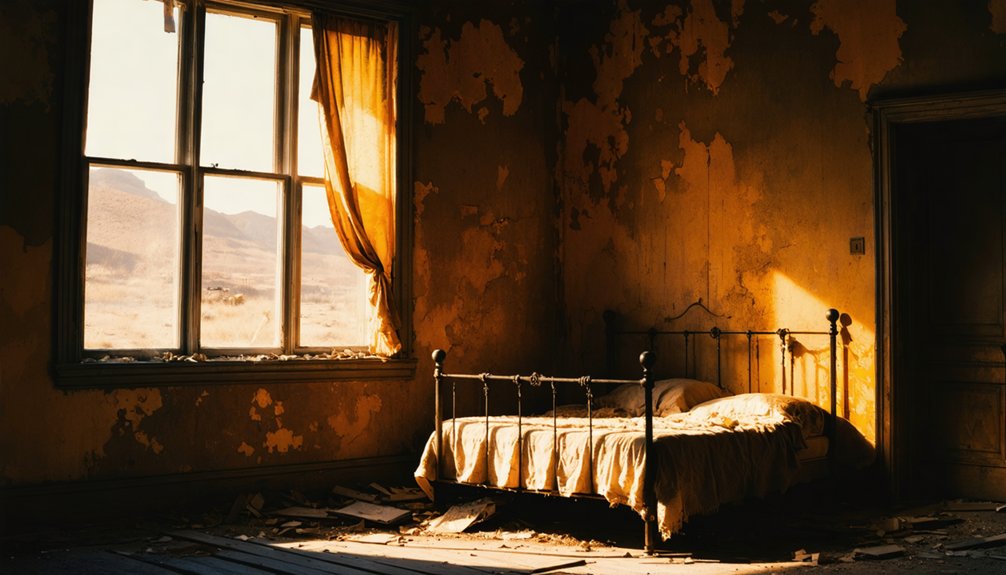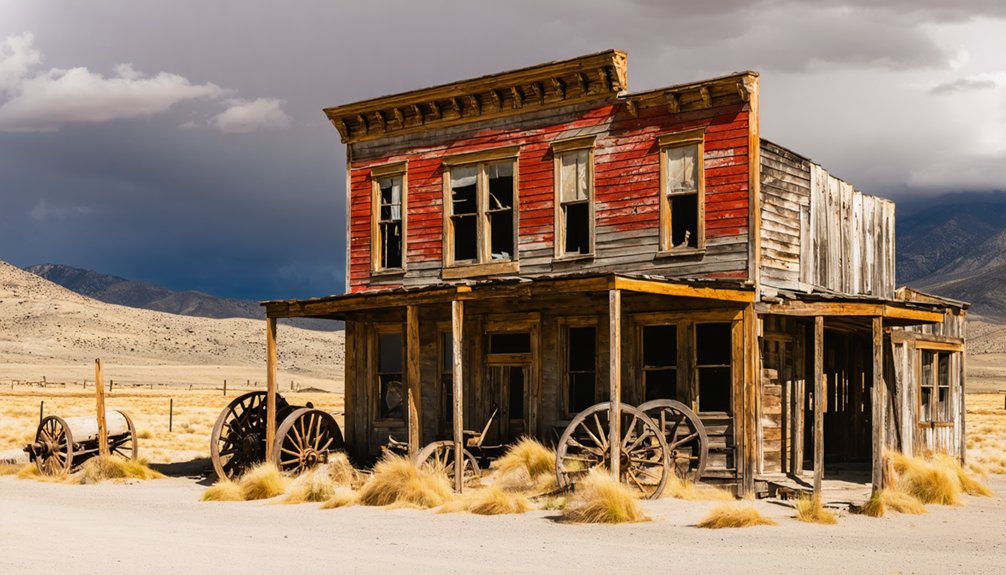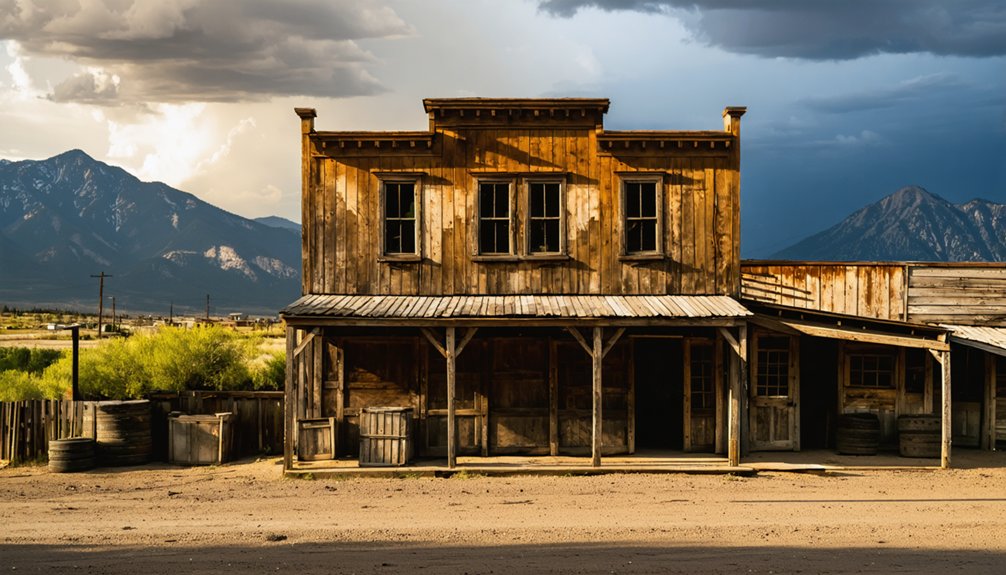
You’ll find iconic Mountain West ghost towns like Grafton, Utah, and Paramount Ranch, California, serving as authentic filming locations for over 500 productions—from classic westerns to *Westworld*. These sites feature weathered 1890s structures, hand-hewn stone foundations, and sun-bleached timber that provide unmatched visual authenticity. Locations like Goldfield offer reconstructed saloons and mine tours, while Monument Valley‘s 17-mile scenic loop showcases formations like West Mitten Butte. Access often requires high-clearance vehicles on unpaved roads, and wildfires pose ongoing preservation challenges that continue shaping these cinematic landscapes.
Key Takeaways
- Rhyolite, Cerro Gordo, and Grafton offer authentic weathered structures requiring minimal set dressing, making them ideal for period-accurate Western film production.
- Paramount Ranch served as a filming location for over 130 films and TV series before the 2018 Woolsey Fire destroyed much of the historic backlot.
- Bodie’s preserved 1890s mining structures provide layered visual textures from decades of filming, eliminating costly new set construction needs.
- Monument Valley’s 17-mile scenic loop features iconic formations like West Mitten Butte, used in over 100 productions including classic Westerns.
- Goldfield Ghost Town recreates an 1890s mining town with functional sets including saloons and mines, serving both filming and tourist purposes.
Grafton Utah: The Most Photographed Ghost Town in the West
When Mormon pioneers arrived at the Virgin River floodplain in 1859, they established Wheeler—a settlement that would survive barely three years before the Great Flood of 1862 swept it away entirely.
Relocated upriver and renamed Grafton, the town peaked at 168 residents before floods, Paiute conflicts, and limited resources triggered abandonment by 1866.
Nature’s fury, indigenous resistance, and scarcity of resources conspired to empty Grafton within a single decade of its founding.
You’ll find five restored structures today: the 1877 John Wood home beneath cottonwoods, the 1886 church-schoolhouse, and Alonzo Russell’s two-story veranda home.
Cultural preservation efforts by the Grafton Heritage Partnership maintain orchards, historic farming equipment, and the haunting cemetery where five Ballard children rest.
Heritage tourism thrives here—filmmakers chose this location for 1929’s *In Old Arizona*, while photographers capture its weathered beauty nine miles from Zion National Park’s entrance. The town experienced brief resettlement in 1868 after peace was achieved with local Paiutes, though depopulation resumed when the Hurricane Canal enabled downstream farming after 1906. Access requires crossing a historic iron bridge built in 1924 over the Virgin River from Rockville.
Cisco Utah: A Railroad Town Frozen in Time
While Grafton’s photogenic ruins draw visitors seeking scenic beauty near Zion, Cisco presents a starker vision of abandonment seventy miles northeast in Utah’s high desert.
Founded as a 1880s railroad watering stop, this town boomed through oil strikes and uranium prospecting before Interstate 70 bypassed it five miles north. You’ll find crumbling tourist infrastructure—shuttered gas stations, collapsed hotels—alongside weathered railroad artifacts that attracted film crews seeking authentic western backdrops.
Cisco’s decline followed a predictable pattern:
- Diesel engines eliminated steam-era water stops (1930s-1950s)
- Uranium boom collapsed after brief prosperity
- Highway rerouting strangled remaining commerce (1970s)
- Population exodus completed ghost town transformation
The town’s eerie landscape caught Hollywood’s attention, appearing in “Thelma and Louise” and other films drawn to its haunting desert atmosphere. The Denver and Rio Grande Railroad, which incorporated in 1870 and spanned from Ogden, Utah, to Santa Fe, New Mexico, established Cisco as a strategic point along its route.
Today you can explore privately-owned structures, including an Airbnb-converted post office, while California Zephyr trains roll past without stopping—freedom seekers documenting railroad history’s forgotten outposts.
Paramount Ranch California: Hollywood’s Western Backlot
You’ll recognize Paramount Ranch’s Western town from classic television series like “Have Gun, Will Travel,” “Bat Masterson,” and “The Cisco Kid,” which transformed its oak-dotted valley into iconic frontier settings during the 1950s and 1960s.
The ranch’s authentic saloon—complete with vintage piano, bar, and period wallpaper—and adjacent church created the visual backdrop for countless shootouts and dramatic scenes across 130 films and numerous TV productions. Studios purchased these movie ranches to provide controlled environments for outdoor scenes while reducing the costs and logistical challenges associated with distant location shooting. The site’s film industry origins trace back to 1921, when Jesse L. Lasky leased the property for movie production.
HBO’s “Westworld” later modified the historic church set for its futuristic narrative, demonstrating how the site’s versatile structures continue serving productions beyond traditional Western genres.
Classic Television Western Productions
Paramount Pictures transformed 2,400 acres of rolling meadows, oak groves, and canyon-carved terrain between Malibu and the Valley into a movie ranch in 1927.
After Bill Hertz purchased 326 acres in 1952, he built a Western town specifically designed for television production rental.
CBS utilized the site as their primary filming location, capitalizing on the early 1950s television Western boom.
The town’s filming logistics evolved through strategic rebuilds:
- Original facades constructed on support buildings for efficient camera work
- 1984 reconstruction after 1985 teardown maintained historical preservation standards
- 1990s overhaul created Colorado Springs set for Dr. Quinn, Medicine Woman (1992-1997)
- Early 2000s redesign incorporated 1930s elements for HBO’s Carnivàle
The National Park Service acquired the property in 1980 and initiated extensive rebuilding to restore the deteriorating Western town structures.
You’ll find this backlot exemplified Hollywood’s adaptable approach to sustaining television Western production beyond the studio era.
Westworld’s Modified Church Set
When HBO constructed the Westworld church at Paramount Ranch‘s 2,700-acre Agoura Hills property, production designers built a complete structure with a functional steeple that would later be removed to distinguish the physical set from its on-screen counterpart.
You’ll find the church modifications included strategic interior repainting to achieve authentic period aesthetics, while digital post-production altered the steeple’s appearance for broadcast.
The filming logistics centered around accommodating interior shots for pivotal scenes, including Dolores’s confrontation with the Man in Black.
Located at 2903 Cornell Road, this purpose-built set served as a primary location throughout Seasons One and Two.
The church exterior became the backdrop for the series’ most significant narrative milestones, including Arnold’s death, Ford’s final speech to the trustees, and the Season 1 finale where Dolores shot Ford in the same location.
When you visit today, you’ll discover one of only two structures that survived the 2018 Woolsey Fire, with windows offering views into the minimally-furnished interior space.
The ranch has been managed by the National Park Service since 1980, maintaining public access for visitors when filming is not taking place.
Goldfield Ghost Town Arizona: From Mining Camp to Tourist Destination
You’ll find Goldfield Ghost Town operates as a fully functional tourist destination four miles northeast of Apache Junction.
Reconstructed 1890s buildings line a recreated Main Street complete with the Blue Nugget Saloon, General Store, and Goldfield Museum.
The site offers underground mine tours ($12 adults), a narrow-gauge railroad ride, and daily gunfight reenactments.
These activities bring the Wild West mining era to life through authentic period details.
Its historically accurate architecture and desert mountain backdrop—rebuilt from original photographs following the 1943 fire—create the same rugged aesthetic that once drew film crews to similar ghost towns throughout the region.
Tourist Attraction Features
Since Bob and Lou Ann Schoose opened the first rebuilt structure in December 1988, Goldfield Ghost Town has transformed from scattered foundations and a rickety water tower into a meticulously reconstructed 1890s mining camp.
You’ll explore authentic Wild West infrastructure built from historical photographs, where mining equipment hauled from throughout the Southwest demonstrates territorial-era extraction techniques.
Your visit includes these independent experiences:
- 25-minute underground tunnel tour departing every 10 minutes ($12 adults, $10 seniors, $8 children ages 5-12)
- Museum exhibits featuring Lost Dutchman folk stories, antique firearms, and mineral collections ($9 adults, $7 seniors, $3 children)
- Arizona’s only narrow gauge train operating through reconstructed Western buildings
- Mammoth Saloon and General Store replicating original 1890s camp amenities
You’ll navigate this five-acre site at your own pace, examining preserved mining machinery and territorial camp layouts.
Western Film Suitability
With its reconstructed 1890s buildings standing against the Superstition Mountains backdrop, Goldfield Ghost Town provides production crews authentic Wild West infrastructure without modern intrusions disrupting period shots.
You’ll find the Mammoth Saloon, General Store, and mining tunnel offering ready-made sets that eliminate costly construction. The site’s filming logistics prove straightforward—Robert Schoose’s 1984-1991 reconstruction positioned period-accurate structures on the historic Goldfield Mill location, creating cohesive streetscapes.
Mining equipment relocated from across the Southwest enhances historical accuracy for gold rush narratives. The narrow gauge train, gunfight staging areas, and operational mine tours deliver practical action sequences.
Located on Apache Trail, you’ll access remote desert scenery while maintaining reasonable proximity to Phoenix production resources, eliminating restrictive shooting permits that plague federally-managed ghost towns.
Monument Valley: The Iconic Landscape of the American West
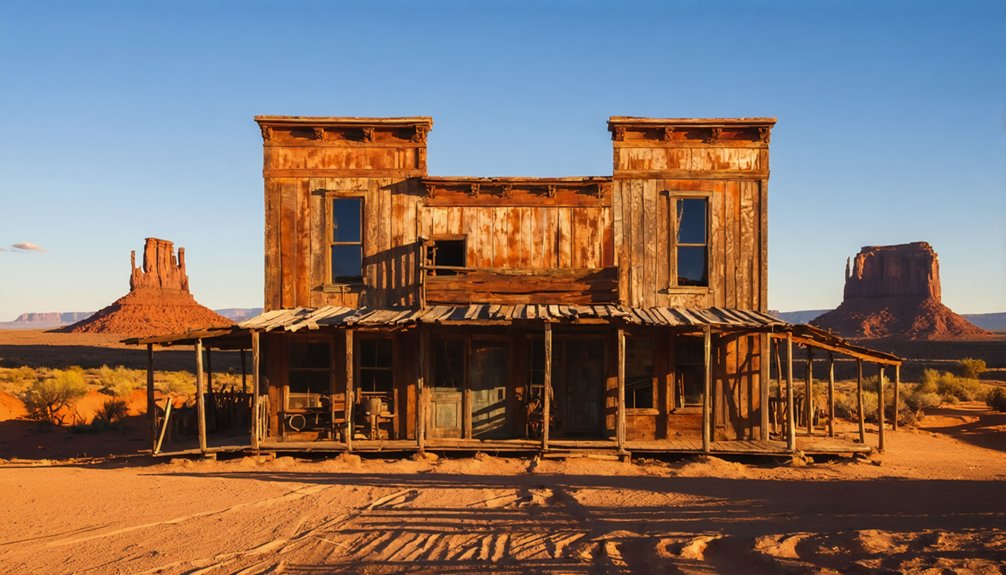
You’ll find these filming landmarks accessible via a 17-mile scenic loop:
- Castle Butte and West Mitten Butte – backdrops for fort scenes in *She Wore a Yellow Ribbon*.
- Totem Pole – where Clint Eastwood climbed in *The Eiger Sanction*.
- Goulding’s Resort – Ford’s headquarters, now featuring a museum with production photographs.
- John Ford Point – panoramic overlook immortalized in countless films.
Over 100 productions have utilized these formations, from *Easy Rider* to *Doctor Who*.
Cerro Gordo Area California: Mining Heritage Meets Modern Cinema
From the sandstone monuments of Monument Valley, California’s Owens Valley presents a different cinematic landscape—one where silver mines carved into steep hillsides replace weathered buttes.
Cerro Gordo’s mining legacy stretches from 1865, when Pablo Flores discovered silver in these “fat hills” above Owens Valley. By 1871, you’ll find the American Hotel, Belshaw House, and functioning saloons serving 4,000 residents who extracted $17 million in precious metals.
The town’s decline began with the 1877 Union Mine fire, reaching ghost town status by 1938. Today’s town preservation efforts include maintaining the 1904 Bunkhouse and converting the church into a movie theater.
Purchased in 2018 for $1.4 million, this 337-acre site offers authentic Wild West architecture—bullet holes included—for filmmakers seeking unregulated frontier authenticity.
Preserving Authentic Western Architecture for Film Production
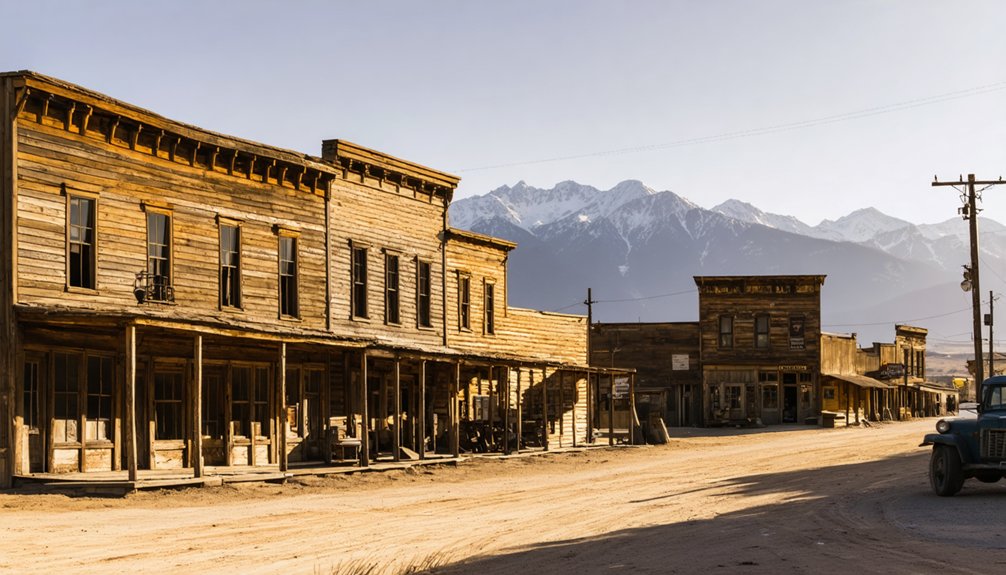
You’ll find that ghost towns like Grafton and Rhyolite maintain their film-ready appeal through deliberate preservation efforts. Grafton’s Heritage Partnership has protected structures since 1997, while Rhyolite’s intact mining-era buildings require minimal set dressing.
When production crews arrive at these locations, they’re working with genuine weathered wood, original stone foundations, and period-accurate architectural details that can’t be replicated on studio backlots.
The authenticity extends to sites like Chesterfield, where Idaho’s historical society actively maintains buildings and structures, ensuring they remain both historically accurate and structurally sound for filming demands.
Structural Maintenance and Restoration
When production companies scout ghost towns for authentic Western backdrops, they’re banking on decades of deliberate preservation work that keeps these weathered structures camera-ready. Heritage partnerships employ technological preservation methods to maintain urban decay aesthetically while ensuring structural integrity.
You’ll find buildings like Grafton’s Alonzo Russell house standing exactly as they did generations ago, protected from collapse but untouched by modern restoration.
Core maintenance approaches include:
- Temporary cosmetic modifications reversed post-filming (Paramount Ranch’s removable church steeple)
- Strategic non-intervention preserving natural weathering patterns
- Structural reinforcement hidden from camera view
- Controlled access preventing unauthorized alterations
This balance lets filmmakers capture genuine deterioration without losing irreplaceable structures. Monument Valley’s towering buttes and Cisco’s untouched railroad remnants prove minimal intervention often delivers maximum authenticity for productions demanding uncompromised historical atmosphere.
Period-Accurate Building Materials
Production designers scrutinizing ghost town locations don’t just assess structural stability—they’re cataloging the exact materials that define authentic Western architecture. You’ll find original timber framing cut to length, stone walls built from locally quarried limestone and granite, and brick-faced structures showing weathered triangular tiles from empire-era techniques.
These innovative materials tell regional stories through visible construction methods—squared stone blocks in opus quadratum patterns, wooden posts silvering naturally with age, and sheet metal substitutes for decorative spandrels.
Sustainable preservation means documenting these authentic elements before filming: recording mortar compositions, identifying load-bearing configurations, and mapping where artisans used stamped tin motifs or zinc-based cast imitations.
When production teams respect these material signatures, they’re capturing architecture that’s endured centuries without compromising the structures future generations might explore.
How Ghost Towns Capture the Spirit of the Old West on Screen
Ghost towns transform into cinematic time capsules where weathered wood, rusted mining equipment, and crumbling stone walls provide filmmakers with instant authenticity that no studio backlot can replicate. You’ll find reel nostalgia embedded in locations like Nelson Ghost Town, where the Techatticup Mine—site of Nevada’s first Spanish gold strike in the 1700s—adds genuine historical weight.
Exploring ghost towns in the mountain west offers a glimpse into America’s rugged past, revealing stories of perseverance and hardship. Each location carries a haunting beauty, attracting not only filmmakers but also historians and adventurers eager to uncover the mysteries left behind. As you wander through these remnants of civilization, the echoes of those who once thrived there linger in the air.
Weathered structures and mining relics create instant cinematic authenticity that no constructed set can match, preserving untamed frontier atmosphere.
The cinematic authenticity extends beyond facades:
- Genuine geological features frame shots with mountain peaks and desert landscapes unchanged since frontier days.
- Real outlaw hideouts like Eldorado Canyon provide documented Wild West connections.
- Accumulated production props create layered visual textures from decades of filming.
- Pre-existing structures eliminate costly set construction while maintaining period accuracy.
These sites deliver unscripted atmosphere that transports viewers directly into America’s untamed past.
Planning Your Visit to Famous Western Film Locations
Experiencing these cinematic landscapes firsthand requires strategic preparation, from traversing unpaved access roads to understanding seasonal closures that can strand visitors miles from the nearest services.
You’ll need high-clearance vehicles for Bodie’s rough dirt roads off US-395, while Grafton offers easier access near Zion.
Check Paramount Ranch’s post-fire trail conditions before departure.
Visitor amenities vary dramatically—Bannack provides camping in preserved buildings, whereas Paramount Ranch permits day-use only.
Moab’s film trail maps from visitor centers guide you to Rio Grande locations among red-rock formations.
Art conservation efforts mean you can’t pocket souvenirs from Bodie, where curse legends reinforce protection policies.
Time visits for summer at high-elevation sites; winter snow blocks mountain ghost towns entirely.
Respect private property boundaries at Grafton while photographing remnants.
The Future of Ghost Town Film Locations in the Mountain West
While catastrophic wildfires and shifting production trends reshape the landscape of Western filming, these historic locations face an uncertain crossroads between preservation authenticity and commercial viability.
You’ll find four distinct paths emerging for Mountain West ghost towns:
- State-managed preservation like Bodie maintains arrested decay, balancing tourism sustainability with filming restrictions in scenic areas.
- Complete destruction exemplified by Paramount Ranch’s 2018 loss, ending decades of production without confirmed restoration.
- Unrestricted access sites such as Cerro Gordo attracting YouTube creators and explorers, risking arson and environmental impact from increased traffic.
- Legal limbo affecting places like Ghost Town Village, where ongoing lawsuits determine future filming availability.
Your freedom to explore these locations depends on evolving regulations, natural preservation challenges, and whether modern productions continue embracing practical Western settings over digital alternatives.
Frequently Asked Questions
What Permits Are Required to Film at Ghost Town Locations?
Like prospectors staking claims, you’ll navigate permit application processes through BLM ($100–$800/day) or State Parks. Liability insurance requirements are mandatory—your certificate of insurance open these weathered locations. Submit forms two weeks ahead for unencumbered access.
How Much Does It Cost to Rent a Ghost Town for Filming?
You’ll pay $118-$120 per hour with a 4-hour minimum ($472-$480 total). Factor in historical preservation fees and liability insurance requirements. Props cost $125 flat, while add-ons run $120 hourly, giving you complete creative control.
Are Ghost Town Filming Locations Accessible During Winter Months?
“When there’s a will, there’s a way”—you’ll find seasonal accessibility varies considerably. Desert ghost towns like Grafton remain open year-round, while Montana’s Bannack faces winter weather challenges with snow-packed roads limiting your freedom to explore remote locations independently.
Can Independent Filmmakers Book These Locations for Small Productions?
You’ll need to contact historical preservation organizations directly, as booking details aren’t publicly listed. Consider local community impacts when planning shoots—these ghost towns balance filmmaker access with conservation efforts, requiring advance coordination and permits.
What Safety Precautions Exist When Filming in Abandoned Structures?
You’ll need permits, daily hazard assessments, and PPE like FFP3 masks and safety boots. Avoid basements, test for structural instability before entry, watch for hazardous debris, and never work alone in these decaying locations.
References
- https://www.youtube.com/watch?v=Dipc5UwHSwo
- https://www.themoviewaffler.com/2015/09/5-iconic-filming-locations-in-american.html
- https://californiathroughmylens.com/paramount-ranch-old-movie-town/
- https://blarefilms.net/goldfield-ghost-town/
- https://www.youtube.com/watch?v=IqLIwp1HeJY
- https://www.youtube.com/watch?v=tZmA_VF6cm8
- https://iefilmpermits.com/library/ghost-towns/
- https://graftonheritage.org/history-settlement/
- https://www.americansouthwest.net/utah/zion/grafton_ghost_town.html
- https://www.hannahhendersontravel.com/grafton-ghost-town-utah/