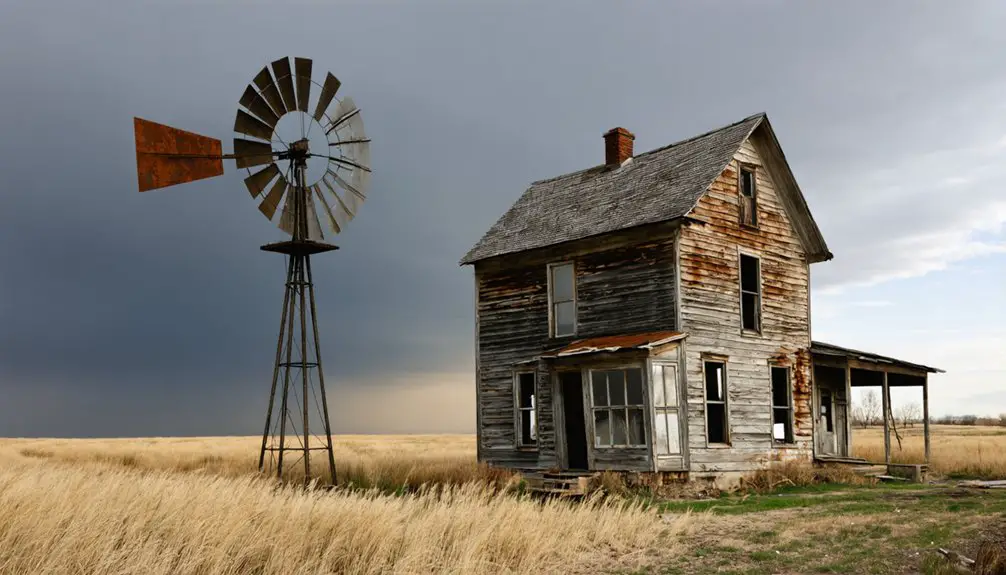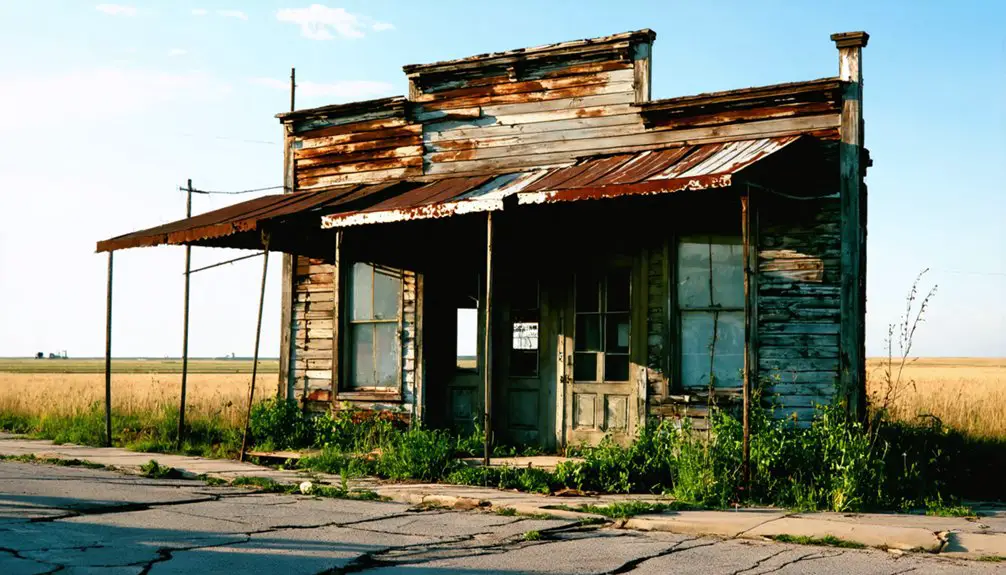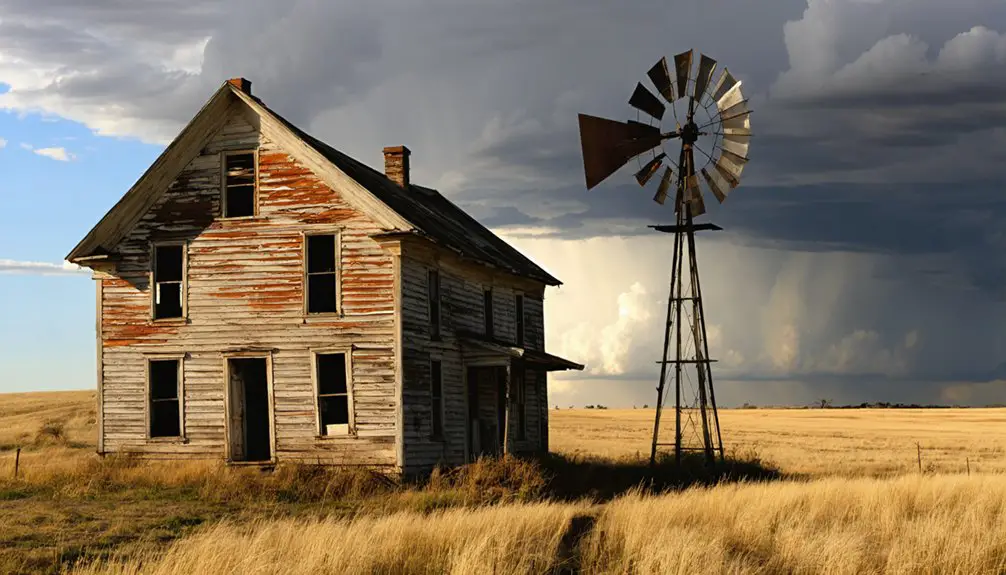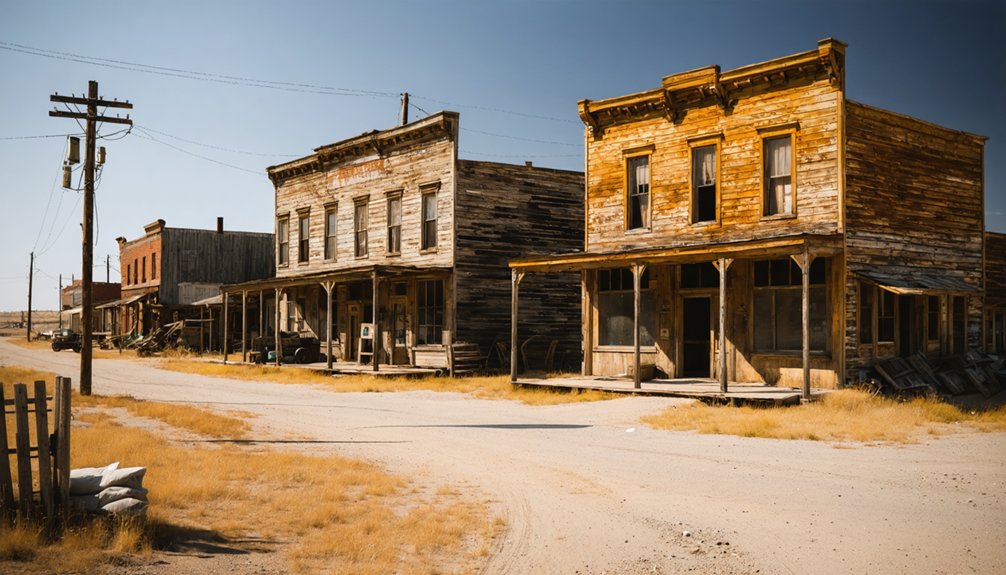
You’ll find Nebraska’s ghost towns like Plainview and Valentine serving as authentic filming locations in movies such as *Nebraska* (2013), *Sea of Grass* (1947), and *Aviation Cocktail* (2011). These sites—including Steele City with its 1880s sandstone banks and Romanesque churches, Belvidere’s Oregon Trail heritage structures, and Roscoe’s weathered railroad architecture—offer filmmakers period-accurate backdrops without costly set construction. Their minimal populations, preserved Victorian storefronts, and absence of modern infrastructure create controlled environments perfect for period productions while supporting regional tourism and heritage conservation efforts you can explore further.
Key Takeaways
- Nebraska ghost towns like Plainview and Valentine served as filming locations for *Nebraska* (2013), *Sea of Grass* (1947), and *Aviation Cocktail* (2011).
- Steele City features preserved 1880s–1890s architecture including sandstone banks, Romanesque churches, and Victorian storefronts ideal for period filming.
- Roscoe offers authentic 1870s railroad structures, grain elevators, and no modern infrastructure, perfect for recreating historic rail scenes.
- Small populations and minimal modern elements enable controlled filming environments with simplified permitting and reduced set construction costs.
- Ghost town filming supports preservation through archival documentation while boosting regional tourism and local economies via crew spending.
Defining Ghost Towns in the Nebraska Landscape
When you examine Nebraska’s vast plains and rolling farmland, certain landscapes reveal stories of communities that once thrived but now exist only as scattered remnants. Ghost towns represent settlements where residents departed after economic anchors—factories, railroads, or agricultural viability—disappeared.
Abandoned infrastructure marks these sites: graded streets lined with century-old trees, isolated grain elevators angled against modern road grids, and deteriorating foundations visible from aerial views.
Landscape scars from 1870-1890 railroad expansion remain identifiable, with most abandonments occurring by the late 1930s during agricultural collapse.
You’ll discover varying degrees of depopulation, from completely vacant settlements to near-ghost towns maintaining minimal populations. River settlements left sparse traces due to flooding, while speculative developments vanished entirely, leaving only cemeteries and tree groves as territorial markers. Some sites preserve historic lime kilns or other industrial remnants that mark where specialized operations once existed. Researchers compare historic maps with current maps to identify where these former communities once stood and trace how their locations have changed over time.
Plainview: The Fictional Hawthorne in “Nebraska” (2013)
Although Plainview maintains a living population of 1,275 residents across its 1.08 square miles in Pierce County, director Alexander Payne selected this community to portray the fictional town of Hawthorne in his 2013 black-and-white film *Nebraska*.
You’ll find Plainview’s small-town architecture and surrounding plains provided authentic visuals for this road trip comedy-drama. The location choice demonstrates how limited urban development preserves cinematic authenticity—original structures like the 1880 railroad depot (now Plainview Historical Museum) and Carnegie library appear throughout the film.
Community engagement supported production logistics, with local businesses and streets serving as primary filming sites. The town functions as a navigational reference point for multiple locations sharing the Plainview name across different states.
Plainview’s positioning along U.S. Highway 20 offered practical access for crews while maintaining the isolated Midwest aesthetic essential to Payne’s narrative about rural Nebraska life. Many Nebraska towns experienced similar origins, as railroad companies named communities alphabetically to encourage expansion and settlement during the 1870s.
Valentine: From “Sea of Grass” (1947) to “Aviation Cocktail” (2011)
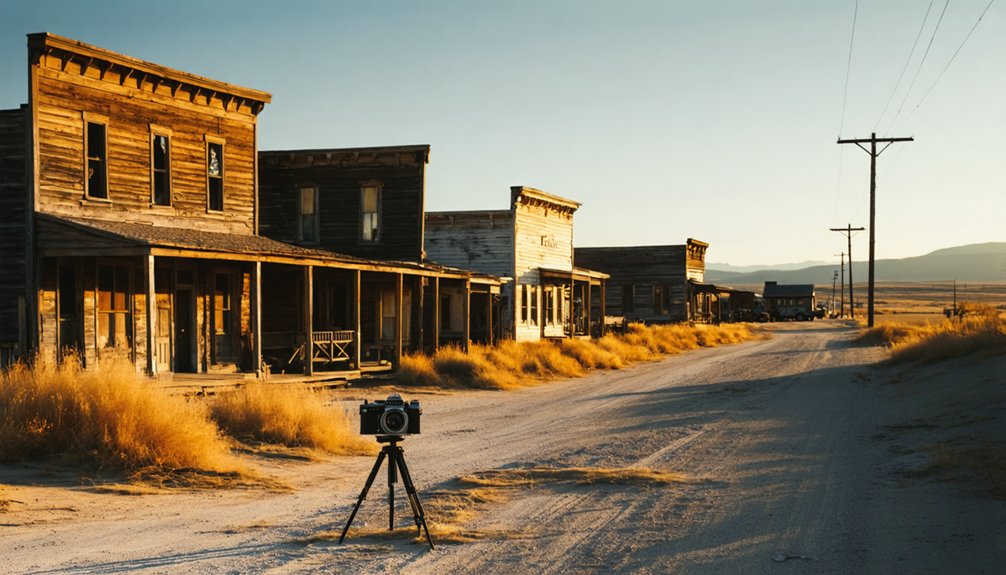
You’ll find Valentine’s northern Sandhills landscape has attracted filmmakers for over seven decades, starting when Elia Kazan’s crew arrived in 1947 to capture the windswept prairie for “Sea of Grass,” substituting Nebraska’s authentic grasslands for fictional New Mexico ranch country.
The region’s abandoned homesteads and ghost town structures provide ready-made period sets accessible via Highway 20, eliminating costly construction while delivering genuine frontier atmosphere. More recently, Kemptville, Ontario stood in for Valentine in a Hallmark production, with the town’s Prescott Street shops decorated with Valentine’s Day themes and a “Welcome to Valentine” banner. Some visitors to these abandoned locations have reported paranormal encounters, with accounts of ghostly figures appearing in deteriorating buildings that once served as filming backdrops.
Sea of Grass Production
Valentine, Nebraska’s rolling sandhills became an unlikely battleground between directorial vision and studio economics during the 1947 production of “Sea of Grass.”
Director Elia Kazan arrived with plans for an anthropological film capturing months of authentic location work across the Nebraska landscape, only to discover that MGM producer Pandro S. Berman had different intentions. Despite Kazan’s determination to shoot a story centered on “grass, country and sky” authentically, the studio insisted on rear-projection soundstage filming.
You’ll find that Valentine and Wood Lake ultimately served as compromise locations, though limited compared to Kazan’s original scope.
The production paired Spencer Tracy and Katharine Hepburn in this western examining homesteaders versus cattle barons—a narrative about resistance against encroaching settlement that inadvertently foreshadowed these locations’ own futures facing urban decay and economic decline. Tracy portrayed a cattle baron while struggling with the physical demands of the western role, a casting choice that highlighted the tension between star power and authentic characterization. The Nebraska Film Office has continued facilitating productions across the state, connecting filmmakers with locations ranging from small towns to urban centers for various commercial and entertainment projects.
Aviation Cocktail Setting
Six decades after Spencer Tracy and Katharine Hepburn’s studio-mandated appearance in Valentine for “Sea of Grass,” David R. Higgins returned to this Nebraska outpost with his independent production “Aviation Cocktail.”
You’ll find his 2011 noir thriller transformed Valentine’s landscapes into a 1950s psychological battlefield, where three PTSD-afflicted war veterans confront their demons.
The production leveraged local talent from Nebraska and Colorado, eschewing Hollywood bureaucracy for authentic regional storytelling.
Higgins handled directing, writing, and producing duties while capturing Valentine’s stark beauty through moody cinematography.
The costume design meticulously recreated postwar America’s polished exterior, concealing the characters’ inner decay.
Though aerial filming showcased Nebraska’s expansive terrain, the intimate drama focused on the claustrophobic paranoia consuming pilot Jack Fisher, Sheriff Henry, and Bob Halloran after murdering a suspected serial killer.
The film joins 37 pages documenting productions that have used Nebraska’s diverse locations for their cinematic storytelling.
The film’s success contributed to Nebraska film industry legislation, with State Senator Colby Coash featuring it as a success story that helped pass a film incentive bill.
Steele City’s Cinematic Potential With Historical Buildings
You’ll find Steele City’s preserved 1880s-1890s architecture—rough-cut sandstone banks, Richardsonian Romanesque limestone churches, and operational blacksmith shops—that offers production-ready period authenticity without extensive set construction.
The town’s population of fifty residents maintains minimal modern infrastructure intrusion while preserving hard wood floors, brick facades, and original building materials that create convincing 19th-century streetscapes.
Its wooded Little Blue River valley location provides natural scenic backdrops with accessible Nebraska logistics, positioning this diminished commercial center as a cost-effective alternative to built sets for Western and period productions.
Preserved Architecture Attracts Filmmakers
When you’re scouting for authentic period architecture, Steele City’s preserved buildings offer filmmakers ready-made sets that span multiple historical eras without costly construction.
The Richardsonian Romanesque church delivers limestone authenticity with its Hanover-quarried blocks and Gothic-influenced cathedral window.
You’ll find the livery stable’s rough-cut sandstone and brick-spanned archways provide genuine 1870s commercial atmosphere.
Main Street’s abandoned storefronts showcase urban decay that’s cinematically perfect—intact Victorian details, chamberlains, and storage buildings frozen in time.
The Zoellin house offers Italianate complexity with carriage-sized doorways, while gabled brick residences display ornate early 1900s craftsmanship.
Rather than expensive architectural restoration, you’re working with structures that’ve maintained their historical integrity through hardwood floors, detailed brickwork, and original design elements throughout Jefferson County’s picturesque Little Blue River valley setting.
Population Fifty Maintains Authenticity
Steele City’s population of 50 residents creates production conditions you won’t find in busier heritage sites—minimal noise interference, natural street emptiness, and authentic abandonment aesthetics without complete dereliction.
You’ll control Main Street without elaborate crowd management or expensive buyouts.
Population stability since 2020 means predictable filming environments where residents understand their town’s value without overwhelming tourist infrastructure diluting period authenticity.
The median household income of $25,000 signals economic receptiveness to production revenue.
The compact 0.23-square-mile footprint enables efficient crew coordination.
Authentic preservation remains intact through 150 years of continuous occupation—weathered buildings display genuine aging patterns rather than artificial distressing.
You’re accessing controlled emptiness with standing structures, eliminating construction costs while maintaining cinematic credibility for Western or historical narratives.
Historical Setting Production Value
Between 1880 and 1890, Abner Baker’s bank building established the architectural foundation that now delivers production-ready period authenticity—rough-cut sandstone and mortar anchor the lower story while brick construction defines the upper level, both opening directly onto street-level camera angles.
You’ll find Richardsonian Romanesque limestone blocks throughout the district, each bordered with smooth rock faces surrounding rough inner surfaces that photograph with dimensional depth.
The 1881 church’s Hanover limestone and detailed gables provide immediate visual credibility, while the operational blacksmith shop enables live-action sequences without CGI intervention.
Demographic shifts left these structures untouched by modern amenities—no utility poles, contemporary signage, or paved surfaces interrupt your period shots.
The livery stable’s sandstone construction and attic quarters offer multiple filming perspectives within authentic hardwood interiors that require minimal set dressing.
Belvidere: Oregon Trail Heritage Meets Film Opportunities
Nestled along the historic Oregon Trail corridor in Thayer County, Belvidere offers filmmakers an authentic glimpse into 1870s railroad settlement architecture frozen in decline.
You’ll find production-ready locations including the 1886 United Church of Christ with its original ornamental tin ceiling, providing period-accurate interiors for heritage preservation projects.
The town’s current population—one-tenth its historical peak—means you’ll navigate film logistics without modern infrastructure interference.
Local storytelling opportunities abound through visible artifacts: a 36-ton Union Pacific Caboose 25632, cemetery graves dating to 1877, and remnants of late 1800s bridge structures.
Memorial Park’s gazebo and Centennial Park’s cement slabs serve as versatile filming backdrops.
You’ll access unincorporated territory without restrictive permitting processes, while informational signage helps location scouts document authentic Western expansion narratives amid genuine rural abandonment.
Roscoe’s Railroad Legacy as a Filming Backdrop
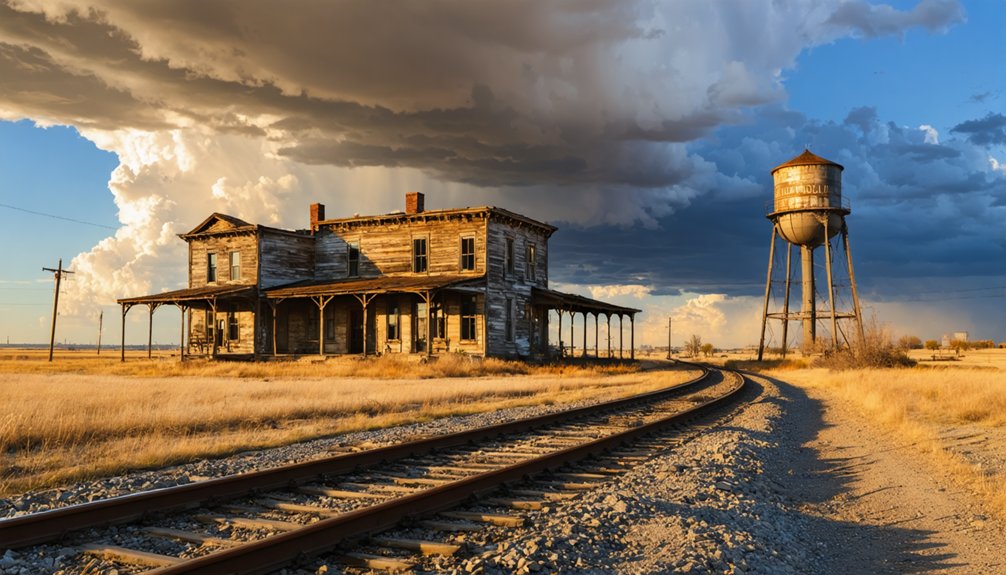
Seven miles east of Ogallala’s cattle-shipping nexus, Roscoe’s weathered railroad infrastructure delivers filmmakers a 1870s steam-era staging ground where Union Pacific’s westward expansion materializes through tangible remnants.
You’ll find Henrique Most’s grain elevator standing as primary rail-oriented architecture, while Harry Most Sr.’s collapsed blacksmith shop provides authentic decay aesthetics.
The Chamberlin family’s vacant store, adjacent cabins, and gas station offer period-appropriate commercial backdrops free from modern infrastructure intrusions—no cellular towers, contemporary signage, or paved lots disrupting historical continuity.
Environmental factors enhance production value: South Platte River proximity mirrors original locomotive water-stop functionality, while Lincoln Highway’s pre-Interstate 80 routing maintains transportation narrative authenticity.
This ghost town’s isolation grants location managers unrestricted creative control, enabling period piece transformations without municipal interference or pedestrian traffic complications disrupting shooting schedules.
Small Town Authenticity in Nebraska Productions
While ghost towns offer untouched historical settings, Nebraska’s inhabited small towns deliver production-ready authenticity through functioning institutions and preserved commercial districts.
You’ll find Plainview transformed into fictional “Hawthorne” with minimal modifications—just a “Monster Tan” salon addition and updated signage at the News office.
Faith Regional Health Services in Norfolk served dual roles as both fictional emergency room and itself, eliminating constructed sets entirely.
Local community engagement streamlines production logistics.
Towns like Crofton maintain heritage buildings like the Argo Hotel, ready for immediate filming.
You’ll navigate filming permits efficiently in ghost towns with populations around 50 residents, minimizing operational disruptions.
The Hartington region’s three-year “Heartland Docs” commitment demonstrates how Nebraska’s small-town infrastructure supports recurring productions without external accommodations, reducing overhead while preserving authentic rural character.
Comparing Ghost Town Locations to Active Filming Hubs
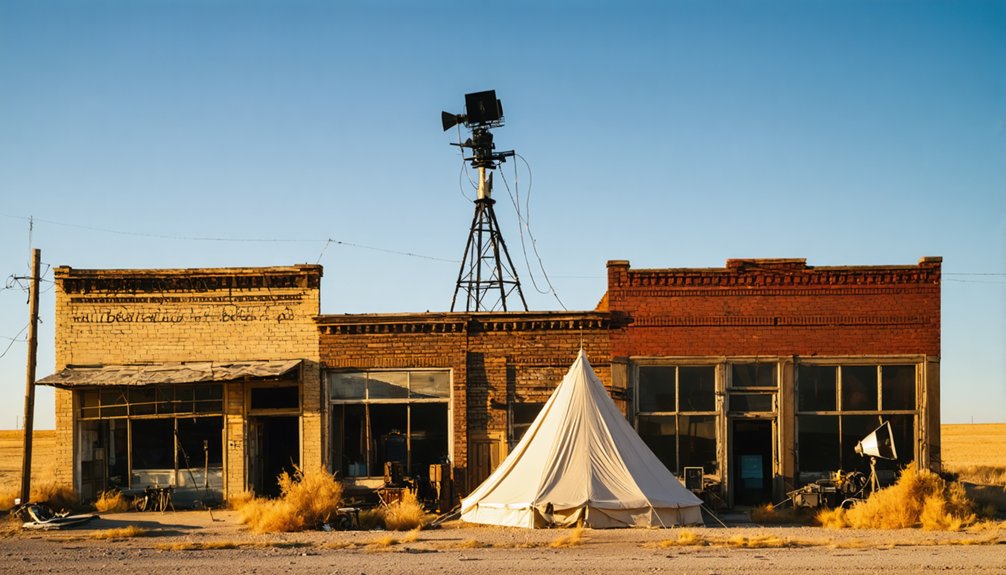
Nebraska’s ghost towns and established filming hubs present distinct production trade-offs you’ll navigate based on project requirements.
Key Location Contrasts:
- Infrastructure Access – Active hubs like Omaha and Lincoln offer production companies (VLA Prods, DEAD Lantern Productions) and repurposed facilities. Meanwhile, ghost towns like Roscoe provide highway-accessible abandoned structures with minimal modern interference.
- Population Dynamics – Filming logistics differ dramatically between Steele City’s 50 residents and Omaha’s multi-production capacity. This impacts crew accommodation and scene control.
- Ghost Town Preservation Advantages – Locations like Brocksburg and Crounse maintain authentic railroad-era structures. These are reduced to one-tenth of their original size, delivering period-accurate backdrops without digital manipulation.
- Versatility Examples – Valentine and Plainview prove you’re not locked into binary choices. They’ve successfully hosted productions while maintaining functional communities.
Preservation and Tourism Through Film Documentation
Beyond production logistics and location selection, filming activity at Nebraska’s abandoned settlements generates lasting documentation value that extends preservation efforts and attracts heritage tourists. When cinematographers capture high-resolution footage of deteriorating structures, you’re witnessing archival-quality records that surpass standard historical photography.
Film industry impact creates tangible economic benefits—crew spending supports local businesses while subsequent visitor interest generates sustainable revenue streams for communities with limited alternatives. Productions like *Nebraska* (2013) established baseline architectural conditions for long-term monitoring while simultaneously boosting regional tourism profiles.
You’ll find film commission databases functioning as preservation planning resources, tracking structural changes across decades. This documentation validates ghost towns as significant cultural landmarks, positioning them for eco tourism potential through location guides and heritage packages targeting independent explorers seeking authentic, off-grid destinations.
Frequently Asked Questions
What Permits Are Required to Film in Nebraska Ghost Towns?
You’ll need a film permit application through the Nebraska Film Office, plus historic site approval if it’s protected. For federal ghost towns, secure National Park Service permits. You’ll also need proof of insurance and municipal coordination.
How Do Production Companies Locate Scout Ghost Town Filming Locations?
Like prospectors panning for cinematic gold, you’ll tap state film commission databases, YouTube ghost town catalogs, and local scouting networks that map historical site preservation needs while evaluating local community impact through direct visits to abandoned structures.
What Infrastructure Challenges Exist When Filming in Abandoned Nebraska Towns?
You’ll face accessibility issues transporting equipment over unpaved roads and safety concerns from crumbling structures with unstable foundations. Expect no electricity, water, or communication infrastructure, forcing you to haul generators, tankers, and portable facilities into remote locations.
Do Ghost Town Property Owners Receive Compensation for Filming Access?
Like negotiating passage through unmarked territory, you’ll find ghost town property owners typically secure compensation agreements through direct deals with production companies, protecting their legal rights while granting filming access—though specific payment terms remain privately negotiated and undisclosed.
Which Nebraska Ghost Towns Have Hosted the Most Film Productions?
No Nebraska ghost towns have hosted multiple film productions. You’ll find most filming occurred in active small towns, not abandoned settlements. Historical preservation and tourism development efforts haven’t transformed any ghost towns into regular filming locations yet.
References
- https://film.nebraska.gov/filmed-in-nebraska/
- https://www.youtube.com/watch?v=l3s2qhSxis8
- https://movie-locations.com/movies/n/Nebraska-2013.php
- https://nebraskalocation.com/2014/01/05/movies-shot-in-nebraska/
- https://history.nebraska.gov/finding-nebraskas-ghost-towns/
- https://kids.kiddle.co/List_of_ghost_towns_in_Nebraska
- https://history.nebraska.gov/wp-content/uploads/2017/12/doc_publications_NH1937GhostTowns.pdf
- https://www.youtube.com/watch?v=redtU6GT-BY
- https://visitnebraska.com/trip-idea/explore-7-authentic-ghost-towns-nebraska
- https://en.wikipedia.org/wiki/List_of_ghost_towns_in_Nebraska