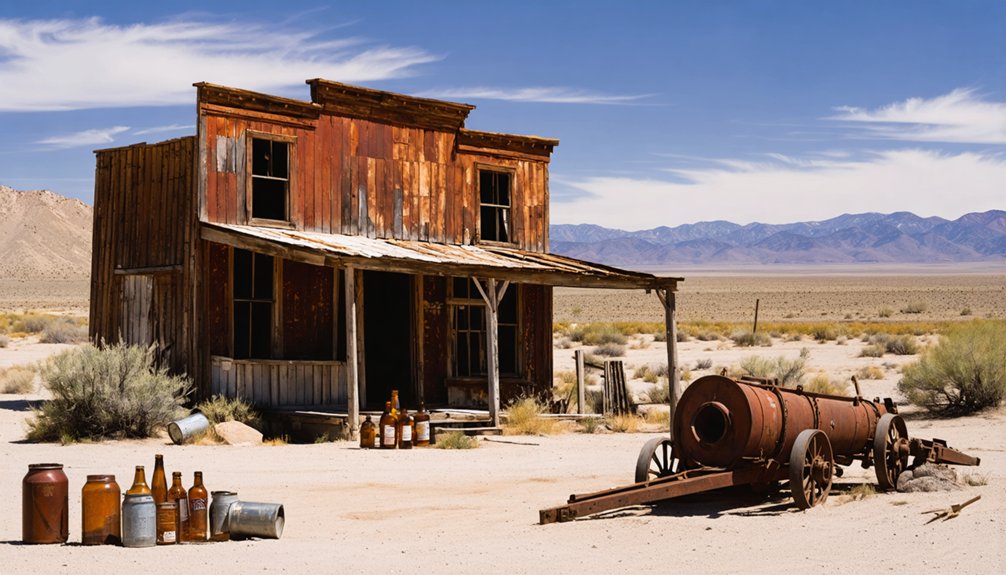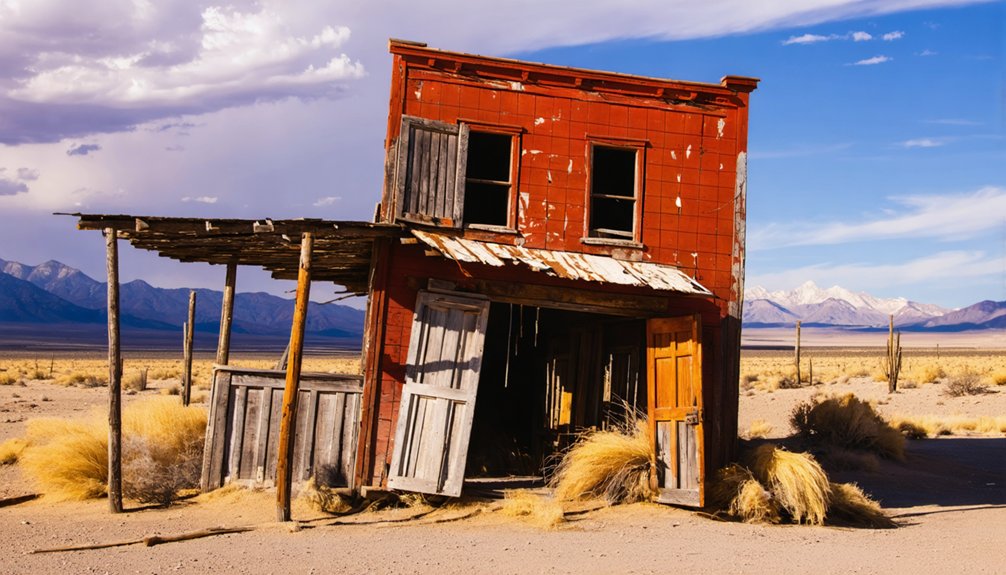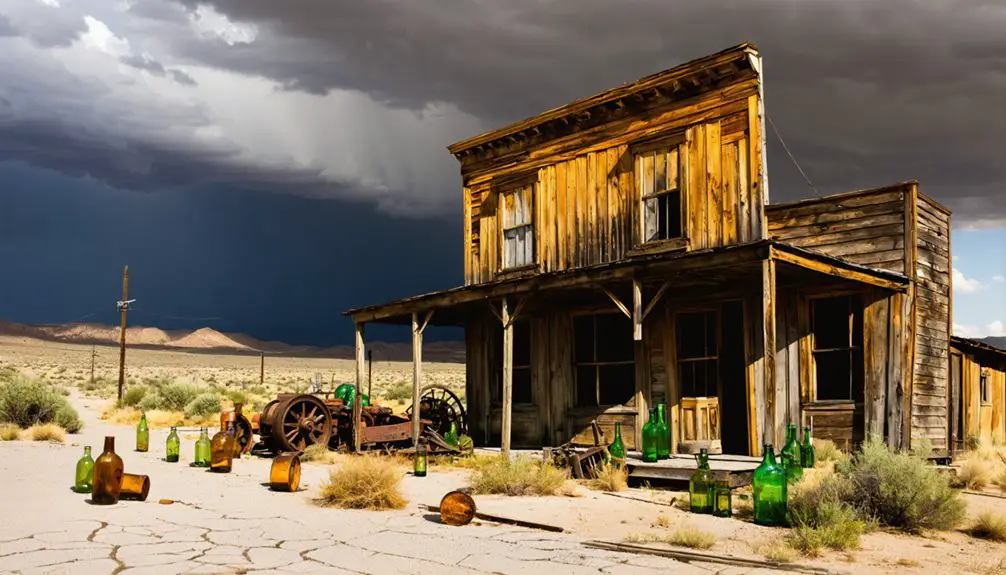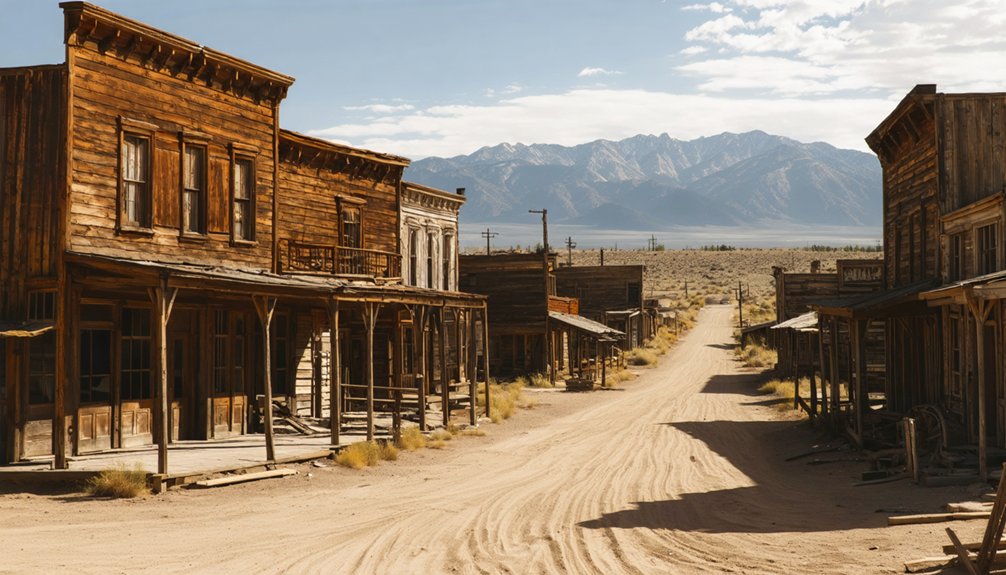
You’ll find Nevada’s ghost towns like Nelson and Rhyolite serving as authentic filming backdrops for movies including *3000 Miles to Graceland*, *The Island*, and *Breakdown*. Nelson, 45 minutes south of Las Vegas, offers weathered mining structures and vehicle wreckage perfect for explosive action scenes, while Rhyolite’s crumbling Cook Bank Building and bottle house create dystopian settings. Both locations provide filmmakers with preserved ruins, historic artifacts, and expansive desert sightlines. The guide below reveals specific filming sites, notable productions, and accessible remnants you can explore yourself.
Key Takeaways
- Nelson Ghost Town, 45 minutes from Las Vegas, features weathered buildings, mining relics, and wreckage used for explosion scenes.
- Rhyolite Ghost Town offers crumbling structures like Cook Bank Building, featured in *The Island* (2005) and *Ultraviolet*.
- Nevada’s ghost towns provide authentic post-apocalyptic settings with preserved ruins, abandoned vehicles, and expansive desert backdrops.
- Film remnants and props from productions like *3000 Miles to Graceland* remain as permanent relics at these locations.
- Most sites offer free public access managed by BLM, requiring no permits for photography and exploration.
Nelson Ghost Town: Hollywood’s Desert Playground
Long before Hollywood discovered its weathered facades and dramatic canyon walls, Nelson Ghost Town earned its reputation through bloodshed and gold.
Nelson Ghost Town built its legacy on violence and precious metals long before becoming a Hollywood filming destination.
You’ll find this former mining camp 45 minutes south of Las Vegas, where Spanish explorers first struck silver in 1775 and Native Americans extracted turquoise centuries earlier. The Techatticup Mine, established in 1861, produced several million dollars in precious metals until 1941, making this southern Nevada’s most successful gold mining region.
Local folklore tells of gunfights over claims and murders far outnumbering natural deaths—the nearest sheriff sat 200 miles away. The town attracted Civil War deserters and other rough characters during its gold boom years from 1864 to 1900.
Today’s restored 51-acre site preserves mining history through hard-rock mine tours, weathered structures, and authentic desert landscapes that’ve attracted film crews seeking genuine Wild West backdrops since the Werlys’ 1994 restoration. The grounds feature old, rusty vehicles scattered throughout the property, creating scenes reminiscent of post-apocalyptic landscapes that photographers and filmmakers find irresistible.
3000 Miles to Graceland and Other Notable Productions at Nelson
The Werlys’ commitment to historical preservation while maintaining robust film infrastructure has attracted countless productions—music videos, TV commercials, and documentaries like *Real Haunts: Ghost Towns*.
Their family-run operation accommodates photographers and filmmakers who book far ahead, transforming authentic mining artifacts into versatile production assets without compromising Nelson’s outlaw-era atmosphere.
The property features distinctive relics including wreckage from the 3000 Miles To Graceland plane, which remains a sought-after backdrop for creative projects.
Among the town’s most dramatic filming moments were explosive helicopter scenes where a body was dropped and an airplane was destroyed for the production.
Rhyolite Ghost Town: A Sci-Fi Filming Gem
You’ll find Rhyolite’s crumbling Cook Bank Building and Tom Kelly Bottle House four miles west of Beatty, where the 2005 sci-fi thriller *The Island* captured its preserved ruins on camera.
The town’s skeletal structures—including the two-story Southern Hotel and vintage train depot—provide ready-made post-apocalyptic visuals without set construction.
Free BLM-managed access from sunrise to sunset makes this Nevada ghost town an ideal filming location for productions seeking authentic desert decay against Death Valley’s dramatic backdrop.
Tom Kelly’s resourceful structure, constructed from 50,000 medicine, whiskey, and beer bottles, was itself restored for the 1926 film *The Air Mail*, demonstrating the site’s long history as a filming destination.
Rhyolite’s infrastructure once included approximately 400 electric streetlights, reflecting the prosperity of a town that peaked between 8,000 and 12,000 residents before its abandonment.
The Island Film Production
When Michael Bay chose Rhyolite’s ruins for “The Island” in 2005, he transformed the Cook Bank Building into a dystopian sci-fi landscape that would captivate audiences worldwide. You’ll spot the 1908 stone structure—complete with marble stairs and mahogany finishes—in the official trailer at 0:33.
Bay, working with screenwriter Caspian Tredwell-Owen, positioned stars Scarlett Johansson and Ewan McGregor against these weathered ruins, creating stark aesthetic transformations that emphasized their characters’ escape from artificial constraints. The town’s desert environment provided an otherworldly backdrop, with summer temperatures often exceeding 110°F adding to the harsh, post-apocalyptic atmosphere the film required.
The production’s local community impact proved substantial. Rhyolite gained recognition as a legitimate filming destination, attracting subsequent projects like “Ultraviolet” (2006). The Cook Bank Building also appeared in episodes of Ghost Adventures, further cementing its status in popular media.
You’re witnessing preservation through popularity—the Cook Bank Building became the ghost town’s most photographed structure, ensuring its cultural survival while showcasing Nevada’s untamed filming potential to independent filmmakers seeking authentic, restriction-free locations.
Preserved Ruins and Artwork
Beyond its film-ready dystopian backdrop, Rhyolite’s physical structures tell their own survival story through architectural persistence and artistic intervention. You’ll encounter the 1908 Cook Bank Building—once boasting marble stairs and mahogany finishings—standing alongside Tom Kelly’s Bottle House, constructed from 50,000 whiskey and beer bottles.
Paramount Pictures restored this bottle structure in the mid-1920s, cementing its cinematic legacy decades before Ultraviolet filmed there.
Adjacent to these ancient artifacts sits the Goldwell Open-Air Museum, where modern art disrupts the desert silence. You’ll find pixelated sculptures like Desert Venus and the peculiar miner-with-penguin piece challenging conventional ghost town aesthetics. The museum also features Grim Reaper statues depicting “The Last Supper,” adding an eerie dimension to the artistic landscape.
The Nevada Bureau of Land Management maintains free public access sunrise to sunset, letting you explore without restriction via passable dirt roads off Highway 374. The California-Mission style Railroad Depot, once essential for transport and commerce, later served as a casino and gift shop until the 1970s.
Accessible Desert Movie Set
Situated 120 miles northwest of Las Vegas in Nye County’s Bullfrog Hills, Rhyolite operates as both a historical relic and a production-ready location where filmmakers access crumbling concrete shells without permits or fees.
You’ll navigate Highway 374 to reach this desert landscape, four miles west of Beatty, where marble-adorned bank buildings and 50,000-bottle structures await your camera.
The Bureau of Land Management maintains sunrise-to-sunset access year-round, transforming early 1900s mining ruins into your sci-fi backdrop.
Film history runs deep here—Michael Bay’s “The Island” utilized the Cook Bank Building’s mahogany interiors, while “Cherry 2000” and “Six-String Samurai” exploited the apocalyptic aesthetics.
You’ll find designated photo spots marking *ideal* angles, all vehicles handling the marked dirt entrance without restriction.
The Island and Rhyolite’s Cinematic Appeal
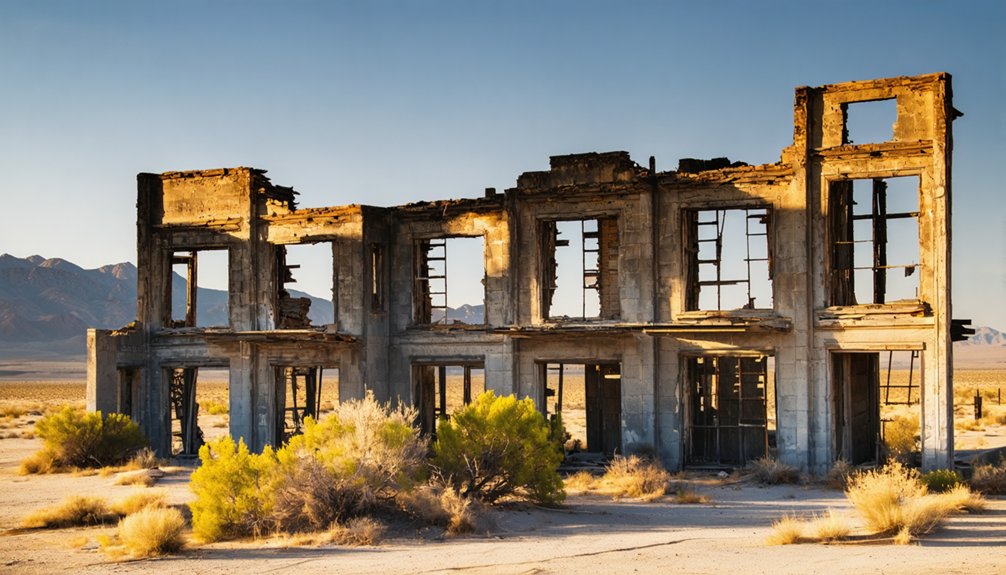
Michael Bay’s 2005 sci-fi thriller *The Island* transformed Rhyolite Ghost Town into a post-apocalyptic refuge where clones Lincoln Six Echo (Ewan McGregor) and Jordan Two Delta (Scarlett Johansson) shelter among crumbling ruins after their desperate escape.
Beginning October 24, 2004, Bay’s crew filmed at coordinates 36.901380, -116.829226, utilizing Rhyolite’s decayed Cook Bank Building and bottle house to achieve authentic dystopian visuals without constructed sets.
The desolate landscapes amplified isolation themes while naturally eroded adobe and concrete structures provided varied textures for cinematic aesthetics.
You’ll find these same ruins 120 miles northwest of Las Vegas, freely accessible via dirt roads from Beatty.
YouTube channels like “The Filming Locations” document current conditions, letting you compare 2005 footage to today’s weathered facades—proof that real decay outperforms Hollywood fabrication.
Breakdown: Kurt Russell’s Nevada Desert Thriller
Filming logistics capitalize on the region’s cinematic potential:
- Remote farm confrontations evoke abandoned Nevada mining settlements
- Barren truck stops replicate ghost town desolation across isolated highways
- Pursuit sequences leverage expansive sightlines through arid backcountry
The 1997 Paramount release grossed successfully by deploying tactical suspense—Russell’s character navigates criminal networks without over-confident heroics.
Stephen Hunter noted Russell’s restrained desperation, while Collider ranks Breakdown as his top thriller for nail-biting tension amplified by unforgiving terrain.
Why Nevada Ghost Towns Attract Filmmakers
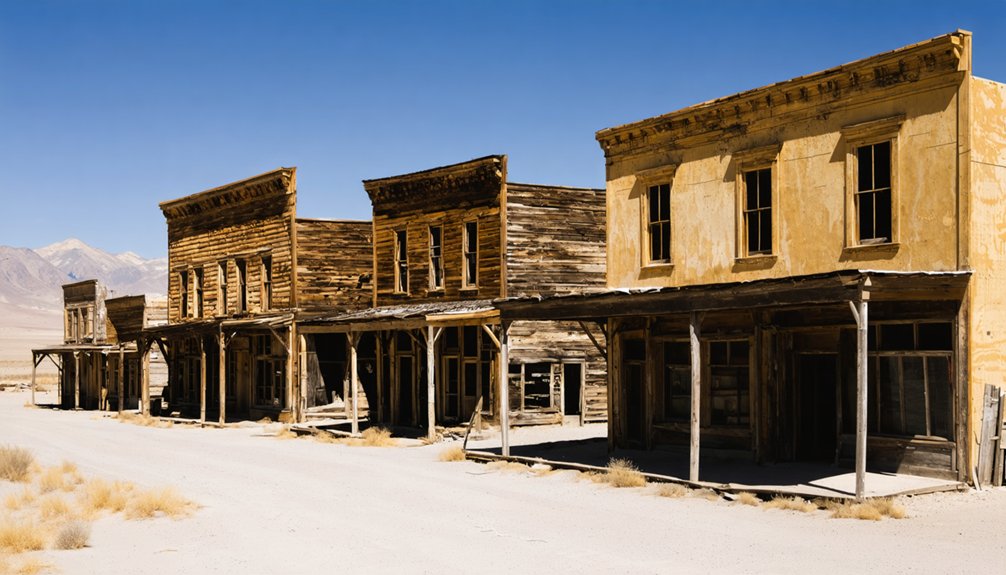
The mining history embedded in sites like Techatticup Mine adds genuine character impossible to fabricate. You’re accessing Nevada’s first gold strike location from the 1700s, complete with outlaw hideouts in El Dorado Canyon.
Located just an hour from Las Vegas, these backdrops offer logistical convenience without urban interference. Nearly 7,000 productions have leveraged this legacy, transforming abandoned boomtowns into cost-effective filming assets that preserve creative freedom while delivering visually striking authenticity.
Behind the Scenes: Movie Props and Remnants Left Behind
When production crews wrap filming in Nevada’s ghost towns, they leave behind tangible layers of cinematic history that you’ll encounter alongside authentic mining relics. The dry climate provides natural props preservation, maintaining set pieces for decades without intervention.
You’ll discover compelling juxtapositions across these sites:
- Nelson’s exploded airplane wreckage mingering with antique cars and weathered gas station signs
- Techatticup Mine’s tourable tunnels integrating film remnants with original 1700s Spanish gold strike artifacts
- Rhyolite’s colorful Michael Bay sci-fi props embedded within ghost town ruins
The relic significance extends beyond visual appeal—these abandoned set pieces become permanent installations you can explore freely.
At Eldorado Canyon’s barn, deer antlers hang near old tools and film-era cannons, while wooden facades weather naturally. This arrested decay creates authentic photography opportunities throughout Nevada’s 600+ ghost towns.
Visiting Nevada’s Famous Film Location Ghost Towns
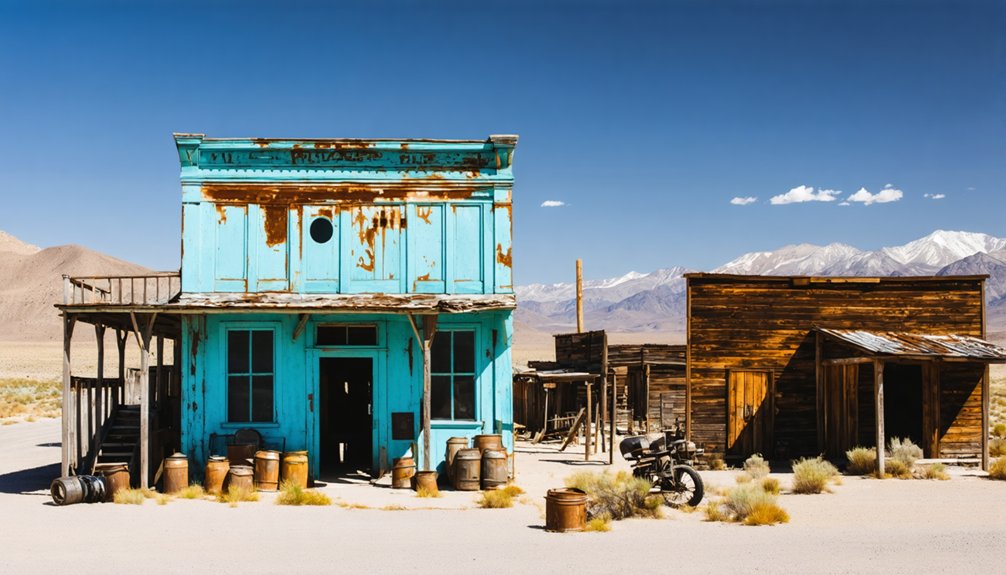
You’re free to photograph historic buildings, tour operational mines like Techatticup, and traverse relic-strewn ruins accessible from multiple Nevada cities.
Future tourism depends on balancing visitor access with structural integrity.
Whether you’re drawn to Rhyolite’s large-budget film backdrops or remote northern locations, Nevada’s ghost towns deliver unregulated exploration opportunities.
Frequently Asked Questions
Do Filmmakers Need Special Permits to Shoot at Nevada Ghost Towns?
Traversing Nevada’s ghost town maze requires permits—you’ll need BLM or federal approvals for public lands, while private property only demands owner permission. Understanding filming regulations unlocks creative freedom, though processing times vary wildly depending on jurisdiction and location specifics.
Which Ghost Town Has Appeared in the Most Movies?
Nelson Ghost Town’s appeared in the most movies, thanks to its convenient filming logistics—just an hour from Vegas—and minimal historical preservation restrictions. You’ll find Kurt Russell shot two films there, plus countless music videos amid its photogenic desert ruins.
Can Visitors Take Home Props Left Behind From Movie Productions?
Don’t let temptation steer you wrong—you can’t take home props left behind from productions. Souvenir restrictions protect these filming artifacts, and props collection isn’t permitted. These weathered treasures remain for everyone’s visual enjoyment and future shoots.
Are Ghost Town Film Locations Accessible Year-Round or Seasonally Restricted?
You’ll find Nevada’s ghost town film locations accessible year-round without seasonal closures. However, you’ll face accessibility challenges at Nelson, requiring advance booking with private owners, while Rhyolite, Gold Point, and St Thomas remain freely open anytime.
The history of rawhide ghost towns reveals fascinating stories of the pioneers who once inhabited these desolate places. Many of these towns served as vital supply stops for mining operations, each with its own unique background and character. As you explore, you’ll uncover remnants of the past that still echo the lives of those who called these ghost towns home.
How Do Production Crews Protect Historical Structures During Filming?
Unfortunately, specific protection data isn’t available, but crews typically employ historic preservation protocols including structural reinforcement of fragile walls, protective flooring over original surfaces, and careful lighting placement. You’d find these measures guarantee authentic locations remain undamaged and accessible.
References
- https://travelnevada.com/shopping-leisure/the-silver-state-on-the-silver-screen/
- https://www.worldatlas.com/cities/4-nevada-towns-where-famous-movies-were-filmed.html
- https://www.youtube.com/watch?v=w_pngAMo9xg
- https://www.youtube.com/watch?v=tZmA_VF6cm8
- https://travelnevada.com/ghost-town/
- https://www.exploratography.com/blog-nv/eldorado-canyon-nelson-ghost-town-nevada
- https://nevadamining.org/nevada-ghost-towns-nelson/
- https://brocarde.com/nelson-nevada-visiting-an-abandoned-ghost-town-and-finishing-ghosts/
- https://www.youtube.com/watch?v=MlH4SKnmgao
- https://travelnevada.com/ghost-town/exploring-eldorado-canyon/