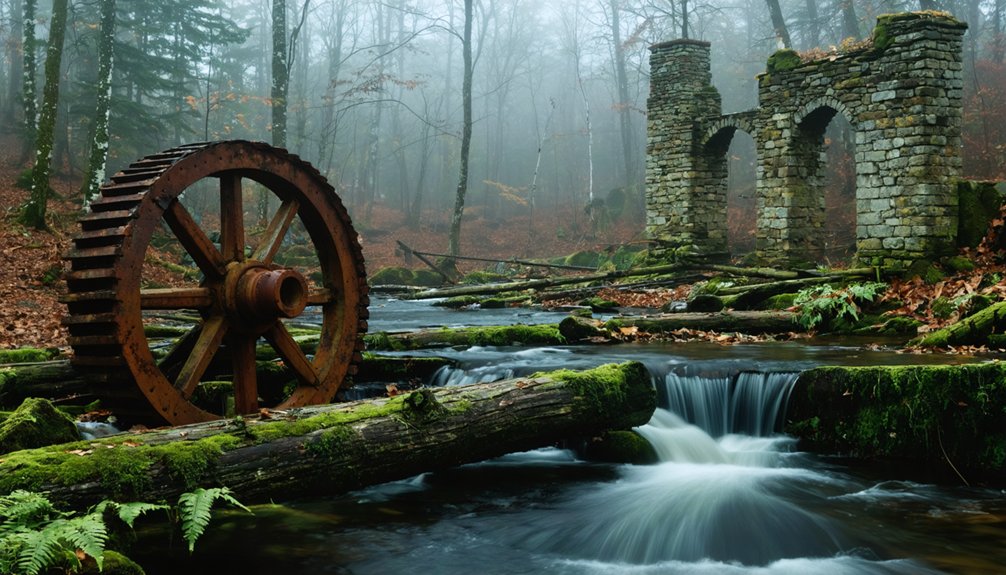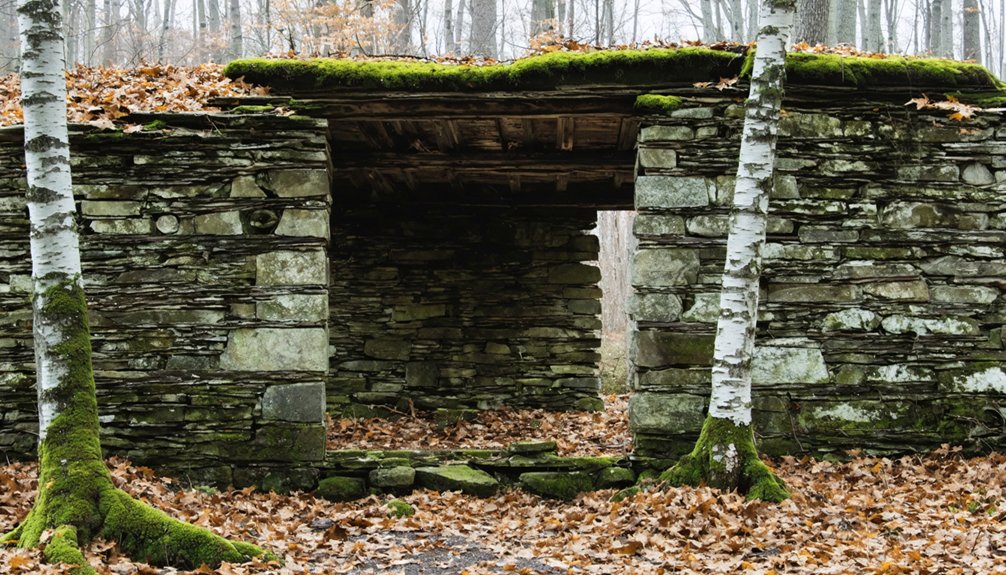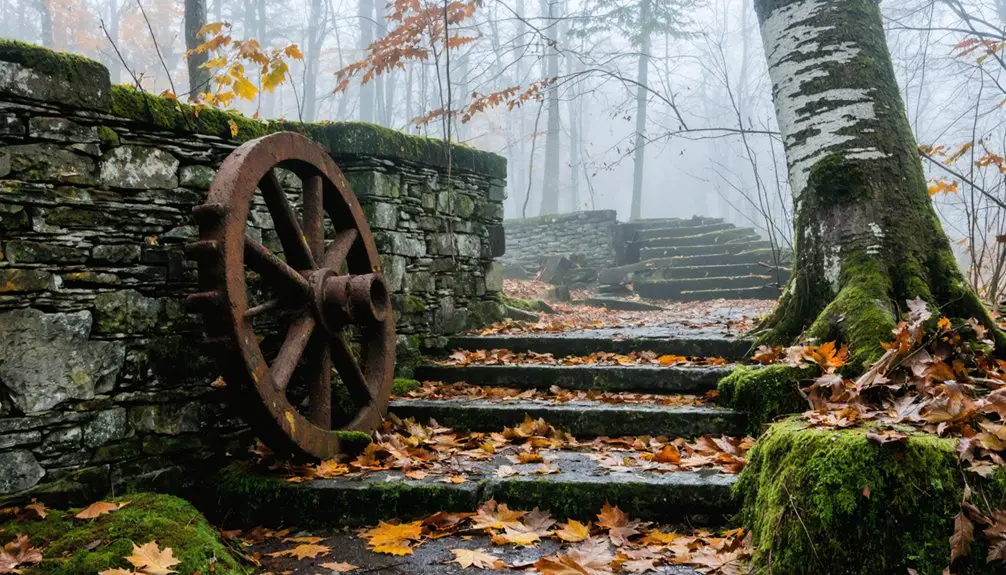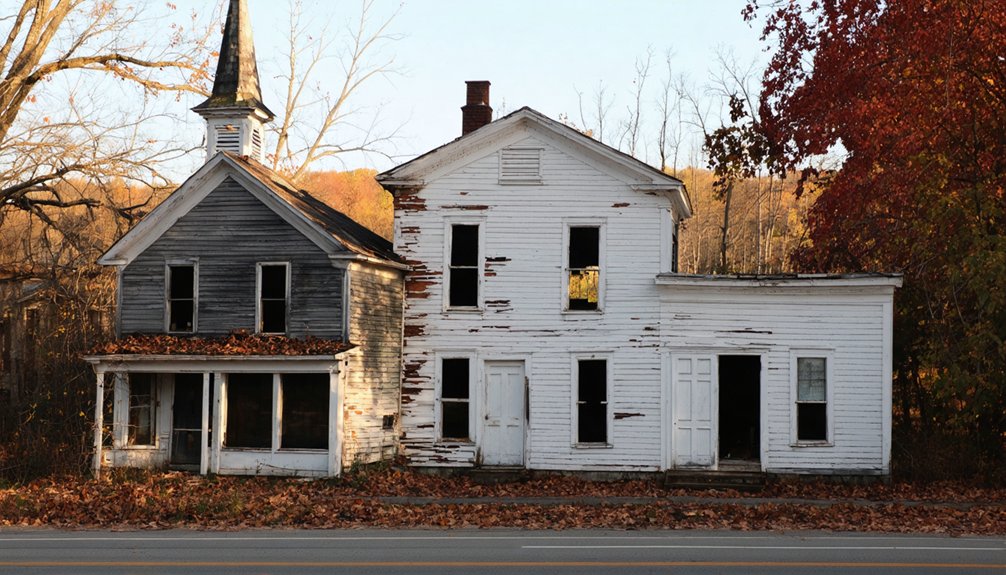
You’ll find Livermore, New Hampshire’s most film-ready ghost town, accessible via a two-mile hike from Kancamagus Highway parking areas, where moss-covered mill foundations, rusted logging machinery, and forest-reclaimed railroad grades provide authentic 19th-century industrial backdrops requiring minimal set construction. The settlement’s concrete ruins, deteriorating structures, and dense forest overgrowth create atmospheric conditions ideal for period dramas and horror productions. Downtown Keene and Nashua offer additional preserved warehouses and colonial architecture, while remote locations like Zealand and Success Town deliver genuine abandoned-settlement environments that enhance your production’s historical authenticity through natural decay and documented backstories.
Key Takeaways
- Livermore offers authentic logging-era ruins including mills, machinery, and artifacts, requiring minimal set dressing for period films.
- Monson Center’s colonial building provides genuine Revolutionary-era architecture ideal for historical productions without extensive construction.
- Industrial sites like Livermore Falls Pulp Mill and Johnson Sawmill Complex deliver authentic manufacturing settings with preserved structural elements.
- Dense forests, overgrown structures, and natural decay create atmospheric backdrops perfect for horror, drama, or supernatural narratives.
- Access via Kancamagus Highway and Route 302 facilitates crew logistics, with permits required from US Forest Service.
Livermore: New Hampshire’s Most Cinematic Abandoned Settlement
Deep in the White Mountains near Bartlett, Livermore emerged in 1876 as a purpose-built logging settlement along the Sawyer River.
You’ll find stone foundations scattered across two miles of Sawyer River Road off Route 302, where 150-200 residents once operated two mills alongside homes, a school, and stores.
The 1927 flood destroyed railroad bridges while smallpox claimed 40 lives in 1880, fueling ghost town ghost stories that attract filmmakers today.
By 1949, the last residents departed, and the state revoked its charter in 1951.
You can explore moss-covered concrete, rusted machinery, and debris marking what remains—though abandoned site preservation efforts remain minimal. Artifacts including glass, cans, pipes, and even a horseshoe lie scattered throughout the site, offering tangible connections to the town’s industrial past.
The atmospheric ruins, overgrown with apple trees and scattered foundations, provide authentic backdrops for period productions.
A prominent red brick chimney from the Livermore powerhouse still towers above the forest, serving as a distinctive visual landmark for location scouts.
Architectural Ruins That Transform Into Authentic Period Backdrops
When filmmakers scout New Hampshire’s abandoned settlements, they discover architectural remnants that eliminate the need for costly period set construction.
You’ll find Monson Center’s sole surviving building standing in cleared pastures, its 18th-century colonial lines preserved for Revolutionary-era productions.
Monson Center’s lone colonial structure offers filmmakers authentic 18th-century architecture amid open fields, eliminating the need for constructed Revolutionary War sets.
Zealand’s overgrown structures blend seamlessly into forested terrain, offering authentic isolation without modern intrusions.
Success’s weathered wooden facades capture 19th-century logging community aesthetics through natural urban decay rather than artificial aging.
The Wentworth by the Sea Hotel showcases Victorian-era grandeur, its ornate details surviving abandonment phases before architectural preservation efforts.
You’re accessing genuine historical textures—cellar holes, dilapidated frames, and crumbling facades—that digital effects can’t replicate. Production teams strategically enhance existing architecture with dead shrubbery and peeling paint to amplify decline, as demonstrated when downtown Keene transformed into fictional Brantford. Nashua’s Fright Kingdom warehouse demonstrates how repurposing existing structures allows filmmakers to transport authentic atmospheres to different shooting locations.
These sites provide filmmakers unrestricted authenticity, transforming New Hampshire’s forgotten communities into production-ready period environments.
Industrial-Era Structures Perfect for Historical Film Productions
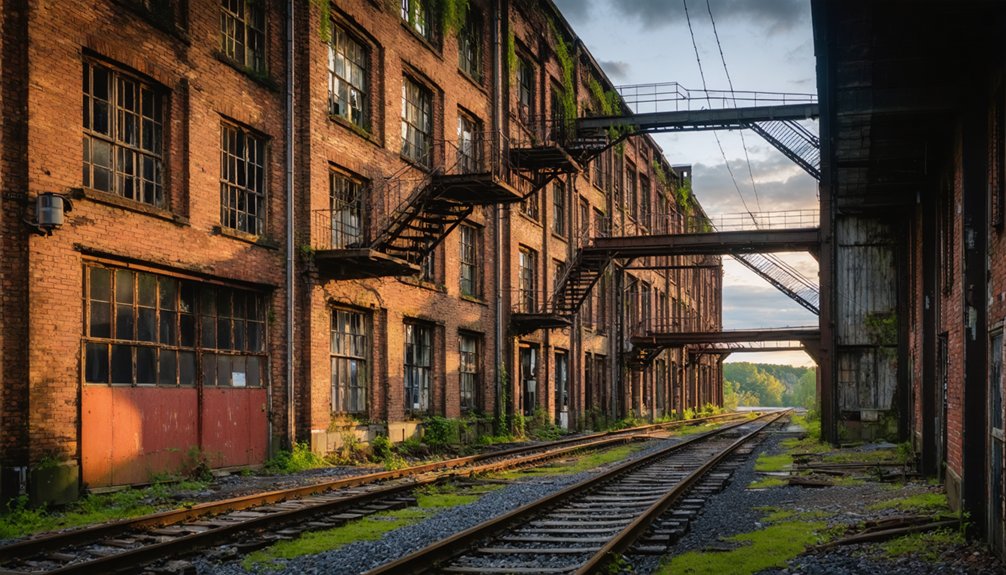
New Hampshire’s abandoned industrial complexes provide filmmakers with ready-made settings that capture authentic 19th and early 20th-century manufacturing environments. You’ll find the Livermore Falls Pulp Mill‘s decaying shell features distinctive arched windows and hallways—perfect for period pieces requiring authentic manufacturing backdrops.
The Johnson Sawmill Complex once housed 30 buildings including powerhouses with three boilers, engine houses, and worker tenements that’d suit labor-era narratives.
Industrial archaeology reveals Little Canada’s wagon hub factory and shared powerhouse system, offering unique production design opportunities.
Modern preservation efforts have maintained enough structural integrity at these sites to support filming equipment while retaining weathered aesthetics. The Pumpkin Seed Bridge, built in 1886 and spanning 263 feet, provides filmmakers with an authentic abandoned transportation structure that connects industrial filming locations across the Pemma Joet River.
The Livermore Sawmill foundations and railroad bridge ruins provide versatile exterior locations spanning multiple industrial periods without artificial aging. The brick Powerhouse stands as a centerpiece of the former lumber operations, its decayed industrial architecture offering filmmakers an authentic glimpse into the town’s manufacturing past.
The Atmospheric Qualities That Attract Filmmakers and Explorers
You’ll notice how dense forest overgrowth consuming stone walls and cemetery headstones creates the visual isolation filmmakers need for authentic abandoned-town scenes. The White Mountains terrain positions these ruins in naturally remote settings where decay appears undisturbed.
Sawmill foundations emerge through leaf litter, and flood-damaged structures lean at unsettling angles. This combination of natural reclamation and structural deterioration gives you ready-made atmospheric backdrops that require minimal set dressing for horror productions or historical dramas. Historic prison cell blocks offer particularly compelling shooting locations where architectural decay and confined spaces amplify psychological tension. Local stores and landmarks provide recognizable New Hampshire backdrops that help ground fictional narratives in authentic regional settings, much like how Keene’s streetscape enhanced Jumanji’s Brantford sequences.
Natural Decay and Isolation
Because New Hampshire’s ghost towns sit abandoned in heavily forested terrain, they’ve developed the exact atmospheric qualities filmmakers seek when shooting isolated, melancholic scenes. Urban decay merges with natural reclamation as moss consumes brick foundations and forests swallow colonial-era structures. You’ll find authentic deterioration here—no staged sets required.
These locations offer distinct visual elements:
- Livermore’s sawmill ruins: brick remnants exposed to relentless weather since the 1920s flood.
- Monson’s cellar holes: preserved 18th-century foundations amid abandoned pastures.
- Zealand’s complete erasure: physical traces so deteriorated they’ve vanished from maps.
- Success’s seasonal remnants: logging infrastructure overtaken by vegetation.
Accessible only through unmarked woods trails, these sites provide the seclusion independent filmmakers value. Productions like In Your Eyes have utilized New Hampshire’s regional landscapes to capture authentic local settings that enhance their narratives.
Dense tree cover, weathered textures, and genuine remoteness create backdrops impossible to replicate elsewhere—perfect for capturing raw, unpolished isolation on camera. Sites like Monson retain capped wells and house foundations that provide tangible connections to mid-1700s colonial existence.
Haunting Visual Storytelling Potential
When fog rolls across Squam Lake’s wooded shorelines, filmmakers capture the exact melancholic isolation that made *On Golden Pond* resonate with audiences—dense tree cover meeting still water, loon calls piercing through mist, and forested islands like Church Island providing naturally secluded backdrops.
You’ll find Livermore’s crumbling stonewalls, brick remnants, and overgrown saw mill foundations offering tangible decay that modern technology enhances through dramatic lighting and stabilized aerial shots.
Mount Caesar Cemetery’s aged headstones delivered authentic haunting visuals for *Jumanji*, while Wentworth by the Sea’s derelict grandeur created dreamlike horror in *In Dreams*.
These locations balance cultural preservation with cinematic exploitation—directors access genuine historical imprints without elaborate set construction, letting nor’easter storms and White Mountains seclusion amplify tension naturally.
Physical ruins speak louder than fabricated sets.
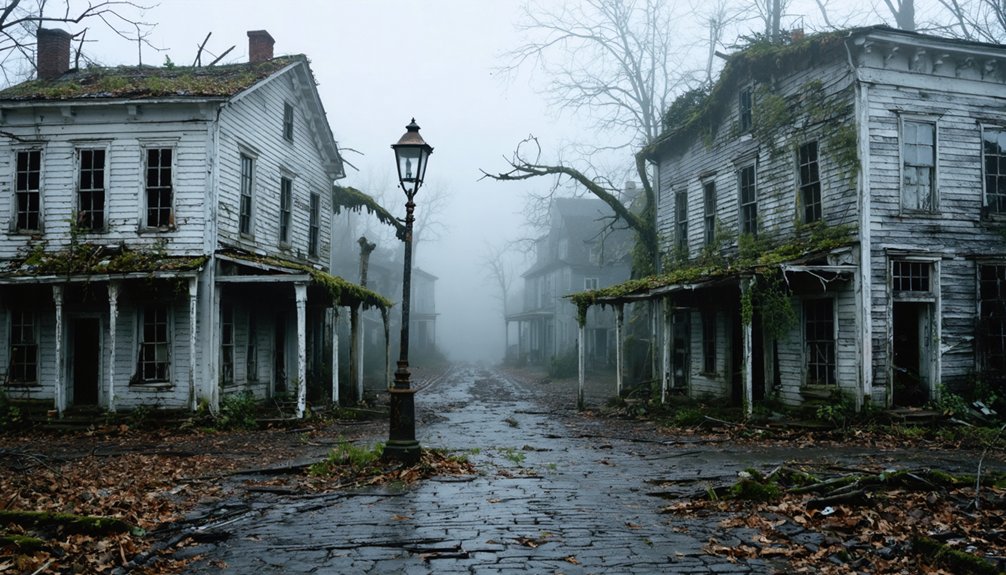
Livermore’s compact village layout radiates outward from the central mill ruins, where brick foundations and scattered timber remnants map the town’s 1876 origins along what’s now an overgrown trail system.
Terrain mapping reveals how flood-altered paths connect surviving structures, while structural preservation efforts maintain accessible footprints despite dense woodland reclamation.
You’ll navigate key filming zones through:
- Mill complex – elevated brick platforms offering dramatic anchor points for period scenes
- Blacksmith shop foundations – stone outlines framing intimate character moments
- School and store clusters – parallel ruins creating authentic village atmosphere
- Barn remnants – weathered timber providing rustic background textures
The linear configuration follows original access routes, letting you track between locations efficiently while capturing Livermore’s authentic communal design centered on the Saunders family’s industrial operations.
Accessing Remote White Mountains Filming Locations
The White Mountains’ remote filming locations demand careful logistical planning beyond Livermore’s established trail network.
You’ll find primary access through Kancamagus Highway and Route 302, with Crawford Notch offering multiple pull-offs for skyline panoramic shots.
Crawford Notch’s strategic pull-offs along Kancamagus Highway and Route 302 provide essential staging points for capturing sweeping mountain panoramas.
Base operations from Maple Haven Campground or Bretton Woods properties provide crew workspace with essential connectivity.
Albany Covered Bridge and Rocky Gorge feature dedicated trailhead parking, while CL Graham Wangan Grounds Overlook delivers paved vehicle access for equipment transport.
Summer months peak accessibility, though winter filming requires specialized preparation.
You’ll navigate drone navigation restrictions maintaining ¼ mile clearance from highways and trailheads within White Mountain National Forest boundaries.
The 45,000-acre Pemigewasset Wilderness demands special permits through New Hampshire State Division of Parks & Recreation and United States Forest Service coordination for commercial operations.
Historical Documentation Supporting Period Accuracy in Productions
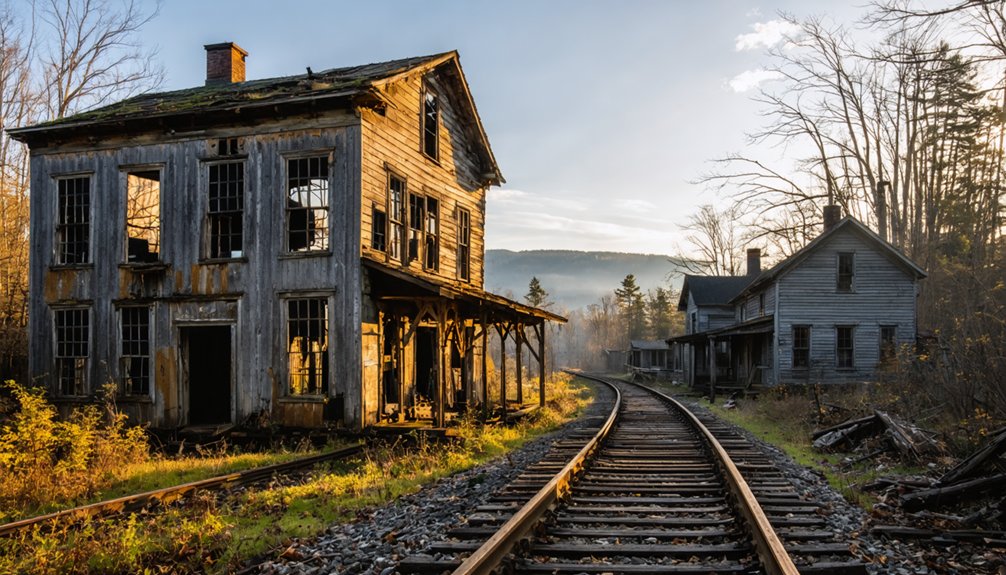
Production teams seeking colonial-era authenticity will find Monson Center’s single surviving structure offers direct visual reference for pre-Revolutionary New Hampshire settlements.
Archaeological insights from these cleared fields reveal how dramatically landscapes changed—modern woodlands replaced open pastures over two centuries.
Zealand’s extreme isolation strengthens supernatural narratives through complete absence from digital mapping systems, creating genuinely eerie atmospheres without fabricated mystery.
Success Town demonstrates boom-and-bust settlement patterns through seasonal structures east of Berlin, documenting transient 19th-century community failures.
Historical accuracy emerges from:
- Original colonial buildings standing in preserved clearings
- Untouched logging-era remnants lacking modern infrastructure
- Documented weather patterns matching narrative requirements
- Period-appropriate landscape shifts from farmland to forest
You’ll discover these abandoned sites maintain uncompromised period integrity precisely because they’ve escaped contemporary development pressures and tourist alterations.
Frequently Asked Questions
What Film Permits Are Required to Shoot in Livermore’s Ruins?
You’ll need to coordinate with the White Mountain National Forest Service for permits, ensuring your shoot respects historical preservation guidelines and minimizes environmental impact on Livermore’s fragile ruins, foundations, and cellar holes throughout the abandoned township.
Are There Liability Concerns When Filming in Abandoned Structures?
You’ll face major insurance concerns filming in Livermore’s decayed ruins—rotted floors, collapsed walls, and debris create serious injury risks. Safety protocols become mandatory, requiring structural assessments, liability waivers, and extensive coverage before crews enter these hazardous, unstable locations.
What Months Offer the Best Weather for Filming in Livermore?
You’ll find July through early September ideal for filming in Livermore, with temperatures reaching 42°F, minimal precipitation, and clear conditions. You’ll navigate historical preservation requirements easier while managing wildlife interactions during stable weather patterns and extended daylight hours.
How Do Production Crews Transport Equipment to This Remote Location?
Threading the needle between wilderness and logistics, you’ll tackle equipment transportation challenges using 4×4 trucks on reclaimed logging roads to trailheads, then backpacking cameras and gear manually through forest terrain, ensuring your crew’s freedom to capture Livermore’s atmospheric ruins.
What Nearby Towns Provide Lodging for Cast and Crew During Filming?
Lincoln and Woodstock provide your crew’s lodging within 10-15 miles of Livermore’s ruins. You’ll find hotels, resorts, and campgrounds offering local dining options and outdoor recreational activities, giving your team comfortable basecamp access while maintaining production flexibility near the ghost town location.
The area is rich in stories and lore, making it an ideal spot for exploring the history of ruddock. As your team unwinds after a day of shooting, take the opportunity to delve into local tales and legends, which can add unique depth to your project. Engaging with the community may also reveal hidden gems that can enhance both your experience and the authenticity of your production.
References
- https://www.nhmagazine.com/look-for-a-little-nashua-in-new-adam-sandler-film-hubie-halloween/
- https://www.worldatlas.com/cities/4-new-hampshire-towns-where-famous-movies-were-filmed.html
- https://nhfilmfestival.com/13-movies-you-might-not-know-were-filmed-in-new-england/
- https://wokq.com/2-new-hampshire-ghost-town-home/
- https://wjbq.com/abandoned-ghost-town-of-livermore-is-new-hampshires-smallest-town/
- https://www.youtube.com/watch?v=blAbKoH-S5Q
- https://www.atlasobscura.com/things-to-do/new-hampshire/film-locations
- https://wokq.com/ghost-town-of-livermore-new-hampshires-smallest-town/
- https://www.oddthingsiveseen.com/2015/09/die-and-less-ghost-town-of-livermore.html
- https://www.nhmagazine.com/livermore-is-a-strange-name-for-a-ghost-town/