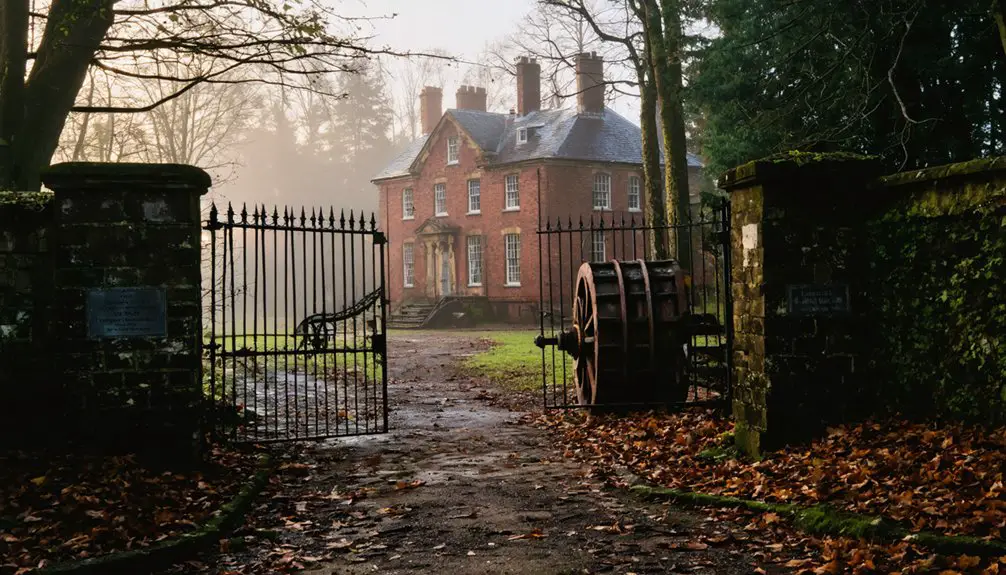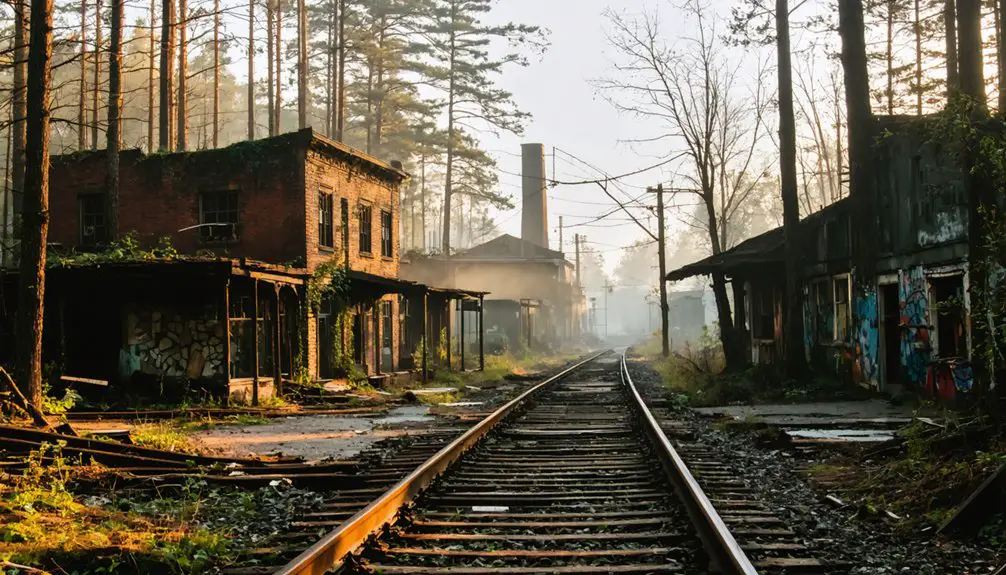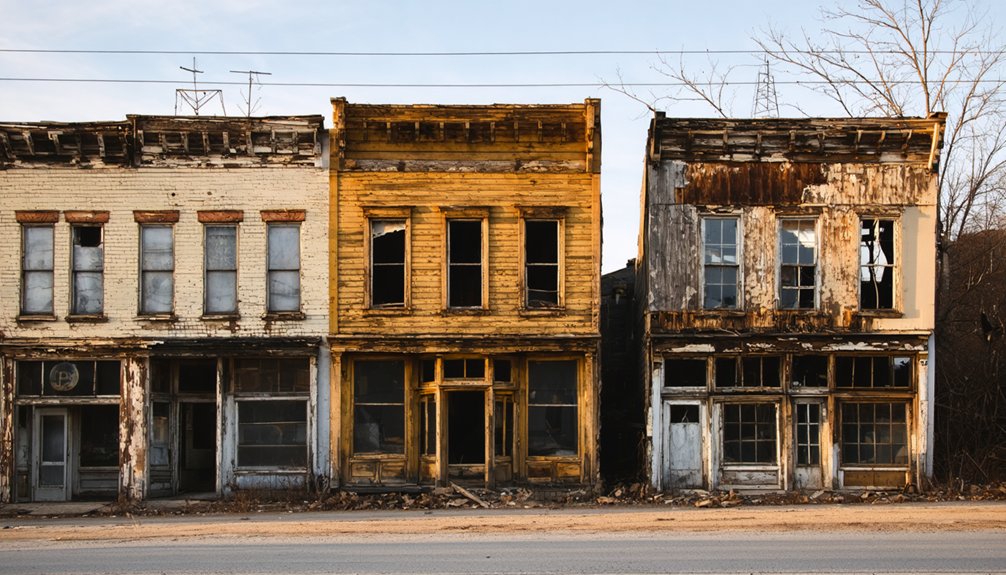
You’ll find New Jersey’s abandoned villages offering filmmakers authentic decay and documented ghost stories without expensive set construction. Feltville’s ten preserved worker cottages and Union Church have stood since 1845, while Allaire Village’s thirteen 19th-century structures—including blast furnaces and workers’ homes—provide weathered industrial backdrops in the Pine Barrens. Ong’s Hat delivers remote, mysterious ruins surrounded by interdimensional legends. Lambert Castle’s Gothic chambers and Sterling Hill’s underground mining tunnels create ready-made horror atmospheres. These locations combine historic authenticity with paranormal appeal, and there’s more to each site’s cinematic potential.
Key Takeaways
- Feltville/Glenside Park features ten preserved worker houses from 1845, offering authentic decay and ghost stories for horror productions.
- Allaire Village contains thirteen original 19th-century buildings including a blast furnace, ideal for period and horror filming.
- Cape May’s Victorian architecture served as filming locations for “The Prowler,” including the Inn of Cape May and Emlen Physick Estate.
- Sterling Hill Mining Museum provides underground tunnels with natural ghostly atmospherics, previously used for horror scene filming.
- Ong’s Hat in the Pine Barrens offers remote, decayed foundations perfect for mystery and conspiracy-themed productions.
Camp No-Be-Bo-Sco: the Real Camp Crystal Lake From Friday the 13TH
Tucked away at 11 Sand Pond Road in Hardwick Township, New Jersey, Camp No-Be-Bo-Sco sits approximately six miles north of Blairstown, just off I-80 near the Pennsylvania border.
This isn’t a ghost town—it’s an active Boy Scout camp with camp history dating to 1927. Yet in 1979, it transformed into the fictional Camp Crystal Lake for Friday the 13th.
You’ll recognize Sand Pond as the lake where Jason drowned and grabbed Alice in that iconic final scene. The filming secrets reveal counselor cabins, the mess hall, and shower house (complete with axes and rain jackets) all served as death scenes.
Though it’s private property protecting youth campers, Crystal Lake Tours grants access during scheduled visits, letting you walk the same grounds where Tom Savini orchestrated those legendary practical effects. The camp holds the distinction of being the oldest Scout camp in New Jersey, maintaining continuous operations since its founding. Additional filming took place in nearby Blairstown, where Main Street’s stone arches remain unchanged from the movie.
Cape May’s Historic Streets Double as Avalon Bay in The Prowler
Unlike the secluded Boy Scout camp that became Crystal Lake, Cape May’s Victorian streets played a fictional seaside town while remaining fully operational as America’s oldest seaside resort.
Cape May served as a living film set, its Victorian architecture providing atmospheric horror backdrops while tourists strolled the nation’s oldest beach resort.
Director Joseph Zito filmed The Prowler (1981) across multiple historic properties lacking urban decay yet rich with ghostly legends.
You’ll find three key locations: The Inn of Cape May (1894) hosted graduation dance scenes and dormitory interiors at coordinates 38.931046, -74.91949.
Southern Mansion at 720 Washington Street filmed the infamous shower sequence and jump scare—Ghost Hunters investigated its reported hauntings.
The Emlen Physick Estate (1048 Washington Street) served as Major Chatham’s house for the final showdown.
The estate now operates as a Victorian house museum offering tours that highlight both its architectural significance and paranormal reports.
On Set Cinema organizes location tours where you can photograph these sites and stay overnight.
The 45th anniversary screening happens March 21, 2026.
The Inn of Cape May celebrated the film’s 40th anniversary in 2021 with balloons and party streamers decorating the historic venue where key scenes were shot.
Pedricktown’s Rural Landscape in The Village
When M. Night Shyamalan needed the perfect backdrop for The Village’s forbidden woods sequences, he found it in Pedricktown’s untamed terrain. You’ll discover this Salem County location provided the rural landscapes essential for Ivy Walker’s perilous journey scenes. The 2004 production captured her departure into the woods with Christop and Finton Coin, plus the jarring truck encounter that revealed the film’s twist. The companions wore the village lore’s safe yellow attire, which symbolized protection against the creatures before fear drove them to abandon Ivy on her dangerous mission.
Pedricktown’s filming ambiance stems from its authentic countryside—vineyards, farms, and isolated roads minutes from Philadelphia and Wilmington. Shyamalan later returned to New Jersey for Knock at the Cabin, filming primarily in Tabernacle and Southampton for his 15th feature film.
You can reach this atmospheric spot via Philadelphia International or Newark Liberty airports, then drive through the same rustic settings that enhanced Shyamalan’s eerie narrative. The location’s accessibility made it ideal for production logistics while maintaining the remote, otherworldly quality the story demanded.
Feltville: Union County’s Authentic Deserted Village
You’ll find ten original worker houses still standing along a single dirt road in Berkeley Heights, preserved within the Watchung Reservation since 1980. The settlement sits on a wooded bluff above Blue Brook, where David Felt’s 1845 mill town housed 175 residents before economic collapse triggered complete abandonment by the 1870s.
Access requires hiking maintained trails through dense forest, leading you to structures that served twice as a failed utopian village and later as Glenside Park resort cottages until 1916. The grounds remain open daily from dawn to dusk, with a visitor center operating on weekends and most holidays for the approximately 90,000 annual visitors. The site includes the Wilcox Badgley Cemetery, where early settlers from 1736 are interred, featuring one original headstone commemorating John Wilcox who died in 1776.
Ten Houses Stand Abandoned
Deep in Union County’s Watchung Reservation, ten weathered houses line a dirt path where 175 residents once lived and worked in what locals now call the Deserted Village of Feltville.
You’ll find these structures standing since David Felt’s 1845 papermill town collapsed, creating New Jersey’s most accessible ghost town for film crews and haunted tours. The village’s authentic abandonment draws productions seeking genuine decay rather than constructed sets.
What remains on-site:
- Ten original workers’ houses from the 1850s mill town era
- Former Union Church converted into the current visitor center
- Historic carriage house among the preserved buildings
- Small cemetery holding 24 individuals near the settlement
Urban legends about drowned factory girls and disappeared campers make Feltville popular for paranormal productions, though you’re free to explore the grounds yourself during daylight hours without permits.
The village earned its place on the National Register of Historic Places in 1980, cementing its status as one of Union County’s 25 officially recognized historic sites. Modern visitors can participate in seasonal activities including apple cider pressing and guided haunted hayrides before Halloween, while Union County staff maintain the property and organize educational programs year-round. Visitors can also experience the site through self-guided walking tours that reveal the village’s forgotten history.
Historic Ghost Town Features
Behind these weathered structures lies a complex timeline spanning nearly three centuries.
You’ll find Peter Wilcox’s original 1736 settlement transformed into David Felt’s industrial village by 1845, complete with papermills, dams, and employee housing for 175 residents.
King David’s mandatory church attendance earned him his nickname before the 1857 financial panic forced abandonment.
Warren Ackerman’s 1882 Glenside Park resort brought temporary revival until automobiles redirected tourists to coastal destinations by 1916.
The site’s urban legends include two factory girls drowned in the mill pond and three sisters vanished during their 1912 camping trip.
Ghost stories claim thirteen witches once terrorized children here, supposedly buried by villagers but vowing return.
These tales contributed to Feltville’s transformation into New Jersey’s most documented deserted village.
Wooded Trails Provide Access
Miles of wooded trails wind through Watchung Reservation, delivering hikers directly to Feltville’s crumbling structures and mill ruins. You’ll navigate paths that follow Blue Brook to original sawmill sites, passing the 1776 Wilcox Badgley Cemetery headstone en route.
Trail maintenance preserves access to eight worker cottages, the church-turned-visitor-center, and carriage house remnants dating to David Felt’s 1845 mill town.
Forest preservation efforts protect routes cleared since Peter Willcocks’ 1736 sawmill operations:
- Trailhead parking at Watchung Reservation connects uphill paths to bluff overlooks
- Brookside segments lead to Feltville Mill Site foundations
- Self-guided tours operate dawn to dusk along forested routes
- October Haunted Hayrides traverse dark woods where three sisters vanished in 1912
You’ll explore freely where 175 workers once lived, now reclaimed by wilderness and persistent ghost legends.
Allaire Village Ghost Town in the Pine Barrens
You’ll find thirteen original 19th-century structures standing throughout Allaire Village, each accessible for exploration and creating authentic backdrop opportunities for period films.
The site’s preserved industrial buildings—including the blast furnace, blacksmith shop, and workers’ homes—maintain their weathered facades and original architectural details from the 1820s-1840s era.
This combination of genuine historical structures and the village’s remote Pine Barrens location generates an atmospheric setting that filmmakers can capture without modern intrusions disrupting the shot.
Historic Preservation and Structures
Nestled within New Jersey’s Pine Barrens, Allaire Village stands as one of the state’s most complete 19th-century industrial ghost towns, with thirteen original structures still anchored to their foundations. You’ll find restoration techniques that’ve preserved everything from the c. 1750 Manager’s House with its original hearth to the 1828 Enameling Building where experimental enamelware production once occurred.
The site’s heritage recognition as a state-managed living history museum means you can explore:
- Industrial buildings including the blacksmith shop, bakery with functioning beehive oven, and carpenter shop
- Residential structures like the Big House (c. 1790) and worker row houses with historic kitchen gardens
- Commercial spaces featuring the general store and chapel
- Interactive demonstrations by volunteer interpreters practicing period-authentic trades
This self-sustained ironworking community reached 400 residents before the 1837 depression shuttered operations permanently.
Eerie Atmosphere and Access
Beyond the meticulously preserved structures, Allaire Village’s reputation for paranormal activity transforms routine historical tours into unsettling experiences.
You’ll encounter bone-chilling ghost stories spanning decades—phantom smells of baking bread, full-bodied apparitions vanishing through walls, and disembodied voices echoing across empty grounds.
Paranormal investigations consistently target the Stone Barn, Grist Mill, and Batstone Mansion, where visitors report sudden temperature drops and spectral children roaming after dark.
You can explore these haunted Pine Barrens grounds year-round from dawn to dusk via self-guided walking tours through 13 historic structures.
October brings specialized experiences: Haunted Hayrides for ages 6+, Night of Frights events, and guided ghost tours.
Access remains unrestricted within Allaire State Park, letting you investigate craft shops, chapel, bakery, and exhibit halls at your own pace.
Ong’s Hat and Other Mysterious Abandoned Settlements
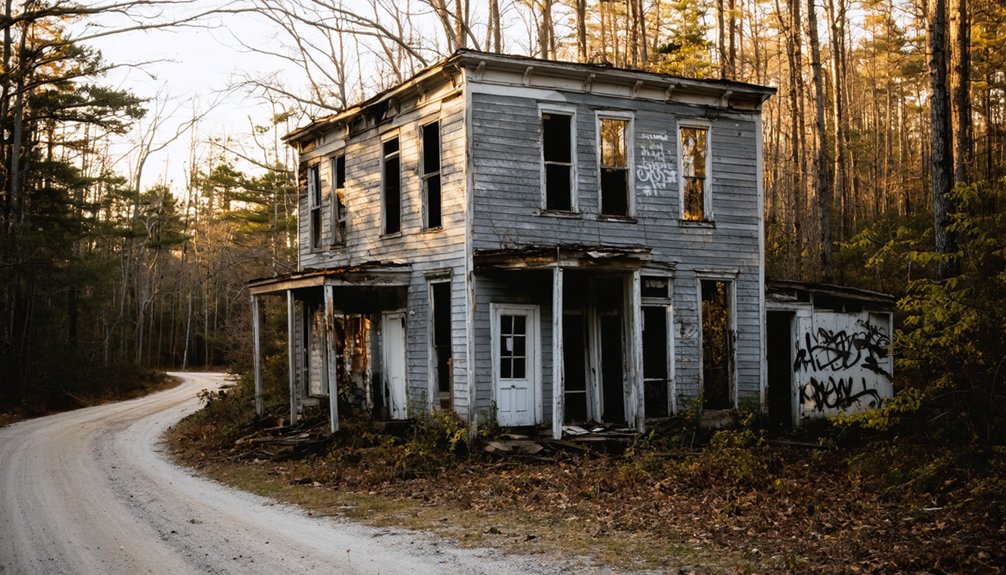
While most ghost towns fade quietly into history, Ong’s Hat has carved out a peculiar legacy that blends verifiable abandonment with decades of digital-age mythology.
Located deep in New Jersey’s Pine Barrens, this settlement vanished completely by 1936, leaving only foundation remnants and scattered debris.
By the mid-1930s, Ong’s Hat had been completely reclaimed by the Pine Barrens, leaving behind only crumbling foundations and forgotten artifacts.
What makes it cinematically compelling is the layered narrative—from documented disappearances to internet-born urban legends about interdimensional portals and government secrecy.
For location scouts, Ong’s Hat offers:
- Historical authenticity dating to 1778 with documented decline
- Unsolved mysteries including the Chininiski disappearances that haunted local law enforcement
- Digital folklore connecting 1980s conspiracy theories to modern ARG culture
- Remote Pine Barrens access providing isolation without extensive permitting obstacles
You’ll find this location appeals to productions exploring themes of conspiracy, disappearance, and the intersection between documented history and manufactured mythology.
Historic Castles and Mining Sites That Set the Scene
New Jersey’s architectural landmarks and industrial relics provide ready-made atmospheric settings that eliminate the need for extensive set construction.
Lambert Castle in Paterson offers Gothic Revival medieval architecture from 1891, complete with secret chambers and a cobwebbed torture chamber that filmmakers exploited for horror sequences. The castle’s stone facade overlooking Paterson’s skyline delivers authentic period detail without artificial staging.
Sterling Hill Mining Museum in Ogdensburg contributed underground zinc mine tunnels for additional torture chamber scenes.
Active from the 1880s to 1986, these passages feature fluorescent mineral displays that enhance ghostly atmospherics naturally.
Both locations remain accessible—Lambert Castle operates through Passaic County’s park system, while Sterling Hill draws over 30,000 annual visitors.
You’ll find genuine historical elements filmmakers can’t replicate on soundstages.
Frequently Asked Questions
Can Visitors Access These Ghost Town Filming Locations Year-Round?
You’ll find year-round access varies by location. Public sites like Pedricktown and Blairstown offer freedom to explore anytime, while Camp No-Be-Bo-Sco requires advance reservations. Visitor amenities differ greatly, so check safety precautions before planning your trip.
Do Filmmakers Need Special Permits to Shoot in New Jersey Ghost Towns?
Yes, you’ll need special permits for ghost town shoots in New Jersey. Filming regulations require state permits for public sites, local approvals for municipal areas, and insurance documentation. Permit requirements vary by location, with fees starting at $500 daily.
Are Guided Tours Available at These Abandoned Movie Filming Sites?
You’ll find limited organized historical tours at these filming sites—Camp Crystal Lake offers advance bookings, while Cape May’s locations remain independently accessible. No interactive map currently exists consolidating these scattered Warren and Salem County destinations for self-guided exploration.
Which Ghost Town Location Has Been Used in the Most Films?
Camp No-Be-Bo-Sco has starred in the most films, with its abandoned history as Jason’s lair. You’ll find haunted legends throughout the entire *Friday the 13th* franchise filmed there, making it New Jersey’s most-filmed ghost town location.
Have Any Paranormal Incidents Been Reported During Filming at These Sites?
You’ll find absolutely zero paranormal incidents documented at these New Jersey filming locations—no supernatural sightings, no mysterious noises. Despite their eerie atmospheres and ghost town reputations, productions proceeded without any reported unexplained events disrupting shoots.
References
- https://thedigestonline.com/new-jersey/scary-movies-nj/
- https://nj.gov/njfilm/assets/images/spotlights/2022-10/Horror-Movies-Filmed-in-New-Jersey-2022.pdf
- https://www.youtube.com/watch?v=ZIp3AYb0ulw
- https://www.youtube.com/watch?v=Y44qdpq5y6M
- https://fridaythe13thfilms.com/bts/locations/part1/
- https://movie-locations.com/movies/f/Friday-The-13th-1980.php
- https://giggster.com/guide/movie-location/where-was-friday-the-13th-filmed
- https://roadtrippers.com/magazine/camp-crystal-lake-friday-the-13th/
- https://www.youtube.com/watch?v=qMLIXmP0E1Q
- https://crystallaketours.com