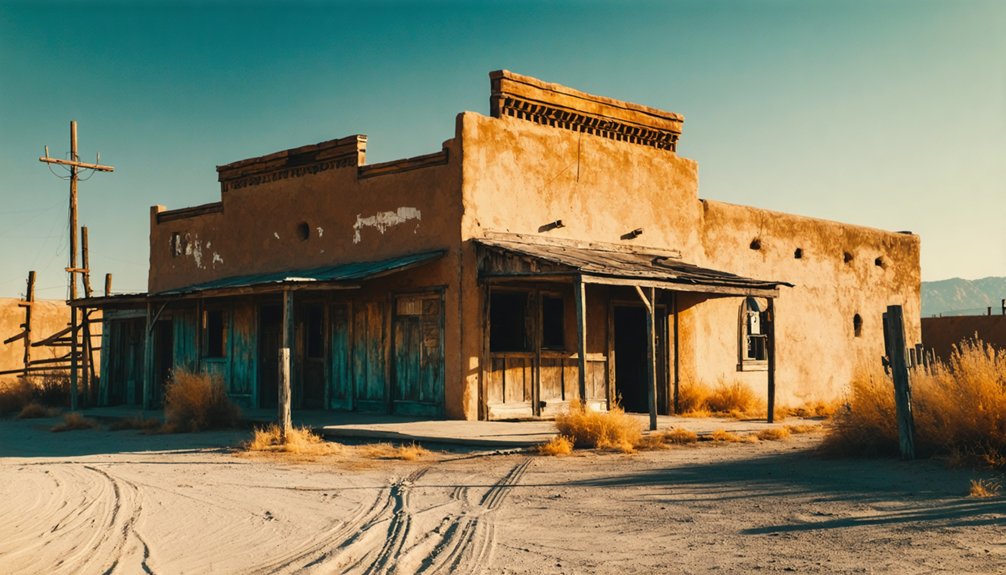
You’ll find New Mexico’s most filmed ghost towns scattered across high desert terrain, where authentic 1880s structures blend with Hollywood-built facades. Bonanza Creek Ranch offers eight distinct sets across working ranchland, while Cerrillos displays weathered plywood saloons from 1970s productions. White Oaks preserves Victorian brick buildings modified for *Young Guns*, and Ghost Ranch‘s 21,000 acres provide redrock canyons used since 1939. Lake Valley maintains over 400 mineshaft sites accessible Thursday through Monday. Each location presents layers of frontier history beneath decades of cinematic additions, creating ready-made sets that reveal surprising details about preservation methods and filming access.
Key Takeaways
- Bonanza Creek Ranch has hosted over 150 productions since 1955, featuring eight distinct sets with preserved structures and authentic Southwestern terrain.
- Cerrillos Movie Ranch, built in early 1970s, showcases weathered Western facades including decaying saloons and hitching posts from films like Young Guns.
- White Oaks Ghost Town blends authentic 1880s structures with Hollywood modifications, serving as a filming location for Young Guns and other Westerns.
- Ghost Ranch encompasses 21,000 acres of redrock canyons near Abiquiú, featured in Young Guns II, The Magnificent Seven, and City Slickers.
- Lake Valley offers genuine Western filming locations with standing structures like Bella Hotel, over 400 mineshafts, and preserved period-era buildings.
Bonanza Creek Ranch: From Active Productions to Abandoned Western Sets
When the Hughes family acquired the former Jarrott Ranch in the 1940s, they couldn’t have anticipated that their property would become one of New Mexico’s most prolific filming locations.
You’ll find Bonanza Creek Ranch spanning thousands of acres near Santa Fe, where over 150 productions have utilized its eight distinct sets since 1955’s *The Man from Laramie*.
The filming logistics here are exceptional—complete free-standing buildings with water and electricity, flexible scheduling with no residential neighbors, and 360-degree unobstructed views of authentic Southwestern terrain.
While historical preservation remains evident in structures like the 1989 Daisy Town set and modified *Silverado* Victorian house, the ranch continues active production despite the tragic 2021 *Rust* incident.
You’re witnessing a working location that bridges Hollywood’s past with New Mexico’s film incentive future.
Cerrillos Movie Ranch: A Crumbling Monument to Spaghetti Westerns
You’ll find weathered plywood facades and sun-bleached lumber scattered across Cerrillos Movie Ranch. It is a location built in the early 1970s that once hosted quick-draw sequences and dusty standoffs for low-budget westerns.
The shootout sets—false-front saloons, ramshackle jails, and skeletal hitching posts—now lean at precarious angles. Their support beams are exposed and window frames hollow.
Unlike maintained facilities like Cook Ranch’s Silverado town, these structures deteriorate openly. They are transforming from functional film infrastructure into genuine ruins that mirror the ghost towns they originally portrayed.
The movie ranch stands near a historic mining town founded in 1880 with the arrival of the railroad to support operations in the surrounding mineral-rich hills. The area’s cinematic heritage includes productions like “Young Guns” and “The Cowboys,” which were filmed in the vicinity during the town’s transition from active mining center to atmospheric backdrop.
Early 1970s Construction Origins
Before the Spaghetti Western craze reached its peak, J.W. Eaves broke ground on what would become the Cerrillos Movie Ranch in 1968.
He built the primary Western set a few miles north of Cerrillos specifically for “Cheyenne Social Club,” which starred Jimmy Stewart and Henry Fonda.
The construction techniques utilized natural materials that would weather authentically into the surrounding red rock formations—a deliberate choice for landscape integration that preserved the wide-open vistas filmmakers demanded.
Meanwhile, another ranch property in the region had already been appearing in films since 1970, gaining particular prominence when location scouts arrived by helicopter in 1984 to select it for Silverado.
Bonanza Creek Ranch featured a fully functional Western town with electricity and water infrastructure, establishing it as one of the area’s most production-ready filming locations.
Decaying Shootout Set Remnants
Although the Cerrillos Movie Ranch sits only three miles north of the historic mining town, its weathered facades tell a distinctly different story than the authentic 1880s structures along Main Street.
You’ll find John Wayne’s 1972 film “The Cowboys” left behind constructed sets that’ve deteriorated into atmospheric ruins over five decades. Unlike Cerrillos’s genuine adobe buildings, these movie-set remnants showcase false fronts and hollow interiors designed solely for cinematic purpose.
The decaying Western streetscapes now present challenges for sustainable restoration efforts, as their theatrical construction methods differ fundamentally from historic preservation techniques. Meanwhile, the nearby Galisteo Basin continues hosting active productions at operational western filming locations that feature maintained structures including saloons, jails, and even functional railroad tracks.
While tourism development strategies focus on Cerrillos’s authentic mining heritage, the ranch’s crumbling facades attract photographers and adventurers seeking atmospheric backdrops. Bonanza Creek Ranch maintains a different approach, operating with over 150 free-range cattle annually while preserving both ranching practices and cinematic scenery.
You’re witnessing purpose-built Hollywood architecture surrendering to New Mexico’s elements—a monument slowly returning to desert dust.
White Oaks Ghost Town: Where Authentic History Meets Hollywood Fiction
You’ll find White Oaks presents a unique challenge in distinguishing genuine 1880s structures from Hollywood additions built nearly a century later.
The town’s cowboy-frontier architecture—two-story brick Victorians, weathered saloons, and false-front businesses—served as filming backdrops that blurred historical authenticity with cinematic fabrication.
When you walk past the Hoyle House or the No Scum Allowed Saloon, you’re experiencing layers of history: original gold rush construction, decades of decay, and strategic film-era modifications that enhanced the town’s Wild West aesthetic.
Founded in 1879 after prospectors discovered a rich vein, White Oaks quickly transformed from mining camp to a thriving settlement that would later attract filmmakers seeking authentic Western settings.
The town’s decline began when gold was mined out and local authorities refused to sell railroad right of way, ultimately reducing what was once New Mexico’s second largest city to the ghost town you see today.
Real 1880s Mining History
Long before Hollywood discovered White Oaks’ weathered buildings and dusty streets, the Piros Indians used this region as hunting grounds until Apache tribes displaced them.
Spanish explorers from Don Juan de Oñate‘s expedition arrived in the late 1500s, naming it Malpais for its volcanic terrain.
When John Wilson struck gold in the Jicarilla Mountains, he shared his discovery with Jack Winters and Harry Baxter before vanishing—allegedly a Texas prison escapee. They staked the Homestake and South Homestake Mines, selling each for $300,000.
By 1882, White Oaks peaked at 4,000 residents, becoming New Mexico Territory’s second-largest city. Mining accidents plagued operations, including an 1891 fire killing two miners.
Outlaw hideouts thrived here—Billy the Kid’s favorite retreat until his violent pursuits ended in deputy Jim Carlile’s death.
1970s Film Structure Additions
When the cast and crew of “Young Guns” arrived at White Oaks in the late 1980s, they found a ghost town that needed minimal set dressing—its weathered brick buildings and Victorian-era structures already looked the part. The production team erected signs reading “We won’t tolerate scum,” which directly inspired the No Scum Allowed Saloon‘s permanent name.
Unlike typical Western film locations requiring temporary facades, White Oaks’ authentic pitched-roof buildings and century-old brick structures provided ready-made sets. This approach to historical preservation created lasting value beyond the shoot—the saloon now operates as a working bar ranked among America’s top cowboy establishments.
Tourism integration followed naturally: visitors explore self-guided trails marked with museum signs identifying filming locations, while the occupied ghost town maintains its cinematic authenticity for future productions.
Blended Authentic-Fictional Architecture
White Oaks’ film-ready appearance stems from architectural choices its original settlers made in the 1880s—choices that defied Southwestern building traditions. You’ll notice pitched roofs instead of flat adobe structures, Victorian brick facades with stained glass, and sharp gables that contrast dramatically with regional norms.
The Hoyle House, built for $40,000-$70,000, showcases hand-carved pine and a widow’s walk—elements foreign to Spanish colonial design. This authentic blend creates what modern urbanization and contemporary architecture can’t replicate: genuine historical anomaly.
Directors exploit this architectural tension, filming scenes where preserved structures like the No Scum Allowed Saloon and stone-façade Exchange Bank Building provide ready-made sets.
You’re witnessing architecture that naturally bridges past and present without artificial reconstruction—the miners’ Eastern sensibilities created Hollywood’s perfect frontier backdrop.
San Cristobal Ranch: The Intact Western Town Left Behind
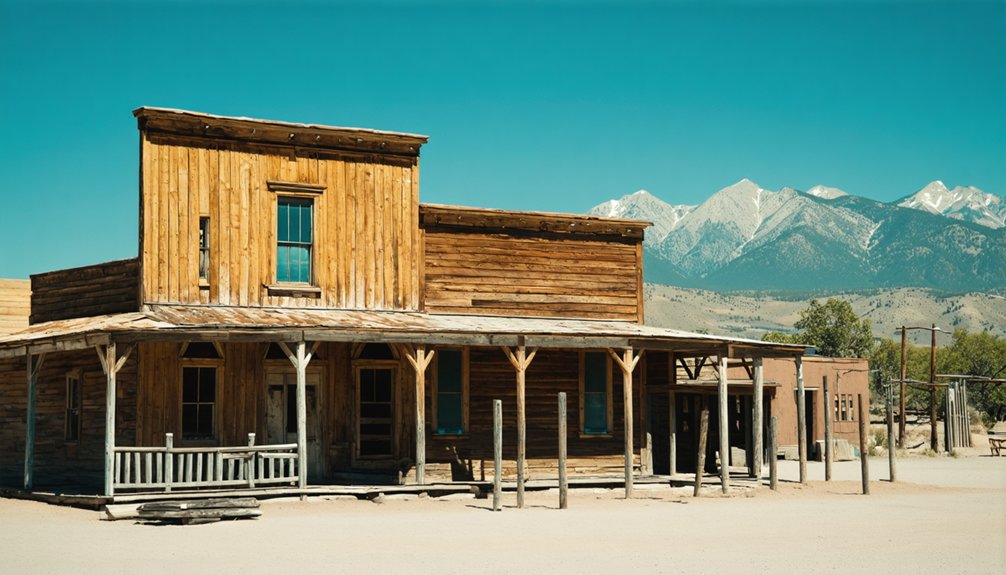
Perched at 8,600 feet on the lower slopes of Lobo Mountain, San Cristobal Ranch sprawls across 160 acres of high country terrain approximately 15-20 miles northwest of Taos. You’ll find structures dating to the 1890s—authentic Western architecture that’s witnessed homesteaders, Angora goat operations, and literary legends.
High country terrain meets frontier history at 8,600 feet, where authentic Western structures have stood since the 1890s.
D.H. Lawrence owned this as his sole property during the 1920s, adding cultural significance to its frontier bones.
The ranch’s historical preservation earned dual designation:
- National Register of Historic Places
- New Mexico State Register of Cultural Properties
- University of New Mexico stewardship since 1956
- Public access restored in 2015 after restoration
You can explore this untamed landscape where authentic settlement history intersects with artistic legacy—no Hollywood facades needed.
Ghost Ranch: Adobe Facades and Alien Settlements Near Abiquiú
From the intimate 160-acre literary sanctuary near Taos, you’ll find an altogether different scale of cinematic landscape 65 miles northwest of Santa Fe. Ghost Ranch sprawls across 21,000 acres of redrock canyons where desert flora frames scenes that’ve appeared in everything from *Young Guns II* to *The Magnificent Seven*.
You can explore actual filming locations through guided tours, tracing paths where Billy Crystal herded cattle in *City Slickers* and Denzel Washington stood against modern construction sets built for Western shootouts.
The Rito del Yeso stream cuts through gorges that’ve doubled as alien terrain and frontier settlements since 1939. This National Natural Landmark operates without restrictions typical of park systems—you’ll access pristine backdrops where major studios and independent productions continuously stage their visions.
Lake Valley: Sierra County’s Remote Mining Town Turned Film Location
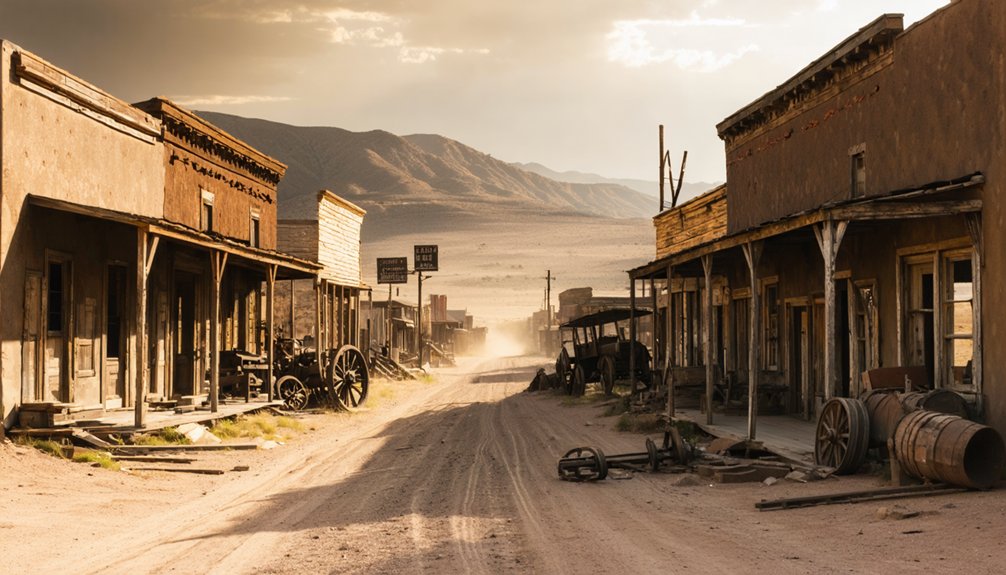
- Access Hours: Thursday-Monday during daylight only; closed Tuesdays-Wednesdays
- Standing Structures: Former Bella Hotel, 2-3 original houses, scattered period buildings
- Historical Authenticity: 400+ mineshaft sites throughout district, Santa Fe Railroad spur remnants
- Self-Guided Tours: Walking routes through preserved townsite without modern infrastructure interference
The remote setting offers filmmakers undisturbed Western backdrops without contemporary intrusions. You’ll navigate genuine mining-era architecture where populations collapsed from 1,000 residents to zero by 1994.
Preserving New Mexico’s Cinematic Ghost Town Legacy
Cultural storytelling through westerns and series like *Dark Winds* (2022–) authentically represents regional history. Creating educational resources you can access through film archives.
Productions simultaneously generate economic impact—crew spending supports local communities. While purpose-built facilities like Bonanza Creek Movie Town maintain infrastructure that protects these locations.
You’re witnessing documentary preservation that serves both historical research and independent exploration.
Frequently Asked Questions
Can Tourists Visit These Abandoned Movie Sets Without Permission?
You can explore these sites freely without permission—they’re open for urban exploration. Tourist restrictions don’t apply to Cerrillos, Bonanza City, Ghost Ranch, or Galisteo’s abandoned areas. You’ll find dirt roads, preserved structures, and film sets accessible anytime.
What Permits Are Required to Film at New Mexico Ghost Towns?
You’ll need filming permits from the controlling agency—whether city, county, or state—if the ghost town’s on public land. For private property ghost towns, you must secure written permission directly from the landowner before filming begins.
Are the Movie Set Structures Safe to Explore on Foot?
Most movie set structures aren’t safe for you to explore independently. Visitor safety concerns—including structural decay, unstable terrain, and legal restrictions—mean historical preservation zones typically require guided tours only, protecting both you and these aging landmarks.
How Much Does It Cost to Rent These Locations for Filming?
Rental fees vary widely—Bonanza Creek’s production-ready sets might cost $2,000-$5,000 daily, while historical preservation requirements at White Oaks could mean negotiating directly with owners. You’ll find budget-friendly options like Cerrillos offering flexible rates for independent filmmakers seeking authentic locations.
Which Ghost Town Location Is Closest to Albuquerque?
Tome Hill or Valverde sits closest at just 20-35 miles south of Albuquerque. You’ll find ghost town history and filming location popularity merge here, where wind-swept adobe ruins and desert landscapes offer unrestricted access for your independent production needs.
References
- https://en.wikipedia.org/wiki/List_of_films_shot_in_New_Mexico
- https://myfamilytravels.com/abandoned-movie-sets-in-new-mexico-that-tourists-rarely-see
- https://abqlibrary.org/filmedinnm
- https://www.newmexicomagazine.org/blog/post/new-mexico-film-locations/
- https://www.elratonmediaworks.org/northern-new-mexico-film-tv-blog/movies-made-in-colfax
- https://sierracountyfilm.com/lake-valley-a-true-ghost-town/
- https://bonanzacreekranch.com/film-history/
- https://en.wikipedia.org/wiki/Bonanza_City
- https://bonanzacreekranch.com
- https://bonanzacreekranch.com/about/