New York’s cinematic “ghost towns” aren’t Western ruins—they’re crumbling Gilded Age estates like Wyndcliffe and Rockwood Hall in the Hudson Valley, where overgrown gardens and deteriorating stone walls create authentic Gothic horror backdrops without construction costs. Meanwhile, Manhattan’s Dakota building and 55 Central Park West have starred in *Rosemary’s Baby* and *Ghostbusters*, their fortress-like architecture and tragic histories providing instant supernatural atmosphere. These locations offer filmmakers period authenticity, lower permits, and natural decay that reduces CGI reliance while enhancing on-screen haunted aesthetics—discover how these sites transformed horror filmmaking.
Key Takeaways
- Upstate estates like Ericstan and Wyndcliffe provide authentic Gothic decay with crumbling stone walls ideal for ghost town atmospheres.
- Lyndhurst mansion served as Collinwood exterior in *Dark Shadows*, offering ready-made haunted architecture without construction costs.
- Rockwood Hall’s abandoned gatehouses and mansard roofs deliver period-authentic, naturally decaying backdrops for horror and supernatural filming.
- Piermont’s weathered structures feature tragedy-evoking ruins that enhance realistic ghost town aesthetics at minimal production expense.
- Lower permits and tax incentives make upstate abandoned estates cost-effective alternatives to constructed sets for supernatural storytelling.
The Dakota: From Rosemary’s Baby to Real-Life Hauntings
While most ghost towns conjure images of abandoned Western outposts, New York City harbors its own spectral landmark in the form of The Dakota—a Gothic fortress rising at 1 West 72nd Street that’s served as both a pioneering luxury residence and an iconic horror film location.
Built between 1880 and 1884, you’ll recognize this German Renaissance structure from Roman Polanski’s 1968 film *Rosemary’s Baby*, where its fortress-like presence, gables, and courtyard portrayed supernatural horror.
The building’s haunted legends intensified after John Lennon’s murder outside its entrance in 1980.
Developer Edward Clarke introduced the concept of full-serviced flats to New York’s Upper West Side, transforming what was then considered remote territory into one of the city’s most fashionable addresses within two decades.
Architect Henry Janeway Hardenbergh designed the seven-story structure with load-bearing exterior walls up to 4 feet thick, creating the fortress-like appearance that enhanced its Gothic character.
Today, you’ll find supernatural legends intertwined with its architectural grandeur—hand-carved oak ceilings, marble mantels, and thick walls that’ve witnessed both Gilded Age luxury and modern tragedy, making it New York’s most notorious intersection of elite living and spectral notoriety.
Spook Central: 55 Central Park West’s Ghostbusters Legacy
When you stand at the intersection of Central Park West and 66th Street, you’re looking at 55 Central Park West—a 19-floor Art Deco cooperative that Ghostbusters transformed into cinema’s most famous haunted address.
The building’s filming secrets reveal impressive Hollywood trickery: matte paintings added eight phantom floors, while a 15-foot miniature handled close-ups of the fictional rooftop temple. You won’t find those terror dog gargoyles—they’re urban legends, actually filmed a block north at 67th Street.
The co-op board initially blocked production until Bill Murray and Dan Aykroyd leveraged Mayor Koch’s intervention. Directors halted Manhattan traffic for exterior shots, though Dana Barrett’s apartment interiors were recreated on Columbia Ranch.
Built in 1929 by Schwartz & Gross, this contributing property to the Central Park West Historic District became “Spook Central”—where supernatural chaos erupted onscreen. In the film, Dana’s eggs frying scene leads to her discovery of a portal to another dimension in her kitchen. The filmmakers also shot scenes on Columbia Studios’ back lot alongside real Manhattan streets to complete the movie’s New York setting.
The Ansonia: A Century of Cinematic Supernatural Stories
Standing at Broadway between 73rd and 74th Streets, you’ll encounter the Ansonia—an 18-story Beaux-Arts fortress built in 1899 whose ornate terracotta façade and baroque turrets have drawn filmmakers to its corridors for decades.
This supernatural legends magnet housed musicians like Caruso and Stravinsky behind heavily soundproofed walls, but directors remember it for darker purposes. *Single White Female* captured its grand 17-floor staircase for psychological terror, while *666 Park Avenue* transformed it into a demon-possessed apartment building.
The structure’s eccentric past—hosting Plato’s Retreat and Continental Baths before their AIDS-era closures—adds authentic unease that set designers can’t fabricate. The building also appeared in Three Days Of The Condor, where scenes were filmed behind the Ansonia. The Ansonia’s history filled with eccentricities and scandals provides filmmakers with an inherently unsettling atmosphere that enhances supernatural storytelling.
You’ll find its atmospheric interiors in *Don’t Say a Word* and *Perfect Stranger*, proving these haunted landmarks need no special effects to unsettle audiences.
Upstate New York’s Abandoned Mansions and Horror Film Appeal
Beyond Manhattan’s corridors, the Hudson Valley’s decaying estates offer filmmakers authentic Gothic horror without construction costs. You’ll find Ericstan in Tarrytown served as “The Old House” exterior in 1960s *Dark Shadows*. Meanwhile, nearby Lyndhurst portrayed new Collinwood in the 1970s films.
Hudson Valley’s Gothic estates eliminated Dark Shadows’ construction budgets—Ericstan and Lyndhurst delivered authentic period horror through existing architectural decay.
These abandoned estates provided production designers with crumbling stone walls, deteriorating foundations, and overgrown gardens—eliminating set-building expenses entirely.
Wyndcliffe’s remnants at Trump State Park showcase what attracts horror filming: stone staircases leading nowhere, foundation ruins suggesting tragedy, and isolation from modern intrusion.
Rockwood Hall’s visible gatehouse on Route 9 demonstrates accessibility for equipment trucks. The mansion’s 204 rooms once included fireplaces in every bedroom before demolition between 1941-1942.
The Hudson Valley’s mansard roofs, dormer windows, and slate roofing create instant period authenticity. The Catskills region’s abandoned winery properties feature overgrown grapevines and deteriorating architectural elements that enhance atmospheric filming locations.
You’re witnessing practical location scouting—these sites deliver atmospheric decay without permit complications or construction budgets.
Ghost Town (2008): Manhattan’s Paranormal Walking Tour
While Ricky Gervais’s *Ghost Town* (2008) delivers comedic supernatural encounters through fictional Manhattan locations, the film’s dentist-turned-medium premise inadvertently created a blueprint for authentic paranormal tourism.
You’ll find real ghost tours touring the same Manhattan streets where Pincus filmed scenes at 1135 5th Avenue and Madison Avenue’s chocolate shop.
These 90-minute expeditions explore thirteen stops where urban legends thrive—Washington Square Park’s 20,000 buried souls, the White Horse Tavern’s poet specters, and Gay Street’s documented hauntings.
Unlike the movie’s high-rise romances, you’ll traverse Chinatown alleyways and Little Italy neighborhoods where ghostly legends predate cinema.
Confucius Plaza and the Manhattan Bridge pedestrian path serve as departure points for confronting the city’s supernatural history—no fictional narrative required.
The experience includes expert local guides who navigate participants through these haunted neighborhoods during carefully planned nighttime explorations.
Tours feature iconic stops like the Astor Place subway stop, where tales of the city’s spectral underground history come alive.
Tudor City and Other Lesser-Known Haunted Film Locations
Nestled between 40th and 43rd Streets on Manhattan’s East Side, Tudor City’s 13-building complex rises from a cliff overlooking First Avenue, transforming five city blocks into a 1920s architectural time capsule that’s housed 5,000 residents and countless cinematic deaths.
You’ll find 5 Tudor City Place doubling as Norman Osborn’s mansion in Spider-Man, complete with crenelated walls and stone grotesques overlooking the Chrysler Building. The same address served Scarface’s bomb-planting scene beneath a Governor’s car.
While urban legends haven’t officially haunted these Tudor Revival cooperatives, The Peacemaker’s special effects team transformed No. 5 into an explosive Gothic cathedral. You can explore these filming locations independently—no haunted tours required—where The Godfather Part III, Splash, and Doctor Who’s “The Angels Take Manhattan” captured Tudor City’s cliff-side drama.
Why New York Became Hollywood’s Favorite Spooky Setting
You’ll find filmmakers gravitating toward New York’s pre-war buildings—art deco towers like 55 Central Park West and Beaux-Arts landmarks like The Ansonia—because their ornate facades and shadowy lobbies create instant atmosphere without CGI.
The city’s architectural density means production crews can capture multiple atmospheric locations within blocks, shooting at Hook & Ladder Company 8 in Tribeca and The Dakota on the Upper West Side during the same day.
Upstate regions offer abandoned asylums and decrepit estates at considerably lower permit costs than Manhattan, letting horror productions stretch budgets while maintaining authentic East Coast gothic aesthetics.
Iconic Architecture Attracts Filmmakers
New York’s Gothic Revival and Art Deco landmarks transformed ordinary city blocks into Hollywood’s premier supernatural playgrounds. You’ll find filmmakers consistently choosing the Dakota’s 1884 Romanesque Revival exterior for Rosemary’s Baby, while 55 Central Park West’s 19-floor silhouette became Ghostbusters’ demon-possessed Spook Central.
These haunted architecture selections weren’t random—directors sought buildings with inherent dramatic presence. The Ansonia’s 1899 construction attracted psychological thrillers like Single White Female, and Hook & Ladder Company 8’s four-story firehouse became paranormal headquarters.
Film location scouts prioritized accessible Upper East Side properties like 1135 5th Avenue and Metropolitan Museum backdrops for Ghost Town’s elegant sequences. Schwartz and Gross’s 1929 designs provided eerie atmospheres without requiring extensive modifications, while Schultze and Weaver’s influence shaped hotel choices that delivered authentic New York grandeur.
Cost-Effective Upstate Locations
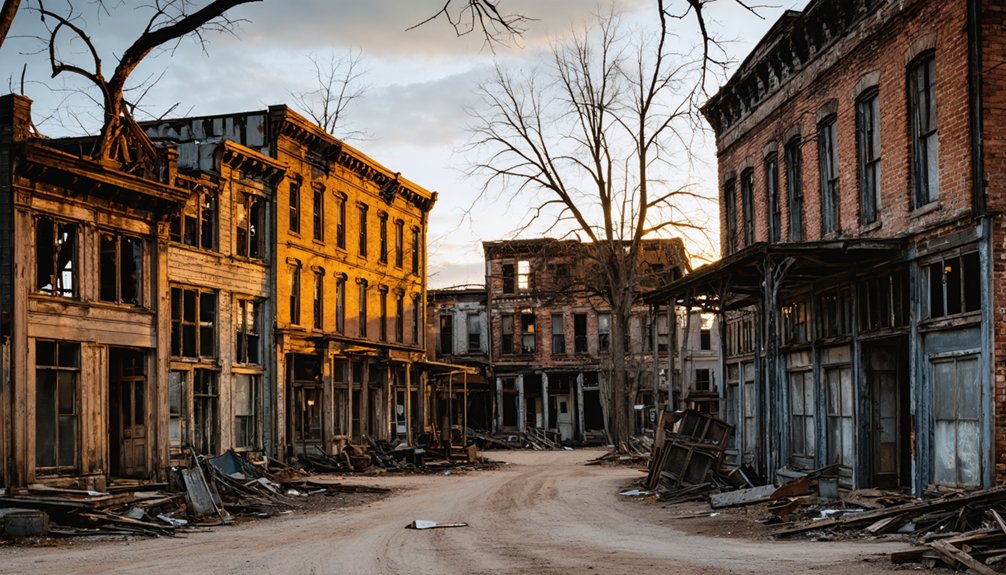
While Manhattan’s architectural gems commanded premium location fees, filmmakers discovered upstate New York’s abandoned settlements delivered identical spooky atmospheres at a fraction of the cost. You’ll find Piermont’s weathered 19th-century structures eliminating set construction budgets entirely, while Sleepy Hollow’s rail connections let actors commute without overnight expenses.
Tax incentives and reduced permitting fees in these locations freed you to allocate resources toward special effects and guest appearances instead of logistics. The Hudson River corridor kept equipment transport under one hour from Manhattan, preserving tight schedules. Productions like *Purple Rose of Cairo* capitalized on this efficiency, shooting period scenes amid natural decay that required zero fabrication.
Urban legends surrounding these ghost towns added thematic depth without additional cost, making upstate New York irresistible for budget-conscious horror filmmakers seeking authentic backdrops.
Frequently Asked Questions
Can the Public Visit Filming Locations at the Dakota Building?
You can’t access the Dakota’s interior for urban exploration—it’s a private co-op prioritizing historical preservation and resident privacy. You’re free to view Rosemary’s Baby’s iconic exterior from Central Park West sidewalks, photographing its German Renaissance architecture.
Are There Guided Ghost Tours Covering These NYC Movie Locations?
No guided tours specifically cover Ghost Town filming locations. However, you’ll find urban exploration opportunities at established tourist attractions like The Dakota and Ghostbusters sites through operators like On Location Tours, focusing on horror classics rather than this comedy-drama.
Which New York Ghost Town Location Requires Filming Permits?
Like explorers claiming territory, you’ll need filming permits for every NYC “ghost town” movie location—from 1135 5th Avenue to The Dakota. The filming permit process protects ghost town history while letting you capture these iconic, freedom-evoking backdrops legally.
How Much Does It Cost to Film at These Locations?
You’ll face permit requirements starting at $300 for NYC applications, plus location fees ranging $1,000-$10,000 daily for urban sites. Cost estimation for ghost town proxies typically runs $2,000-$20,000 per day, depending on negotiations.
What Safety Precautions Exist for Abandoned Upstate NY Filming Sites?
You’ll conduct hazard assessments, secure proper permits, and bring safety equipment like first-aid kits. You’ll cover cables, coordinate with local law enforcement, maintain liability insurance, and guarantee you’ve obtained written location releases before accessing abandoned properties.
References
- https://onlocationtours.com/blog/top-5-spookiest-film-locations-nyc/
- https://www.untappedcities.com/10-lesser-known-but-still-famous-film-locations-in-nyc/
- https://www.youtube.com/watch?v=tZmA_VF6cm8
- https://wgna.com/lights-camera-upstate-ranking-the-top-15-movies-filmed-in-upstate-new-york/
- https://onthesetofnewyork.com/ghosttown.html
- https://981thehawk.com/classic-horror-movie-filming-locations/
- https://aviewoncities.com/new-york/the-dakota
- https://en.wikipedia.org/wiki/The_Dakota
- https://www.youtube.com/watch?v=oq4OPHRvHPI
- https://thelittlehouseofhorrors.com/the-dakota/