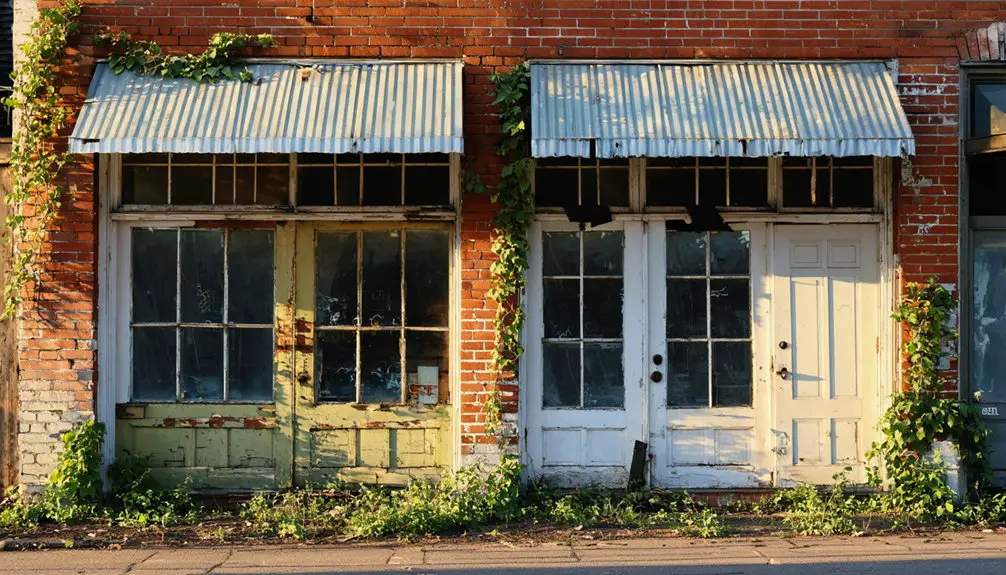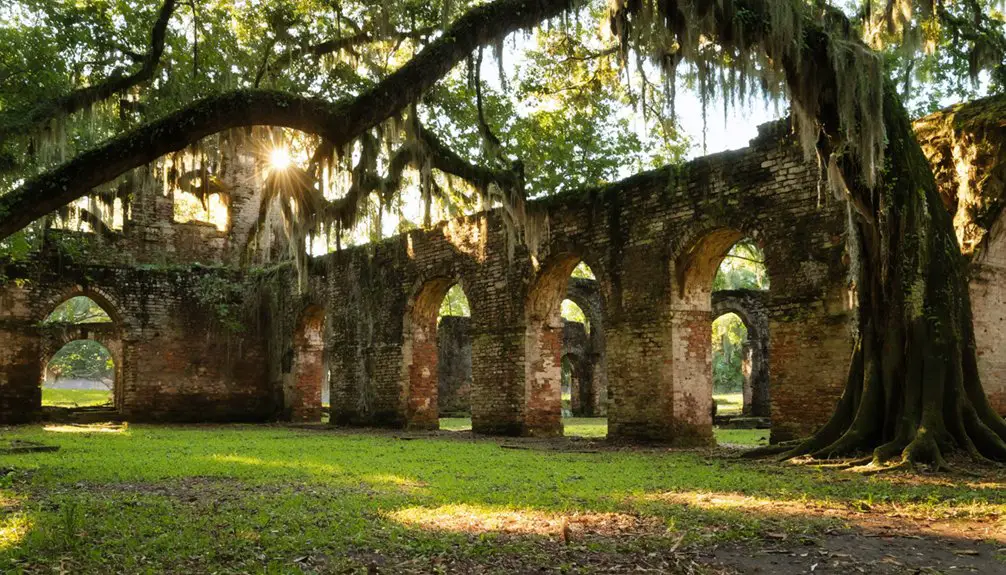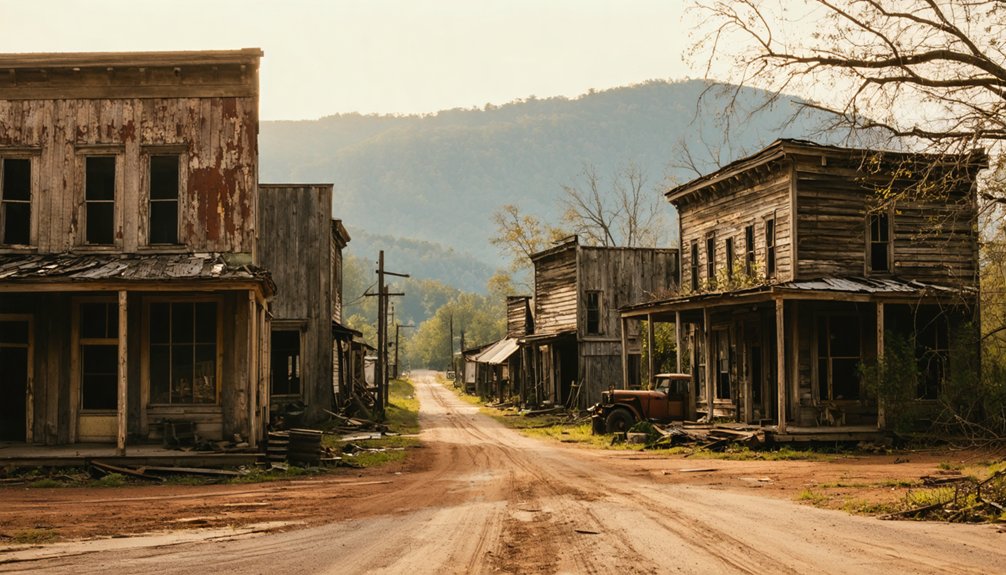
You’ll find North Carolina’s abandoned textile villages and industrial ruins transformed into iconic film sets, most especially Henry River Mill Village—a 1900s company town that became District 12 in *The Hunger Games*. Its weathered mill houses, rusted infrastructure, and authentic decay provided Hollywood with post-apocalyptic realism no studio could replicate. Other locations include the *Evil Dead II* farmhouse near Wadesboro and the Ideal Cement Factory’s dystopian remains featured in *Teenage Mutant Ninja Turtles*. Each site offers genuine deterioration—peeling paint, collapsing porches, overgrown paths—that creates cinematic atmospheres worth exploring further.
Key Takeaways
- Henry River Mill Village portrayed District 12 in *The Hunger Games*, featuring authentic 1900s textile village structures now preserved for tours and rentals.
- The farmhouse at 2323 Diggs Road and surrounding woods served as filming locations for *Evil Dead II* in 1986.
- Ideal Cement Factory, abandoned in 1982, provided post-apocalyptic settings for *Teenage Mutant Ninja Turtles*, *Cyborg*, and *Super Mario Bros.*
- Brunswick Town & Fort Anderson offers 18th-century colonial ruins and Civil War earthworks for historical film productions seeking period authenticity.
- Lake Lure’s scenic landscapes create eerie ghost town atmospheres, while nearby Camp Chimney Rock (now Firefly Cove) hosted *Dirty Dancing* filming.
Henry River Mill Village: From Textile Hub to District 12
When Michael Erastus Rudisill surveyed the Henry River‘s rushing waters in 1904, he recognized the perfect combination of topography and hydropower potential. He’d transform 1,500 acres into a self-sustaining textile operation—complete with a three-story brick mill, 30-foot dam, and 35 worker cottages.
A visionary industrialist harnessed raw waterpower to create an entire self-contained village from Carolina wilderness.
By the late 1960s, production had tripled to 12,000 spindles before overseas competition shuttered the operation.
You’ll find the ghost town one mile south of Hildebran, where 20 original cottages still line the gorge.
The 1977 lightning strike destroyed the main mill, but the two-story company store remains standing. The village infrastructure included a steel truss bridge built in 1912, reputed to be the highest in North Carolina before its replacement with concrete in 1960.
Since its 2019 National Register listing, new owners have prioritized historical preservation and community revitalization—maintaining the structures that once housed 450 workers who shopped with “doogaloo” coins. The village gained international recognition in 2011 when filmmakers transformed it into District 12 for The Hunger Games, with the company store converted into a bakery for the production.
The Hunger Games Transforms an Abandoned Company Town
After decades of silence punctuated only by wind through broken windows, Henry River Mill Village roared back to life in 2011 when Lionsgate selected the abandoned textile town as District 12—the coal-mining home of Katniss Everdeen in *The Hunger Games*.
For nine days, Hollywood crews transformed the 35 worker houses and Company Store into Mellark’s Bakery and Seam dwellings. They constructed hog pens and captured exterior shots that would define the franchise’s dystopian aesthetic.
Film controversy erupted when one mill house exploded during unauthorized production activities, triggering a lawsuit that barred further filming. Despite these preservation challenges, the site’s exposure launched it from forgotten relic to tourist destination.
You’ll find House #12 restored for overnight stays, with plans for a museum and restaurant honoring both textile heritage and cinematic legacy.
Restoration and Preservation Efforts at Henry River
You’ll find the village undergoing systematic transformation since the Reyes family purchased it in 2017. With plumbing systems installed throughout in 2021 to replace the absent water and sewage infrastructure that vanished during the 1970s-2020s abandonment period.
The ownership team has completed full restoration of House #12 as a vacation rental, demonstrating their commitment to converting the remaining 20 original worker cottages into functional accommodations alongside planned museum and restaurant facilities. During the village’s peak operation, approximately 300 residents lived across the more than 35 homes, with many families sharing single dwellings and communal outhouses.
They’ve also secured 1,500 surrounding acres to preserve the broader landscape, while the 2019 National Register designation provides preservation guidelines and grant funding access for the estimated multi-million dollar restoration project. The Henry River Preservation Fund, a non-profit organization, hosts tours and events to generate support for ongoing preservation efforts.
Reyes Family Restoration Plans
Following Wade Shepard’s death in 2015, the Henry River Mill Village sat dormant for two years before Drew Reyes discovered the property and recognized its preservation potential.
You’ll find Reyes committed immediately to saving these deteriorating structures, approaching the project as both art conservation and community revitalization.
By 2021, he’d installed the village’s first-ever indoor plumbing in a remodeled building and fully restored House #12 as a vacation rental.
Of the original 35 worker cottages, 20 remain standing. Reyes envisions transforming additional homes into rentals while establishing a restaurant and museum on-site.
His restoration philosophy prioritizes returning buildings to functional use rather than static preservation.
You’ll notice he’s balancing historical authenticity with modern visitor needs, creating accessible spaces where you can experience Carolina textile mill life firsthand.
Museum and Rental Development
Since the 2017 acquisition, Drew Reyes has pursued a dual-track development strategy that transforms Henry River’s 20 surviving structures into revenue-generating assets while preserving their historical integrity.
You’ll find House #12 operating as a fully restored vacation rental since 2021, capitalizing on the District 12 filming connection.
Additional worker cottages with concrete porches—deemed structurally safer—are slated for market restoration as short-term rentals.
Meanwhile, the two-story brick company store anchors museum plans, showcasing textile-era artifacts within its historically significant walls that once housed offices and a school.
Preservation challenges persist: collapsing floors restrict interior access, while the absence of running water and sewer systems complicates modern development.
Guided tours navigate these constraints, offering visitors access to macabre village history while generating funds for ongoing restoration work.
Touring the Real-Life District 12 Today
You’ll access Henry River Mill Village through guided history tours led by owner Calvin Reyes, who shares firsthand accounts of the 2011 filming transformation that turned weathered mill houses into Katniss’s world.
House #16, designated as Katniss Everdeen’s home during production, will become an on-site museum displaying artifacts from former residents alongside Hunger Games memorabilia.
For overnight immersion, you can book the fully restored House #12, which has operated as a vacation rental since 2021, with plans to convert additional historic homes and the former Company Store into guest accommodations and a restaurant. The village’s abandoned houses remain structurally unsafe for entry, so viewing the unrenovated buildings from outside is strongly recommended. Located approximately an hour from Charlotte, the site at 4255 Henry River Road in Hickory offers convenient access for visitors exploring North Carolina’s film history.
Guided Tours and Admission
When you arrive at Henry River Mill Village, located just off I-40 at exit 119 near Hildebran, you’ll find yourself standing in the authentic filming location that served as District 12 in *The Hunger Games*.
Tour accessibility remains year-round, allowing you to explore the preserved mill houses and walk the same paths Katniss traversed during the 2011 filming.
Guided tours take you through multiple structures, including the Company Store that transformed into Mellark’s Bakery and house 16, Katniss’s film residence.
You’ll witness authentic Appalachian mill town architecture across 72 acres, with approximately 20+ original structures still standing from the 35-house settlement.
The walkthrough also includes notable walk-in areas where scenes from the movie were shot inside the location.
The village stands along the Henry River, which adds to the authentic atmosphere of this now-ghost town setting.
Ticket pricing and current tour schedules require advance booking through the property’s official channels, as the privately-owned village operates special events throughout the year.
Katniss House Museum Plans
House 16 stands as the centerpiece of Henry River Mill Village’s preservation efforts, transformed into a dedicated museum showcasing artifacts from the abandoned settlement’s heyday. You’ll find items collected from throughout the 72-acre property, documenting both mill worker lives and film memorabilia from the nine-day Hunger Games shoot.
The Reyes family’s 2017 purchase enabled these preservation challenges to finally receive dedicated attention.
The museum features:
- Personal belongings recovered from abandoned homes across the village
- Film memorabilia connecting District 12 scenes to actual locations
- Historical documents from the cotton yarn production era (1900s-1970s)
- Photographic evidence of the mill’s water-powered operations
You’re free to explore this authentic slice of textile mill history while discovering how Hollywood transformed forgotten structures into Katniss Everdeen‘s fictional home.
Restored Vacation Rental Accommodations
Since the Reyes family’s 2017 acquisition, Henry River Mill Village has transformed from abandoned relic into an accessible destination where you can actually stay overnight. House #12, fully restored and operational since 2021, offers you an authentic District 12 experience without the typical constraints of luxury retreats or sanitized eco-friendly lodging.
You’ll sleep in the same mill workers’ quarters that appeared on screen, surrounded by original architectural details and artifacts discovered during restoration.
The property’s 72 acres give you room to roam independently, exploring the waterfall that powered the original mill and photographing structures frozen in time.
Additional homes are slated for vacation rental conversion, expanding your options for experiencing this genuine piece of Appalachian history.
You’re free to wander grounds where Katniss once walked—no velvet ropes required.
Wadesboro Woods: Where Evil Dead II Came to Life
Deep in the rural woods of Wadesboro, North Carolina, director Sam Raimi transformed a white farmhouse at 2323 Diggs Road into the epicenter of horror film production from May to September 1986.
This property—previously featured in Spielberg’s The Color Purple—became ground zero for Evil Dead II’s fourteen-week shoot. You’ll find Wadesboro history intertwined with rural filmmaking as the production utilized multiple locations:
- J.R. Faison Junior High School gymnasium converted into a two-story cabin soundstage with fruit cellar
- Bonsal Ballast Pits in Lilesville featured plywood castle facade for medieval sequences
- Woods surrounding Diggs Road housed cabin exterior constructed specifically for filming
- Anson County Airport at 2980 Airport Rd. served production logistics
Though the school now sits abandoned and fans relocated cabin remnants in 2016, these sites remain pilgrimage destinations for horror enthusiasts seeking authentic filming locations.
Brunswick Town and Fort Anderson’s Cinematic Ruins
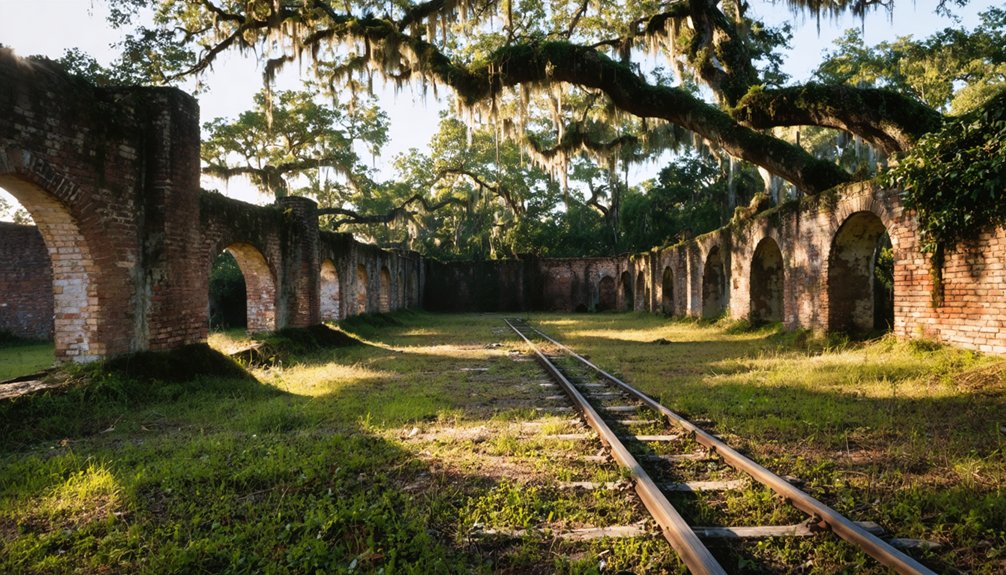
You’ll find Brunswick Town’s 18th-century foundations and Fort Anderson’s Civil War earthworks creating layered visual texture that filmmakers exploit for period authenticity.
The exposed brick walls of St. Philip’s Church—still bearing Union cannonball scars—stand alongside moss-covered tombstones and crumbling fort ramparts, offering ready-made backdrops that span three centuries of conflict.
Directors can position cameras within excavated colonial street grids while Confederate earthen berms frame shots, eliminating the need for constructed sets when capturing Revolutionary or Civil War narratives.
Historic Ruins and Architecture
When you arrive at Brunswick Town/Fort Anderson State Historic Site, you’ll encounter a cinematographer’s dream: layered ruins from two distinct American conflicts creating depth and visual complexity rarely found in a single location. The exposed foundations and crumbling walls evoke Medieval castles and Gothic architecture, providing atmospheric backdrops without Hollywood set construction costs.
The site’s visual elements include:
- Twenty-plus colonial foundation excavations from 1727-1776, including Governor Russellborough’s estate remains
- St. Philip’s Church ruins that survived both Revolutionary and Civil War destruction
- 1862 Confederate earthen fort walls strategically positioned along Cape Fear River
- Accessible trails connecting excavated structures through unrestricted landscapes
These authentic historical layers offer filmmakers pre-aged textures, strategic river positioning, and architectural fragments that can represent multiple time periods without expensive modifications.
From Fort to Filmset
Since *Sleepy Hollow*’s production team selected Brunswick Town/Fort Anderson for its television series, the site has demonstrated how genuine ruins reduce pre-production budgets while delivering period-accurate visuals. You’ll find colonial foundations and Confederate earthworks that require no set construction—just cameras and talent.
St. Philip’s Church ruins, bearing actual cannonball damage from Union bombardment, provide ready-made dramatic backdrops.
The site’s dual historical zones let you film multiple periods without relocating equipment. Ecological preservation mandates ensure the Cape Fear River setting remains pristine for cinematography, while community engagement protocols streamline permitting processes.
With Wilmington’s production infrastructure thirty minutes away and visitor center facilities supporting crew coordination, you’ve got authentic 18th and 19th-century environments without Hollywood’s restrictive oversight. The ruins deliver visual credibility that reconstructed sets can’t match.
Industrial Decay Meets Hollywood: The Ideal Cement Factory
Rising from the banks of the Cape Fear River, the abandoned Ideal Cement Plant stands as one of North Carolina’s most cinematically significant industrial ruins. Built in 1963 and shuttered by 1982, this Castle Hayne colossus transformed from cement production to cinematic gold, serving multiple productions seeking authentic post-apocalyptic backdrops.
You’ll recognize this industrial heritage site from:
- Teenage Mutant Ninja Turtles (1990): Shredder’s Foot Clan hideout sequences
- Cyborg (1989): Jean-Claude Van Damme’s post-apocalyptic battleground
- Super Mario Bros.: Dystopian set pieces
- FEAR TV Series: Controversial episode location
Film preservation enthusiasts still scout the gated perimeter at 6411 Ideal Cement Road, where that iconic stack chimney remains visible.
Though cement stairs were removed to restrict upper-level access, the plant’s massive interior spaces continue attracting urban explorers hunting 1990s movie locations along this stretch of coastal North Carolina.
Lake Lure’s Ghost of Resort Past in Dirty Dancing
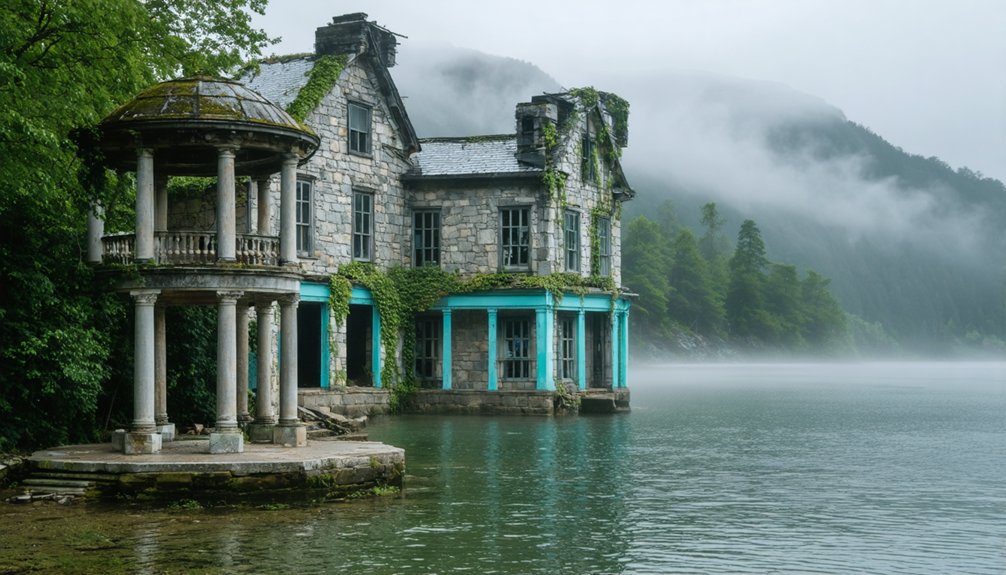
While post-apocalyptic cement plants captured gritty dystopian futures, North Carolina’s mountain resort locations provided the backdrop for one of cinema’s most beloved romantic dramas. *Dirty Dancing*’s iconic scenes weren’t filmed at a functioning resort—they captured Camp Chimney Rock‘s final curtain call.
You’ll find haunted nostalgia in what’s now Firefly Cove, a private residential development where camp cabins and ruins whisper silent stories of the 1987 production. Those stone stairs where Baby practiced her moves still exist, though they’re tucked into lakefront properties.
The gymnasium that hosted the climactic “(I’ve Had) The Time of My Life” performance vanished into redevelopment. You can book pontoon tours past these transformed locations, witnessing how Hollywood preserved a dying resort’s legacy on film before time erased the physical evidence.
Behind the Scenes: Challenges of Filming in Abandoned Sites
When film crews arrived at Henry River Mill Village for *The Hunger Games*, they confronted a 1905 textile settlement where nature had already claimed victory.
Decaying roofs demanded safety scaffolding, while rotting foundations shifted beneath equipment logistics challenges.
Hazmat teams cleared asbestos and lead paint before cameras rolled, and wildlife disruptions from bat colonies required fumigation of mill houses.
The abandoned site presented obstacles you’d expect from structures exposed to elements for decades:
- Structural reinforcements prevented collapses in buildings slated for controlled demolition scenes
- Geotechnical monitoring tracked foundation shifts under heavy gear weight
- Generator transport through overgrown paths, since utilities hadn’t existed for years
- Weather delays from Blue Ridge Mountain fog and flash floods
Remote access, 1 mile off I-40, required custom transport solutions while preserving the village’s historic integrity.
North Carolina’s Forgotten Places on the Big Screen
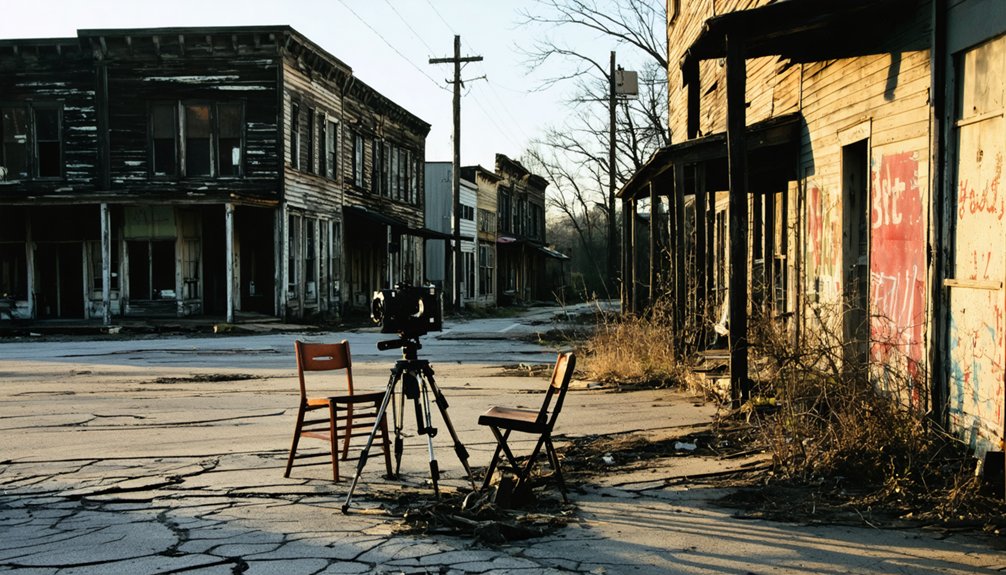
These production hurdles transformed Henry River Mill Village from a deteriorating textile settlement into District 12’s coal-dusted streets, where Katniss Everdeen’s story began among weathered clapboard houses and mud-rutted pathways.
Henry River Mill Village’s authentic decay became District 12, turning abandoned textile history into Katniss Everdeen’s cinematic home.
You’ll find North Carolina’s forgotten industrial sites offering filmmakers authentic backdrops that CGI can’t replicate. The urban decay sprawling across Henry River’s 72 acres provided raw storytelling ambiance—peeling paint, collapsed porches, and overgrown vegetation created post-apocalyptic authenticity without construction.
Production crews capitalized on this genuine deterioration, even demolishing one house during an explosion sequence. The state’s abandoned textile villages, shuttered mining towns, and derelict mill communities present diverse filming environments from mountains to coastal plains.
These locations deliver economic value beyond nostalgia, attracting international productions seeking cost-effective alternatives to Hollywood backlots while preserving North Carolina’s industrial heritage through cinematic documentation.
Frequently Asked Questions
Are There Other Hunger Games Filming Locations Open to Visitors in North Carolina?
You’ll find DuPont State Forest’s waterfalls and Pisgah National Forest’s wilderness trails open for exploration, showcasing historic preservation through community involvement. Visit Charlotte’s Knight Theater and explore these accessible Districts 12 filming sites where Katniss hunted freely.
What Safety Precautions Are Required When Filming at Abandoned Industrial Sites?
Over 70% of abandoned industrial sites contain asbestos. You’ll need FFP3 masks for hazardous material protocols when filming. Safety gear requirements include respiratory protection against mold and asbestos in deteriorating ceilings, pipes, and humid spaces before cameras roll.
How Much Does It Cost to Rent Filming Locations at Historic Sites?
Rental costs and historic site fees vary widely—you’ll find no standard pricing published for North Carolina’s filming locations. Private owners like Henry River Mill Village negotiate individually, while public lands often don’t disclose their filming agreements publicly.
Can Visitors Stay Overnight at Any Ghost Town Filming Locations?
You’ll find overnight accommodation only at Henry River Mill Village’s restored house #12, available since 2021. Other ghost town filming locations have safety restrictions preventing stays, though you’re free to explore them during daytime visits.
Which North Carolina Ghost Town Locations Are Still Available for Film Productions?
A picture’s worth a thousand words: You’ll find Henry River Mill Village, Brunswick Town/Fort Anderson, and Wadesboro sites welcome productions. Each balances history preservation with filming permission requirements, letting you capture authentic abandoned settings while respecting their cultural significance.
References
- https://www.visitnc.com/list/screen-scream-horror-film-sites-and-haunts-north-carolina
- https://waltermagazine.com/art-and-culture/10-movies-filmed-in-north-carolina/
- https://www.romanticasheville.com/henry-river
- https://www.youtube.com/watch?v=0Cxg-0Bc7Os
- https://www.explore.com/1460059/north-carolina-filming-locations-you-need-to-visit/
- https://www.atlasobscura.com/things-to-do/north-carolina/film-locations
- https://henryrivermillvillage.com
- https://en.wikipedia.org/wiki/Henry_River_Mill_Village
- https://roadtrippers.com/magazine/henry-mill-river-hunger-games-district-12/
- https://henryrivermillvillage.com/history/