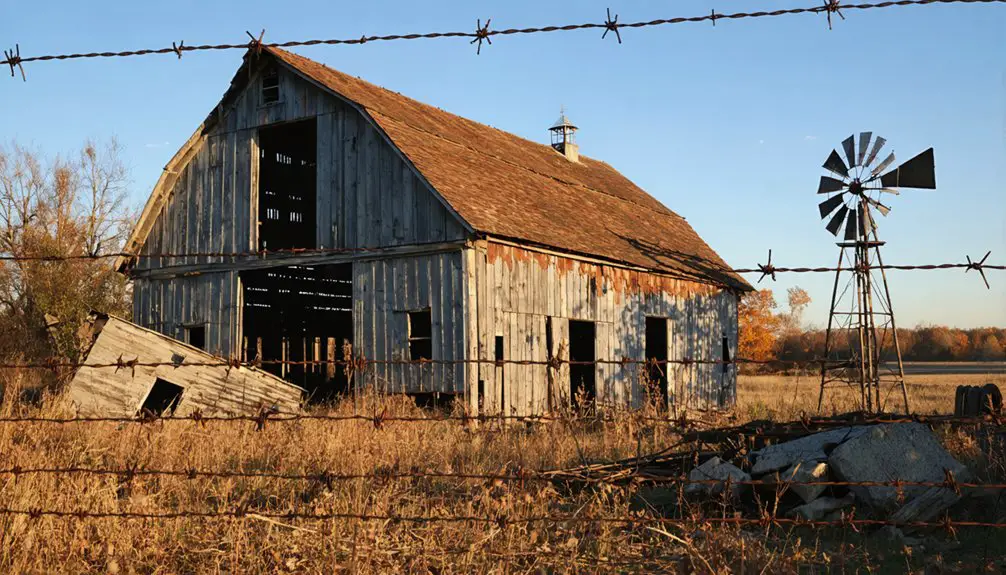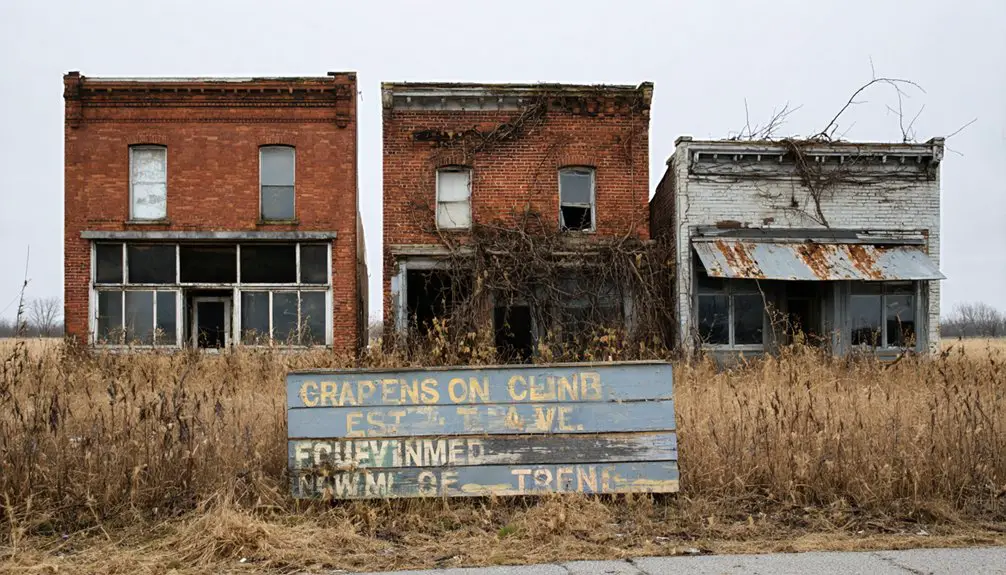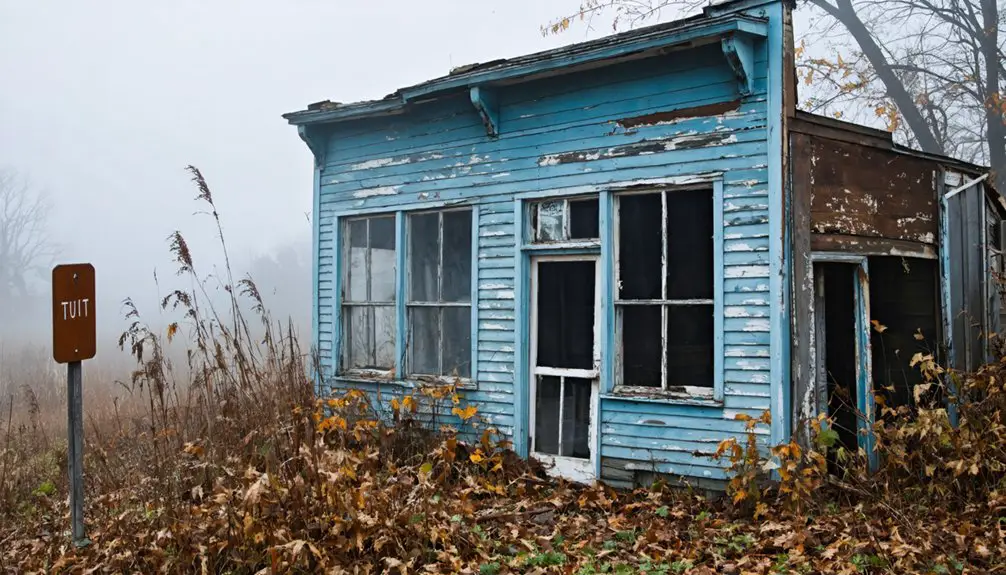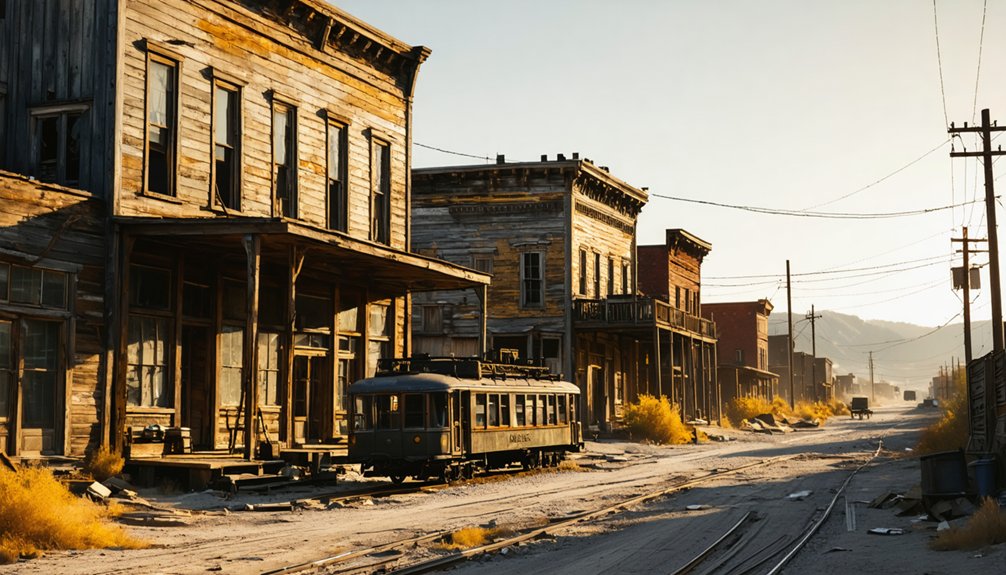
You’ll find Ohio’s ghost towns like Boston Mills (“Helltown”), Moonville, and Oreton serving as authentic film backdrops, where abandoned railroad infrastructure, brick-lined tunnels, and overgrown ruins replace digital effects with genuine decay. *The Children of the Corn* used Boston Mills’ deliberately burned structures, while Moonville’s haunted 1850s railway tunnel and Oreton’s coal mining remnants offer atmospheric settings for horror and period productions. These forgotten communities, scattered across southeastern Ohio’s forested hills, provide filmmakers with ready-made landscapes steeped in historical ambiance—and there’s considerably more to their cinematic transformations.
Key Takeaways
- Mansfield Reformatory, a Gothic-style prison from the 1800s, served as the primary filming location for *The Shawshank Redemption*.
- Malabar Farm State Park, built in 1939, was featured in *The Shawshank Redemption* and hosted Hollywood celebrities like Humphrey Bogart.
- Boston Mills and “Helltown,” established in 1806, provided authentic abandoned railroad town backdrops for *The Children of the Corn* (1984).
- Moonville’s haunted 1850s railroad tunnel in Vinton County offers authentic decay for supernatural horror films without digital enhancement.
- Oreton, an abandoned coal mining town from the 1880s, provides untouched industrial ruins ideal for derelict landscape film settings.
Mansfield Reformatory: From Prison to Hollywood Set
Built in the late 1800s as part of a 19th-century reform movement, the Mansfield Reformatory initially aimed to provide humane treatment for inmates through its imposing Gothic castle-like design—the largest such structure in the United States.
America’s largest Gothic castle-style prison, the Mansfield Reformatory represented 19th-century ideals of humane incarceration through its distinctive architectural design.
After operating as a maximum-security prison until 1990, this landmark transformed into a celebrated filming location.
You’ll recognize its cell blocks from *The Shawshank Redemption*, now IMDb’s #1-ranked film.
The prison architecture proved perfect for cinematic storytelling—filmmakers cut doors for camera cables and drilled lens holes in the parole hearing room to create spatial illusions.
Filming techniques included breaking eight glass panes across multiple takes for one scene.
Beyond Shawshank, the reformatory’s exterior gates and cell blocks have appeared in major productions including *Air Force One* and *Escape Plan: The Extractors*.
Tours showcase Warden Norton’s office, the parole boardroom, and Brooks’ hotel room where visitors can see the actual film settings.
Today, you can explore 15 Shawshank Trail locations independently or join guided tours revealing how Hollywood transformed this once-condemned facility into an internationally famous movie set.
Malabar Farm State Park: Where Cinema Meets Paranormal History
Just 20 miles southwest of Mansfield Reformatory lies another *Shawshank Redemption* filming location with its own Hollywood legacy—Malabar Farm State Park. You’ll find the Pugh Cabin here, where the film’s opening scene captured Andy Dufresne’s drunken confrontation with fate.
Built by Pulitzer Prize-winner Louis Bromfield in 1939, this 900-acre estate attracted Hollywood royalty long before film crews arrived. Humphrey Bogart and Lauren Bacall exchanged vows in the 32-room Big House in 1945, establishing the property’s cinematic legacy. During filming, James Whitmore and Clancy Brown received a personal tour of the grounds.
The paranormal lore runs deep—*Ghost Hunters* investigated supernatural claims throughout the grounds in 2014. You can explore the Big House’s double staircase where celebrities once gathered, hike the Doris Duke Woods trail to Pugh Cabin, and browse Bromfield’s books at the Visitors Center. The park’s famous oak tree, which appeared in the film’s final scenes, stood near the cabin until 2016.
Hocking Hills: A Backdrop for Modern Horror
When you watch the 2021 *Wrong Turn* reboot, you’re seeing Hocking Hills State Park‘s distinctive rock formations and cave systems standing in for the Appalachian Trail‘s most treacherous terrain.
Director Mike P. Nelson positioned his cameras at coordinates 39.423458°N, -82.538445°W to capture the park’s natural hills and limestone outcroppings, which provided the isolated mountain setting where hikers encounter deadly, territorial inhabitants.
The film’s opening sequences showcase the exact geological features—towering cliffs, narrow passages, and dense forest cover—that transform this Logan, Ohio location into a convincing wilderness death trap. Local residents from the Hocking Hills area confirmed recognizing the terrain in the finished film. Like *The Shining’s* use of Timberline Lodge, Oregon to portray the fictional Overlook Hotel, Hocking Hills substitutes for a different geographic location entirely while maintaining atmospheric authenticity.
Wrong Turn Reboot Details
Released in 2021, the Wrong Turn reboot transformed Ohio’s rugged landscape into a chilling Appalachian nightmare under director Mike P. Nelson’s vision. You’ll find that Hocking Hills State Park provided the primary backdrop, while Clermont County locations—Felicity, New Richmond, Utopia, and Milford—hosted crucial sequences.
The production required maneuvering complex filming permits through Film Cincinnati and local authorities between September and November 2019.
Screenwriter Alan B. McElroy, who penned the original, crafted this first trilogy installment featuring hikers confronting a bloodthirsty mountain community. Matthew Modine led the cast through scenes that eschewed cannibalistic slasher tropes for deeper themes.
The crew’s 1,400 hotel room nights and rented Union Township facilities injected economic vitality into communities anxious to embrace Hollywood’s arrival, proving urban legends about Ohio’s cinematic potential weren’t mere folklore. The film garnered 64% on Rotten Tomatoes from 64 reviews, reflecting the divided critical response to its reimagined narrative approach. The film industry has brought nearly $80 million to the Greater Cincinnati region, demonstrating the substantial financial impact of productions choosing Ohio locations.
Appalachian Trail Terrain Features
Although the Appalachian Trail never crosses through Hocking Hills State Park, the terrain mirrors the Trail’s rugged characteristics with 25 miles of interconnected gorges carved from 330-million-year-old Blackhand sandstone.
You’ll find mountain ridges rising sharply above deep ravines, their exposed rock faces creating dramatic vertical drops that filmmakers exploit for atmospheric tension. The forested slopes cascade down weathered cliffs toward shadowed valleys where hemlock trees block sunlight even at midday.
Massive recess caves like Ash Cave—a 700-foot-wide amphitheater with 90-foot walls—provide natural sound stages requiring minimal set construction.
Rock formations create confined passages and isolated pockets where characters can’t easily escape, essential for horror narratives. The sandstone divides into three distinct zones, with the middle layer weathering more easily than the upper and lower sections, creating the overhangs and recesses that define the park’s dramatic topography.
The erosion-sculpted landscape offers production teams authentic wilderness aesthetics without venturing into actual Appalachian backcountry, keeping crews accessible while maintaining visual authenticity. The region’s transformation began when glacial melt 10,000 years ago reversed the Hocking River’s flow and carved out the gorges that now define this cinematic landscape.
Moonville and Oreton: Authentic Abandoned Communities on Film
You’ll find Moonville’s crumbling railroad tunnel cutting through dense southeastern Ohio forest, where iron tracks once carried coal trains and now frame shots of weathered brick arches draped in moss and shadow.
The tunnel’s documented history of fatal accidents creates an authentic backdrop that filmmakers exploit for horror and period pieces requiring genuine deterioration rather than constructed sets.
Oreton’s scattered foundations and rusted mining equipment offer similar production value—real decay that digital effects can’t replicate, with exposed coal seams and collapsed structures providing ready-made dystopian landscapes.
Moonville’s Haunted Railroad Tunnel
Deep in Vinton County’s forested hills, Moonville’s brick-lined railroad tunnel cuts through the landscape as one of Ohio’s most atmospheric filming locations—a genuine abandoned settlement where tragedy and legend converge. You’ll find this 1850s structure where over 21 documented fatalities occurred, creating Ohio’s richest concentration of railroad ghosts.
The engineer Theodore Lawhead still reportedly walks these tracks with his lantern after dying in an 1880s head-on collision, while the Brakeman haunts the site where he fell beneath train wheels in 1859. These haunted tunnels gained cinematic appeal through their authentic decay—you’re walking where the last resident departed in 1947, leaving only foundations and the Moonville Rail Trail threading through genuinely cursed infrastructure that demands no Hollywood embellishment.
Oreton’s Coal Mining History
Just fifteen miles from Moonville’s haunted tunnel, Oreton’s coal mining remnants offer filmmakers a different species of desolation—industrial abandonment rather than supernatural dread. You’ll find only a brick safe from the general store standing amid the forest where seventy houses once sheltered miners who worked twelve-hour shifts extracting coal by tonnage.
The New York Coal Company established this operation in the 1880s, sustaining it until abandonment in 1909. What makes Oreton uniquely cinematic among Ohio’s ghost towns is its complete erasure—no cemetery despite a century of habitation, no standing structures beyond that lone safe, just concrete foundations disappearing beneath undergrowth.
This thorough obliteration provides directors unrestricted terrain for building temporary sets without interfering with preserved historical sites.
Boston Mills and Other Forgotten Railroad Towns
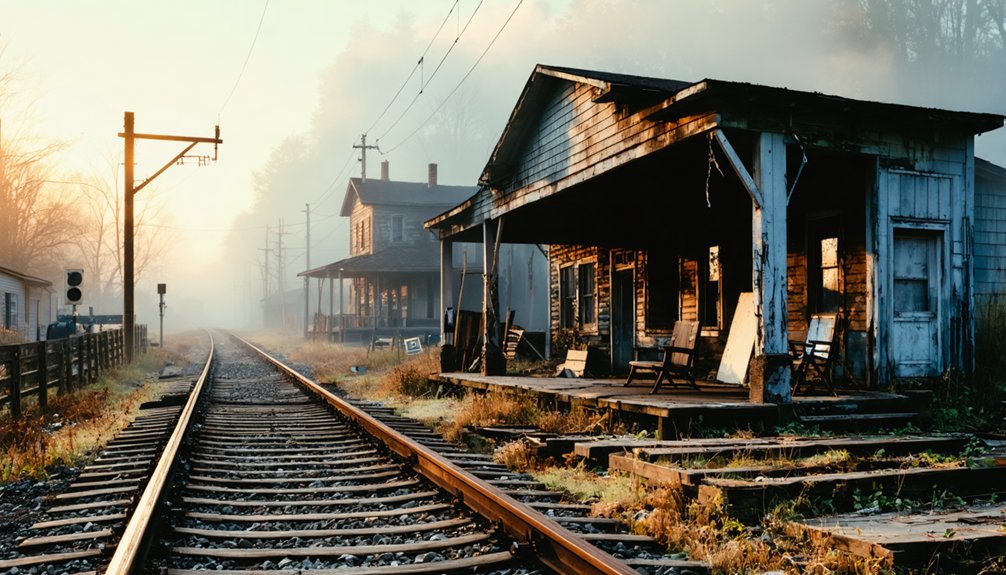
When the National Park Service began purchasing properties in Boston Mills in 1974, this 168-year-old settlement transformed from Ohio’s oldest Summit County village into a desolate filming backdrop within two decades.
You’ll find railroad relics scattered throughout these forgotten railroad towns, where abandoned infrastructure created perfect horror-movie aesthetics. Stephen King’s “The Children of the Corn” crew capitalized on this in 1984, filming among boarded-up houses and overgrown vegetation.
The federal government’s rapid land acquisition displaced hundreds of residents, leaving structures intentionally burned for fire department training.
You can trace the town’s evolution from its 1806 establishment through its 1821 sawmill construction to its 2016 demolition.
The Presbyterian Church’s architectural oddities and misidentified “slaughterhouse” near Boston Cemetery spawned “Helltown” legends that enhanced its cinematic appeal for productions seeking authentic abandonment.
Independent Horror Productions in Central Ohio’s Rural Landscape
Meanwhile, *Wrong Turn*’s 2021 reboot utilized Hocking Hills’ forested terrain to depict Appalachian horror, proving Central Ohio’s landscapes deliver authentic backdrops without studio constraints.
These low-budget productions leverage Pierce Township’s rural crossroads and Malabar Farm’s secluded acres, giving you unfiltered access to Midwestern horror geography that Hollywood executives overlook.
Frequently Asked Questions
What Permits Are Required to Film at Ohio Ghost Town Locations?
You’ll need filming permits if ghost towns sit on public or government property, plus insurance requirements including a certificate naming the city as additional insured. Private ghost town locations only require owner permission unless impacting public safety.
Are Ghost Town Filming Locations in Ohio Accessible to the Public?
You’ll find Ohio lacks true ghost towns, but urban exploration enthusiasts can access filming sites like Ohio State Reformatory and Malabar Farm State Park. Historical preservation efforts maintain these locations as public attractions, offering you unrestricted freedom to visit year-round.
Which Ohio Ghost Towns Offer Guided Tours for Film Location Enthusiasts?
You’ll find guided tours at Ohio State Reformatory in Mansfield, where historical preservation and local community support maintain Shawshank Redemption filming sites. Tours showcase cell blocks, warden’s quarters, and iconic movie scenes, offering freedom to explore authentic corridors.
What Safety Precautions Are Necessary When Filming in Abandoned Ohio Structures?
When a film crew explored Ohio’s crumbling grain elevator, structural collapse nearly occurred. You’ll need thorough hazard assessments identifying unstable floors and asbestos. Safety training covering respirators, hard hats, and emergency evacuation routes protects your team’s autonomy and lives.
How Much Does It Cost to Rent Ohio Ghost Towns for Filming?
You’ll find true Ohio ghost towns rarely available for rental due to private property rights and historical preservation restrictions. Instead, budget $5,000-$50,000 daily for maintained alternatives like Mansfield Reformatory, which offers controlled access without legal complications.
References
- https://destinationmansfield.com/film-mansfield/
- http://oreateai.com/blog/beyond-the-tourist-trail-uncovering-mansfield-ohios-cinematic-footprint/57799d65bebeaf09e19e256a1e771916
- https://www.youtube.com/watch?v=ONB5GV9T-GI
- https://abc6onyourside.com/news/local/8-horror-movies-filmed-in-ohio-i-see-you-wrong-turn-obscura-take-shelter-clay-zombies-ozone-the-bye-bye-man-obstacle-corpse-amazon-prime-tubi-pluto-plex-halloween-horror-film
- https://www.youtube.com/watch?v=5DA1qyLcNJg
- https://shawshanktrail.com/a-path-worth-remembering.html
- https://www.mrps.org/inside-shawshank/
- https://cameraderie.org/threads/the-ohio-state-reformatory-history-and-hollywood.57217/
- https://shawshanktrail.com/sites-listed/the-hollywood-connection/
- https://www.ohiomagazine.com/travel/article/ohio-s-shawshank-trail