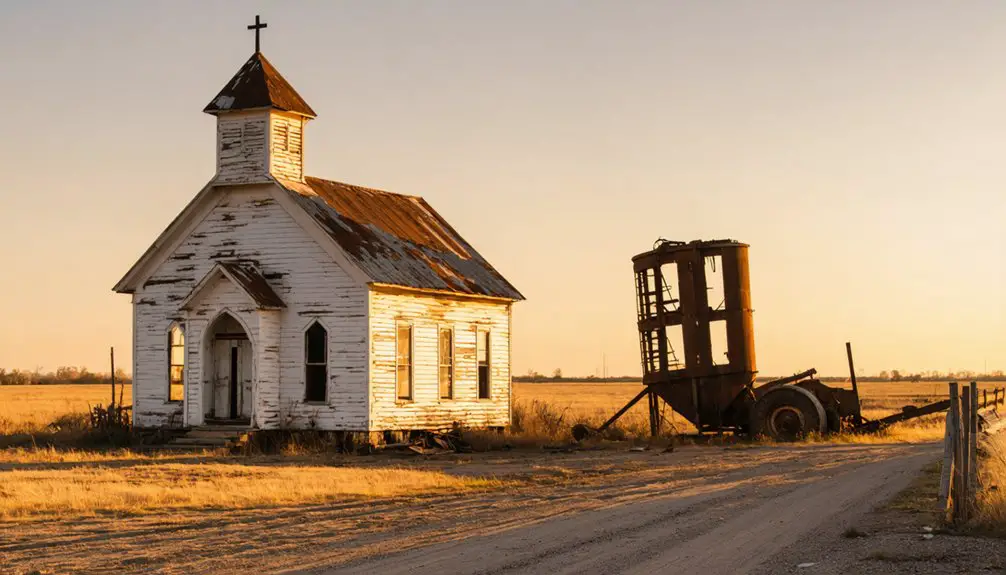
You’ll find Gray Horse Ghost Town three miles east of Fairfax serving as *Killers of the Flower Moon*’s authentic backdrop, with original structures including Mollie Kyle’s reconstructed house and a ceremonial roundhouse. Picher’s abandoned mining infrastructure offers 14,000 mineshafts and toxic chat piles requiring no permits, while Okmulgee’s decaying 701 W 6th Street building anchored *Reservation Dogs*. Terlton’s House Creek remnants and Fairfax’s transformed storefronts provide additional period-appropriate settings. The state’s five ghost towns within Osage County—Carter Nine, Little Chief, Foraker, and Grainola—offer varied abandonment aesthetics that reveal deeper production possibilities.
Key Takeaways
- Gray Horse Ghost Town, three miles east of Fairfax, served as the primary filming location for *Killers of the Flower Moon*.
- Five Osage County ghost towns—Gray Horse, Carter Nine, Little Chief, Foraker, and Grainola—offer distinct abandoned aesthetics within 40 miles.
- Abandoned Picher mining town features 14,000 mineshafts, chat piles, and industrial decay, requiring no filming permits as an EPA Superfund site.
- Terlton ghost town remnants and Okmulgee’s abandoned W 6th Street buildings provided locations for *Reservation Dogs* and other productions.
- Cogar’s abandoned general store, used in *Rain Man*, and Gray Horse’s historic school exemplify cinematic decay attractions statewide.
Okmulgee’s Abandoned Building in Reservation Dogs Season 1
When you visit the abandoned building at 701 W 6th Street in Okmulgee, you’ll find the raw, atmospheric hideout where Bear and his friends gathered throughout Reservation Dogs Season 1.
This urban decay landmark sits at the intersection of 6th and Oklahoma streets, serving as the crew’s secret refuge where they plotted their futures and shared unfiltered moments. The production team preserved the abandoned architecture’s unpolished character, adding minimal props to maintain authenticity.
You can explore this location freely, as it remains accessible unlike many controlled filming sites. The structure’s weathered walls and stripped-down interior perfectly captured the series’ gritty tone, contrasting sharply with active locations like the nearby Sonic Drive-In at 900 E 6th Street, another featured spot in Okmulgee’s transformation into television’s newest indigenous storytelling backdrop. Reservation Dogs’ production spent $40 million in Oklahoma, demonstrating the show’s significant economic impact on the local film industry. The tranquil, leafy surroundings of this hideout location provide an unexpected contrast to the building’s weathered interior.
Gray Horse Ghost Town’s Role in Killers of the Flower Moon
You’ll find Gray Horse’s abandoned WPA schoolhouse and weathered structures three miles east of Fairfax.
Martin Scorsese filmed *Killers of the Flower Moon* there to capture the 1920s Osage Murders setting.
The ghost town’s cemetery holds burial sites of actual victims—Mollie, Lizzie, and Anna—whose headstones appear in the film’s most haunting sequences.
Gray Horse’s ceremonial grounds and remaining seasonal homes provided authentic Osage cultural context that no studio set could replicate, anchoring the film’s visual narrative in the Big Hill Band’s historical territory. The settlement received the in-lon-schka dance from the Ponca Indians in the mid-1880s, establishing traditions that continue during annual June celebrations at the pavilion built in 1964. The Roundhouse has been rebuilt three times since its original construction in the early 1900s, serving as the ceremonial center for the community’s traditional dances.
Historic Buildings and Cemetery
Located approximately five miles from Fairfax on the Osage reservation, Gray Horse served as one of the most crucial filming locations for *Killers of the Flower Moon*.
Production designer Jack Fisk studied the settlement’s existing historic structures to understand 1920s Osage living conditions before constructing Mollie Kyle’s house set from scratch on-site.
The team built a cemetery specifically for filming sequences—a closed historic burial ground for many Native individuals that reinforces Native memorials within the narrative.
Ghost town preservation enabled filmmakers to shoot directly where events unfolded, integrating authentic architectural elements with new constructions.
This approach eliminated artificial backlot sets, allowing you to witness genuine Osage County landscapes combined with period-accurate buildings that recreate the reservation atmosphere during the murder investigations.
Filming began in April 2021 at various Oklahoma locations, with Gray Horse providing essential historical authenticity for scenes depicting the Osage community during the tragic events of the 1920s.
Proximity to Fairfax Setting
Since Gray Horse sits just five miles from Fairfax, the production team leveraged this proximity to create a filming strategy that honored geographical authenticity while addressing practical construction needs.
You’ll find this sister-community relationship enabled Scorsese’s crew to consolidate logistics across nearly 50 locations during the five-month shoot while preserving the 1920s narrative’s true setting.
The close distance facilitated critical production advantages:
- Mollie Kyle’s house construction in Gray Horse while maintaining connection to Fairfax events
- Cemetery placement on reservation grounds less than five miles from primary filming sites
- Seamless movement between authentic Osage locations throughout the $200 million production
This geographic arrangement strengthened local storytelling by filming where events actually occurred, supporting community preservation through deliberate use of Osage land rather than distant substitutions. The area’s historic cemetery near Greyhorse contains graves of many Native Americans connected to the events depicted in the film. Bartlesville served as the operational base for cast and crew, housing production offices and soundstage facilities throughout the filming period.
Osage Cultural Significance
Gray Horse carries profound ceremonial weight within Osage Nation as the settlement named after Ka-wa-ko-dsa, a revered medicine man whose legacy anchored the Big Hill band’s establishment in this southwestern reservation territory.
You’ll find Indigenous storytelling preserved through the i’n-lon-schka dance ceremonies held each June at the pavilion erected in 1964, replacing the original 1908 round house destroyed by prairie fire.
The settlement gained tragic national prominence during the 1920s Reign of Terror, when oil wealth sparked the murders documented in *Killers of the Flower Moon*.
Gray Horse Cemetery serves as sacred ground for victims including Mollie, Lizzie, and Anna.
Historic preservation efforts maintain seasonal structures and tribal facilities, ensuring this oldest Osage settlement continues connecting generations to their cultural foundations.
The settlement’s name honors the distinctive coat coloring that gray horses develop progressively with age, transforming from dark birth coats to lighter appearances while maintaining pigmented skin beneath.
Fairfax Area Settlements and Historic Osage County Filming
The small town of Fairfax sits in Osage County with a population of just 1,136 residents—less than half its former size—yet maintains a sprawling downtown district that belies its diminished numbers. Martin Scorsese chose this authentic location to film *Killers of the Flower Moon*, with Leonardo DiCaprio walking the same streets where the Osage murders actually occurred.
You’ll find the Shoun brothers’ medical building still standing downtown, where production crews repainted period-accurate signage. The historic structure now offers second-floor tours detailing poisoning allegations. The filming included scenes at Rita Smith’s home, which was later depicted as bombed in the film.
Modern tourism has revitalized abandoned spaces:
– Fairfax Osage Reservation Museum occupies a renovated building
- Tallchief Theater awaits restoration by preservationists
- Local cuisine establishments fill once-vacant storefronts
- Sister’s Attic (former Oklahoma Hotel) hosted vital second-floor scenes
- Big Rain Gallery and First Christian Church provided additional filming backdrops
- Courthouse and Masonic Lodge transformed into period-appropriate Fairfax establishments
- Steam locomotive and three Pullman cars positioned on 1,200-foot track transported from Arkansas
- First Christian Church interior converted into functioning courthouse setting
- Big Rain Gallery and Drumright Bank repurposed while maintaining exterior authenticity
- Gray Horse – housed 10,000 during peak oil activity, now scattered ruins near *Killers of the Flower Moon* filming sites.
- Carter Nine – minimal company town remains amid desolate prairie remnants.
- Little Chief – crumbled 1930s store with few remaining houses along Little Chief Creek.
- Beggs, Inola, Sand Springs, and Claremore supplemented Terlton’s authentic atmosphere.
- Meadowlake Ranch’s 260 acres provided woodland scenes with waterfalls and streams.
- Production crews built new roads accessing remote filming areas.
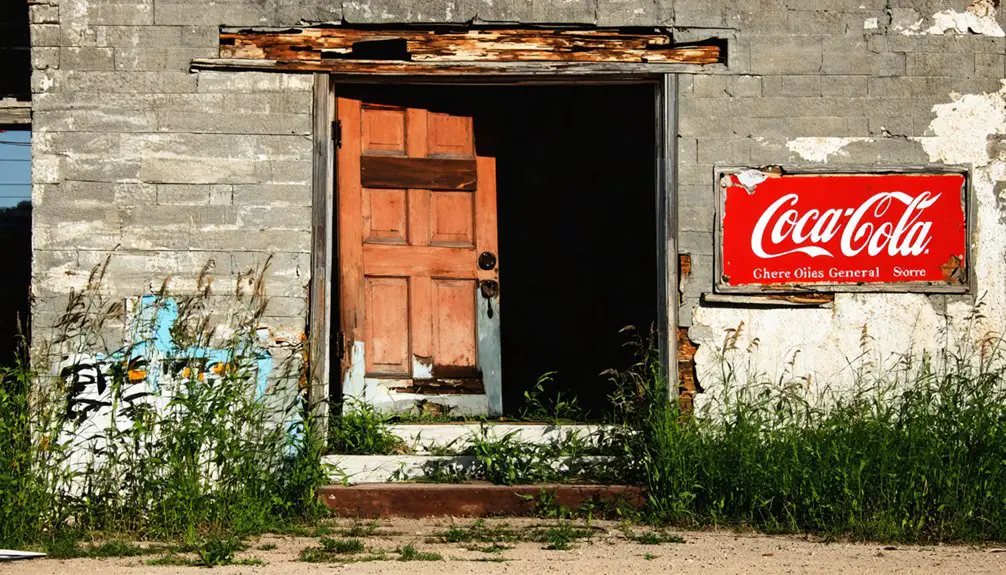
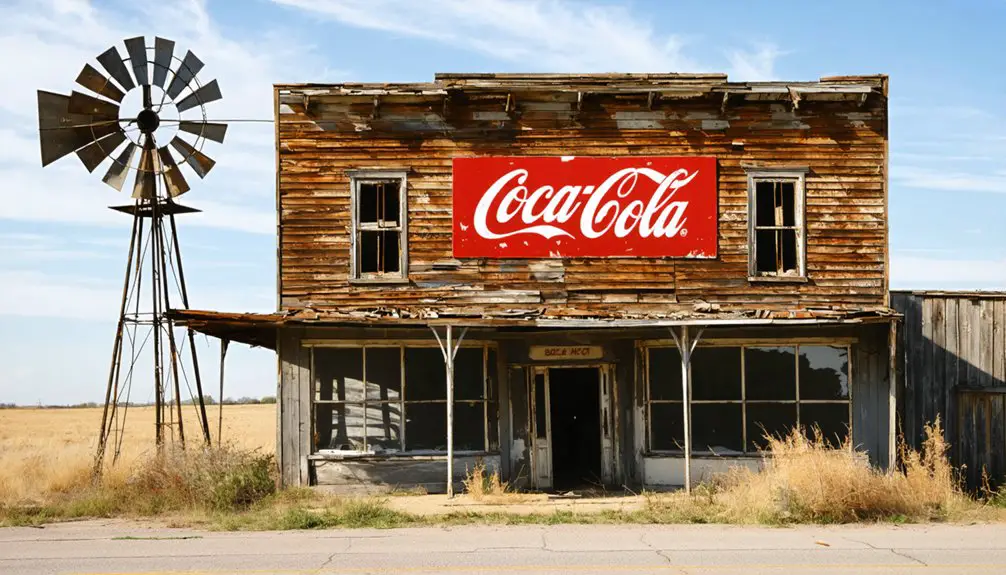
- Cogar’s general store served as a Rain Man scene location, its cinematic decay attracting photographers
- Gray Horse’s abandoned school near Osage County borders provides documented filming-ready architecture
- Pawhuska’s Main Street hosted Killers of the Flower Moon, blending Osage Nation Museum context with early 20th-century streetscapes
- Okmulgee’s reservation structures – 701 W 6th Street and 1506 Creek Pl served *Reservation Dogs* hideout and residential scenes.
- Route 66 drive-in theaters – Tee Pee Drive-In (1950, 400-car capacity) and Broken Arrow’s ’51 Drive-In showcase cinema relics.
- Osage County ghost towns – Gray Horse’s abandoned school and Pusa’s period buildings offer time-capsule authenticity.
- https://giggster.com/guide/movie-location/where-was-reservation-dogs-filmed
- https://www.atlasofwonders.com/2022/01/where-was-ghostbusters-afterlife-filmed.html
- https://www.worldatlas.com/cities/4-oklahoma-towns-where-famous-movies-were-filmed.html
- https://www.youtube.com/watch?v=lXDXLRK_4RM
- http://www.thennowmovielocations.com/2022/01/oklahoma.html
- https://www.okfilmmusic.org/locationsdirectory
- https://www.youtube.com/watch?v=rDIIpr_Z6fE
- https://www.okhistory.org/publications/enc/entry?entry=GR028
- https://www.youtube.com/watch?v=RBTUvBJiBO4
- https://www.youtube.com/watch?v=-jYN1_E2VV0
Nearby Gray Horse remains largely abandoned—bypassed by railroads—while former Remington settlement marks where Anna Brown’s murder unfolded.
Pawhuska’s Main Street Transformation for Major Productions
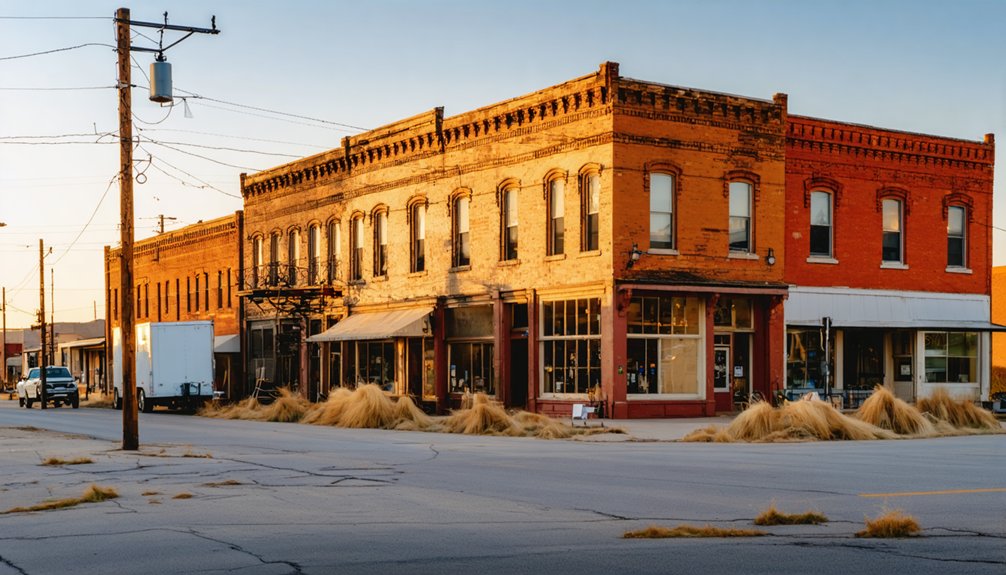
When you walk down Pawhuska’s Kihekah Avenue today, you’re seeing the same street that Martin Scorsese buried under tons of dirt to recreate 1920s Fairfax for his 2023 film starring Leonardo DiCaprio and Robert De Niro.
The production gutted storefronts between 6th and 8th Streets, installing period-accurate facades on buildings like the 1914 Oklahoma Hotel and converting the Big Rain Gallery into a dance studio.
This five-month transformation marks Oklahoma’s largest motion picture production, with Pawhuska’s preserved downtown architecture standing in for its neighboring Osage County town.
Dressing as Historic Fairfax
Although Fairfax’s own historic downtown remained available, filmmakers selected Pawhuska’s Main Street as their primary canvas for recreating 1920s Osage County. You’ll notice how several tons of dirt covered Kihekah Avenue’s pavement, transforming modern roads into period-accurate thoroughfares.
The production dressed multiple structures to capture Fairfax’s oil-boom heyday:
Meanwhile, actual Fairfax locations like Water Bird Gallery became Shoun Brothers’ doctors’ offices, with set dressings still visible in windows today.
This modern preservation approach honored cultural heritage while creating Oklahoma’s largest motion picture production, balancing 2020 development plans with historic authenticity requirements.
Scorsese’s 2023 Film Production
The production’s local economic impact reached unprecedented levels—75,000 COVID tests processed on-site prevented shutdowns, while restricted Main Street access during shoots integrated with community excitement.
Producer Daniel Lupi’s preference for real locations over soundstages meant Pawhuska functioned as the production hub, contributing to Oklahoma’s $100 million in crew wages across 669 statewide production days.
Osage County Authenticity Captured
For Martin Scorsese’s *Killers of the Flower Moon*, Pawhuska’s Kihekah Avenue underwent a complete physical transformation that erased decades of modern development. You’d witness storefronts buried behind 1920s-era facades, streets covered in authentic dirt, and nightlife venues converted into period-appropriate commercial structures.
This $200 million production—Oklahoma’s largest—spent five months reconstructing historical Fairfax architecture.
The transformation included:
Modern architecture disappeared beneath dilapidated blocks designed to replicate downtown Fairfax’s 1920s appearance, creating an immersive experience where contemporary Osage Nation land merged seamlessly with historically accurate period construction.
Picher Mining Town’s Potential as a Desolate Backdrop
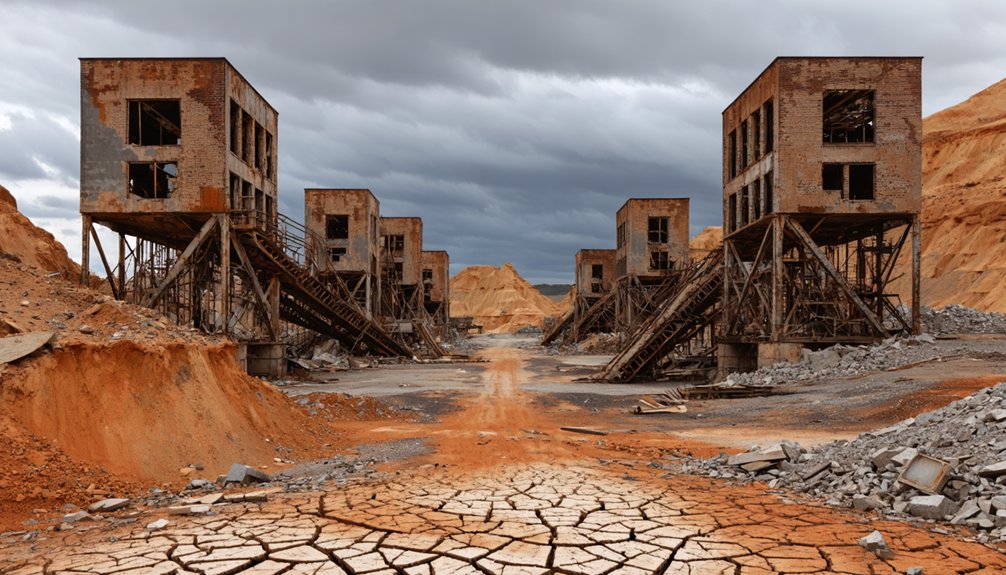
When filmmakers scout locations for dystopian or post-apocalyptic productions, Picher’s authentic devastation eliminates the need for expensive set construction. You’ll find 86% of remaining structures teetering toward collapse, creating genuine tension without special effects.
The environmental decay speaks for itself—mountainous chat piles from 248 mills dominate the horizon, while 14,000 abandoned mineshafts riddle the underground, generating spontaneous sinkholes across the townscape.
Mining hazards transformed this EPA Superfund site into a cinematographer’s dream for desolation aesthetics. Since Gary Linderman’s death in 2015 marked complete abandonment, you’ve got unrestricted access to crumbling infrastructure, contaminated waterways, and toxic tailings without traversing residential complications.
Federal buyouts cleared the population, leaving deteriorating buildings against industrial wastelands—no permits for crowd control, just raw footage of genuine post-industrial collapse.
Osage County’s Prairie Landscapes and Abandoned Remnants
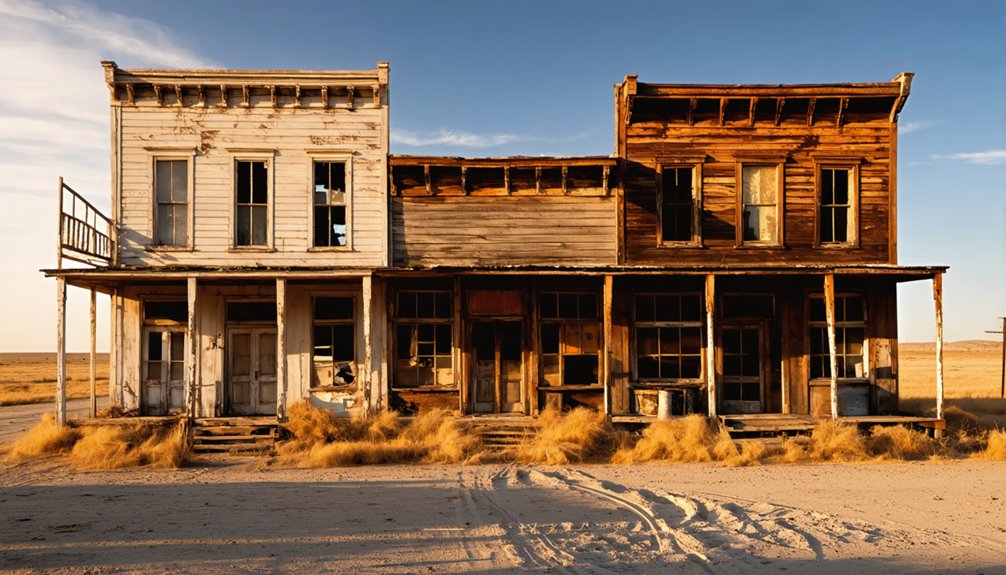
Rolling across 2,300 square miles of tallgrass prairie, Osage County delivers cinematographers five distinct ghost town locations within a 40-mile radius—each offering variations on abandonment aesthetics against undulating grasslands.
Osage County concentrates five ghost towns within 40 miles, each offering distinct abandonment aesthetics across sweeping tallgrass prairie.
Production-ready locations include:
Foraker (population 18) and Grainola (population 31) persist as incorporated towns with authentic abandoned structures blending into open terrain.
Wildflower blooms transform these settings seasonally, while sunset horizons create dramatic lighting across wide-open backdrops. You’ll find unrestricted access to prairie landscapes that frame oil-boom remnants without modern intrusions—perfect for period pieces requiring authentic rural isolation.
Terlton and Northeast Oklahoma’s Authentic Rural Settings
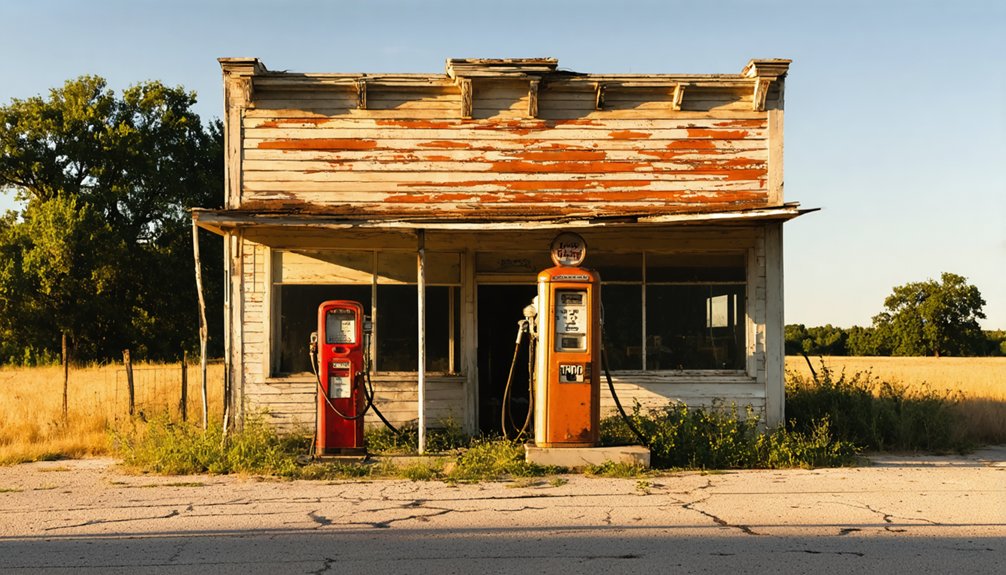
You’ll find Terlton’s ghost town remnants along House Creek in Pawnee County, where the FX series *Reservation Dogs* captured northeast Oklahoma’s rural authenticity starting in 2021.
The production team selected nearby Okmulgee’s abandoned structures—including the building at 701 W 6th Street for hideout scenes and 1506 Creek Pl for Bear’s house—to portray Midwestern small-town life with geographical precision.
These locations sit within 30 miles of each other, offering filmmakers concentrated access to deteriorating railway-era architecture and authentic agricultural landscapes that defined the region’s wheat and corn farming economy.
Terlton’s Reservation Dogs Filming
The collaboration between property owners and filmmakers generated economic opportunities while maintaining Oklahoma’s untamed character across all three seasons.
Regional Abandoned Structure Access
Rural authenticity drives location selection across the region. West 4th Street’s abandoned buildings near Interstate 40 provide desert-like environments mimicking reservation struggles.
You can access these filming sites via county roads and interstate highways, where structures remain untouched. Production crews capitalize on Northeast Oklahoma’s spread-out geography, utilizing genuine abandonment rather than constructed sets for maximum visual impact.
Historic Cemeteries and Cultural Sites in Film Production
Oklahoma’s ghost towns preserve cemeteries and cultural landmarks that double as atmospheric filming locations, offering production crews ready-made historic settings without extensive set construction.
Spring Creek Cemetery anchors explorations alongside abandoned schools and churches, creating isolated backdrops where haunted legends naturally emerge from decades of neglect.
You’ll find these sites require minimal cemetery restoration before cameras roll, as weathered headstones and overgrown paths already evoke period authenticity.
Cultural filming extends beyond graveyards to preserved structures:
These locations give you unscripted atmosphere—no permits for fictional sets needed.
Tallgrass Prairie Preserve’s 11,000 Acres of Cinematic Isolation
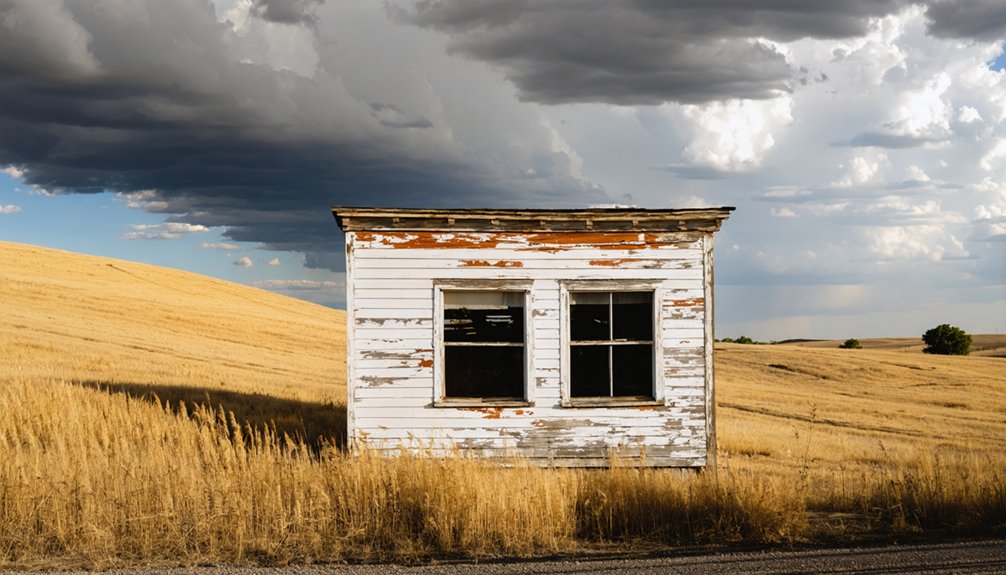
Beyond the weathered structures and cemetery plots, production scouts seeking uninterrupted horizons find 39,650 acres of protected tallgrass at The Nature Conservancy’s preserve in Osage County—the world’s largest remaining tract of its kind.
You’ll access this 61-square-mile canvas via country roads through Pawhuska, where native wildlife including 2,500 free-roaming bison creates authentic frontier atmosphere without CGI budgets.
The preserve’s patch-burn management maintains visual diversity—charred earth shifting to shoulder-high grasses that ripple like ocean swells. Ecosystem preservation work ensures 755 plant species and 300 bird varieties populate frames naturally.
Production teams utilize the 50-mile scenic loop for tracking shots, while 11,000 cattle-grazed acres provide period-appropriate agricultural backdrops.
No permits navigate government bureaucracy since private funding maintains operations, streamlining location agreements for crews requiring absolute remoteness.
Abandoned Structures Throughout Oklahoma’s Film Regions
Production scouts exploring Oklahoma’s film regions encounter layered strata of abandonment—from reservation-era structures documenting Indigenous community hardships to mid-century drive-in theaters frozen along Historic Route 66. These rustic facades provide authentic backdrops without constructed sets.
Oklahoma’s forgotten structures—spanning Indigenous histories to Route 66 nostalgia—deliver raw, unfiltered authenticity that production designers spend fortunes attempting to replicate.
Key filming locations include:
Oklahoma City’s West 4th Street presents urban decay within three miles of downtown.
Meanwhile, historic landmarks like the 1894 Pawnee Dry Goods Co. building and Sand Springs’ inactive Discoveryland amphitheater provide diverse architectural periods for unrestricted creative exploration.
Frequently Asked Questions
What Permits Are Required to Film in Oklahoma Ghost Towns?
You’ll navigate mountains of paperwork for ghost town permits: secure local community approval first, then state filming permits, liability insurance, and historical preservation clearances if applicable. Private property owners control access, so you’ll need signed location agreements guaranteeing your creative freedom.
How Do Filmmakers Ensure Safety in Abandoned Buildings During Production?
You’ll conduct thorough hazard assessments before filming, identifying structural weaknesses and environmental dangers. Then you’ll implement all-encompassing safety protocols including PPE requirements, restricted zones, emergency procedures, and on-site safety officers who monitor compliance throughout production.
Are Ghost Town Filming Locations Open to Public Visits?
You’ll find weathered storefronts and dusty streets wide open—most Oklahoma ghost town film sites welcome visitors freely. Historical preservation efforts and local community impact mean places like Pawhuska, Gray Horse, and Wakita remain accessible for your exploration year-round.
What Tax Incentives Does Oklahoma Offer for Filming Productions?
You’ll get a 20-30% cash rebate on qualified expenses including costume design and stunt coordination. Oklahoma requires $50,000 minimum spend, offers rural location uplifts, and provides additional incentives for multi-film deals and local post-production work.
How Long Does It Take to Transform Locations for Period Films?
You’ll find transformations take days to weeks—Pawhuska’s second floor converted quickly for historical accuracy. Preservation challenges minimize in ghost towns since existing structures need light dressing. Minimal alterations respect your location’s authenticity while achieving period-perfect visuals efficiently.