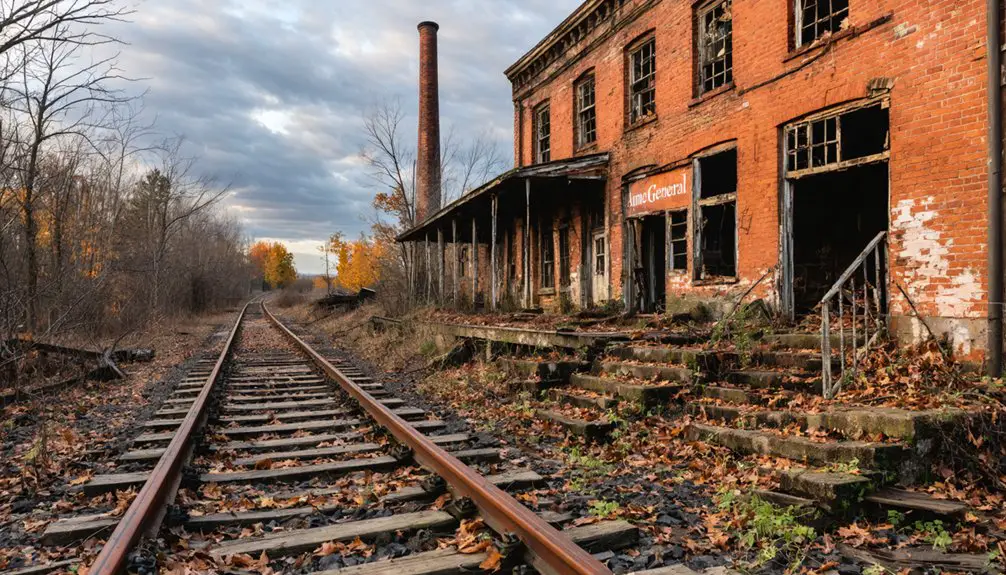
You’ll find Pennsylvania’s most authentic ghost town film locations at Eckley Miners’ Village, where preserved coal breakers and company stores from the 1850s served as the backdrop for “The Molly Maguires,” and at Nemacolin’s abandoned slate dumps, transformed into post-apocalyptic scenes with volunteer extras. Evans City Cemetery launched zombie cinema with “Night of the Living Dead” in 1968, while the abandoned Pennsylvania Turnpike near Breezewood offers 13 miles of overgrown tunnels and decaying infrastructure that filmmakers use for dystopian narratives with minimal set dressing—each location revealing how industrial decay becomes cinematic gold.
Key Takeaways
- Greene County’s mining ghost town serves as a dystopian cinema backdrop with minimal alteration required for authentic post-apocalyptic filming.
- Eckley Miners’ Village, preserved since “The Molly Maguires,” functions as both museum and filming location with original coal-era structures.
- Evans City Cemetery gained fame from “Night of the Living Dead” and spawned Pittsburgh’s Horror Film Trail tourism initiative.
- Nemacolin’s abandoned slate dumps and 1780s castle provide post-apocalyptic and period-appropriate settings for paranormal films.
- Abandoned Pennsylvania Turnpike near Breezewood offers overgrown tunnels and decaying infrastructure ideal for dystopian productions since 1968.
Evans City Cemetery: The Birthplace of Zombie Horror Cinema
Nestled in Butler County near Pittsburgh, Evans City Cemetery became an unlikely landmark in horror cinema history when director George A. Romero filmed “Night of the Living Dead’s” opening scenes here in 1968.
George A. Romero’s 1968 horror masterpiece found its perfect opening backdrop in this unassuming Pennsylvania cemetery near Pittsburgh.
You’ll find the Nicholas Kramer gravestone where the iconic line “They’re coming to get you, Barbra” was delivered, transforming ordinary grave symbolism into cultural touchstones.
The cemetery’s chapel faced demolition in 2011, but fans raised $50,000 for historical preservation, with Romero reopening it in 2014.
Incorporated in 1891, the grounds hold Civil War veterans marked by Grand Army of the Republic stars.
Today, you can walk these filming locations freely, exploring the exact spots where Romero’s $144,000 independent film redefined zombie horror and grossed over $30 million.
Despite environmental growth over the decades, including taller trees and minor terrain alterations, the area remains largely recognizable to film devotees.
The cemetery is located off Franklin Road, just south of Evans City, and remains open daily from dawn till dusk for visitors who want to experience this piece of horror film history.
Jim Thorpe: Where Coal Mining History Meets Hollywood Drama
While Evans City Cemetery’s horror legacy draws fans to a single location, Jim Thorpe spreads its cinematic appeal across an entire Victorian town preserved by economic collapse.
You’ll find filmmakers drawn to its authentic coal heritage, where abandoned mines and industrial remnants create ready-made sets without construction costs.
The town’s Victorian architecture—Italianate mansions, Second Empire facades, Queen Anne details—survived the Great Depression’s neglect, providing directors with genuine 19th-century backdrops along Broadway’s “Millionaire’s Row.”
You can walk streets where gravity railroads once transported anthracite, now doubling as period-accurate film locations.
The surrounding Lehigh Gorge’s steep ridges frame shots with dramatic elevation changes that earned the area its “Switzerland of America” nickname.
Production teams exploit these preserved transportation innovations and coal-era structures, transforming historical authenticity into cinematic atmosphere.
Behind the picturesque facades lies a darker history of the Molly Maguires, the secret Irish-American organization whose violent labor struggles against coal mine operators left an indelible mark on the region’s identity.
The town itself took its current name in 1954, rebranding from Mauch Chunk to honor the legendary athlete whose remains were interred here despite his lack of connection to the area.
Nemacolin: From Union Tragedy to Post-Apocalyptic Wasteland
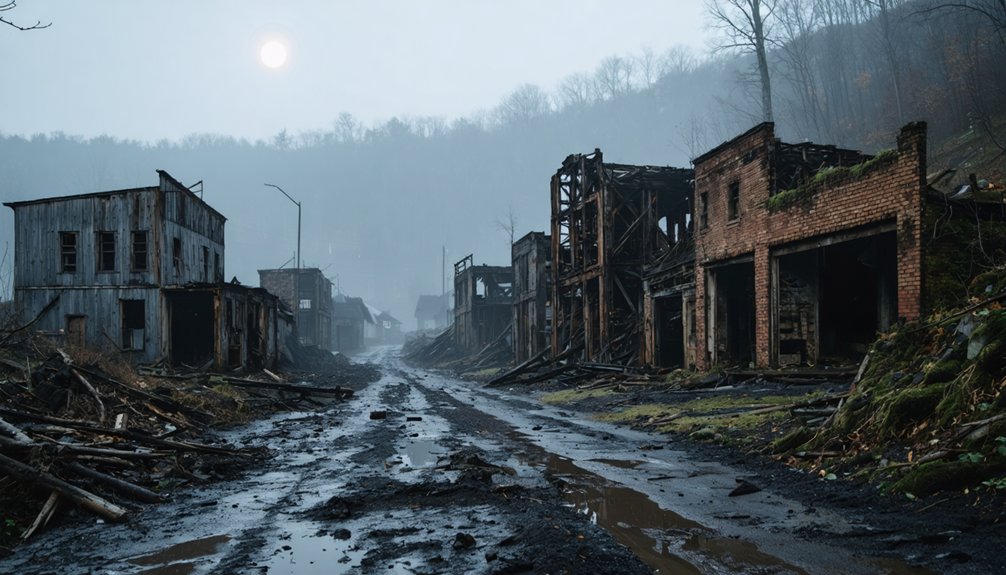
You’ll find Nemacolin’s abandoned slate dumps transformed into convincing post-apocalyptic terrain, where filmmakers captured scenes of desolation against gray rock piles and crumbling infrastructure.
The production recruited local volunteers as extras, positioning them throughout the former mining site to populate the wasteland narrative.
Directors chose this location specifically for its union murder backstory, which added authentic tension to scenes depicting societal collapse.
The castle’s shadow figures and apparitions have been documented by paranormal investigators since its conversion to a museum in 1975, adding another layer of eerie atmosphere to the filming location. The mansion’s interior features low ceilings and rough beams from its 1780s origins as a trading post, creating an authentically aged backdrop for period scenes.
Union Murder Story Filming
The Nemacolin coal mine transformed into a stark filming location for Tredd Production’s union murder story, which documented the assassination of Joseph Yablonski and his family—a tragedy rooted in Pennsylvania’s violent labor conflicts.
You’ll find that production crews utilized the mine’s authentic structures and downtown Waynesburg’s historic courthouse on High Street to recreate these documented events. The film captured Pennsylvania’s mining heritage during industrial decline, with labor disputes providing the narrative foundation.
Tredd Production compressed filming just months after completing “A Jury of His Peers,” maximizing regional infrastructure across Greene County. The coal mine’s remaining buildings offered visceral authenticity—industrial decay that served both historical documentation and cinematic storytelling. Charles Bronson and Ellen Burstyn headlined the production alongside local fire trucks and community members who participated as extras.
This location choice preserved visual evidence of extraction operations while depicting union-era violence that defined the region’s working-class struggles. The filming site now sits near modern-day Nemacolin resort, positioned in the Allegheny mountains of southwestern Pennsylvania.
Local Volunteers as Extras
Production crews for *Act of Vengeance* recruited Nemacolin’s Volunteer Fire Department to supply functional fire trucks as on-screen props, establishing immediate community engagement in the 1986 filming.
You’ll find this practical approach extended to casting locals as extras in coal mine sequences, where their familiarity with mining culture enhanced authenticity without studio constraints. The volunteer contributions weren’t orchestrated through casting agencies—residents simply stepped into frame, bringing lived experience to union tragedy depictions.
Fire department equipment rolled directly from service into scenes, eliminating costly rentals while grounding the production in genuine regional context.
This grassroots collaboration allowed filmmakers to capture Nemacolin’s industrial reality through people who understood its weight firsthand, creating documentary-like texture that polished actors couldn’t replicate in the Joseph Yablonski story. The transformation from 1970s hunting lodge to resort destination came later, when the property was purchased at auction in 1987 and redeveloped into the luxury destination it is today. The resort now sits on land that was originally Native American territory, marked by cultural statues and native-themed elements throughout the property.
Post-Apocalyptic Slate Dump Scene
The slate dump’s industrial decay required minimal production alteration—its scarred terrain and skeletal mining structures already resembled civilization’s collapse.
You can still spot this landmark from surrounding vantage points, where Greene County’s mining ghost remains preserved as dystopian cinema.
Few original buildings stand, yet the dump’s eerie atmosphere continues attracting location scouts seeking genuine apocalyptic backdrops without Hollywood fabrication.
Waynesburg: A Hub for Horror and Paranormal Productions
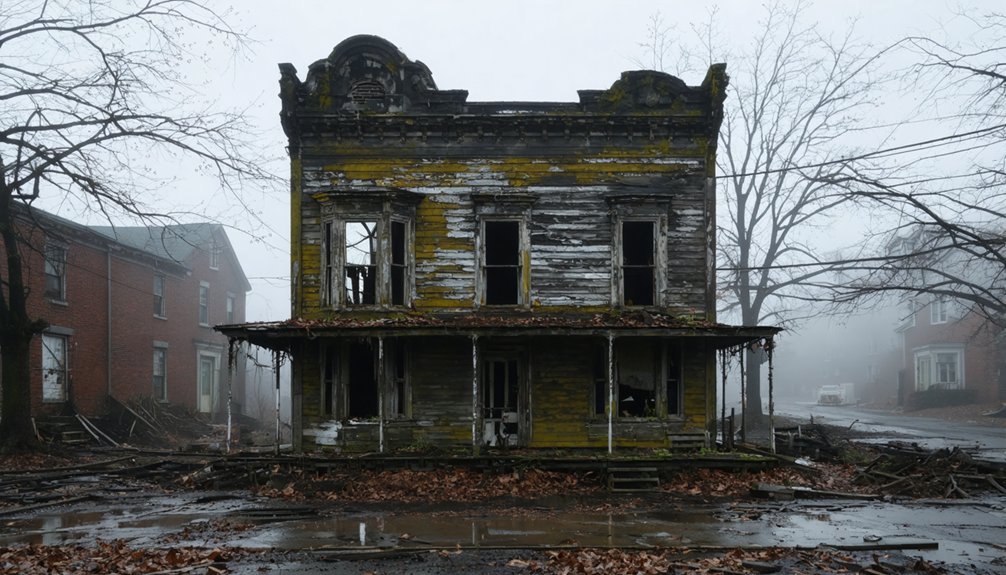
Nestled in the rolling hills of Greene County, Waynesburg has emerged as an unexpected filming destination for paranormal investigators and horror filmmakers seeking authentic small-town atmospheres.
Travel Channel’s *Destination Fear* and *Kindred Spirits* transformed the Greene County Historical Society Museum into haunted tourism content in 2021, showcasing paranormal investigations led by Dakota Laden’s crew.
The Greene County Historical Society Museum became a paranormal hotspot when Dakota Laden’s investigation crews descended in 2021.
Horror productions followed suit—*Severe Injuries* (2003) depicted a sorority house stalked by an inept serial killer, while *Razor Days* (2012) tracked three women hunting cannibalistic warriors through town.
Science fiction entered the mix when *Night Zero* filmed survival scenes throughout Waynesburg in 2017, documenting three couples escaping an alien chemical attack.
These productions capitalize on Waynesburg’s genuine small-town architecture and willing local extras, establishing the borough as Pennsylvania’s emerging hub for independent thriller content.
Brownsville: Small Town Transformed Into Fictional Crime Scenes
While Waynesburg captures paranormal and horror productions through its preserved architecture, Brownsville’s filming reputation stems from its adaptable industrial landscape that filmmakers reshape into multiple fictional crime scenes and period settings.
You’ll find the Flatiron Building and deteriorating banks creating an “American rust feel” that transforms into 1890s Philadelphia for the “Hershey” biopic or 1976 Rust Belt laboratories in “The Abomination of Frankenstein.”
The borough building’s old jail, Fiddle’s Diner’s checkered floors, and abandoned mine structures provide filmmakers authentic backdrops without Hollywood pretense.
This town revival through historical nostalgia attracts productions seeking genuine decay—the 1913 Brownsville Bridge spanning the Monongahela appears in Netflix’s “I Am Not Okay With This,” while 208 Bank Street housed “Maria’s Lovers.”
Location scouts value your freedom to explore eight filming sites representing four different cities simultaneously.
Old Allegheny County Jail: Pittsburgh’s Prison Turned Serial Killer Set
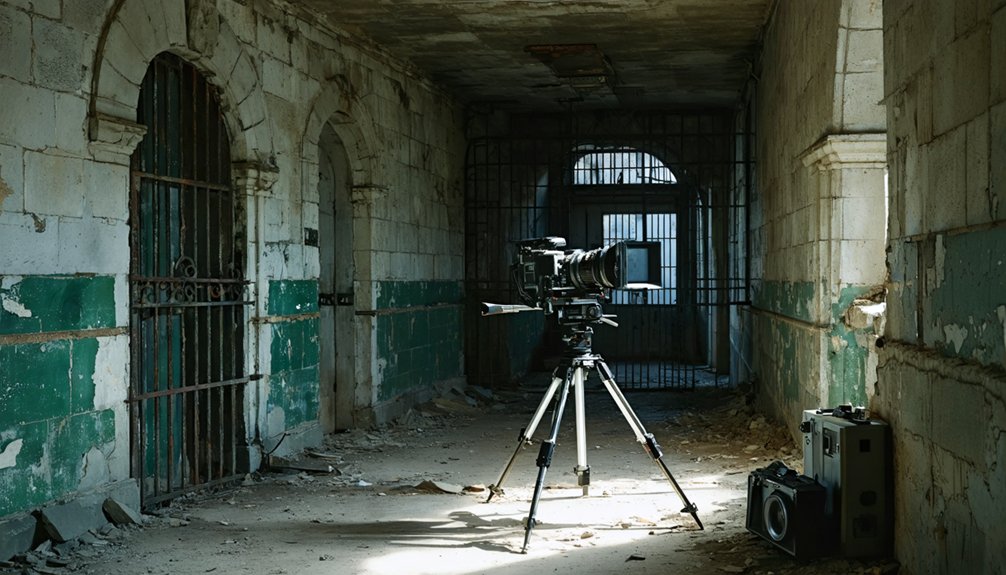
Since its 1886 completion, Henry Hobson Richardson’s fortress-like jail at 440 Ross Street has evolved from functional prison to preserved crime drama backdrop. You’ll recognize this National Historic Landmark’s distinctive arches from *The Silence of the Lambs*, where Clarice Starling approached Hannibal Lecter’s cell.
The Norcross Brothers construction closed in 1995, transforming into haunted prison tours and museum spaces showcasing historical architecture.
Your filming exploration includes:
- *Mrs. Soffel* (1984): Three-day shoot with actual prisoners as extras
- *The Next Three Days* (2010): Russell Crowe’s jailbreak thriller
- *John Q.* (2002): Downtown chase sequences
- Bridge of Sighs connecting to Allegheny County Courthouse
- Self-guided museum tours first and third Mondays, 11:30 am-1:00 pm
- Ray’s Hill Tunnel’s single-lane darkness frames the feral road gang’s emergence
- Human skulls on spears mark the tunnel’s apocalyptic entrance
- Post-production bleached surrounding greenery to dystopian grey
- Nearby unopened Route 43 sections provided storm sequences
- Complete vehicle prohibition maintains the site’s eerie authenticity
- Jack eliminates henchmen and corrupt detective Emerson across limestone terraces
- Cash (Robert Duvall) delivers sniper support from elevated positions
- The Zec (Werner Herzog) delivers his chilling Siberian prison monologue
- Raw stone faces and heavy equipment create authentic danger zones
- https://www.visitpa.com/explore/trips-trails/horror-film-trail/pittsburgh-countryside/
- https://uncoveringpa.com/movies-set-in-pennsylvania
- https://visitgreene.org/2023/06/movie-locations/
- https://www.golaurelhighlands.com/blog/stories/post/binge-worthy-films-and-shows-shot-in-the-laurel-highlands/
- https://pabucketlist.com/exploring-the-evans-city-cemetery-in-butler-county-pa/
- https://www.youtube.com/watch?v=uNJN3cliHCw
- https://www.youtube.com/watch?v=krPjncP_d7k
- https://en.wikipedia.org/wiki/Jim_Thorpe
- https://www.americanessence.com/jim-thorpe-a-wealth-of-history-tucked-in-a-charming-small-town_1341.html
- https://www.poconomountains.com/jim-thorpe/
Security screening’s required—cameras aren’t permitted inside this operational court facility.
Washington & Jefferson College: Academic Grounds for Psychological Thrillers
Twenty miles south of Pittsburgh, Washington & Jefferson College‘s 60-acre campus transforms from a liberal arts institution into a psychological thriller backdrop through its 19th-century architecture and Gothic Revival elements.
You’ll find Netflix’s “Mindhunter” and “The Chair” utilized Old Main’s twin towers and classical facades to establish authentic academic tension.
Campus architecture provided production designers with ready-made period settings without extensive set construction—George Romero shot “The Dark Half” in Old Main’s Pastor’s Study, while Sandra Oh navigated department politics through Swanson Science Center and Lazear Hall.
Filming logistics kept crews away from active classrooms, positioning equipment on South College Street and East Wheeling Street.
The college’s established Netflix relationship and strategic building selection meant productions captured atmospheric Gothic elements while students maintained normal operations—no institutional lockdowns required.
Abandoned Pennsylvania Turnpike: The Perfect End-of-World Highway
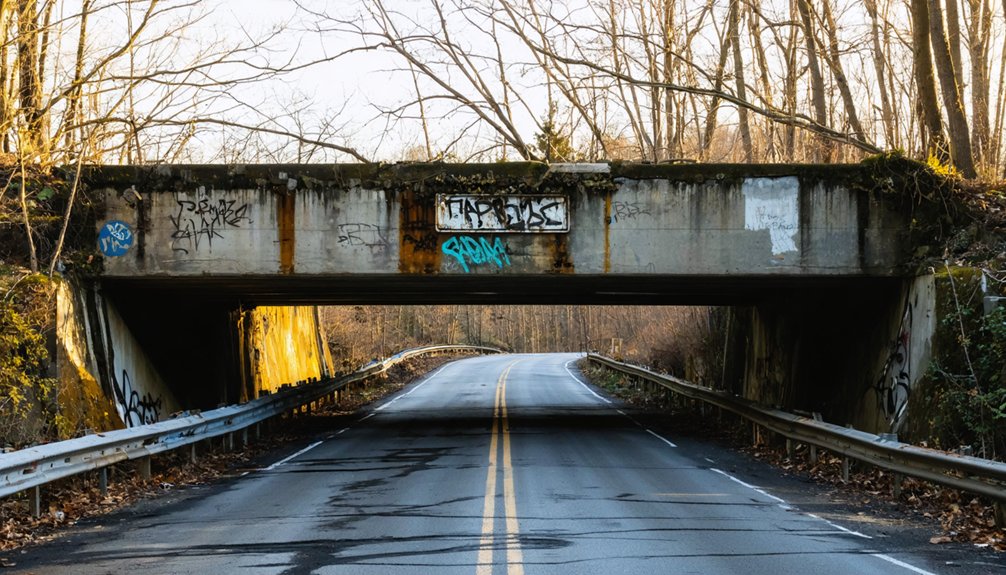
You’ll find a 13-mile stretch of abandoned highway near Breezewood that became the backbone of 2009’s “The Road,” starring Viggo Mortensen steering through a post-apocalyptic America.
The production team selected this derelict turnpike section—closed since 1968 and left to decay—for its authentically desolate appearance, requiring minimal set dressing to portray civilization’s collapse.
Rays Hill Tunnel received only mild exterior restoration before cameras rolled, capturing the crumbling concrete and overgrown asphalt that perfectly embodied the film’s end-of-world narrative.
Featured in “The Road”
The 2009 film adaptation of Cormac McCarthy’s “The Road” found its perfect post-apocalyptic setting in an eight-mile stretch of the Abandoned Pennsylvania Turnpike near Breezewood. This unmaintained section, closed since 1968, provided authentic urban decay without artificial set design.
The state’s deal gave filmmakers access to thirteen miles of derelict highway, where historic preservation took a backseat to nature’s reclamation.
Key filming elements transformed this location:
Now managed by the Nature Conservancy as hiking trails, you’ll find this atmospheric location couple miles northeast of Breezewood, PA 15533.
Post-Apocalyptic Film Setting
Since its 1968 closure, this eight-and-a-half-mile stretch of America’s first superhighway has evolved into filmmakers’ blueprint for civilization’s collapse.
You’ll find overgrown infrastructure breaking through concrete lanes, nature reclaiming what humanity abandoned. The two tunnels—Rays Hill at 0.7 miles and Sideling Hill at 1.3 miles—deliver total darkness and isolation.
These abandoned tunnels feature silent ventilation fans untouched for five decades, dripping interiors, and graffiti-marked walls that enhance dystopian visuals.
Filmmakers access three entry points: Tannery Road near Breezewood, Pump Station Road at the eastern terminus, or the less-crowded middle access between tunnels.
You’re entering on an “at your own risk” basis, exploring broken pavement, empty service plazas, and debris-strewn shoulders that authentically mirror post-collapse America without artificial set construction.
Hoover Stone Quarry: Saltsburg’s Action-Packed Showdown Location
Nestled 30 miles east of Pittsburgh along Pennsylvania Route 981, Hoover Stone Quarry transforms from a working limestone operation into Jack Reacher’s climactic battleground.
This family-owned site at 150 Moween Road has maintained limestone production since 1953, serving builders and landscapers before Hollywood discovered its dramatic potential.
The quarry’s industrial landscape provides the perfect backdrop for Reacher’s final confrontation:
Quarry safety protocols were suspended for controlled filming sequences.
You’ll find this location by following PA-66 East through Delmont, then turning onto Sandy Hill Road before reaching Moween Road.
The Lasting Impact of Pennsylvania Ghost Towns on American Cinema
Beyond their roles as atmospheric backdrops, Pennsylvania’s abandoned industrial sites have fundamentally altered how filmmakers approach authentic storytelling—and in some cases, they’ve reversed the fate of entire communities.
Pennsylvania’s decaying factories and mines haven’t just provided film settings—they’ve become unexpected engines of community revival and cultural memory.
Eckley Miners’ Village exemplifies this transformation: “The Molly Maguires” filming saved the 1800s ghost town from demolition, with movie-built props like the wooden coal breaker and company store still standing after 50 years.
The site now operates as a Pennsylvania Historical and Museum Commission museum, attracting visitors who explore preservation through cinema.
Evans City Cemetery achieved horror landmark status through Romero’s “Night of the Living Dead,” spawning the Pittsburgh Horror Film Trail‘s three-day itineraries.
These locations demonstrate how filming transforms urban decay into cultural preservation tools, generating tourism revenue while embedding community history into American cinema’s permanent record through streaming platforms and self-guided tours.
Frequently Asked Questions
Can Tourists Visit the Actual Filming Locations Mentioned in These Movies?
You’ll find most filming locations accessible through abandoned site preservation efforts, though you’ll need filming permission procedures if shooting your own footage. Evans City Cemetery, Eckley Miners’ Village, and Old Allegheny County Jail welcome visitors exploring iconic movie scenes independently.
Are Any of These Filming Locations Reportedly Haunted in Real Life?
Picture shadowy corridors and moonlit gravestones—you’ll find genuine haunted legends at these locations. Old Allegheny County Jail reports ghost sightings from former inmates, while Greene County Historical Society Museum earned recognition as one of America’s most-haunted sites by Travel Channel.
In addition to these chilling tales, the history of corydon ghost town offers a rich backdrop of eerie encounters and forgotten stories. Visitors often share experiences of strange noises and fleeting shadows as they explore the remnants of this once-thriving settlement. Many believers in the supernatural consider it one of the must-visit spots for ghost enthusiasts eager to uncover its haunted past.
What Permits Are Required to Film at Abandoned Locations in Pennsylvania?
You’ll need property owner permission first, then follow local filming regulations based on your crew size and equipment. The permit application process varies by region—contact your local film commission since abandoned sites often have unclear ownership requiring extra research.
How Do Local Communities Benefit Economically From Movie Productions?
Picture money raining onto deserted main streets while film crews invade. You’ll witness economic impact through immediate job creation, vendor contracts, and hospitality revenue. Community involvement transforms abandoned properties into tourist attractions, generating sustainable income long after production wraps.
Which Pennsylvania Filming Location Has Appeared in the Most Movies?
Based on the information provided, you’ll find Nemacolin Coal Areas has appeared in multiple films, showing the film industry impact on historical preservation through “The Road,” the Yablonski story, and “Severe Injuries,” making it the most frequently used location.