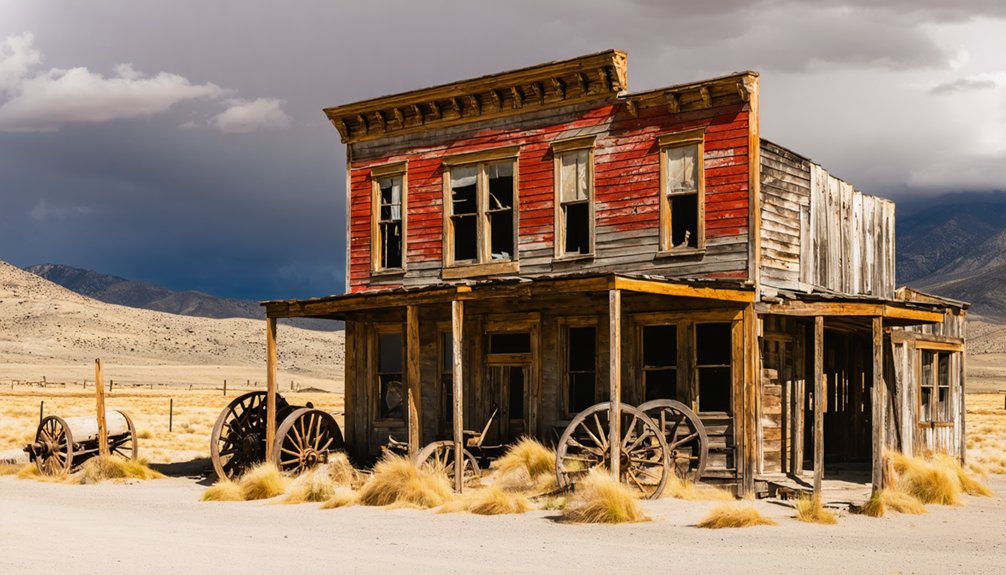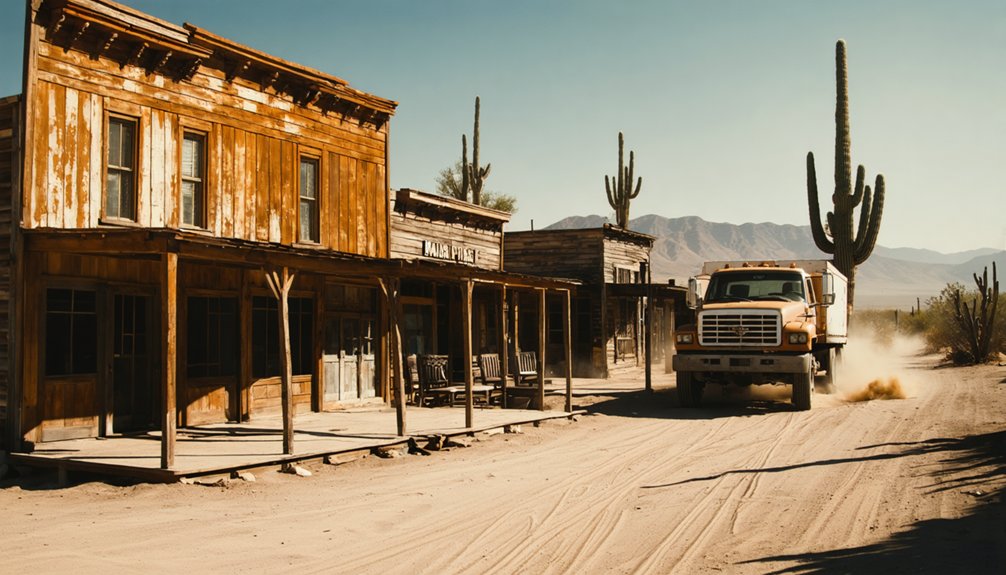
You’ll discover authentic filming locations like Grafton, Utah—where *Butch Cassidy and the Sundance Kid*’s iconic bicycle scene was shot—along with Arizona’s Goldfield Ghost Town and California’s Cerro Gordo near Alabama Hills. These sites feature period-appropriate structures from the 1890s, including mining headframes, original saloons, and brick schoolhouses set against dramatic red rock formations and desert backdrops. Accessibility varies from free public access at Grafton to tourist-oriented operations at Goldfield, with permitting requirements depending on jurisdiction. Below, you’ll find detailed logistics on infrastructure, preservation challenges, and site-specific filming considerations.
Key Takeaways
- Grafton, Utah featured the iconic bicycle scene in *Butch Cassidy and the Sundance Kid* and remains the most photographed ghost town.
- Cerro Gordo, California has served as a filming location for over 11 productions since the 1920s at 8,500 feet elevation.
- Arizona’s Goldfield Ghost Town, built in 1984, provides period-authentic structures for both filming and tourist activities.
- Alabama Hills offers iconic Western scenery with easy accessibility and temporary filming infrastructure for productions.
- Nevada’s Goldfield and Rhyolite ghost towns feature architectural decay that creates authentic backdrops for desert Southwest films.
Notable Desert Southwest Ghost Towns Featured in Film and Television
When scouting authentic Western backdrops, filmmakers have transformed several Desert Southwest ghost towns into recurring production sites that blend historical ruins with purpose-built movie infrastructure.
You’ll find Pahreah in Utah’s Grand Staircase-Escalante National Monument, where *The Outlaw Josey Wales* utilized 1870s structures alongside constructed sets. The region’s dry climate has helped preserve these filming locations and historic structures with minimal deterioration over decades. Arizona’s Goldfield Ghost Town operates as a commercial venture 40 miles east of Phoenix, offering mine tours and purpose-built filming locations like the Mammoth Steakhouse.
California’s Cerro Gordo near Lone Pine has anchored 11 productions since the 1920s, with specific coordinates marking sites for *Tremors* and other films. Utah’s Grafton Ghost Town, most photographed ghost town in the West, gained fame through appearances in *Butch Cassidy and the Sundance Kid* and has been preserved since 1997 by the Grafton Heritage Partnership.
The ghost towns of the desert southwest offer a unique glimpse into the past, showcasing the remnants of once-thriving communities. Many of these sites, like Bodie in California and Goldfield in Nevada, have become popular destinations for history enthusiasts and photographers alike. Visitors are often intrigued by the stories of the miners and families who once called these barren lands home.
These locations balance historical preservation with production demands, though environmental impact remains a consideration when crews establish temporary infrastructure like the tent city near Alabama Hills’ Movie Road.
Grafton, Utah: A Filming Icon Near Zion National Park
You’ll find Grafton nine miles east of Rockville via Bridge Road, where dramatic red rock formations frame preserved brick structures from the 1860s.
The townsite gained fame as a filming location after its 1946 purchase by producer Harry Sherman, especially appearing in the iconic bicycle scene from *Butch Cassidy and the Sundance Kid*.
Access remains free through a donation system, allowing you to photograph the restored church and three remaining homes that made this the most photographed ghost town in the West.
Mormon settlers first established the town in 1859 with hopes of cotton cultivation, though the Virgin River’s devastating 1862 flood completely submerged the settlement and forced residents to shift their agricultural focus. The settlement name references Grafton, Massachusetts, reflecting the New England origins of some early Mormon pioneers.
Classic Western Film Heritage
Nestled against the dramatic red rock backdrop near Virgin, Utah, Grafton Ghost Town stands as the most photographed ghost town in the American West and a cornerstone of classic Western cinema.
You’ll discover authentic 1860s pioneer architecture that’s anchored Wild West films since 1929, with its cinematic heritage cemented when Paul Newman and Robert Redford filmed “Butch Cassidy and the Sundance Kid” here in 1969.
Robert Redford’s two production visits transformed Grafton’s abandoned buildings and river views into iconic silver screen moments that launched Utah’s film reputation.
You can trace these filming paths just 225 miles from other Butch Cassidy locations near Zion National Park and Springdale.
The preserved settlement offers you unscripted exploration of authentic desert Southwest terrain where Hollywood’s Western legacy meets freedom-seeking adventure.
Grafton’s historic structures also attracted production crews for the classic TV series “Gunsmoke” and other Western productions.
Today’s visitors can walk the same publicly accessible grounds where Newman and Redford rode, with the ghost town remaining open for photography and scenic exploration.
Pristine Schoolhouse Photography Spot
Rising from a lava rock foundation quarried from Grafton’s hillside in 1886, the two-story schoolhouse anchors the ghost town’s photography-perfect landscape with handmade adobe bricks sourced from a clay pit west of the settlement.
You’ll find this structure standing as the most photographed among abandoned structures in the Western U.S., backed by Zion National Park’s massive tan and red walls.
The schoolhouse offers photographic opportunities through:
- Hand-hewn beams hauled 75 miles from Mount Trumbull across the Arizona Strip
- Original adobe walls preserved through Grafton Heritage Partnership restorations since 1997
- Pristine condition contrasting five remaining structures from the original 30+ buildings
Located at 37°10′02″N 113°04′48″W, you’re accessing authentic 1859 settlement architecture without crowds or restrictions. The building’s versatile interior served multiple community functions beyond education, making it central to Grafton’s social fabric until its last teaching session in 1918-19. Historic social events transformed the schoolhouse into a dancing hall venue where community gatherings extended into early morning hours, exemplifying the lively pioneer spirit that defined Grafton’s communal identity.
Free Admission Public Access
Unlike most preserved ghost towns charging entrance fees, Grafton operates as a freely accessible historic site maintained by the Grafton Heritage Partnership since 1997.
You’ll navigate a 3.4-mile dusty, rocky road from Rockville without encountering admission booths or restricted hours. This ghost town accessibility approach mirrors the site’s filming heritage—producers value the unspoiled, unmanicured landscape that’s kept authentic through ongoing agricultural operations on the surrounding 150 acres.
The public attraction management model relies on 24-hour surveillance rather than gates, with caretakers monitoring the four preserved brick structures and cemetery. Descendants hold annual reunions at the site to preserve the community’s history and maintain connections to their pioneering ancestors.
Heavy rains render the clay road impassable, naturally limiting access during adverse conditions.
You’re free to explore this photographed location where Hollywood captured iconic scenes, experiencing the same red rock backdrop that’s drawn filmmakers since 1929.
Goldfield Ghost Town: Arizona’s Living Western Movie Set
At the base of the Superstition Mountains, thirty minutes east of Phoenix, Goldfield Ghost Town occupies a small hill along the historic Apache Trail where Arizona’s most dramatic gold rush erupted in 1892.
Unlike urban preservation projects requiring complex filming permits, you’ll find this reconstructed Wild West set operating as both tourist destination and ready-made filming location.
This reconstructed Wild West set functions as both tourist attraction and filming-ready location without the permit complications of urban historic sites.
Bob Schoose and Lou Ann rebuilt the town starting in 1984, meticulously recreating structures from period photographs.
The site delivers immediate production value through:
- Authentic head frames with giant winches replicating 1890s mining operations
- Period buildings including the Mammoth Saloon, General Store, and working underground mine tunnel
- Original foundations and rickety water tower remnants providing genuine historical texture
You’re accessing a functioning Western town designed for visual authenticity without restrictive access barriers. The location requires no entry fee, with visitors paying only for specific activities, food, or souvenirs they choose to purchase.
Cerro Gordo and Alabama Hills: California’s Blockbuster Backdrop
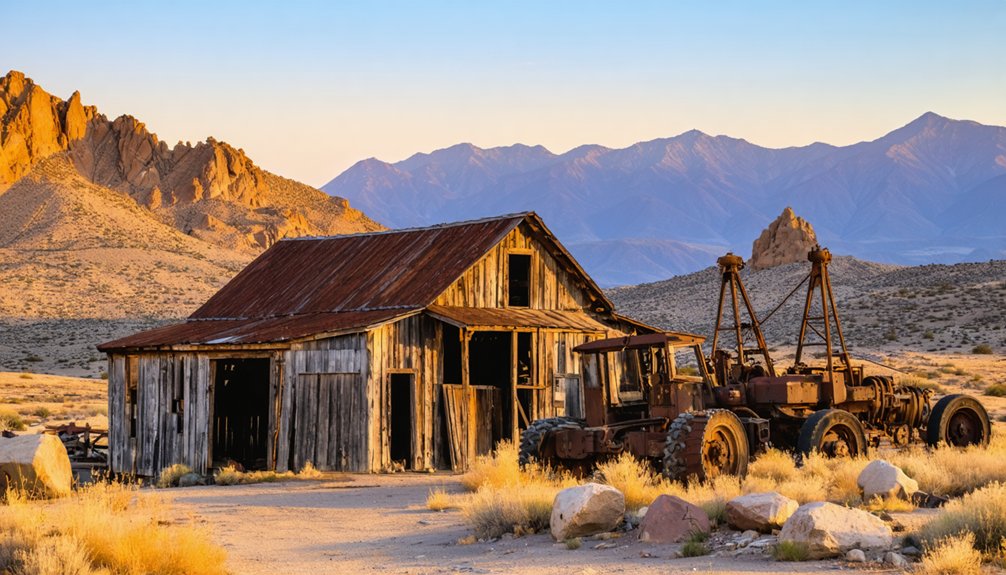
Where Hollywood discovered its most profitable desert filming corridor, Cerro Gordo Ghost Town commands a strategic perch at 8,500 feet in California’s Inyo Mountains, overlooking the alabaster expanse of dried Owens Lake.
You’ll traverse the treacherous Yellow Grade toll road to reach eleven filming locations that’ve hosted blockbusters since the 1920s. The surrounding Alabama Hills—accessible via Cerro Gordo Road through sparse desert flora—provided go-to backdrops for iconic Western productions.
Mining operations extracted silver, lead, and zinc here from 1866 to 1957 before abandonment.
Current owner Brent Underwood purchased the town for $1.4 million in 2018, documenting restoration efforts despite challenges including a 2020 hotel fire and seismic activity threatening century-old structures. Miles of tunnels still crisscross beneath authentic buildings.
Geographic Reach Across the Sonoran and Mojave Deserts
The filming corridor extends far beyond California’s Inyo Mountains, spreading across 54,000 square miles of the Mojave Desert and 100,000 square miles of the Sonoran Desert—two distinct ecosystems that have shaped ghost town preservation and accessibility.
You’ll find production-ready locations spanning three states, each offering unique visual characteristics and logistical advantages:
- Nevada’s Goldfield and Rhyolite deliver authentic architectural decay with urban legends that enhance atmospheric storytelling.
- Arizona’s Goldfield Ghost Town provides controlled tourist infrastructure 40 miles from Phoenix with period-authentic structures.
- California’s Route 66 corridor features Amboy’s photogenic abandonment showcased in fashion editorials and major films.
Preservation challenges vary dramatically—some sites maintain operational saloons like Goodsprings, while others face Joshua tree reclamation at Cima, creating evolving backdrops that filmmakers exploit for authentic Western aesthetics.
From Tourist Attractions to Working Film Sets: Infrastructure Considerations
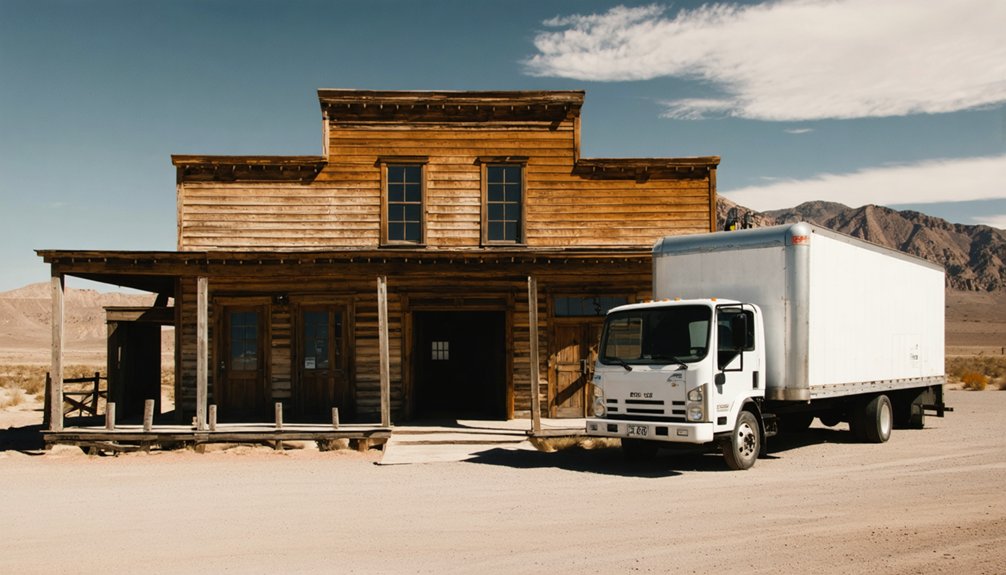
Converting abandoned settlements into commercially viable tourist destinations fundamentally alters their utility as film locations, creating operational conflicts that production companies must navigate carefully.
At Goldfield Ghost Town, every structure houses active businesses—Mammoth Steakhouse, reptile exhibits, wedding chapels—generating revenue that outweighs potential film income. You’ll find infrastructure challenges limiting full-scale productions; while music videos and short films remain feasible, motion pictures requiring extended shutdowns face resistance.
Commercial operations at tourist ghost towns prioritize steady visitor revenue over film production income, making extended shutdowns economically unfeasible.
Visitor management complicates logistics further, as scheduled gunfighter reenactments and $7-$12 exhibit tours can’t easily accommodate crew vehicles and equipment.
Compare this to Cerro Gordo’s rough-road access or Ruby’s forest isolation—both preserved through limited commercial development. For productions seeking authentic ghost town settings without operational interruptions, remote sites like Total Wreck’s standing smelter walls offer unencumbered freedom.
Planning Your Film Production at Desert Ghost Town Locations
You’ll need to contact site operators directly—Grafton Heritage Partnership requires donations for access, while Bannack State Park coordinates full commercial shoots like the 2020 KIA Ghost Town production featuring multiple vehicle models.
Assess your production’s feasibility by evaluating dirt road accessibility (Grafton south of Zion), remote approach routes (Cerro Gordo Road across dry Owens Lake), and jurisdictional requirements like tribal permissions for Navajo Nation locations such as Canyon de Chelly.
Factor in your crew’s proximity to amenities—Lone Pine serves Alabama Hills productions, while Butte and Dillon provide base operations for Southwest Montana’s historic sites with their preserved architecture and wide-open landscapes.
Contacting Ghost Town Operators
When planning a film production at desert ghost town locations, establishing direct contact with site operators becomes your essential first step in securing permits and negotiating filming arrangements.
Ghost town preservation requires respecting visitor access policies while discussing your production needs. You’ll find operators responsive to custom requests through direct communication channels.
Key Contact Methods for Film Production Inquiries:
- Shakespeare Ghost Town – Email visit@shakespeareghostown.com or call (575)-542-9034 to discuss filming at this preserved historic site.
- Vulture City Ghost Town – Reach out via contact@vulturecityghosttown.com or 877-425-9229 for location access near Wickenburg, Arizona.
- Southwest Expeditions – Call 877-808-6877 for customizable arrangements requiring minimum guest coordination.
Phone conversations work best for negotiating specialized filming requirements beyond standard tour schedules.
Assessing Filming Feasibility Factors
Before committing to a desert ghost town location, production managers must evaluate five critical feasibility dimensions that separate successful shoots from logistical nightmares.
Environmental impact assessments address hydration needs in Mars-training-worthy heat and high-altitude challenges above 8,000 feet.
Accessibility determines whether your crew can navigate 120-mile drives like Rhyolite’s or Ruby’s border-adjacent routes through Coronado National Forest.
Structural integrity varies drastically—Bodie’s dozens of intact buildings versus McMillville’s foundations dictate safe interior possibilities.
Filming permits depend on jurisdiction: state parks like Bodie, federal lands surrounding Ruby, or private operations like Vulture City each demand different approvals.
Finally, proven cinematic pedigree matters—locations like Total Wreck (*Hombre*) and Grafton (*Butch Cassidy*) offer visual validation your investors’ll recognize.
Frequently Asked Questions
What Permits Are Required to Film at Desert Southwest Ghost Towns?
You’ll need liability insurance, hold harmless agreements, and location-specific permits from county, state, or BLM offices. Historical preservation requirements differ by site, so expert consultations with local film offices confirm you’re capturing authentic landscapes legally.
Are Overnight Accommodations Available Near Remote Ghost Town Filming Locations?
You’ll find absolutely zero overnight facilities at most remote ghost towns themselves, but nearby communities offer local lodging and camping options. Springdale near Grafton and Apache Junction near Goldfield provide accessible bases for your independent production ventures.
What Weather Conditions Should Production Crews Expect Filming in Desert Ghost Towns?
You’ll face extreme desert heat exceeding 100°F daily, with nighttime drops to 40°F. Sudden dust storms with 50+ mph winds drastically reduce visibility. Expect intense UV exposure, minimal rainfall, and frequent flash flood risks during monsoon season.
Can Ghost Town Filming Locations Provide Electricity and Running Water for Crews?
Need power on location? You’ll find active ghost towns like Old Tucson Studios offer modern utilities, while historical preservation at abandoned sites like Cerro Gordo requires you to bring generators and water trucks for filming logistics.
How Far in Advance Should Filming Dates Be Reserved at Ghost Towns?
You’ll need 3-6 months’ advance notice for ghost town filming permits, allowing time for historic preservation reviews and local community engagement. Popular locations book faster, so contact venues early to secure your preferred dates and coordinate logistics.
References
- https://blarefilms.net/goldfield-ghost-town/
- https://www.youtube.com/watch?v=tZmA_VF6cm8
- https://www.visitutah.com/things-to-do/history-culture/ghost-towns
- https://www.youtube.com/watch?v=DzlJWdyLdr4
- https://www.youtube.com/watch?v=jNEjnzYn9tY
- https://www.atlasobscura.com/itineraries/these-8-arizona-ghost-towns-will-transport-you-to-the-wild-west
- https://en.wikipedia.org/wiki/Eagle_Mountain
- https://visitmarblecanyon.com/nl/ghost-towns-and-old-west-history-near-marble-canyon-arizona/
- https://www.themoviewaffler.com/2015/09/5-iconic-filming-locations-in-american.html
- https://mojaveproject.org/dispatches-item/the-technicolor-desert-cinema-and-the-mojave/