You’ll find authentic ghost town filming locations across the Northeast, from New Jersey’s Hermann City ruins along the Mullica River (featured in *Fallen*) to North Carolina’s Henry River Mill Village, which became District 12 in *The Hunger Games*. These abandoned industrial sites and historic settlements—like Burkittsville, Maryland (*The Blair Witch Project*)—offer weathered architecture, overgrown foundations, and genuine decay that filmmakers prefer over constructed sets. Each location combines documented history with cinematic atmosphere, creating backdrops where real abandonment enhances fictional horror narratives and draws explorers seeking those precise filming coordinates.
Key Takeaways
- Hermann City in New Jersey’s Pine Barrens, abandoned since 1873, served as a filming location for the 1998 horror film *Fallen*.
- Camp NoBeBoSco in Hardwick, New Jersey doubled as Camp Crystal Lake in the original 1980 *Friday the 13th* film production.
- Henry River Mill Village in North Carolina, a former industrial ghost town, became District 12 in *The Hunger Games* film series.
- Abandoned Pine Barrens structures near Hermann City feature brick foundations and glassworks remnants popular with film location scouts and explorers.
- Ghost town filming locations in the Northeast attract tourists but often require access restrictions to prevent vandalism and preserve historic sites.
Camp Nobebosco: the Real Camp Crystal Lake From Friday the 13TH
Tucked along 11 Sand Pond Road in Hardwick, New Jersey, Camp NoBeBoSco sits six miles north of Blairstown as an active 380-acre Boy Scout facility that doubled as the fictional Camp Crystal Lake in the original 1980 *Friday the 13th*.
The camp history dates back to 1927, and filmmakers capitalized on its weathered 1979 appearance for $25,000. Sand Pond served as the lake where Jason drowns, while original cabins hosted iconic death scenes—including Kevin Bacon’s character in Brenda’s cabin.
Tom Savini’s effects team actually bunked on-site during the monthlong 1979 shoot. Among filming secrets: the shower house still contains axes referencing Marcy’s murder scene. The camp entrance is located at 11 Sand Pond Road, marking the exact spot where counselors first arrived in the film.
You’ll need to book periodic Crystal Lake Tours, as this functioning Scout camp restricts public access for youth safety. Tours typically sell out well in advance, so checking availability and signing up early is essential for fans hoping to visit.
Burkittsville: The Blair Witch Project’s Eerie Maryland Setting
The Blair Witch Project’s found-footage technique draws its unsettling power from Burkittsville’s authentic small-town atmosphere—population under a few hundred in 1997—where real residents sat for on-camera interviews alongside unknowing actors during the eight-day October shoot.
You’ll recognize the village’s weathered town sign and historic Burkittsville Union Cemetery at 5 E. Cemetery Dr. Locations that became pilgrimage sites for fans who stole the sign three times after the film’s 1999 release.
The fictional Blair Witch legend‘s connection to these tangible Maryland streets and gravestones transformed the village into a haunted destination 90 minutes from D.C., blurring the line between cinematic horror and the town’s actual 200-year history. The filmmakers’ marketing as truth—promoting the movie as a documentary of real events—amplified the unsettling effect on audiences who questioned what they were watching.
Local residents were so displeased with how the film portrayed their community that they booed the filmmakers when approached about participating in a sequel.
Found-Footage Amplified by Setting
When directors Daniel Myrick and Eduardo Sánchez scouted Maryland’s Frederick County in 1998, they discovered Burkittsville—a historic village of a few hundred residents whose isolation and genuine unease would become inseparable from their film’s authenticity.
You’ll find the raw, handheld camera style gained unprecedented power through these eerie woods and secluded locations.
Real townspeople interviewed alongside actors blurred fiction’s boundary, while Seneca Creek State Park‘s dense trails transformed into the menacing Black Hills Forest.
The crew shot eight days, capturing 20 hours of raw footage across genuine sites—crumbling ruins suggesting urban decay, cemetery headstones under atmospheric lighting, forgotten roads disappearing into wilderness.
This marriage of found-footage technique with Maryland’s authentic locations revolutionized horror filmmaking, proving you don’t need Hollywood sets when reality provides more unsettling backdrops than any studio could manufacture.
The production’s shoestring budget of approximately $35,000 would ultimately yield a staggering $248 million worldwide, making it one of the most profitable independent films ever created.
The filmmakers fabricated the Blair Witch legend itself as a promotional tool, using internet marketing and guerrilla tactics to generate interest and blur the line between documentary and fiction.
Ghost Walks and Haunted Lore
Beyond cinematic technique, *The Blair Witch Project*’s lasting power stems from how it transformed Burkittsville into a pilgrimage site where fans blur the line between movie tourism and genuine paranormal investigation. You’ll find self-guided walks leading to the cemetery at 5 E. Cemetery Dr., where witch legends intertwine with actual gravestones from the film’s backstory.
Cemetery tours extend into surrounding trails—fisherman’s rock, the red shed, abandoned mill ruins—each location amplifying the isolation that made the footage so unsettling. The town sign’s been stolen three times by souvenir hunters.
Combine your visit with Seneca Creek’s Greenway Trail, where most woodland scenes were shot, or venture to Patapsco Valley’s 150-year-old Griggs House ruins. The film’s promotional campaign was so effective that it convinced audiences the actors were missing, adding authenticity to location visits. The tourism surge prompted officials to block alleys in 2016 after persistent vandalism and trespassing incidents. Locals resent the disruption, but nighttime exploration remains accessible for those seeking authentic eerie atmosphere.
Hermann City Area: New Jersey’s Forgotten Film Location Ruins
You’ll find Hermann City’s ruins scattered along the Mullica River in southern New Jersey’s Pine Barrens.
The nearby cabin appeared in the 1998 thriller *Fallen*.
The former hotel site now sits as an empty field marked only by occasional front steps, with flowers emerging each spring from ground that once supported a structure until arson destroyed it in 1987.
Stone foundations and cellar holes from the 1870s glass works community remain hidden in the forest, drawing urban explorers.
These explorers follow YouTube walkthroughs starting at County Route 542 down to the riverbank.
The settlement’s origins trace back to circa 1750, with major expansions occurring in 1840 and 1869 before its eventual conversion into a hotel.
Founded around 1870 as a glass manufacturing town, Hermann City saw its glass works close after just three years of operation in 1873.
Overgrown Hotel Foundation Remains
Although Hermann City’s glassworks operation collapsed after only a few years in the 1870s, the hotel foundation persists as the settlement’s most visible archaeological remnant. You’ll find the overgrown cellar hole in a riverside field, where habitat regeneration has transformed the Koster family’s century-old establishment into a seasonal wildflower meadow.
Winter exploration offers ideal visibility for identifying structural indicators:
- Foundation walls emerging from receded vegetation
- Front steps marking the original entrance
- Sycamore trees and yucca plants defining property boundaries
Archaeological challenges intensify during growing seasons when dense forest vegetation conceals adjacent glassworks ruins.
You can reach this site via County Route 542 through Wharton State Forest, though water-based paddling routes provide alternative access to low-tide foundation viewing along the Mullica River’s exposed banks.
Cinematic Connections Draw Explorers
When Denzel Washington’s supernatural thriller “Fallen” filmed scenes near Hermann City’s ruins in 1997, the production crew transformed a secluded Pine Barrens cabin into a pivotal location that would inadvertently redirect exploration traffic to this forgotten glassworks settlement.
You’ll find that film enthusiasts charting Wharton State Forest’s restricted Bulltown Road corridors now seek both movie archaeology and industrial heritage simultaneously. The cabin’s post-release notoriety attracted vandals before its eventual destruction by fire, yet explorers continue documenting abandoned factories and glass furnace foundations along the Mullica River corridor.
Winter months offer exemplary visibility through forest reconstructions, where brick foundations and ornamental yucca plantings emerge from seasonal vegetation die-back. Online communities maintain GPS coordinates and access route intelligence, merging cinema tourism with Pine Barrens industrial archaeology documentation.
Salem: Where Witch Trial History Meets Horror Cinema
Salem’s cobblestone streets and weathered colonial architecture create an atmospheric backdrop that’s drawn filmmakers to this Massachusetts coastal city for decades. Between February 1692 and May 1693, spectral evidence and colonial justice led to 24 deaths during America’s deadliest witch hunt.
Today, you’ll find these same locations transformed into film sets where history amplifies horror.
Key filming advantages include:
- Gallows Hill’s execution site provides authentic period locations requiring minimal set dressing
- The 1692 Court of Oyer and Terminer courthouse architecture matches colonial-era courtroom scenes
- Reverend Parris’s preserved parsonage area offers genuine 17th-century structures
Filmmakers capitalize on Salem’s documented paranormal history—nineteen hangings, one pressing death, and over 200 accusations—to create narratives that blur reality with supernatural terror.
You’re exploring where actual persecution grounds modern cinematic horror.
Henry River Mill Village: District 12 From the Hunger Games
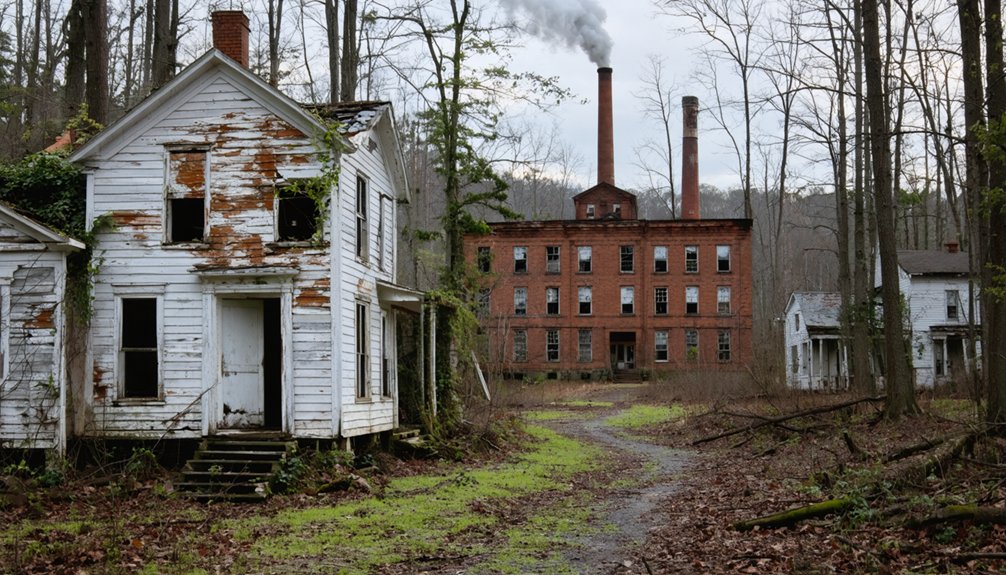
Nestled along a small gorge where the Henry River cuts through Burke County, North Carolina, this abandoned textile mill village transforms 20th-century industrial decay into Panem’s coal-mining District 12.
You’ll find the dilapidated company store that became Mellark’s Bakery and mill houses where Katniss prepared for the reaping during nine days of 2011 filming. Film nostalgia drives today’s guided tours and special events, though abandoned exploration requires caution—collapsing floors make interiors treacherous.
Access the site via I-40 exit 119, one mile south of Hildebran, halfway between Charlotte and Asheville. Stay on main roads unless you’re attending scheduled events.
House #12 now offers overnight stays since restoration in 2021, with future plans including a restaurant and museum celebrating this authentic slice of Appalachian history.
Wilmington’s Historic District: Halloween Kills and Beyond
Though Wilmington’s downtown blocks never became a true ghost town, its historic architecture doubled as the fictional Haddonfield, Illinois during nine weeks of Halloween Kills production in 2019. You’ll find Cape Fear Community College’s A building transformed into Haddonfield Memorial Hospital, while The Rusty Nail bar at 1310 S. 5th Avenue hosted pivotal reunion sequences.
Filming logistics stretched across multiple districts:
- Screen Gems Studios anchored indoor production requirements
- Residential corridors on S. 20th Street and Pender Avenue captured chase sequences
- Russell’s Quik Stop (2101 Wrightsville Avenue) provided authentic small-town atmosphere
Director David Gordon Green utilized Wilmington’s brick facades and tree-lined streets to recreate 1978 Midwestern suburbia. Jamie Lee Curtis and crew spent fall 2019 shooting throughout these neighborhoods, proving North Carolina’s coastal city offers versatile backdrops for horror franchises.
Frequently Asked Questions
Are Visitors Allowed to Camp Overnight at These Filming Locations?
You won’t find telegram-accessible campgrounds here. Overnight restrictions and campground regulations prohibit traditional camping at these Northeast filming locations. Instead, you’ll discover freedom through cozy historic inns, restored house rentals, and waterfront lodging with vintage porches.
How Much Do Guided Ghost Tours Typically Cost at These Sites?
Pricing information isn’t publicly available for most Northeast ghost town filming locations. You’ll need to contact sites directly, as many focus on historical significance and preservation efforts rather than commercial tours, offering you self-guided exploration instead.
Exploring abandoned towns in Pennsylvania can provide a haunting glimpse into the past. These forgotten places are often steeped in rich history, showcasing architecture and stories long overshadowed by modern development. Visitors are encouraged to tread lightly and respect the remnants of the lives once lived there, as they offer a unique perspective on the region’s heritage.
What Safety Precautions Should Explorers Take When Visiting Abandoned Film Locations?
Over 60% of abandoned site injuries involve structural collapses. You’ll need hazard awareness training before exploring, plus emergency preparedness gear—sturdy boots, flashlights, first aid supplies, and charged phones. Travel in groups and respect private property boundaries for safe, unrestricted access.
Can Filming Locations Be Rented for Private Events or Photoshoots?
You’ll find limited private event rentals at Northeast filming locations, as most prioritize public tours over exclusive bookings. Always secure photography permission beforehand—owners typically focus on historical preservation rather than hosting private photoshoots at these atmospheric, weathered sites.
Which Locations Offer the Best Accessibility for Visitors With Mobility Issues?
You’d think ghost towns would advertise their wheelchair accommodations, but they don’t. Thurmond, West Virginia offers accessible pathways through its National Park Service facilities, though specific mobility details remain frustratingly scarce. Contact rangers directly before visiting.
References
- https://www.idyllicpursuit.com/10-movie-filming-towns-with-spooky-tours-and-cozy-inns/
- https://www.romanticasheville.com/henry-river
- https://magazine.northeast.aaa.com/daily/life/spooky-season/northeast-halloween-movies/
- https://farandwide.com/s/abandoned-film-locations/
- https://www.youtube.com/watch?v=Y44qdpq5y6M
- https://onthesetofnewyork.com/ghosttown.html
- https://newjerseyisntboring.com/friday-the-13th-new-jersey/
- https://movie-locations.com/movies/f/Friday-The-13th-1980.php
- https://www.smithsonianmag.com/travel/the-1980-slasher-movie-friday-the-13th-was-filmed-at-this-boy-scout-camp-in-new-jersey-180978933/
- https://roadtrippers.com/magazine/camp-crystal-lake-friday-the-13th/