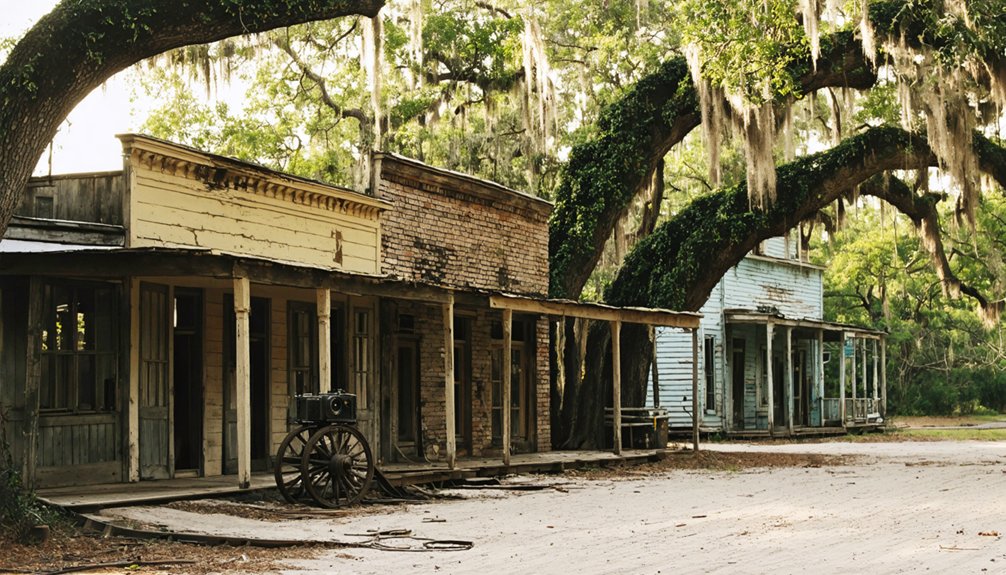
You’ll find Southern ghost towns like Terlingua in Texas and Henry River Mill Village in North Carolina offering authentic 19th-century structures that require minimal modification for Western productions. These preserved locations feature weathered storefronts, abandoned mines, and naturally decayed buildings that filmmakers use for period authenticity. Sites near major cities—like Henry River near Charlotte—provide logistical advantages with existing infrastructure, regional filming incentives, and year-round accessibility. Many maintain permanent props from previous shoots, creating open-air archives where Hollywood debris merges with genuine historical remnants. The specifics of each location reveal distinct filming opportunities.
Key Takeaways
- Henry River Mill Village in North Carolina hosted *The Hunger Games*, preserving natural deterioration and offering year-round tours with restored vacation rentals.
- South Carolina’s Babcock Building required minimal modifications, with its decay enhancing hospital scenes for film productions in the region.
- Terlingua Ghost Town in Texas served as a filming location for *Gambler V* and *Streets of Laredo*, showcasing authentic desert landscapes.
- Southern ghost towns balance film production with tourism through temporary cosmetic changes that maintain historical authenticity and structural integrity.
- States like Georgia, Louisiana, and South Carolina offer regional filming incentives, making Southern ghost towns cost-effective production locations near major cities.
Abandoned Mining Towns That Became Western Film Sets
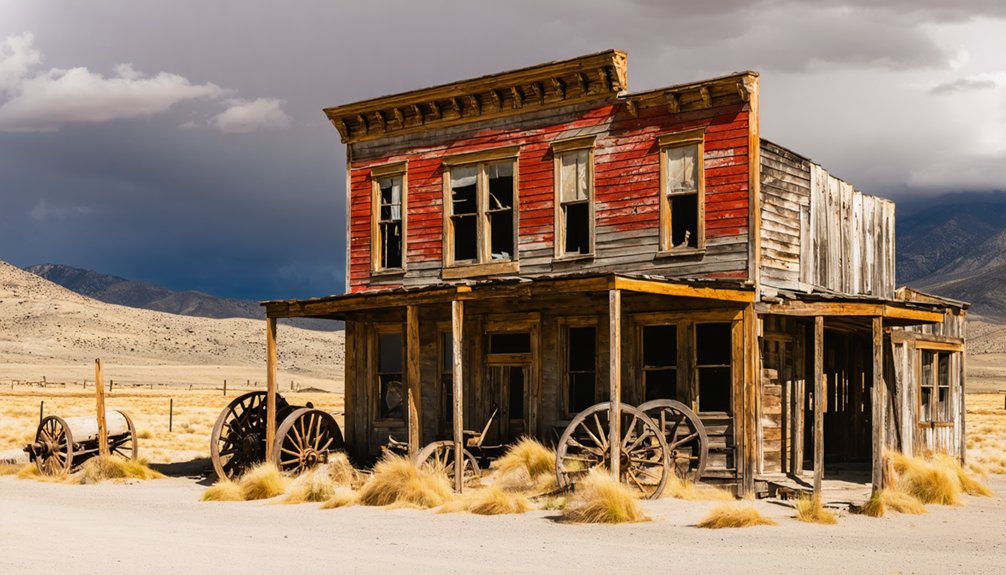
When Hollywood needed authentic Western backdrops, abandoned mining towns offered ready-made sets with weathered facades and desert vistas that no studio lot could replicate. You’ll find Goldfield Ghost Town near Arizona’s Superstition Mountains, where 1890s structures survived a 1940s brushfire to become a commercial filming destination in 1984.
Nevada’s Techatticup Mine in Eldorado Canyon has hosted productions like 3000 to Graceland, with its canyon remnants stretching toward the Colorado River through rocky terrain.
California’s Cerro Gordo served blockbusters since the 1920s, utilizing eleven distinct locations including the dry Owens Lake bed and surrounding hills dotted with desert flora. Paramount Ranch in Malibu’s hills offered another alternative, where the National Park Service acquired and revitalized the property in 1980 after decades of private ownership and continuous filmmaking. These sites delivered genuine Old West atmosphere—dusty main streets, weathered mining structures, and untamed landscapes that captured frontier authenticity without artificial construction. The Goldfield property features Western shootouts performed by gunfighters that showcase the kind of authentic action sequences ideal for Western film casting.
Historic Ghost Towns Transformed for Television Productions
You’ll find television productions favor ghost towns that support episodic shooting schedules and repeated set modifications. Paramount Ranch exemplifies this adaptability—its Western facades hosted six different 1950s-60s series.
It underwent complete remodeling for HBO’s Carnivale in the early 2000s, then returned to Western styling for Westworld with a custom-built church in 2016. Nelson Ghost Town demonstrates similar versatility, with seven scenes shot for 3000 Miles to Graceland featuring explosive helicopter sequences and a destroyed airplane whose remnants remain on site. The Caerleon Campus in South Wales followed a similar transformation, with its interior redesigned to become Moordale Secondary School for Netflix’s Sex Education after closing in 2016. These locations offer production teams the logistical advantage of temporary cosmetic changes between shoots while maintaining their core structures for long-term accessibility.
Western Series Filming Locations
Historic ghost towns offered television producers authentic Western backdrops that couldn’t be replicated on studio lots. They transformed abandoned settlements into working film locations throughout the 1950s and 1960s. These sites balanced historical preservation with location accessibility, allowing crews to capitalize on weathered structures without extensive construction.
Today, many filmmakers still seek out ghost towns in the southern states for their unique charm and historical significance. These locations not only provide stunning visuals but also evoke a sense of nostalgia that resonates with audiences. As a result, the trend of reviving these forgotten places continues to grow, attracting both producers and tourists.
Key filming locations included:
- Paramount Ranch (Agoura Hills, California) – hosted The Cisco Kid, Tombstone Territory, and Bat Masterson before its 2018 destruction
- Cerro Gordo (near Owens Lake) – served Gunsmoke and Have Gun Will Travel with panoramic desert shots
- Paria Townsite (Kanab, Utah) – provided canyon settings from 1870s mining ruins
- Terlingua Ghost Town (Brewster County, Texas) – featured in Gambler V and Streets of Laredo
These abandoned settlements delivered genuine Western decay without manufactured facades. The region’s cinematic legacy extends beyond television, with the Alabama Hills hosting over 400-500 movies since the early film industry days. The Texas State Railroad in Palestine and Rusk served as a recurring filming location for Western series including Streets of Laredo and Rough Riders, representing heist sequences and recruitment scenes.
Television Set Modifications
Production teams frequently repurposed decaying structures as ready-made sets, though the extent of modifications varied dramatically between minimal touch-ups and complete interior overhauls.
You’ll find South Carolina’s Babcock Building required almost no changes—its authentic decay provided Gary Oldman’s hospital scenes with shadowy atmosphere producers couldn’t replicate elsewhere. Henry River Mill Village similarly remained untouched for *The Hunger Games*, with filmmakers preserving its natural deterioration as District 12.
This creative set design approach balanced historical preservation with production needs, letting you explore locations maintaining their original character. The 72-acre North Carolina site stayed accessible post-filming, while the 1857 asylum’s abandoned rooms delivered genuine eeriness without artificial enhancement. Some productions enhanced authenticity by incorporating well-preserved antique furniture that matched the historical period of their filming locations. Filmmakers often researched historic photos to ensure accurate representation of period details during location scouting.
Both locations proved modification-free zones respect existing architecture while delivering compelling backdrops.
Preserved Towns for Production
When abandoned mill villages and desert outposts transform into filming destinations, they gain dual identities as both preserved historical sites and active production facilities. You’ll find these locations operating beyond traditional urban renewal models, creating sustainable revenue through strategic community engagement with production companies and tourists.
Production-Ready Historic Sites:
- Henry River mill village maintains year-round guided tours while housing fully restored vacation rentals.
- Nelson Ghost Town preserves hundreds of film props alongside operational mine tours at Techatticup.
- Kanab Movie Fort remains available for contemporary productions since its 1954 construction.
- The Patriot’s church and bridge structures permanently integrate with Cypress Gardens’ landscape.
These dual-purpose facilities demonstrate how preservation funds work by supporting productions while maintaining authentic historical character for location scouts seeking untouched settings. Henry River’s Company Store building served as Mellark’s Bakery during The Hunger Games’ nine-day filming schedule in the village. Gold Point Ghost Town operates under the Sheriff’s guidance, offering visitors both historical authenticity and immersive ghost story experiences from Nevada’s Gold Rush era.
Desert Landscapes Perfect for Outlaw Movie Scenes
Striated cliffs and color-drenched mesas transform desert ghost towns into ideal outlaw movie locations, where directors capitalize on rugged terrain that naturally frames pursuit and confrontation.
You’ll find Kanab Canyon‘s Angel Canyon surrounded by geological formations perfect for ambush sequences, while Paria’s Mars-like landscapes along Smokey Mountain Road provide color-saturated backdrops.
Desert flora punctuates wide-open expanses where camera crews capture authentic chase scenes across unpredictable terrain.
Old Tucson’s 1860s street configurations let you explore saloon showdowns against genuine Pima County horizons.
Cultural influences shape these locations—from Lone Pine’s Alabama Hills hosting standoffs beneath Mount Whitney to Marble Canyon’s isolation emphasizing deceptive encounters.
Flash flood-prone rivers and abandoned mining towns add visual authenticity that sanitized studio lots can’t replicate, giving you unfiltered western atmosphere.
Preserved Ghost Town Parks Available for Commercial Filming
California’s Calico Ghost Town operates within the San Bernardino County Regional Parks network. It offers you a permitted filming environment where restored 1880s silver rush architecture meets modern production logistics.
Calico Ghost Town merges authentic 1880s silver mining heritage with film-friendly infrastructure under San Bernardino County’s structured permitting system.
This officially designated Silver Rush Town balances preservation challenges with commercial access through structured permitting systems.
When scouting preserved ghost town locations, you’ll find four key filming-ready parks:
- Calico Ghost Town – Restored buildings, camping infrastructure, off-road terrain access
- Terlingua Ghost Town – Hand-dug mercury shafts, crumbling mansion near Big Bend
- Rhyolite Ghost Town – Weathered foundations, best-preserved gold rush structures near Death Valley
- La Purísima Mission – Authentically restored mission architecture respecting Native traditions
San Bernardino County requires commercial permits but welcomes drone applications, giving you production flexibility while maintaining historic integrity across these Western backdrops.
Authentic 19th-Century Structures Featured in Classic Westerns
Hollywood’s golden age of Westerns relied on ghost towns where genuine 19th-century construction provided directors with weathered authenticity no studio set could replicate.
You’ll find that filmmakers mainly chose Western locations over Southern ghost towns for their classic productions.
Grafton, Utah’s 1862 structures appeared in “Butch Cassidy and the Sundance Kid,” while California’s Cooperstown and Warnerville delivered authentic architecture for numerous Hollywood films.
New Mexico’s Bonanza Creek Movie Ranch has served Western productions since the early 1950s.
These sites offered practical advantages: existing period-correct buildings, expansive desert backdrops, and accessible filming permits.
The focus on 19th century preservation remains concentrated in Western states, where mining boom towns left behind substantial infrastructure.
Southern ghost towns, though historically significant, rarely featured in classic Westerns due to geographic preferences and vegetation differences.
Ghost Towns Near Major Cities Attracting Film Crews
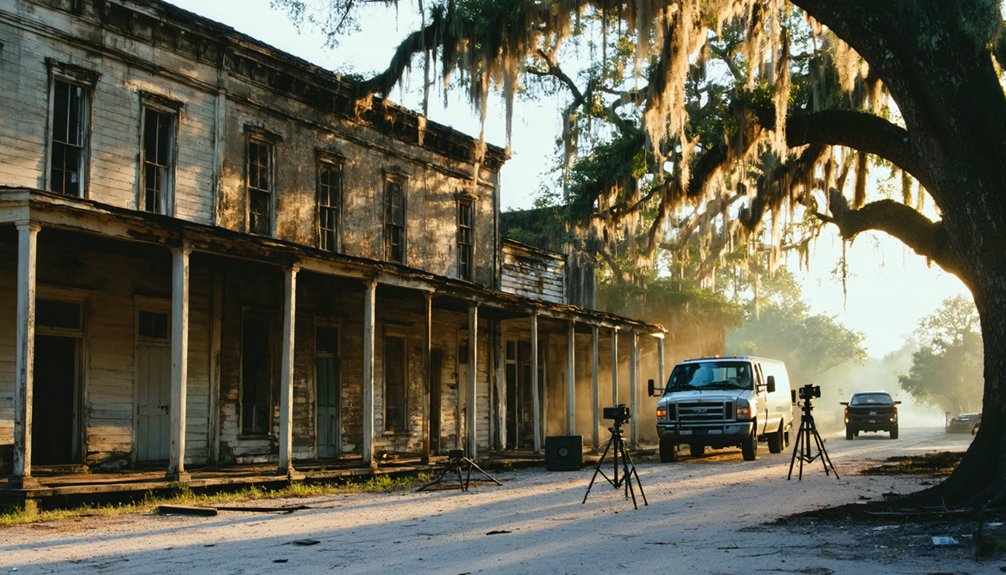
When you’re scouting ghost towns for production, proximity to major cities determines crew efficiency and budget feasibility. Locations like Henry River Mill Village near Charlotte or Byrne’s Lake outside Mobile offer authentic abandoned aesthetics.
While maintaining access to equipment rentals, lodging networks, and transportation hubs within two hours. This urban-adjacent positioning lets you capture isolated, period-appropriate visuals without the logistical penalties of truly remote filming.
Accessibility From Urban Centers
Film crews gravitate toward ghost towns within two hours of major cities, where proximity transforms abandoned settlements into practical shooting locations. You’ll find production teams selecting sites based on urban accessibility and transportation infrastructure that minimize travel costs while maximizing shooting days.
Strategic positioning near metropolitan hubs creates these advantages:
- Elko Tract sits 30 minutes from Richmond, offering WWII-era military ruins without extended crew commutes.
- Old Cahawba connects to Selma via direct routes, placing Alabama’s first capital within a 400-mile south Alabama loop.
- Cole Family Cabin reaches Durham’s urban center quickly, embedding deep woods atmosphere near city resources.
- Byrne’s Lake in Stockton positions near Mobile, explaining its selection for Friday the 13th Part VII’s Camp Crystal Lake scenes.
This geographical sweet spot delivers authentic abandonment without logistical nightmares.
Production Infrastructure and Logistics
Beyond arrival times and highway access, ghost towns near metropolitan areas deliver the physical infrastructure that transforms abandoned shells into working film sets.
You’ll find gutted mall interiors and warehouse bays that accommodate heavy equipment staging without structural modifications.
Large truck bays enable seamless movement of cameras, lighting rigs, and grip trucks through buildings already stripped to their bones.
Logistics planning becomes straightforward when existing parking lots—like those at Six Flags New Orleans—provide ready-made staging areas for custom builds such as Deepwater Horizon’s oil rig.
Water supply and electrical hookups require basic checks rather than full installations.
The pre-existing vandalism and decay eliminate costly distressing work, while sprawling spaces let you position crews, catering, and wardrobe departments without off-site rentals.
Private ownership negotiations grant access faster than municipal permitting processes.
Regional Filming Tax Incentives
As production accountants calculate bottom lines, transferable tax credits reshape ghost town viability across the South. You’ll find Georgia’s 30% credits pulling Western shoots to Scull Shoals, while Louisiana’s 40% packages transform Burrwood into profitable backlots.
These incentives don’t just subsidize filming—they’re turning forgotten sites into tourist attractions and funding cultural preservation through location fees.
Regional credit structures driving ghost town selection:
- Georgia’s proximity model: 22% base plus 8% uplift positions sites 75 miles from Atlanta’s infrastructure
- New Mexico’s uncapped rebates: 40% returns make Shakespeare ghost town economically competitive at 120 miles from Albuquerque
- Texas rural adders: 5% bonus elevates remote Terlingua despite 500-mile distance from Austin
- South Carolina’s labor stacking: 25% crew credits favor preserved Ellenton, 45 minutes from Charleston’s equipment rentals
You’re watching tax policy rewrite location scouting economics.
Canyon and Mesa Locations for Action Sequences
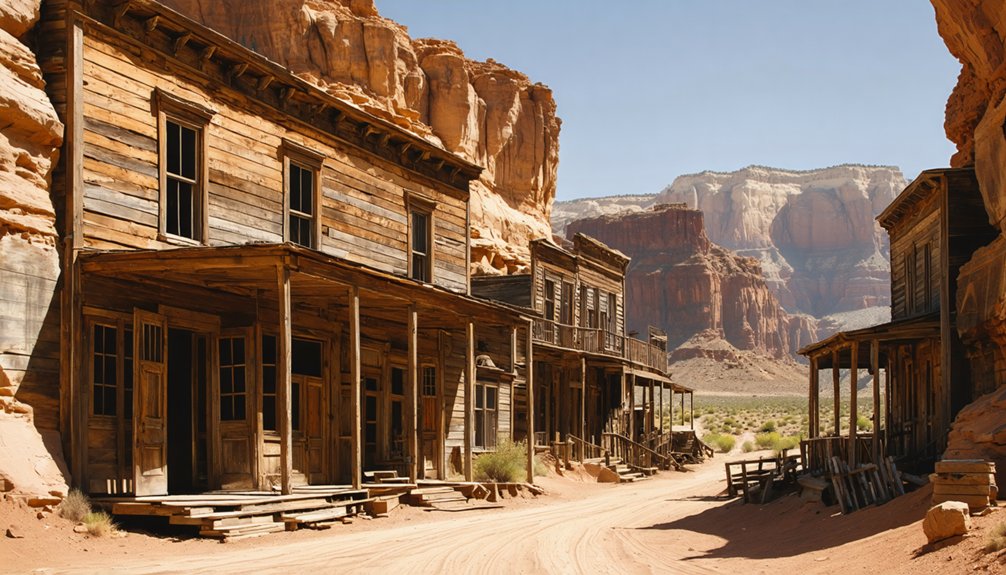
When action directors scout ghost towns for high-octane sequences, they prioritize terrain that amplifies kinetic energy—sweeping mesas for vehicular pursuits, narrow canyon passes for close-quarters combat, and elevated vantage points for aerial cinematography.
Real de Catorce’s windy gravel roads delivered Brad Pitt’s approach shots in *The Mexican*, while Almería Province’s barren canyons provided authentic wild west scenery for spaghetti Western shootouts.
Tabernas Desert’s eroded formations offer desert terrain variations mimicking the American Southwest, enabling dozens of films to exploit geographic surrogacy.
Craco’s hilltop positioning and Matera countryside canyons facilitated James Bond’s *Quantum of Solace* chase sequences.
You’ll find these locations deliver untamed backdrops where abandoned infrastructure won’t constrain stunt choreography—no permits for demolishing buildings already claimed by nature.
Film Set Graveyards and Permanent Movie Props
Some ghost towns preserve more than crumbling walls—they’ve become permanent museums of Hollywood debris. You’ll find film set graveyards where props outlast productions, turning abandoned settlements into open-air cinema archives.
Where Hollywood meets history, forgotten film sets merge with authentic ruins, creating accidental monuments to both cinema and abandonment.
Notable permanent movie props you can explore:
- Nelson’s exploded airplane from a specific Elvis-impersonating ex-cons scene
- Gold Point’s “The Sheriff” prop featured in Real Haunts documentaries
- Grafton’s preserved structures from Butch Cassidy and the Sundance Kid
- Southport’s waterfront corners from I Know What You Did Last Summer
These locations blend authenticity with Hollywood residue.
You’re free to walk through Wilmington’s cobblestone segments used in Halloween Kills or photograph Techatticup Mine’s tourable elements.
Each site offers unscripted access—no velvet ropes, just weathered sets aging alongside genuine 19th-century architecture.
Modern Productions Using Vintage Ghost Town Settings
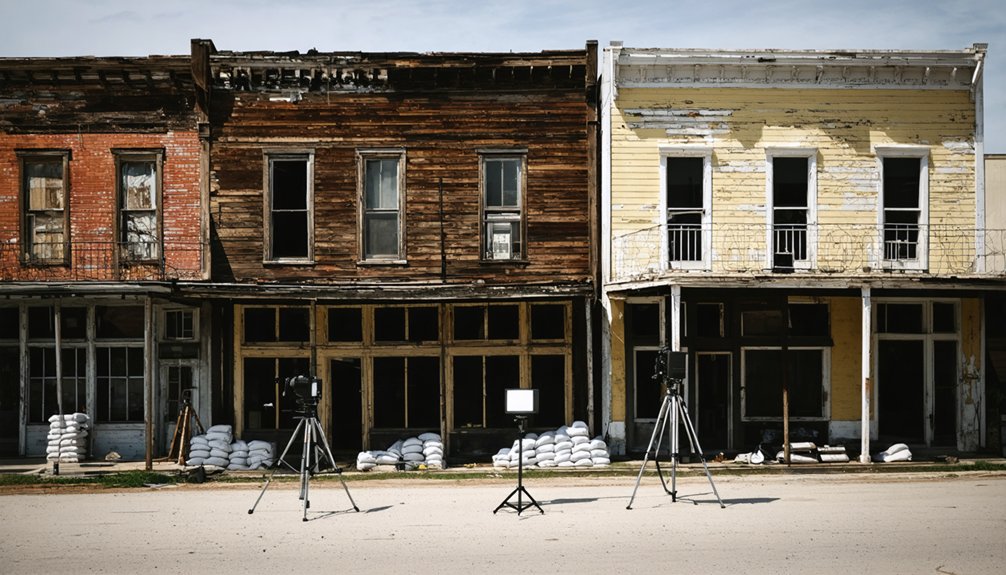
While digital effects can recreate almost any environment, contemporary filmmakers increasingly seek authentic ghost town locations for their productions. You’ll find that places like Juliette, Georgia provided “Fried Green Tomatoes” with ready-made period settings, eliminating costly set construction.
Thurmond, West Virginia’s coal mining remnants served John Sayles’ 1987 “Matewan,” where distinctive facades and abandoned hillside structures became boarding houses on screen. Montana’s Bannack State Park even landed a 2020 KIA commercial, proving ghost towns transcend period pieces.
These locations offer you visual credibility impossible to achieve with modern architecture or digital effects alone. Remote sites deliver isolation from contemporary infrastructure while reducing production timelines.
Nevada’s Nelson and Gold Point ghost towns continue attracting multiple projects, establishing proven relationships between preservation organizations and returning production companies seeking authentic Southern and Western backdrops.
Frequently Asked Questions
Do Ghost Town Filming Locations Require Permits for Independent Filmmakers?
You’ll need permits since 90% of ghost towns sit on public land. Historical preservation requirements and local community engagement dictate approval processes. You’re looking at 4+ business days minimum for processing, even for independent productions seeking creative freedom.
Are Southern Ghost Towns Accessible Year-Round for Location Scouting Visits?
You’ll find most southern ghost towns accessible year-round, though remote access roads become challenging during winter storms or heavy rains. Abandoned buildings remain visible, but you should verify seasonal conditions and private property restrictions before planning scouting trips.
Which Ghost Towns Offer On-Site Amenities for Film Production Crews?
You’ll find Old Tucson Studios offers full production infrastructure near historic landmarks, while Bannack State Park provides visitor centers and camping. Fort Hays delivers crew-friendly workshops. Most abandoned mines lack amenities—you’ll need nearby urban bases for equipment and lodging.
Can Ghost Town Structures Be Modified Temporarily for Specific Filming Needs?
You’ll find ghost town structures can absolutely receive temporary structural modifications for filming. Production teams regularly install scaffolding, lighting rigs, and safety equipment while respecting abandonment preservation protocols, allowing authentic backdrops without permanent alterations to historical architecture.
What Insurance Requirements Exist When Filming at Historic Ghost Town Sites?
Need liability protection for your shoot? You’ll require $1-2 million general liability insurance coverage, with property owners named as additional insureds. Workers’ compensation and automobile policies complete your essential protection package for historic locations.
References
- https://californiathroughmylens.com/paramount-ranch-old-movie-town/
- https://www.motionpicturevideo.com/top15locations
- https://roadtrippers.com/magazine/kanab-utah-little-hollywood/
- https://www.youtube.com/watch?v=tZmA_VF6cm8
- https://film.southwestmt.com/filmography/
- https://www.visitutah.com/articles/5-utah-film-itineraries
- https://farandwide.com/s/abandoned-film-locations/
- https://www.loveexploring.com/gallerylist/73310/21-surprising-movie-locations-across-america
- https://blarefilms.net/goldfield-ghost-town/
- https://www.telegraph.co.uk/travel/destinations/north-america/united-states/forgotten-ghost-towns-americas-wild-west-how-see-real-life/