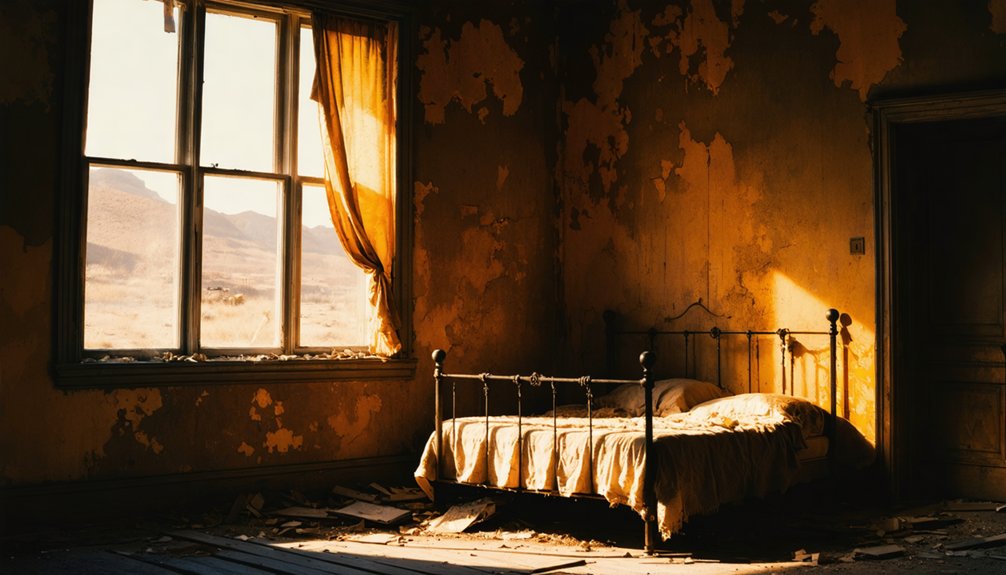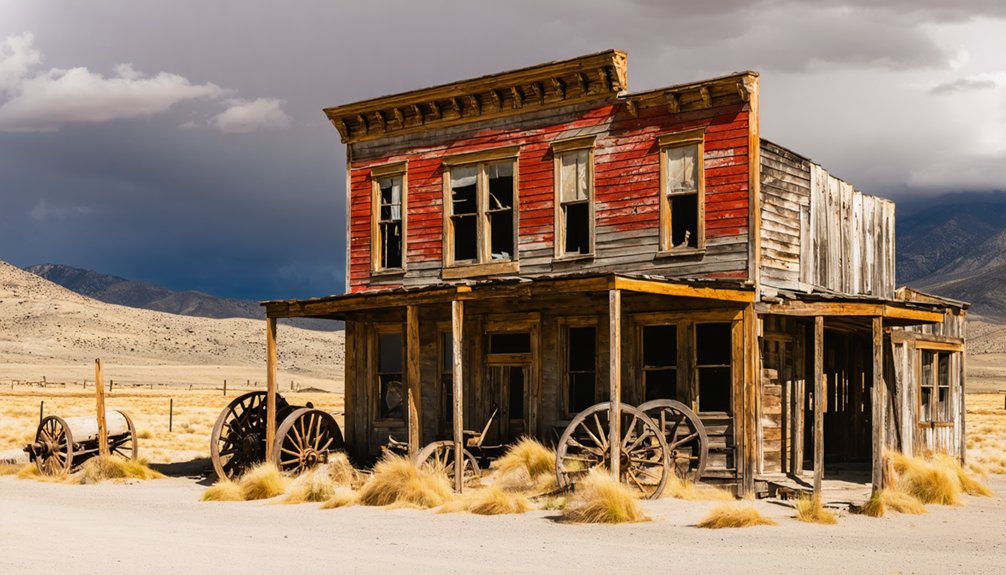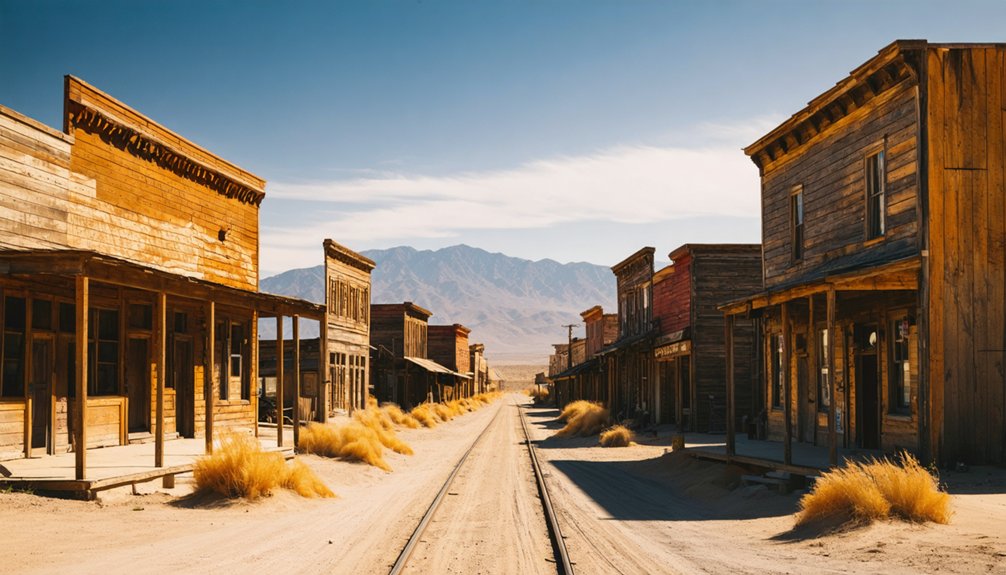
You’ll find authentic Western backdrops at Grafton, Utah—featured in “Butch Cassidy and the Sundance Kid”—and Bannack, Montana, with 60 preserved structures from its 1862 gold rush. Cisco, Utah served as the gritty setting for “Thelma & Louise’s” iconic desert scenes, while Paramount Ranch‘s classic facades appeared in countless TV Westerns before the 2018 Woolsey Fire. Cerro Gordo’s 8,500-foot elevation offers cinematic mining ruins and panoramic views. These locations balance preservation efforts with visitor access, though you’ll need detailed coordinates and winter preparation for backcountry sites.
Key Takeaways
- Grafton, Utah appeared in “Butch Cassidy and the Sundance Kid” and is known as the most photographed ghost town.
- Cisco, Utah served as a filming location for “Thelma & Louise,” featuring police chases and desert explosion sequences.
- Paramount Ranch, California was built in 1954 and used for TV Westerns including “Gunsmoke” and “Tombstone Territory.”
- The Westworld Set in Agoura Hills features a temporary church structure used for key HBO series scenes and confrontations.
- Cerro Gordo, California offers authentic mining ruins and industrial landscapes at 8,500 feet in the Inyo Mountains.
Grafton Utah: The Most Photographed Ghost Town in the American West
When five Mormon pioneer families arrived in Utah’s Virgin River valley in 1859, they couldn’t have predicted that their modest cotton farming settlement would become the most photographed ghost town in the American West.
Originally named Wheeler, Grafton grew to 168 residents before the devastating 1862 flood forced relocation upriver. Persistent flooding, the Black Hawk Indian War, and irrigation challenges steadily depleted the population.
The 1906 Hurricane Canal completion triggered mass exodus, with final residents departing by 1944. The National Park Service acquired the land in 1933 to ensure its preservation for future generations.
Today, you’ll find Grafton’s weathered structures frozen in time—a memorial to urban decay transformed into cinematic gold. Its appearance in “Butch Cassidy and the Sundance Kid” cemented its cultural preservation status, offering you unfiltered glimpses into frontier hardship without sanitized historical narratives. The town’s film legacy began even earlier when it hosted the first outdoor talkie “Old Arizona” in 1929, which earned five Academy Award nominations.
Bannack Montana: From Gold Rush to Modern Productions
While Grafton served Utah’s agricultural pioneers, Montana’s Bannack exploded into existence through raw mineral wealth—a violent, chaotic contrast that makes it equally compelling for filmmakers seeking authentic Western grit.
You’ll find 60 preserved structures from its 1862 founding, when 10,000 fortune-seekers extracted $500,000 in gold within months.
Unlike artificial ghost towns built purely for tourists, Bannack’s preservation agreement explicitly prohibits commercial development—maintaining the raw atmosphere that attracted vigilantes who hanged 22 men in 1864.
Film set preservation here means protecting genuine outlaw history: Sheriff Henry Plummer’s hanging site, the first Governor’s Mansion, and Hotel Meade where Dorothy Dunn’s spirit allegedly roams.
The town briefly served as Montana’s territorial capital before being replaced in 1865, adding political significance to its frontier legacy.
Montana’s Department of Fish, Wildlife, and Parks manages this state park specifically for productions requiring uncompromised 1860s authenticity.
The park’s 1,154-acre expanse at 5,800 feet elevation includes 28 campsites with modern amenities, allowing film crews extended access to multiple historic locations within a single protected zone.
Paramount Ranch California: A Hollywood Staple in Agoura Hills
You’ll find Paramount Ranch’s Western Town set anchored by a prominent white church structure that served as the central backdrop for classic 1950s television series including “The Cisco Kid,” “Tombstone Territory,” and “Bat Masterson.”
The church building you see today is actually a temporary replacement constructed specifically for HBO’s “Westworld” production after the original 1953 structure burned down in California’s 2018 Woolsey Fire.
When you visit the 2,700-acre property—now part of the Santa Monica Mountains National Recreation Area—you’re walking through the same dusty streets where Gary Cooper and Bob Hope filmed during Paramount Pictures’ 1927-1943 ownership period. The ranch also served as a popular hiking destination for locals when filming wasn’t taking place. The National Park Service acquired part of the property in 1980 and revitalized the ranch, leading to its use as the filming location for “Dr. Quinn, Medicine Woman” from 1992 to 1997.
Classic Television Western Productions
Paramount Ranch’s Western Town became television’s go-to filming location when William Hertz constructed it in 1954 using Academy Award-winning facades from RKO Pictures’ Encino Movie Ranch.
You’ll recognize this Hollywood history hotspot from *The Cisco Kid*, *Gunsmoke*, and *Tombstone Territory*, where dusty streets and weathered storefronts provided authentic backdrops for your favorite TV Westerns.
The versatile facades doubled for countless frontier towns in *Bat Masterson*, *Have Gun, Will Travel*, *Wanted: Dead or Alive*, *The Rough Riders*, *Hotel de Paree*, and *Klondike*.
Hertz’s strategic design allowed production crews to transform Western Town’s buildings quickly between shoots, maximizing rental value during television’s golden Western era. Studios’ investment in movie ranches like Paramount eliminated costly disputes over crew travel expenses to distant Arizona and Nevada locations.
The National Park Service later restored these iconic structures using Hertz family photographs, preserving the site’s television legacy until wildfire consumed this piece of entertainment freedom. Recycled materials from old film sets formed the saloon, hotel, and jail facades that appeared in classic shows like *The Lone Ranger*.
Westworld’s Temporary Church Set
When HBO built the Westworld church set at 2903 Cornell Road in Agoura Hills, they created a structure that would outlast most of Paramount Ranch’s historic Western Town.
This temporary construction for seasons one and two survived the devastating 2018 Woolsey Fire that claimed nearly everything around it.
Church architecture and filming set evolution highlights:
- Featured in pivotal Dolores confrontations and Arnold’s death scene visible from the saloon.
- Steeple deliberately removed post-production to alter the building’s appearance.
- Interior remains accessible with minimal furnishings for public exploration.
- Stands alongside the train depot as one of two surviving structures.
- Ford’s death occurred at the same location where he delivered his final narrative speech.
You’ll find free access daily from 8 am to sunset at this National Park Service site within Santa Monica Mountains National Recreation Area, where fundraising continues for the Western Town’s rebuild. The surrounding hills and countryside provide excellent opportunities for hiking, mountain biking, and horseback riding throughout the property.
Cisco Utah: Where Thelma & Louise Made History
You’ll find Cisco at the junction of SR-128 and I-70 in Grand County, Utah, where this 1880s railroad water station became the filming location for roughly half of *Thelma & Louise*’s iconic desert sequences in summer 1990.
The production crew shot the police chase scenes across the wide-open terrain, captured Susan Sarandon’s phone booth conversation at Cisco Clifton’s Filling Station (coordinates: 38.97078, -109.31846), and filmed the explosive 18-wheeler scene off I-70 between Green River and Cisco.
This deteriorating ghost town, which had declined into abandonment by the early 1990s, provided the ramshackle buildings, rail tracks, and barren landscape that defined the film’s desperate flight across the American Southwest.
Railroad Town Turned Backdrop
Tucked between the rust-colored mesas of Grand County, Utah, Cisco began as an 1880s railroad outpost where steam locomotives stopped to refill water tanks and thirsty travelers wandered into makeshift saloons.
As steam engines became obsolete, the town withered into a haunting affirmation to railroad preservation gone wrong—abandoned cars and weathered wooden structures scattered across the desert landscape.
By the 1990s, filmmakers recognized Cisco’s cinematic potential:
- Vanishing Point (1971) captured the town’s desolate final scene
- Thelma & Louise featured Cisco Clifton’s Filling Station for the pivotal phone booth sequence
- Both productions exploited the authentic decay without Hollywood artifice
- Directors chose this location for its unvarnished, ramshackle aesthetic
You’ll find Cisco at coordinates 38.97086, -109.32036, accessible off I-70.
The barren setting offers filmmakers—and freedom-seekers—an unfiltered glimpse of abandonment.
The Iconic Explosion Scene
As police cruisers closed in on the fugitive duo, Ridley Scott’s crew positioned cameras along a desolate stretch near Thompson Springs, Utah—roughly 15 miles east of Cisco—to capture one of 1991’s most visceral action sequences.
Without modern special effects budget, they rigged an actual 18-wheeler for detonation right off I-70. The location’s isolation—no structures for miles—made it perfect for pyrotechnics.
You’ll notice the wide-open sandstone terrain amplified the explosion’s impact, giving viewers that endless-desert sensation during the high-speed pursuit.
Earlier scenes established atmosphere through Cisco’s urban decay: Thelma’s phone booth call at Clifton’s Filling Station, Susan Sarandon beside Ernie among ramshackle buildings.
These authentic ghost town elements—withered structures, abandoned cars, wind-swept sagebrush—created cinematic effects no soundstage could replicate.
Johnny Cash’s Musical Tribute
Beyond the film cameras and explosive stunts, Cisco’s cultural footprint expanded into American music when Johnny Cash recorded a tribute celebrating the ghost town’s connection to Thelma & Louise. This music history moment cemented Cisco’s place beyond cinema into broader American counterculture.
You’ll find tangible remnants of this legacy throughout the ghost town:
- Buzzard’s Belly General Store sells Thelma & Louise T-shirts and posters
- Film stills displayed throughout link Cash’s tribute to the movie’s shooting locations
- Artist residencies through Home of the Brave continue Cisco’s creative tradition
- Monthly artists live without utilities amid the same ramshackle structures that attracted Cash’s attention
The convergence of film, music, and visual arts transforms this deteriorating railroad stop into an ongoing celebration of artistic freedom and American rebellion.
Paria and Old Paria Near Kanab Utah: A Television Western Hub
The ghost town of Paria sits at coordinates 37°14′54″N 111°56′57″W within Grand Staircase–Escalante National Monument, where its dramatic canyon vistas first attracted Hollywood’s attention in the 1940s.
You’ll find the movie set location via a 5-mile dirt road off Highway 89, accessible at milepost 31.
The original farming community, founded in 1870, was abandoned after 1880s floods devastated its 130 residents.
Film crews built an imitation Old West town one mile west in 1961 for *Sergeants 3*.
*The Outlaw Josey Wales* utilized these structures in 1975, but arson destroyed the set in 2006.
Despite filming site preservation efforts, only rudimentary remnants survive.
Local ghost town legends persist around these weathered structures, accessible via washboard gravel roads when dry.
Cerro Gordo California: The Mining Town That Shaped Classic Westerns
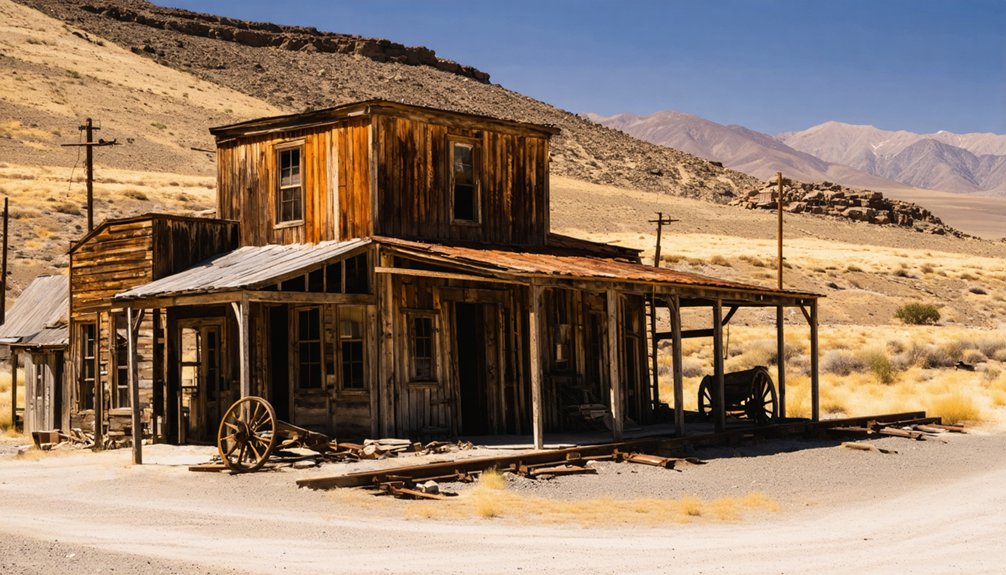
Perched at 8,500 feet elevation in California’s Inyo Mountains, Cerro Gordo’s weathered ruins overlook Owens Lake Valley with the Sierra Nevada range dominating the western horizon. This authentic silver mining camp, which produced nearly $500 million in minerals from 30 miles of underground tunnels between 1866-1877, offers filmmakers unmatched mining archaeology authenticity.
Authentic 1860s silver mining ruins at 8,500 feet elevation deliver unmatched historical accuracy for Western film productions.
Ghost town preservation elements attracting production crews:
- Stone building foundations and deteriorating wood-frame structures from the 1870s boom period
- Original smelter ruins and mining equipment scattered across the steep hillside terrain
- Eleven-mile pipeline remnants from the 1873 water delivery infrastructure
- Accessible mountain location with panoramic desert valley vistas
You’ll find legitimate historical staging grounds here—no Hollywood reconstructions necessary. The town’s remote setting and preserved industrial remnants provide cinematographers with genuine Old West backdrops.
Iconic Films Shot in Southwestern Ghost Towns
From dusty main streets to towering red rock formations, Southwestern ghost towns have anchored some of cinema’s most memorable Westerns and genre-defying films. You’ll find Grafton, Utah—featured in *Butch Cassidy and the Sundance Kid* (1969)—preserved through historical preservation efforts since 1997, maintaining authentic 19th-century structures for filming logistics.
In addition to Grafton, several other ghost towns in the southwest offer a glimpse into a bygone era. Each of these abandoned settlements tells a unique story of life during the mining boom and the subsequent decline, drawing in history buffs and curious travelers alike. Exploring these sites not only reveals the architectural styles of the past but also connects visitors to the rich cultural heritage of the region.
Monument Valley’s iconic buttes appeared in *The Lone Ranger* (2013) and *A Million Ways to Die in the West* (2014), while Canyon de Chelly‘s dramatic landscapes housed *The Sea of Grass* (1948).
Paramount Ranch served as the go-to Western town set throughout the 1950s-1960s, hosting *The Cisco Kid* and *Bat Masterson* before diversifying into non-Western productions.
These locations offer you unrestricted access to authentic frontier backdrops where Hollywood’s greatest outdoor adventures unfolded.
Preservation Efforts Keeping Ghost Town Film Sets Alive
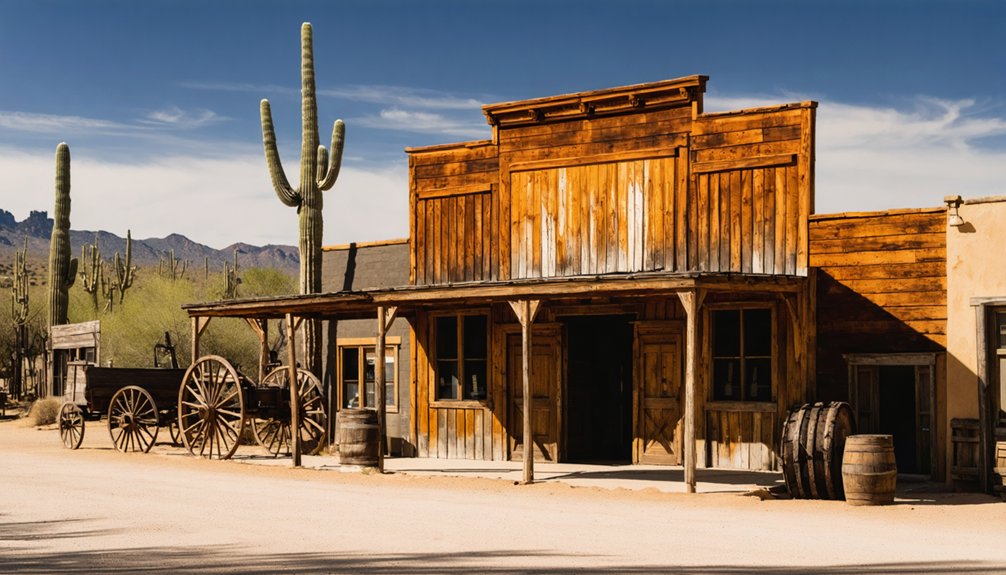
Without dedicated preservation partnerships, many ghost towns that served as Hollywood backdrops would’ve crumbled into unrecognizable ruins decades ago.
You’ll find restoration techniques ranging from faithful reconstruction to careful artifact preservation. Funding sources include heritage partnerships, private ownership, and National Park Service intervention.
Notable preservation successes include:
- Grafton, Utah – Protected in 1997 by Grafton Heritage Partnership after appearing in *Butch Cassidy and the Sundance Kid*, maintaining its status as the West’s most photographed ghost town
- Vulture City, Arizona – Restored 15 buildings with original elements like the Assay Building’s gold-silver testing lab and 17th-century Cookhouse stove
- Thurmond, West Virginia – NPS acquired buildings in 1995, transforming the depot into a functioning visitor center and Amtrek stop
- Bodie, California – Preserved as “preservationist theater” prioritizing historical accuracy over commercialization
Planning Your Visit to These Historic Film Locations
These preserved locations welcome visitors with varying degrees of accessibility and infrastructure—from fully-developed state parks to rugged backcountry sites requiring four-wheel drive.
Bannack charges $8 daily entry with 50+ campsites available through Montana’s reservation system.
Grafton offers free daylight access via State Route 9, though you’ll find no on-site facilities.
Film location logistics demand preparation: Lake Valley requires high-clearance 4WD along BLM dirt roads, while Cerro Gordo’s remote mountain setting necessitates checking Inyo County conditions.
Ghost town architecture photography thrives at Alabama Hills’ Tremors boulders (coordinates: 36.6097700, -118.1263300), accessible from Lone Pine.
Winter visitors need chains; cellular service proves unreliable at backcountry sites.
Book Butte’s Uptown walking tours through local chambers, exploring authentic Victorian streetscapes where “1923” crews filmed.
Frequently Asked Questions
Do Film Productions Pay Fees to Use Ghost Town Locations?
You’ll typically pay permit fees when your film crew logistics require access to ghost town locations. State parks and federal lands charge based on crew size, while privately preserved sites often request donations supporting ghost town restoration efforts instead.
Can Visitors Explore Interior Buildings at These Ghost Town Filming Sites?
You’ll find visitor access restrictions vary by location. Bannack State Park offers full interior building preservation with open access, while Bonanza Creek and Grafton limit entry to exteriors only, protecting film sets and historical structures from damage.
What Permits Are Required to Film at Ghost Town Locations?
Like pioneers claiming uncharted territory, you’ll need Bureau of Land Management permits if causing disturbance, plus historical preservation clearances and local government regulations. Federal lands require multi-jurisdictional approvals, while tribal ghost towns demand respective government coordination.
Are Ghost Town Filming Locations Accessible During Winter Months?
You’ll find most Southwest ghost town filming locations offer winter access year-round, though you should verify seasonal closures beforehand. Grafton and similar desert sites typically remain open, while Montana’s mountain locations face weather-related road restrictions during harsh conditions.
Which Ghost Town Location Hosted the Most Film Productions?
You’ll find Bodie, California hosted the most film productions among these locations. Its historical preservation efforts and frozen-in-time atmosphere create unmatched cinematic backdrops, though exact counts aren’t documented. The local community impact remains minimal given its remote, state-managed status.
References
- https://www.themoviewaffler.com/2015/09/5-iconic-filming-locations-in-american.html
- https://film.southwestmt.com/filmography/
- https://californiathroughmylens.com/paramount-ranch-old-movie-town/
- https://www.youtube.com/watch?v=IqLIwp1HeJY
- https://roadtrippers.com/magazine/kanab-utah-little-hollywood/
- https://www.youtube.com/watch?v=tZmA_VF6cm8
- https://destinationfilmguide.com/film-in-southwest-montana/
- https://sierracountyfilm.com/lake-valley-a-true-ghost-town/
- https://en.wikipedia.org/wiki/Eagle_Mountain
- https://graftonheritage.org/history-settlement/