You’ll find Grafton Ghost Town, located 9 miles from Zion National Park, served as the iconic backdrop for *Butch Cassidy and the Sundance Kid*, with its 1886 schoolhouse and adobe structures framing authentic Wild West scenery. Cisco Ghost Town along State Route 128 offers abandoned railroad buildings and rusting vehicles that’ve appeared in numerous Hollywood productions. Paria’s colorful mesas and Eureka’s rolling hills provide diverse filming landscapes dating back to 1944. Explore further to discover the production challenges, cemetery stories, *best* touring seasons that bring these cinematic locations to life.
Key Takeaways
- Grafton Ghost Town, near Zion National Park, famously hosted *Butch Cassidy and the Sundance Kid* and features preserved 1886 structures.
- Cisco Ghost Town along Route 128 offers abandoned buildings and desert landscapes ideal for frontier and Western film backdrops.
- Paria’s colorful mesas and Eureka’s rolling hills have attracted filmmakers since 1944 with diverse, authentic 19th-century settings.
- Filming at these sites faces restrictions on modifying historic structures and requires careful logistical planning for remote equipment transport.
- Visit April-May or September-October for optimal weather, accessible roads, and fewer crowds when exploring these cinematic ghost towns.
Grafton Ghost Town: Where Western Cinema History Was Made
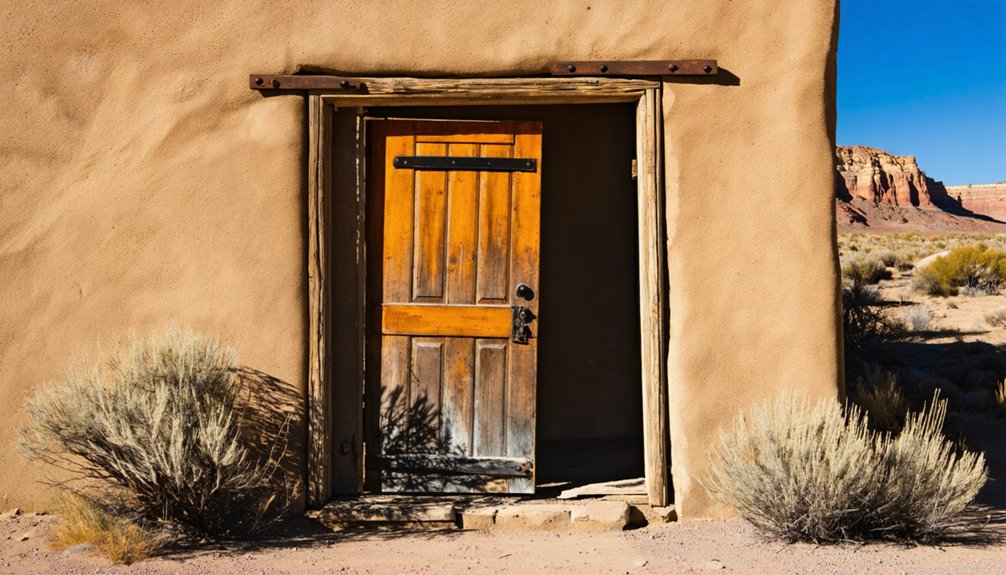
Grafton’s weathered adobe walls and wooden structures rise from the Virgin River valley floor, nine miles from Zion National Park’s entrance.
Adobe ruins emerge from the valley floor beneath towering canyon walls, nine miles from Zion’s gateway.
This is where five families led by Nathan Tenney established the original Wheeler settlement in December 1859.
You’ll find the most photographed ghost town in the West, where *Butch Cassidy and the Sundance Kid* and 1929’s *In Old Arizona*—the first outdoor talkie—were filmed.
The 1886 schoolhouse, built with lumber hauled 75 miles from Mount Trumbull, stands alongside the chapel and cemetery as proof of historic architecture that survived flooding, the Black Hawk War evacuation, and gradual abandonment by 1944.
A devastating January 1862 flood destroyed the original settlement, forcing survivors to relocate to higher ground at the current site.
The community emphasized collaboration on irrigation and homes, with settlers working together to maintain ditches and dams despite repeated washouts.
Cultural preservation efforts through the Grafton Heritage Partnership maintain these accessible structures, letting you explore authentic frontier ruins without restrictions or guided tours.
Cisco Ghost Town: An Authentic Setting for Hollywood Productions
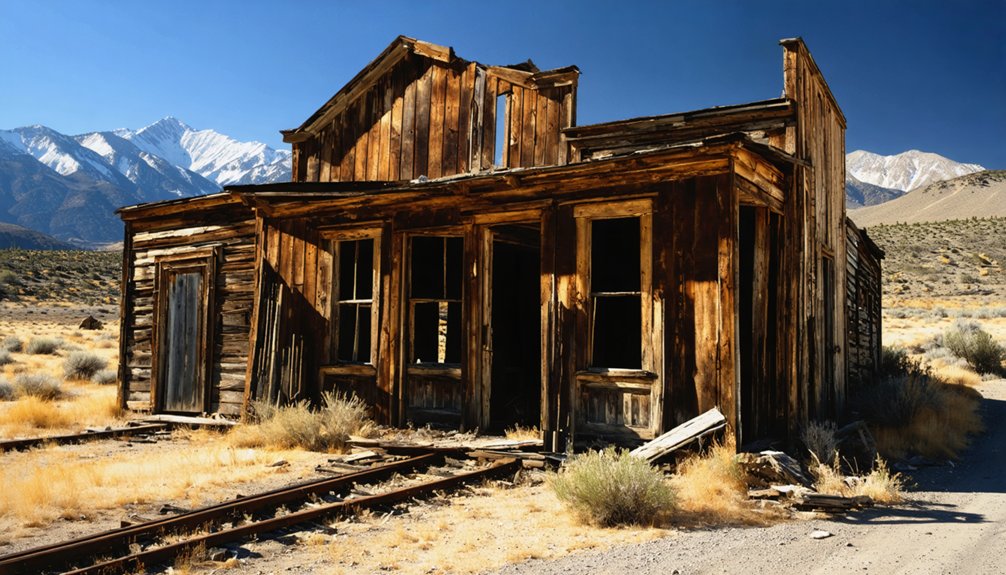
You’ll find Cisco Ghost Town along State Route 128 near the Utah-Colorado border, where its water-filling station origins in the 1880s created a thriving railroad community that peaked at 200 residents before diesel engines and Interstate 70’s construction sealed its abandonment by the 1990s.
The town’s rotting buildings, rusting vehicles, and desolate desert landscape attracted Hollywood productions including *Vanishing Point* (1971), *Thelma & Louise* (1991), and *Don’t Come Knocking* (2005), which used its authentic decay as atmospheric backdrops. The historic gas stations, once in better condition, now stand heavily vandalized among the ruins.
Beyond its film appearances, Cisco inspired Johnny Cash’s “Cisco Clifton’s Filling Station” and once operated as Utah’s largest oil and natural gas producer after 1924, leaving behind weathered structures that now serve an artist’s vision of creative renewal. The Cisco Landing Store once functioned as a community gathering place for local residents and surrounding farmers during the town’s prosperous years.
Railroad Origins and Development
The Denver and Rio Grande Western Railroad established Cisco in the 1880s as a critical water-filling station where steam engines could resupply during their desert crossings through Grand County.
You’ll find Colorado River water was pumped directly to the depot, while section crews hand-carried drinking water to cisterns throughout the settlement.
The railroad transformed this isolated landscape—once dominated by wildlife habitats and ancient architecture of sandstone formations—into a thriving hub.
Stores, hotels, and restaurants sprang up around the tracks to serve travelers and workers.
Ranchers from the Book Cliffs shipped over 100,000 head of sheep annually through Cisco’s depot at the century’s turn.
The town’s strategic position made it indispensable for livestock operations seeking access to distant markets via rail.
By 1944, the community supported a post office, general store, one-room schoolhouse, and several residential houses that served railroad workers and ranching families.
The railroad maintained water tanks and section buildings along the main line to support its operations and workforce.
Hollywood Films at Cisco
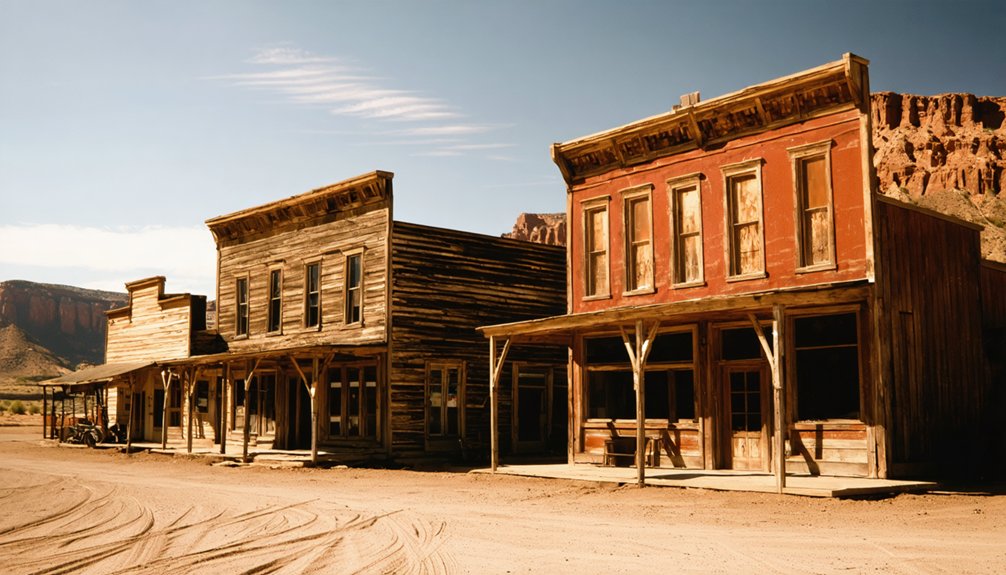
Cisco’s dusty streets and weathered structures caught Hollywood’s attention decades after the railroad’s decline, transforming the abandoned settlement into a filming location for two cult classics.
In 1971, Vanishing Point utilized the town’s apocalyptic aesthetic for its explosive climax featuring a 1970 Dodge Challenger, with the Shell gas station shell still standing as evidence.
Two decades later, Thelma & Louise captured semi-truck explosions near the ghost town, where Susan Sarandon’s costume design contrasted sharply against Cisco’s desolate backdrop.
The town’s lone resident appeared alongside Sarandon, adding authentic local texture to scriptwriting techniques that demanded genuine frontier isolation.
The film’s production team used three identical Thunderbirds during filming, though the ghost town sequences focused on the surrounding Utah landscape rather than the vehicles themselves.
Beyond its cinematic legacy, the site gained additional cultural significance when Johnny Cash wrote a song reflecting on Cisco’s decay after stopping at a nearby filling station in the 1960s.
Today, Buzzard’s Belly General Store serves movie pilgrims seeking these iconic locations, selling memorabilia while displaying images from both productions across its weathered walls.
Cultural Legacy and Recognition
- *Thelma & Louise* T-shirts and posters available at general store
- Tripadvisor reviews documenting film location authenticity
- YouTube videos chronicling Hollywood production history
- Johnny Cash’s “Cisco Clifton’s Fillin’ Station” musical reference
- Vintage aesthetics maintaining unaltered Western film appeal
- The Shell gas station shell remains as a standing landmark at the town’s intersection
- Visitors share stories and appreciation of film sites through online community comments
- Southern Paiute workers buried alongside Mormon settlers
- Robert Madison Berry (24), Mary Isabella Berry (20), and Joseph Berry (22) killed during raids
- Thirteen deaths in rapid succession during 1866
- Missing headstones obscure complete settlement records
- Accessible grounds connect film tourism to authentic pioneer experiences
- Spring (April-May): Post-thaw dirt roads, mild temps, fewer tourists
- Fall (September-October): Cooler days, stable trails, reduced wildfire risk
- Avoid July-August: Extreme heat, monsoon flash floods, peak family crowds
- Winter caution: Freezing temps, route closures to Bullion City
- Midweek advantage: Solitude at Johnson Canyon year-round
- Weekend sprint: Grafton-Snow Canyon loop covering iconic Butch Cassidy locations
- Extended circuit: 4-5 day loop connecting Cisco, Johnson Canyon, and southwestern ghost towns
- Ghost town trifecta: Grafton-Thistle-Bullion City covering varied terrain and urban legends
- Film history immersion: Multi-site Butch Cassidy tour plus cemetery exploration
- Remote access days: Johnson Canyon movie set requiring guided off-road transport
- https://www.utahlifemag.com/blog/post/4-ghost-towns
- https://www.youtube.com/watch?v=IqLIwp1HeJY
- https://www.youtube.com/playlist?list=PL4jqwLUrhjNSlCR2ujWDioG18RBL1HAmC
- https://www.visitutah.com/articles/5-utah-film-itineraries
- https://www.youtube.com/shorts/AkBwSbFjbmg
- https://film.utah.gov/horror-genre/
- https://graftonheritage.org/history-settlement/
- https://graftonheritage.org/history-settlement-2/
- https://www.hannahhendersontravel.com/grafton-ghost-town-utah/
- https://zionriversedgeadventures.com/article/the-history-behind-graftons-ghost-town
This preservation strategy positions Cisco as living film history rather than reconstructed tourist attraction.
The Dramatic Landscapes That Draw Filmmakers to Utah’s Abandoned Towns
When Hollywood scouts search for authentic Western backdrops, Utah’s ghost towns deliver dramatic landscapes that digital effects can’t replicate. You’ll find Grafton’s remarkably intact adobe structures framed against Zion’s towering cliffs—the perfect Wild West setting that made Butch Cassidy’s bicycle scene iconic.
Grafton’s weathered adobe walls against Zion’s cliffs offer filmmakers an irreplaceable authenticity that no green screen can manufacture.
Cisco’s abandoned railroad buildings stand stark against eastern Utah’s rugged terrain, providing the desolate atmosphere that made Thelma & Louise’s truck explosion unforgettable.
Paria’s location on flood-prone river shores offers color-drenched mesas that’ve drawn filmmakers since 1944.
Eureka’s rolling hills and sprawling vistas create versatile desert landscapes ranging from bucolic homesteads to harsh frontier environments.
These preserved 19th-century structures amid expansive, untamed terrain give you something CGI never can—authentic freedom captured on film.
From Frontier Hardships to Silver Screen: Stories Preserved in Ghost Town Cemeteries
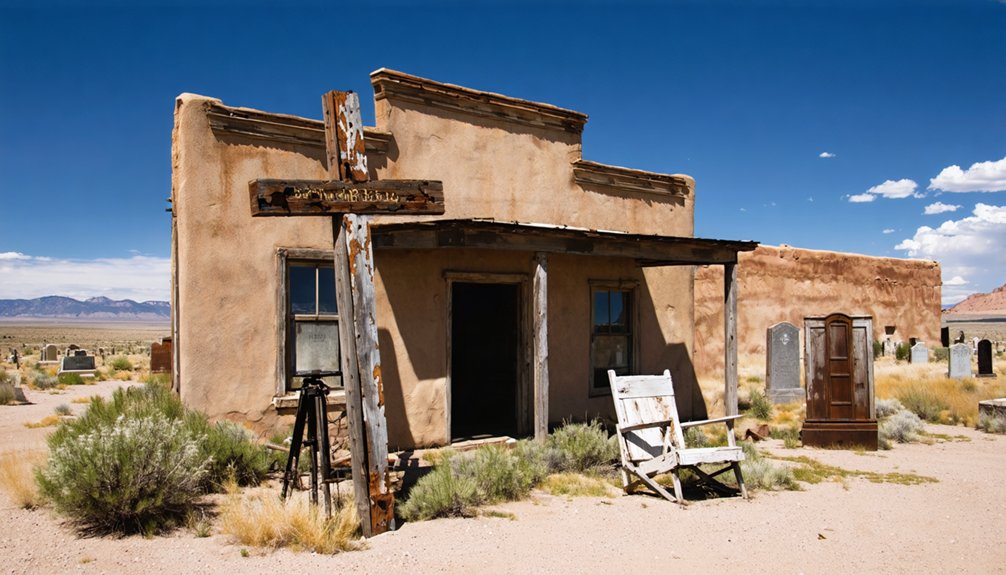
Beyond the weathered adobe walls and photogenic storefronts, Grafton Cemetery tells the unvarnished story of Mormon pioneer survival that Hollywood cameras can’t fully capture. You’ll find 74 to 84 graves documenting the brutal 1866 epidemic season and Native American history conflicts that shaped settlement patterns. Headstones inscribed “Killed by Indians” mark the Berry family’s deaths during Navajo raids—retaliation for Mormon militia actions near Pipe Spring.
Cemetery preservation maintains direct evidence of frontier tensions:
While “Butch Cassidy and the Sundance Kid” brought fame, these graves reveal settlement’s true cost.
Behind the Scenes: Production Challenges and Logistics at Remote Ghost Town Locations
Production crews arriving at Utah’s ghost towns face a logistical matrix where historical preservation mandates collide with modern filmmaking demands.
At Grafton Ghost Town, you’ll navigate restrictions on modifying 19th-century pioneer structures while coordinating equipment logistics across five miles of Highway 191 from Moab.
The Lehi Roller Mills‘ operating facility status limits your production modifications despite its “Footloose” legacy.
You’re managing crew accommodations in remote locations like Kanab Canyon, where film sets must be systematically removed post-production.
Wendover Airfield’s dual mandate—preserving World War II infrastructure while supporting modern shoots—exemplifies your challenges.
When filming at Paria’s remnant movie sets or Lake Powell‘s fluctuating waterlines, you’re balancing environmental constraints with tight schedules, often coordinating local extras and specialized equipment across Utah’s unforgiving terrain.
Planning Your Utah Ghost Town Film Location Tour
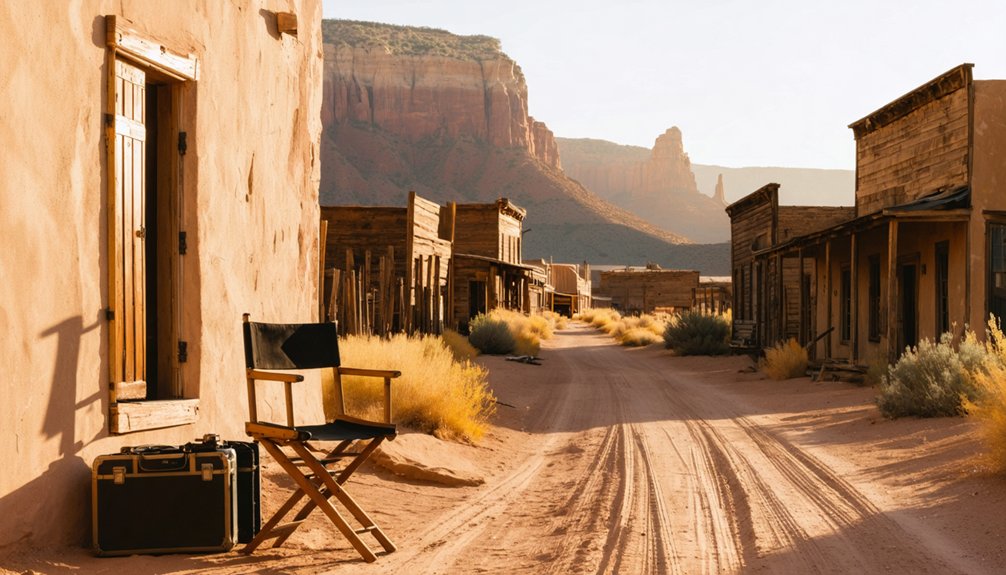
You’ll want to schedule your Utah ghost town film tour between April and October when unpaved roads remain passable and temperatures stay moderate for extended outdoor exploration.
Plan multi-day itineraries that pair morning visits to remote locations like Paria’s color-drenched mesas with afternoon recreation at nearby Zion National Park or Snow Canyon State Park.
Consider basing yourself in Kanab to access the film set graveyard, Grafton’s red rock landscapes, and Cisco’s railroad remnants along a circuit that connects Kane County’s preserved movie structures with eastern Utah’s authentic mining towns.
Best Times to Visit
Since Utah’s desert climate swings between scorching summers and frigid winters, timing your ghost town film location tour requires strategic planning around weather extremes and accessibility challenges.
Climate patterns dictate your exploration window—spring and fall shoulder seasons (April-May, September-October) deliver ideal conditions with 50-70°F temperatures and minimal crowds at sites like Cisco and Grafton.
Visitor accessibility peaks during these months when unpaved roads remain passable without mud or ice.
Optimal visiting conditions:
Combining Film and Recreation
Utah’s ghost town film locations cluster into distinct geographic zones that allow you to stack cinematic history with national park adventures, desert recreation, and red rock exploration. Grafton pairs with Zion hiking and Mount Kinesava views, while Cisco anchors eastern Utah road trips connecting Castle Valley’s Fisher Towers climbing to Canyonlands backcountry.
You’ll find wildlife observation opportunities along the Paria River corridor where mule deer and raptors frequent canyon approaches to old film sets.
Southwestern itineraries link multiple Kanab-area locations—Paria ghost town, equipment graveyards, and historical markers—within single tours.
Between filming location stops, St. George and Moab offer local cuisine that fuels extended exploration days. The Colorado River provides rafting breaks, and Snow Canyon adds technical climbing routes to your ghost town circuit.
Multi-Day Itinerary Options
When mapping your Utah film location circuit, base camp selection determines how efficiently you’ll access multiple ghost towns while maintaining manageable drive times. Southwestern circuits anchor from St. George, positioning you within striking distance of Grafton’s Butch Cassidy bicycle scene and Zion’s cinematic backdrop. Eastern routes use Moab or Green River as staging points for Cisco’s Thelma & Louise truck explosion site and Castle Valley’s Western landscapes.
Strategic multi-day configurations:
Local legends enhance each stop’s atmospheric appeal beyond Hollywood connections.
Frequently Asked Questions
Do I Need Permission to Visit and Photograph Utah’s Ghost Towns?
You don’t need permission to visit most Utah ghost towns like Grafton or Cisco. Legal considerations are minimal, though preservation efforts encourage respectful photography. You’re free to explore these cinematic landscapes, capturing weathered buildings against dramatic red rock backdrops without reservations.
Among these intriguing sites are the underwater ghost towns in Utah, where remnants of past communities peek through the surface of shimmering lakes. These submerged landscapes offer a unique glimpse into history, inviting adventurous souls to ponder the stories hidden beneath the water. As you delve into this lesser-known aspect of Utah, you’ll experience the perfect blend of nature’s beauty and echoes of a bygone era.
Which Ghost Town Locations Are Accessible Year-Round Versus Seasonally?
Year-round access awaits you at all four ghost towns—Grafton, Cisco, Johnson Canyon, and Paria—with no seasonal closures. You’ll find freedom to explore these historical preservation sites anytime, though you should minimize environmental impact during visits.
Are There Guided Tours Available Specifically for Film Location Enthusiasts?
You’ll find self-guided exploration at these film locations rather than organized tours. Historical preservation limits access inside buildings, but you’re free to photograph exteriors and discover movie sets independently across Utah’s cinematic desert landscapes.
What Safety Precautions Should Visitors Take When Exploring Abandoned Structures?
Test structural integrity before entering—avoid rotted beams and unstable floors. Watch for wildlife encounters like rattlesnakes in debris. Wear sturdy boots, bring water, and document your route. Never explore alone in these remote, crumbling film sets.
Can the Public Stay Overnight Near Ghost Town Filming Locations?
You’ll find local accommodations available in Pioneertown, where over 400 residents offer rentals within the actual movie set. Follow safety tips carefully—these historic structures weren’t built for permanence, but they’ll give you authentic Wild West sleeping quarters.