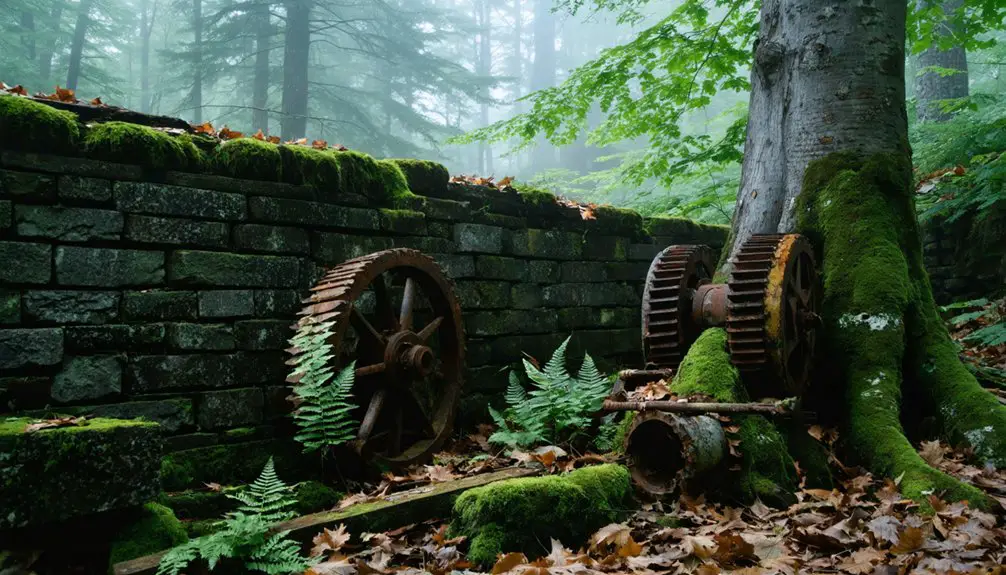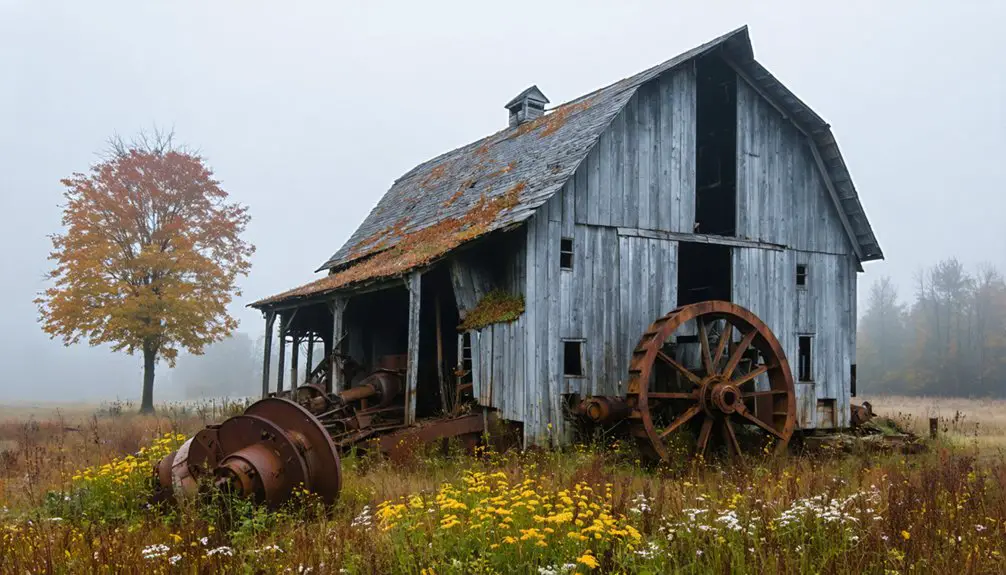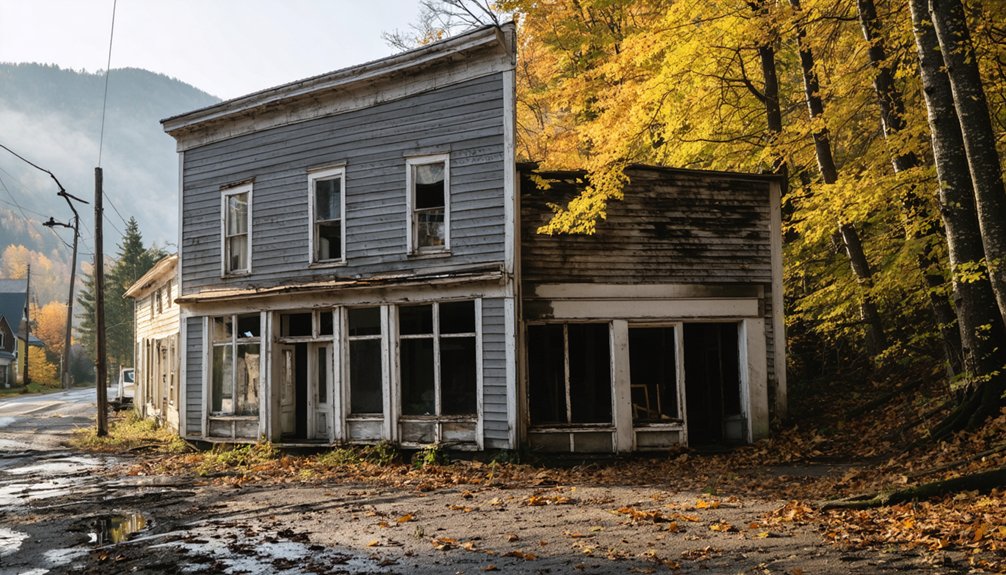
Vermont doesn’t feature actual ghost towns as filming locations, but you’ll find living communities transformed into eerie settings through production design. Woodstock’s most notable example came with *Ghost Story* (1981), where Universal Pictures converted the village into fictional Milburn, using Village Square, Bond Street, and Elm Street Bridge—though 90% of footage was cut. Earlier, *Dr. Cook’s Garden* (1970s) utilized Woodstock’s authentic architecture, while *Way Down East* (1920) captured White River Junction’s waterfalls. The state’s approach favors adapting existing towns over abandoned locations.
Key Takeaways
- Woodstock, Vermont was transformed into the fictional town of Milburn for Universal Pictures’ *Ghost Story* (1981).
- Filming locations in Woodstock included Village Square, Bond Street, Central Street, Elm Street Bridge, and Riverside Cemetery.
- Approximately 90% of Woodstock footage was cut from *Ghost Story’s* final film version despite extensive local filming.
- White River Junction served as a location for *Way Down East* (1920), featuring waterfall scenes with actress Lillian Gish.
- Vermont established its Film Commission in 1995 after rejecting *Peyton Place*, recognizing film production’s economic potential.
Woodstock’s Transformation for Ghost Story Productions
When Universal Pictures selected Woodstock as the primary filming location for *Ghost Story* in 1981, the town’s commercial district underwent a dramatic transformation to portray the fictional New England town of Milburn.
You’ll find that Village Square, Bond Street, and Central Street became functioning movie sets, with local cuisine establishments and visitor attractions coordinating directly with producers.
The Chamber of Commerce projected $300,000 in trade revenue, prompting the Woodstock Inn manager and other businesses to actively invite production teams onto their properties.
Filming locations included the Elm Street Bridge, Riverside Cemetery, and the Windsor County Clerk building at 12 The Green.
A Minuteman monument on Central Street served as one of the historical landmarks visible in the town’s transformation into the fictional setting.
The production was based on Peter Straub’s novel of the same name, bringing the horror story’s atmospheric New England setting to life in Vermont’s picturesque landscape.
Ironically, approximately 90 percent of Woodstock’s footage was cut from the final theatrical release, though the production demonstrated Vermont’s capability for major motion picture work.
Revolutionary War Statue Installation at Village Square
Vermont’s Revolutionary War commemorations manifest through two distinct sculptural installations that anchor separate downtown corridors across the state.
Two Revolutionary War monuments stand in different Vermont cities, each preserving distinct stories of colonial resistance through permanent stone memorials.
You’ll find the seven-foot marble Ann Story sculpture at Rutland‘s West Street and Cottage Street intersection. It was revealed October 19, 2019, through collaborative efforts between Green Mountain Power, MKF Properties, Carving Studio, and Vermont Quarries.
This downtown sculpture trail enhancement honors the Revolutionary War hero through meticulous sculpture craftsmanship funded by $40,000 in family donations. The marble piece depicts Ann Story and her son Solomon peering from a doorway, with Solomon holding an ax as both figures gaze in opposite directions.
Meanwhile, Bennington’s 306-foot-4.5-inch stone obelisk—Vermont’s tallest structure—commemorates the August 16, 1777 Battle of Bennington victory.
Completed in 1889 from blue-grey magnesian limestone, this historical preservation effort required $112,000 originally and demands $40 million for ongoing restoration. The monument’s installation was completed on March 6, 1891, marking its official dedication at 15 Monument Circle.
Both installations represent Vermont’s commitment to accessible Revolutionary War heritage.
Filming Locations Along Bond Street and Elm Street Bridge
During *Ghost Story*’s 1980 production in Woodstock, Bond Street and the Elm Street Bridge served as minimally altered filming locations that preserved the town’s authentic architectural character while portraying the fictional Milburn.
You’ll find these sites required far less preparation than Village Square’s elaborate period filming transformations. Bond Street’s commercial streetscapes appeared on screen with retained original facades. Meanwhile, the Elm Street Bridge provided picturesque exterior shots using its natural setting.
This location preservation approach aligned with Woodstock’s community-supported filming agreement, approved by a four-to-one petition margin through the Chamber of Commerce.
Though Peter Jennison estimates 90 percent of Woodstock footage was ultimately cut, these unaltered locations demonstrate how production teams leveraged Vermont’s existing architecture rather than constructing artificial sets. Vermont’s distinctive landscapes and authentic small-town settings attracted filmmakers throughout the 1980s and beyond, making it a sought-after location for productions seeking genuine New England character. The state’s railroad stations and historic sites continued to serve as authentic film settings for productions well into the following decades.
This was a practical choice that respected both budget constraints and residents’ preferences for minimal disruption.
The Fate of Woodstock’s Ghost Story Footage
The extensive Woodstock filming ultimately yielded minimal screen time in *Ghost Story*’s December 1981 release. Peter Jennison documented that approximately 90 percent of Woodstock footage was cut, including the North Universalist Chapel interior, Riverside Cemetery scenes, and Bond Street sequences.
You’ll find the Village Square transformation and Elm Street Bridge received minimal screen time despite significant production efforts. This massive deletion raised local community reactions about disruption versus economic benefit.
Historical preservation concerns emerged when crews temporarily replaced the Village Square’s Revolutionary War statue with a dummy. The Windsor County Courthouse, which locals claim experiences mysterious door movements and phantom footsteps, also served as a filming location during production.
The deleted courthouse scenes at Windsor County Clerk and café footage from 11 Central Street represent lost opportunities for showcasing Woodstock’s authentic architecture.
The film retained only the climactic White River Junction ice floe sequence.
Dr. Cook’s Garden Television Movie in Early 1970s Vermont
The production’s commitment to film preservation and location authenticity established essential precedents:
- On-location shooting replaced studio backlots, capturing Vermont’s architectural character.
- Local landscapes provided genuine small-town atmosphere for the thriller’s dark narrative.
- Community participation demonstrated Vermont’s viability as a filming destination.
- Economic benefits flowed directly to Woodstock businesses and residents.
This Paramount Television production aired January 19, 1971, proving that independent filmmakers could bypass Hollywood constraints while maintaining technical precision. The film featured Bing Crosby’s final screen performance as the morally complex Dr. Leonard Cook, marking a departure from his traditional wholesome roles. Production took place in Woodstock, Vermont during September 1971, utilizing the town’s authentic New England architecture and rural character.
Way Down East’s White River Junction Waterfall Sequences
Half a century before *Dr. Cook’s Garden*, D.W. Griffith’s 1920 silent film *Way Down East* transformed White River Junction into a dramatic waterfall sequence. You’ll find that historical preservation efforts now commemorate where Lillian Gish floated unconsciously on dynamited ice floes toward a low dam substituting for Niagara Falls.
The crew worked relentlessly through March blizzards, sawing frozen Connecticut River sections and controlling floes with ropes. Gish performed without doubles, permanently damaging her hand in frigid water during 90-mph gales. Richard Barthelmess risked drowning jumping ice chunks in fur coats. Dorothy Barthelmess also performed stunt work alongside Gish during the treacherous ice-floe sequences.
Griffith pioneered parallel-action editing here, combining footage from White River at Hartford and Farmington, Connecticut rivers. Local tourism benefits from this filmmaking legacy, where extreme dedication produced cinema’s most dangerous rescue sequence without modern safety protocols.
Peyton Place Proposal and Community Opposition
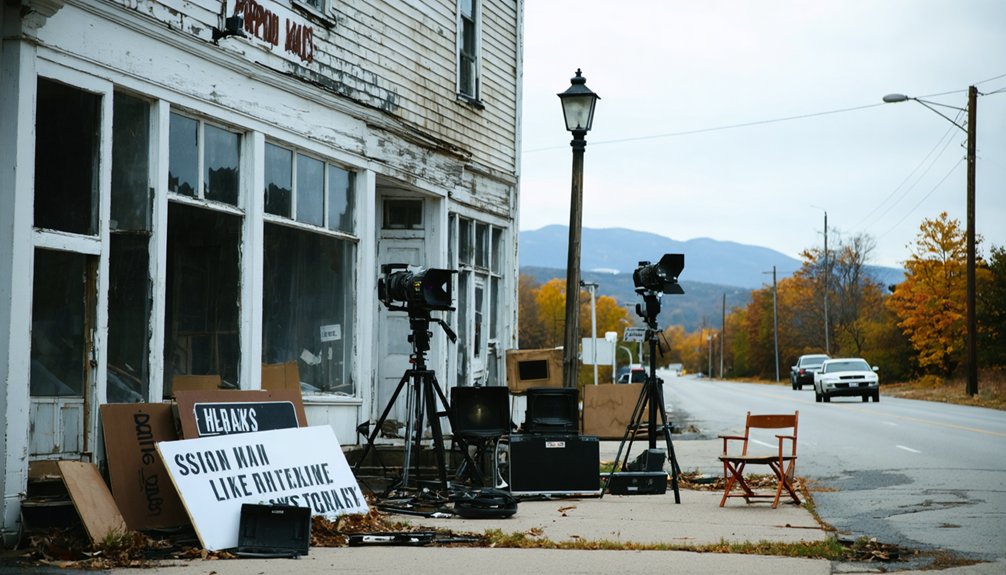
- Vermont towns refused association with content depicting adultery, sexual abuse, and murder.
- Gilmanton, New Hampshire—the novel’s inspiration—declined despite wary fame.
- Twenty New Hampshire communities turned down location shooting requests.
- Leaders avoided linking real places to fictional scandal.
This widespread opposition forced producers to pivot toward Maine in June 1957, ultimately selecting Camden after exhaustive scouting.
Vermont Film Industry Growth Through the 1990s
Decades after Vermont communities rejected Peyton Place, state officials recognized they’d missed significant economic opportunities by turning away film productions.
Vermont’s rejection of Peyton Place taught state officials a costly lesson about the economic value of film production.
You’ll find that Vermont’s 1995 Film Commission establishment under the Department of Tourism and Marketing marked a strategic shift toward talent recruitment and budget improvements.
Director Bill Stetson actively courted Hollywood productions, implementing tax credits from 1998 that attracted major pictures like What Lies Beneath with Harrison Ford and Me, Myself & Irene starring Jim Carrey.
The state’s golden age peaked in the late 1990s, though you’d notice Vermont’s indie filmmaking reputation proved more sustainable than chasing blockbusters.
Without competing incentive packages matching other states and Canada, Vermont couldn’t maintain Hollywood’s interest once producers found better deals elsewhere.
Rutland’s Evolution as a Recurring Production Hub
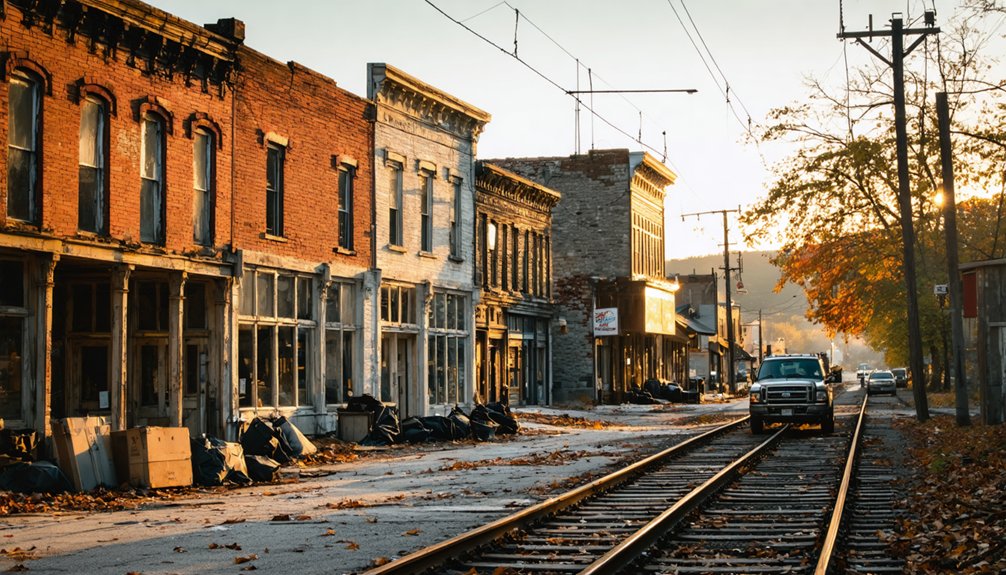
You’ll find Rutland’s film infrastructure spans nearly a century, anchored by the Paramount Theatre’s 1914 opening for vaudeville and cinema through its 1975 closure. Then its 2000 restoration for cultural events.
The city’s production capacity expanded markedly with David Giancola’s establishment of Edgewood Studios at the 18-acre Howe Center site, converting former industrial facilities into a dedicated filmmaking hub. This evolution positioned Rutland to capitalize on Vermont’s late-1990s commercial shoot boom and subsequent 2011-2025 state-level creative economy initiatives.
These developments transformed Rutland from a historic exhibition venue into an active production base.
Multiple Production History
Between 1996 and 2011, Rutland transformed from an occasional filming location into Vermont’s most active independent film production hub, hosting at least six feature films and numerous regional shoots within its city limits.
You’ll notice Rutland’s production trajectory follows a distinct pattern:
- 1996-1997: Initial momentum with *Diamond Run* and *Pressure Point* establishing technical capabilities.
- 2005 peak: Three productions (*Illegal Aliens*, *Zombietown*, *The Blood in This Town*) demonstrating sustained infrastructure.
- Genre diversity: Horror, suspense, and zombie films choosing Rutland’s atmospheric locations.
- Regional integration: Shoots extending to Fair Haven, Dorset, and Poultney while maintaining Rutland as base operations.
Director David Giancola’s repeated selection of Rutland created filming legends that attracted other independent filmmakers.
The city’s infrastructure supported multiple annual productions by 2005, rivaling Vermont ghost towns in atmospheric appeal while offering modern logistical advantages.
Edgewood Studios Connection
When David Giancola founded Edgewood Motion Picture & Video in a small plaza off Route 7, he couldn’t have anticipated that his wedding videography business would evolve into Vermont’s most prolific independent film studio. Over 35 years, Edgewood Studios transformed Rutland into a recurring production hub.
The studio mastered location scouting across the region’s industrial sites and rural landscapes. The 1994 sci-fi film “Time Chasers” showcased this expertise, utilizing the renovating Howe Center as a dystopian backdrop alongside mid-1980s Rutland locations that remain recognizable today.
You’ll find Edgewood’s commitment to film preservation through their merchandise sales, including vintage Castleton State College shirts from the original production. Their technical reputation attracts Vermont filmmakers seeking quality equipment and post-processing.
This has established Rutland as the state’s de facto independent film capital.
Infrastructure Development Over Time
You’ll observe four distinct infrastructure development phases:
- 1996-2000: Initial equipment procurement and crew training periods
- 2002: *The Mudge Boy* expanded regional connectivity to surrounding municipalities
- 2005: Dual productions (*Illegal Aliens*, *Zombietown*) tested maximum capacity
- 2011: *Craptastic* validated sustained industrial infrastructure despite economic downturns
This progression created embedded production knowledge—camera operators became gaffers, location scouts evolved into production coordinators, and local businesses adapted services specifically for film crews’ technical requirements.
Frequently Asked Questions
Are Any of Vermont’s Actual Ghost Towns Available for Film Productions?
Vermont ghost towns like Glastenbury aren’t officially available for film productions due to their remote, reclaimed nature. You’ll find underground legends and cellar holes accessible via trails, but they lack infrastructure and legal frameworks necessary for professional filming operations.
What Permits Are Required to Film in Vermont’s Small Towns?
You’ll need to contact each town clerk directly for their specific film permit procedures and town approval requirements. Burlington and Montpelier have formal processes, while smaller towns handle approvals individually. You’ll also need proof of general liability insurance.
How Much Do Film Productions Typically Pay Vermont Communities for Location Use?
Like Hollywood’s golden handshake, you’ll find Vermont location fees aren’t publicly disclosed. Productions negotiate privately with property owners and municipalities, though film tourism and local economy benefits—like *Beetlejuice’s* East Corinth boost—often outweigh direct payments received.
Which Vermont Ghost Towns Have the Best Preserved Historical Buildings for Filming?
East Corinth and Woodstock offer you the best-preserved historical buildings for filming, with intact bridges, period facades, and unaltered structures. Their historical preservation standards and straightforward filming logistics make them ideal for productions seeking authentic Vermont architecture without restrictions.
Do Film Crews Restore Locations After Production or Leave Set Modifications?
Ever wonder what remains after cameras stop rolling? Film crew responsibilities typically include removing temporary props, but post-production restoration rarely happens. You’ll find most Vermont locations keep modifications minimal—think temporary signage rather than structural changes requiring restoration work.
References
- https://www.woodstockhistorycenter.org/articles/2022/7/26/vermont-in-film
- https://www.vermonter.com/movies-filmed-in-vermont/
- https://vtliving.com/film/
- https://www.oreateai.com/blog/cinematic-vermont-a-journey-through-films-shot-in-the-green-mountain-state/dc23cbe80bd2654e8961fb8a78047d84
- https://www.youtube.com/watch?v=BCT4Irx4IPU
- https://www.kinoafisha.info/en/movies/8362571/locations/
- http://cultfilmlocations.blogspot.com/2017/11/ghost-story-1981.html
- https://en.wikipedia.org/wiki/Ghost_Story_(1981_film)
- https://greenmountainpower.com/news/rutland-sculpture-honors-revolutionary-war-hero-ann-story/
- https://www.legion.org/memorials/united-states/vermont/united-states-vermont-bennington-battle-monument