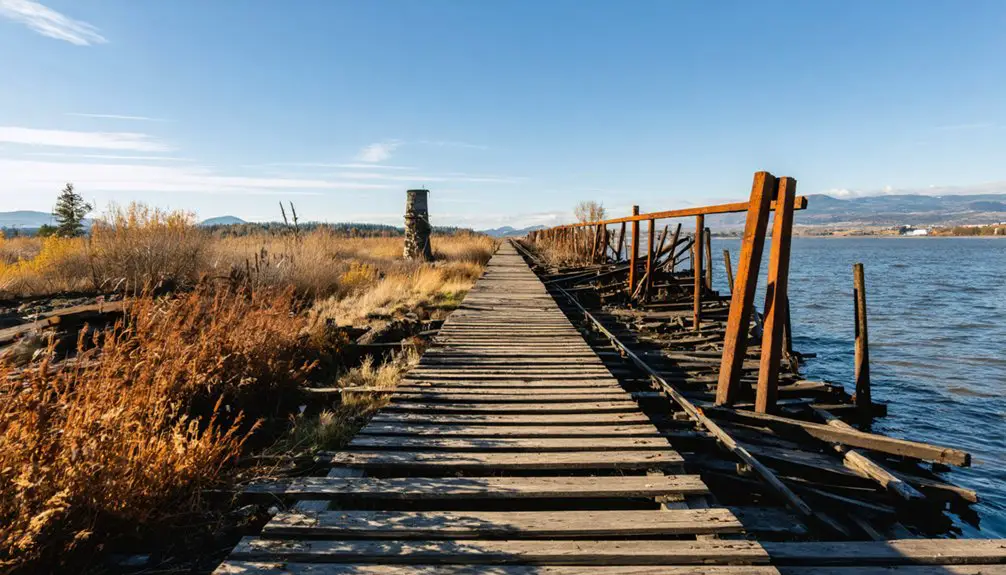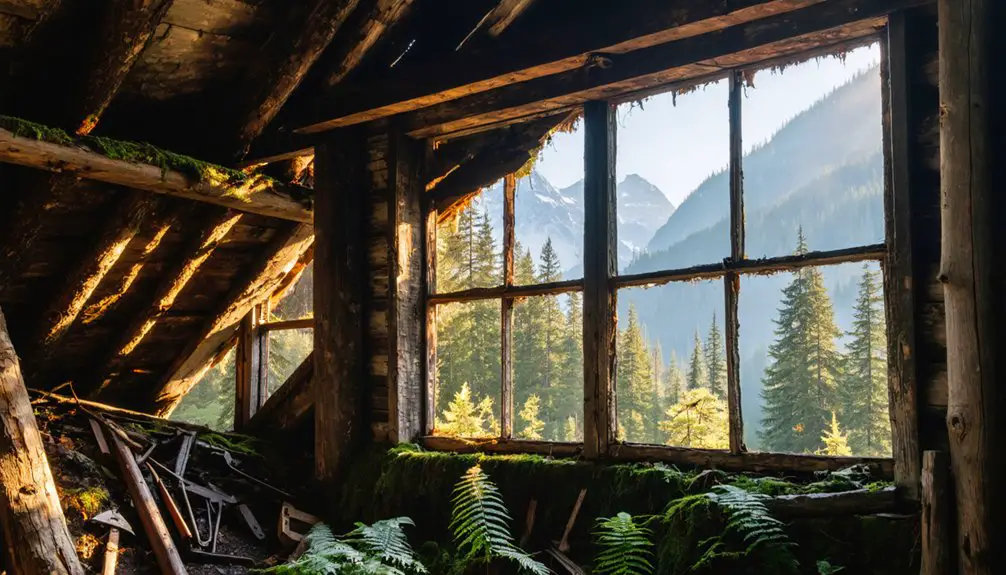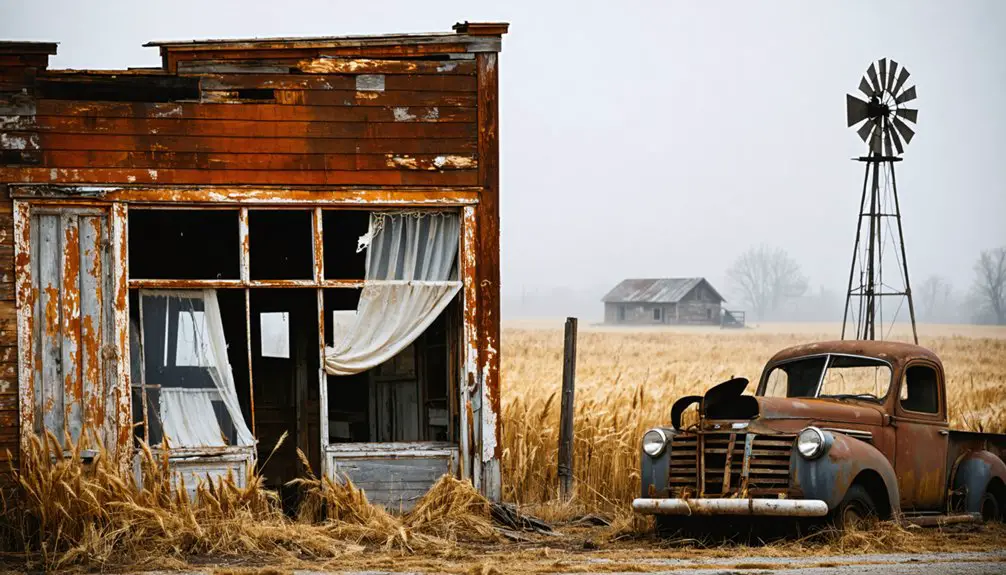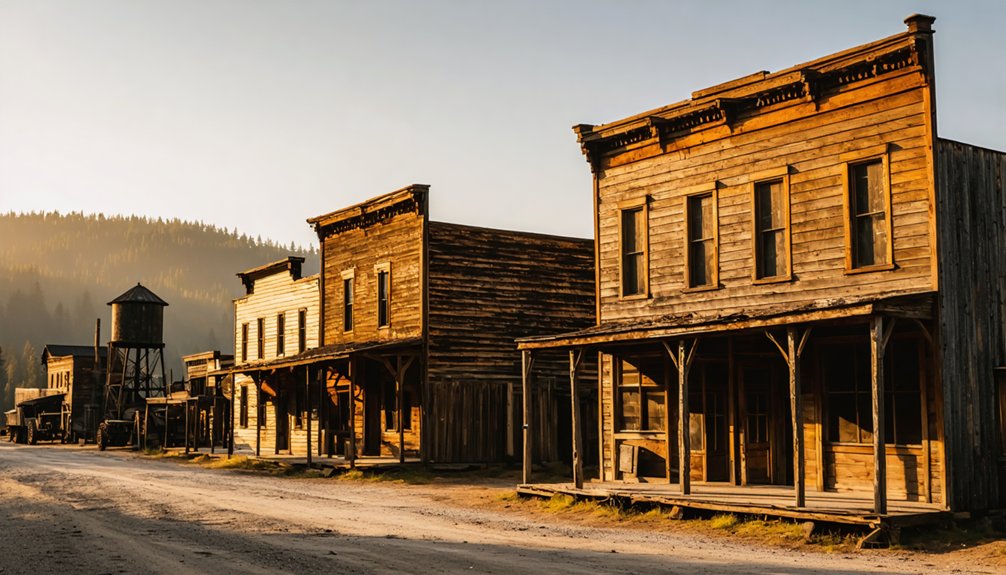
You’ll find Washington’s remote settlements like Index serving as authentic backdrops for supernatural thrillers, leveraging their Pacific Northwest isolation for productions including *The Stairs* and *Z Nation*. Former logging outposts near Sultan provide dense forest corridors with weathered structures perfect for survival scenarios, while industrial sites at Newhalem—featuring the Gorge Powerhouse and Engine Number 6—transform into 1920s company towns for political dramas. These locations offer production teams ready-made sets where decades of abandonment create naturally distressed environments that capture both wilderness authenticity and historical atmosphere without artificial construction.
Key Takeaways
- Washington’s small towns like Index and Winlock provide authentic Pacific Northwest backdrops for supernatural thrillers and regional legend films.
- Newhalem’s historic industrial sites recreate 1920s company towns, offering atmospheric ghost-town settings for political thrillers and period productions.
- Remote forest locations near Sultan feature abandoned logging roads and clearings that serve as wilderness and survival film settings.
- Leavenworth’s Bavarian architecture, established since 1925, transforms into versatile European-style village backdrops for diverse film productions.
- Rural farmlands along the SR 9 corridor provide pastoral landscapes depicting abandoned or isolated settlements for cross-country journey films.
Index: Where Bigfoot Legends Meet Hollywood
While Index, Washington sits nestled between towering Cascade peaks and the Skykomish River, its rugged terrain has attracted filmmakers seeking authentic Pacific Northwest backdrops for supernatural thrillers. *The Stairs* production crews spent three-quarters of their shooting schedule in the Index area, with additional scenes filmed in Shoreline and Snohomish.
The Espresso Chalet became both base camp and story location, featuring local cast members while surrounding fields staged crew operations. You’ll find Index’s haunted history and abandoned structures provided perfect settings for zombie apocalypse narratives too—*Z Nation* season 3’s “Everyone Dies in the End” utilized nearby roads and fields during a three-week Snohomish and Island counties shoot.
These remote locations offer filmmakers unrestricted access to weathered landscapes where civilization’s edges blur into wilderness. Washington’s regional Bigfoot legends have similarly drawn indie comedy productions to small towns like Winlock, where filmmakers embrace the Pacific Northwest’s cryptid mythology for quick-turnaround projects. SyFy’s original movie “Bigfoot” filmed at Tolt-MacDonald Park in Carnation, featuring Alice Cooper and Danny Bonaduce in a story about attacks on an 80s rock festival.
Sultan: Forest Wilderness Transformed for Action Cinema
You’ll find Sultan’s dense Cascade forests served as the primary filming location for *Edge of Honor* (1991).
Here, Corey Feldman’s action sequences unfolded beneath towering timber that once fueled the town’s logging economy.
The production team captured establishing shots at Hurricane Ridge and coastal lighthouses before returning crews to Sultan’s remote woodland for the majority of filming.
These isolated forest settings provided the authentic wilderness backdrop needed for adventure cinema while maintaining proximity to Seattle’s production infrastructure.
Sultan joined other communities like Monroe, where the Monroe Correctional Complex hosted prison fight scenes for films including *The Butterfly Effect*.
Unlike some productions that receive DVD and Blu-ray releases, *Edge of Honor* followed a similar distribution pattern to other independent action films of the early 1990s.
Edge of Honor Production
Released in 1991, Edge of Honor transformed the dense forests surrounding Sultan, Washington into a harrowing wilderness battleground where Boy Scouts face off against criminals in director Michael Spence’s survival thriller.
You’ll find Corey Feldman leading the cast through Sultan’s Cascade Loop region, where production crews utilized the area’s thick forest canopy and natural terrain to amplify the film’s survival stakes.
While the Olympic Peninsula setting frames the narrative, Sultan’s woods provided the authentic Pacific Northwest backdrop for the action sequences.
The production avoided Hurricane Ridge except for establishing shots, concentrating filming around Sultan’s wilderness.
Boy Scout themes merge with dark thriller elements as characters employ survival skills against Don Swayze’s unhinged antagonist, creating a forgotten adventure that showcases Washington’s untamed forests as both refuge and threat.
The carefully chosen backgrounds enhance realism and emotional depth, much like military justice dramas that explore ethical dilemmas through authentic settings.
Fort Warden State Park, part of Washington’s historic Triangle of Fire defense system, later gained fame as the primary filming location for “An Officer and a Gentleman” with its authentic military structures.
Hurricane Ridge Establishing Shots
Though Edge of Honor’s narrative unfolds on the Olympic Peninsula, production crews captured Hurricane Ridge’s alpine panorama strictly for establishing shots before shifting cast and equipment to Sultan’s forested terrain 90 miles northeast.
You’ll recognize the 5,242-foot ridge‘s sweeping vistas in opening sequences—snow-capped peaks stretching toward Canada across the Strait of Juan de Fuca, accessed via the winding 18-mile Hurricane Ridge Road from Port Angeles.
The 1991 film utilized these high-elevation landscapes to establish wilderness authenticity, though today’s visitor experience differs notably. Climate change has altered snowpack patterns that once guaranteed winter filming conditions.
Production teams selected specific viewpoints near the visitor center, capturing the Bailey Range’s dramatic backdrop before moving to Sultan’s lower-elevation forests where Corey Feldman and the principal cast executed action sequences under denser canopy cover. The Olympic Peninsula loop encompasses 300 miles of diverse terrain including rainforests, lakes, and historic lodges that have attracted filmmakers for decades. Visitors can explore mountain vistas and waterfalls at Hurricane Ridge, where misty evergreens frame the same scenic overlooks that filmmakers used to establish the movie’s remote wilderness setting.
Remote Forest Action Scenes
Sultan’s dense old-growth forests provided the primary shooting grounds for Edge of Honor’s intense chase sequences and wilderness survival scenes.
You’ll find these untamed landscapes northeast of Seattle, where towering Douglas firs and western red cedars create natural corridors perfect for high-stakes pursuits.
The production team capitalized on the area’s rugged terrain, transforming logging roads into tactical escape routes while maintaining the authentic wilderness atmosphere that urban exploration enthusiasts and wildlife photography specialists prize.
The forest’s thick canopy filtered sunlight, creating dramatic shadows essential for the film’s tension-building moments.
Location scouts identified clearings near the Skykomish River for establishing shots, while dense undergrowth sections became tactical ambush points.
You won’t find typical Hollywood artifice here—Sultan’s raw wilderness delivered genuine isolation that amplified every footfall and branch snap.
The site’s categorization as a place name disambiguation helped location managers efficiently identify multiple suitable filming areas within the broader Sultan region.
While Vancouver, BC attracts many productions with competitive tax incentives, Sultan’s authentic Pacific Northwest terrain offered irreplaceable natural features that set design alone couldn’t replicate.
Sisco Heights: Rural Landscapes for Comedy and Drama
You’ll find Sisco Heights’ open rural terrain between Arlington and Marysville provided the visual backdrop for *Bustin’ Loose* (1981), where Richard Pryor’s comedy-drama required authentic pastoral settings along Washington’s State Route 9 corridor.
The production team utilized the area’s farmland east of 67th Avenue NE to frame exterior sequences showing the cross-country journey of inner-city children to their new rural home.
Leavenworth’s mountain landscapes complemented these Snohomish County locations, creating the film’s contrasting urban-to-wilderness transformation arc.
Bustin’ Loose Production Details
When Universal Pictures selected Washington’s Snohomish County for *Bustin’ Loose* in 1981, the Sisco Heights area became a crucial filming backdrop for the road comedy-drama’s rural destination sequences.
You’ll find this locale provided authentic Pacific Northwest terrain for Richard Pryor’s cross-country bus journey, where eight special needs children traveled from Philadelphia to a Washington farm.
The production team navigated filming challenges across Snohomish’s rugged landscapes, capturing both comedic moments and dramatic scenes essential to the redemption narrative.
Sisco Heights’ undeveloped terrain offered visual contrast between urban desperation and rural hope, while the area’s local history as agricultural land reinforced themes of freedom and new beginnings.
Director Oz Scott utilized these open spaces to showcase the characters’ transformation during their 1 hour 34-minute journey toward independence.
Leavenworth Area Film Settings
Leavenworth’s transformation into a Bavarian-themed village in the 1960s created film-ready architecture that has served productions for nearly a century, beginning with “The Ancient Highway” in 1925.
You’ll find this Alpine setting has attracted diverse productions from Disney’s 1978 “Three on the Run” to Amazon’s 2023 rom-com “Somebody I Used to Know,” starring Alison Brie.
The town’s Leavenworth charm extends beyond downtown, with nearby Cashmere orchards and The Outpost Saloon providing versatile backdrops.
Recent holiday films capitalize on the location’s marketability:
- Lifetime’s “Cloudy with a Chance of Christmas” (2022) featured meteorologist storylines
- “All I Want For Christmas” (2012) branded the setting as “Christmastown USA”
- Seasonal decorations enhance the town’s year-round winter aesthetic
- Maypoles, reindeer attractions, and Bavarian architecture create instantly recognizable visual elements
Lake Chelan: Mountain Beauty in Classic Film Productions
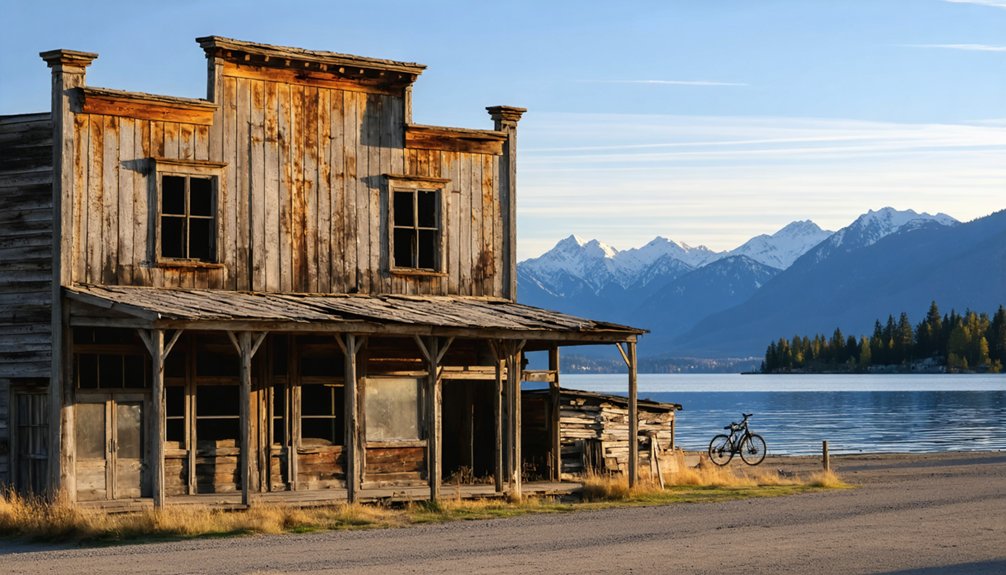
Lake Chelan’s dramatic alpine scenery has doubled for Scottish highlands and exotic mountain retreats since Hollywood discovered the location during World War II.
Lake Chelan’s alpine peaks have convincingly portrayed Scottish highlands and remote mountain sanctuaries for Hollywood productions since the 1940s.
You’ll find filming location history at Railroad Creek near Lucerne, where MGM shot most of “Courage of Lassie.” The production relied on steamer Cascade Flyer for supplies until it sank below Safety Harbor—locals recovered canned groceries washing ashore afterward.
“Lassie Come Home” captured scenic lake views that mimicked Scottish lochs, with crews constructing an entire village in nearby Brinnon.
Later productions like “Lost Horizon” and “The Parallax View” utilized the valley’s remote landscapes, including Stehekin’s Historic Buckner Orchard.
You can still access these isolated filming sites via Lady of the Lake boat, experiencing the same rugged terrain that attracted Hollywood’s location scouts decades ago.
Newhalem: Cascade Scenery for Political Thrillers
- Gorge Powerhouse museum showcasing hydroelectric operations
- Engine Number 6 from Skagit River Railway
- Temple of Power gazebo with recycled electrical equipment
- 1920 General Store and company town architecture
These Cascade Loop settings provided the remote, industrial aesthetic thriller productions required.
Mead: Industrial Ruins in Post-Apocalyptic Television
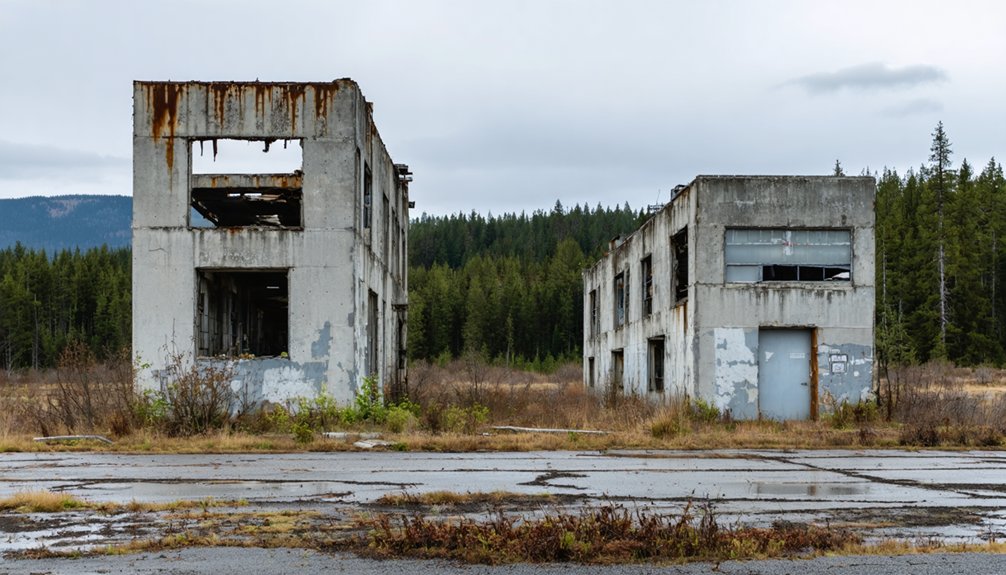
When the Defense Plant Corporation constructed the massive aluminum facility in Mead in 1942, they couldn’t have envisioned its transformation into a post-apocalyptic filming location seventy years later. The Kaiser Aluminum plant operated until 2000, leaving behind sprawling industrial decay perfect for Z Nation’s fourth season.
Spokane-based North by Northwest Inc. shot scenes throughout the abandoned complex in 2014, utilizing guard shacks, research buildings, and warehouse structures. You’ll find remnants of zombie action scattered through Building 44 and demolished shower facilities.
The abandoned industrial complex offered guard shacks, research buildings, and warehouses that became authentic zombie battlegrounds requiring no digital enhancement.
The production employed 75 extras per episode at $90 daily, completing four to five major scenes during twelve-hour shoots.
Though now redeveloped as North Spokane Industrial Park, the site’s post apocalyptic scenery provided authentic backdrops for television’s zombie wasteland—no CGI required.
Frequently Asked Questions
Are These Washington Filming Locations Accessible to the Public Year-Round?
You’ll find most Washington filming locations open year-round without access restrictions. Twin Peaks sites, Practical Magic’s Coupeville streets, and Z Nation’s Spokane landmarks offer unrestricted seasonal access. However, you’ll need permission for Stadium High School’s interior spaces.
What Permits Are Required to Film in These Washington Ghost Towns?
You’ll need location-specific permits since 73% of Washington ghost towns sit on mixed private-public land. Permit requirements and legal considerations vary drastically—from simple landowner consent to complex federal authorizations, depending on each site’s jurisdiction and ownership status.
Which Ghost Town Location Has Been Used Most Frequently for Filming?
None of these ghost towns have documented filming frequency. You’ll find remote location challenges prevent them from becoming popular filming spots. The rugged terrain, limited access, and lack of infrastructure make these authentic Washington sites logistically difficult for productions.
How Do Filmmakers Find and Select These Remote Washington Locations?
Despite remote access challenges, you’ll discover filmmakers partner with regional film commissions and tourism boards who maintain location databases, while preservation considerations guide selections through historical societies offering vetted access to architecturally authentic, visually striking ghost town sites statewide.
Do Local Communities Benefit Economically From These Film Productions?
You’ll see direct economic impacts through location fees, crew lodging, and equipment rentals. Community engagement flourishes as locals work as extras, provide catering services, and later attract film tourism—transforming forgotten ghost towns into revenue-generating destinations.
References
- https://stateofwatourism.com/filmed-in-washington-state/
- https://newstalkkit.com/filming-locations-washington-state/
- https://kffm.com/7-worst-movies-ever-filmed-in-washington/
- https://www.theamericanroadtripcompany.co.uk/blog/pacific-northwest/top-5-movie-locations-pacific-northwest/
- https://www.cascadeloop.com/filmed-on-the-cascade-loop
- https://bigfootkilledmywife.com/making-of/
- https://www.valleyrecord.com/news/petes-hosts-carnation-set-movie-premiere-of-bigfoot-with-alice-cooper-tv-stars-slideshow/
- https://www.heraldnet.com/life/bigfoot-zombies-and-viggo-mortensen-whats-been-filmed-near-index/
- https://www.cascadepbs.org/culture/2021/08/artsea-searching-bigfoot-snoqualmie-valley/
- https://www.columbian.com/news/2024/aug/28/feet-of-death-sw-washington-filmmakers-bigfoot-story-to-screen-thursday-at-the-kiggins-in-vancouver/