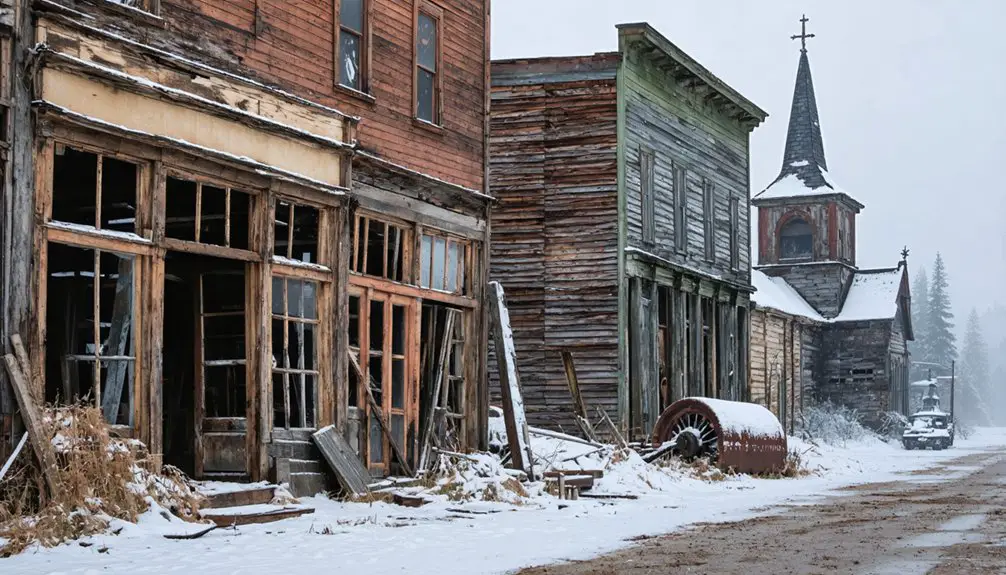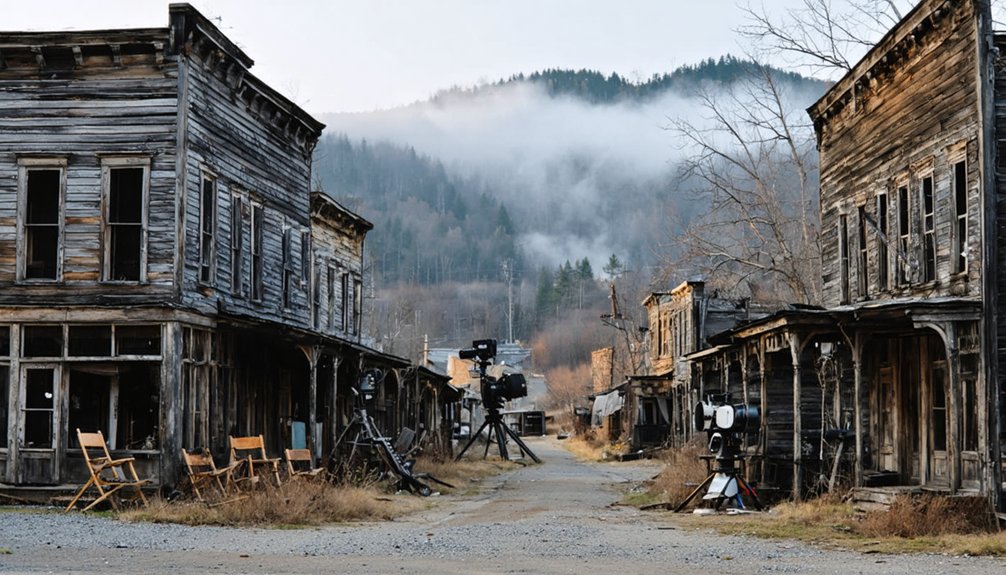
You’ll find Thurmond in the New River Gorge serving as the primary filming location for John Sayles’ *Matewan*, where its nearly abandoned railroad town provided authentic early 1900s architecture—including the C&O depot, National Bank building, and hillside boarding houses—without requiring set construction. Over 60% of original structures remain intact, offering weathered storefronts, period brickwork, and coal-era industrial sites. Weirton’s Main Street was similarly transformed into fictional 1970s Ohio for *Super 8*. Exploring these preserved communities reveals how West Virginia’s ghost towns became versatile cinematic backdrops.
Key Takeaways
- Thurmond served as the primary filming location for *Matewan*, utilizing its authentic abandoned buildings, railroad depot, and commercial structures from the early 1900s.
- Over 60% of Thurmond’s original structures remain historically intact, including hillside homes, the C&O depot, and weathered commercial buildings ideal for period films.
- The town’s preserved 1904 railroad depot, coaling tower, and industrial relics provide authentic early-20th-century industrial backdrops for movie production.
- Weirton’s Main Street was transformed into fictional Lillian, Ohio for *Super 8*, demonstrating West Virginia’s versatility as a filming location using existing structures.
- Thurmond is accessible within New River Gorge National Park, offering filmmakers authentic ghost town atmosphere with minimal modern alterations required.
Thurmond: The Star of John Sayles’ Matewan
Nestled in the depths of New River Gorge National Park, Thurmond served as the primary filming location for John Sayles’ 1987 labor drama *Matewan*. When cameras rolled, this former coal town was already nearly abandoned—its distinctive building facades, railroad tracks, and gorge setting providing authentic period atmosphere without extensive set construction.
You’ll recognize the Banker’s Club restaurant inside the former National Bank and the depot exterior in key sequences. Director Sayles shot boarding house scenes in hill homes above the holler, carefully budgeting daylight in the shadowed gorge. The production team cast local and regional actors to enhance the film’s authenticity, including a young Louisville teen who portrayed both narrator and preacher. The film features notable actors like Chris Cooper, James Earl Jones, and Mary McDonnell.
The film tourism impacts transformed Thurmond into a walking tour destination, while eco tourism development through NPS management preserved its authenticity.
Today, you can explore these shooting locations freely, discovering how Sayles unearthed the region’s buried labor history.
Why Thurmond Was Chosen Over the Real Matewan
When John Sayles scouted locations in 1986, Thurmond’s virtual abandonment gave him what the actual town of Matewan couldn’t: complete creative control over a 1920s coal town frozen in time.
Matewan’s 412 residents, active Norfolk Southern railway operations, and ongoing urban renewal efforts would’ve complicated the seven-week shoot.
You’ll notice Thurmond’s population of five meant zero interference—no modern storefronts, no traffic, no residents disrupting period authenticity.
The ghost town’s buildings lined a single street along railroad tracks, their distinctive facades perfectly matching Sayles’ Western-like shootout vision.
Meanwhile, Matewan’s tourism development and flood prevention projects, including the massive 2,350-foot floodwall, would’ve compromised the film’s authentic 1920 aesthetic.
Thurmond delivered complete freedom from modern intrusions.
The town’s location on Tug Fork of the Big Sandy River provided the essential geographic authenticity that matched the historical setting of the Mine Wars.
Haskell Wexler’s cinematography emphasized the dirt, sweat, and grim struggle of coal country without overpoetry, capturing the location’s raw authenticity that earned him an Oscar nomination at the 60th Academy Awards.
Iconic Thurmond Buildings That Appear on Screen
You’ll notice the former National Bank building’s distinctive facade appearing throughout *Matewan*. It now houses the Banker’s Club restaurant that serves as a recognizable landmark in multiple scenes.
The preserved storefronts along Thurmond’s main streets provide authentic 1920s coal mining era architecture that required minimal set dressing for filming. Thurmond’s location along the New River Gorge made it an ideal filming site for capturing the region’s natural beauty alongside its historic coal mining heritage. The town’s historic significance is preserved today as part of the New River Gorge National Park and Preserve.
Period residential structures on the hillside, including the abandoned home used for Mary McDonnell’s boarding house scenes, maintain their original character and create visually accurate domestic settings for the film’s narrative.
Historic Hotel and Theater
The 1987 film *Matewan* transformed Thurmond’s century-old structures into a convincing stand-in for the coal town of Matewan, Kentucky, with director John Sayles capturing the settlement’s distinctive building facades throughout the New River Gorge production.
You’ll spot the former National Bank building, now Banker’s Club restaurant, prominently featured in street scenes—its iconic facade representing the coal boom’s commercial hub along the Chesapeake & Ohio Railway.
The hilltop boarding house where Mary McDonnell’s character resided was John Bullock’s circa-1900 structure, known as Fatty Lipcomb’s, which served the Littlepage family before becoming rafters’ lodging.
The C&O depot anchors exterior shots, its theater-like presence essential to Thurmond’s National Register listing.
The Dun Glen Hotel, a 4½-story wooden establishment built in 1900, towered over the town before it burned in 1930 under suspicious circumstances.
Unlike medieval architecture or contemporary art installations, these preserved structures offer authentic American industrial heritage.
Reconstructed Bank Facades
Among Thurmond’s most photographed structures, the National Bank building commands Commercial Row with its limestone classical revival facade—a 1920s remodeling that replaced the original 1917 cast iron storefront when the bank relocated from Hotel Thurmond in 1923.
You’ll recognize this distinctive facade from several films, including *Matewan* and *The Shawshank Redemption*, where its pedimented entrance provided authentic period atmosphere.
The building’s transformation showcases contrasting architectural styles:
- Historical restoration by the National Park Service stabilized the brick structure after decades of abandonment.
- Original 1917 Bullock Realty Company construction housed diverse commercial tenants and apartments.
- Bank operations ceased in 1931 during the Depression.
- Erskine and Jacqueline Pugh operated the Banker’s Club hotel and restaurant from the 1970s until 1988.
- Current preservation maintains its ghost town appeal for filmmakers seeking authentic Appalachian settings.
The bank’s prominent location on main street places it alongside other stabilized structures that together form Thurmond’s historic district, which showcases the town’s role as a former railroad and coal transportation hub. The 1904 rail depot, now serving as a visitor center after its 1995 renovation, anchors the historic district as one of Thurmond’s earliest surviving structures.
The Rise and Fall of a Railroad Boom Town
Following the completion of the C&O Railroad through southern West Virginia in 1873, Capt. W. D. Thurmond transformed 73 acres into a strategic railroad hub that’d generate extraordinary wealth.
By 1910, you’d witness $5 million in freight revenue—surpassing Cincinnati, Richmond, and Charleston combined.
The town’s industrial legacy included massive rail yards, coaling facilities, and maintenance shops employing 200 men who kept steam engines running.
Two banks held West Virginia’s richest deposits while coal barons operated hotels, restaurants, and a meat-packing company.
The railroad facilitated rapid shipment of coal to East Coast markets, the Great Lakes, and other major industrial centers.
But this prosperity couldn’t withstand progress.
Highway construction and the 1950s shift from steam power triggered economic decline.
The railroad empire that’d once heated entire cities and forged America’s steel ultimately succumbed to modern transportation and changing industrial demands.
Architectural Details That Made Thurmond Camera-Ready
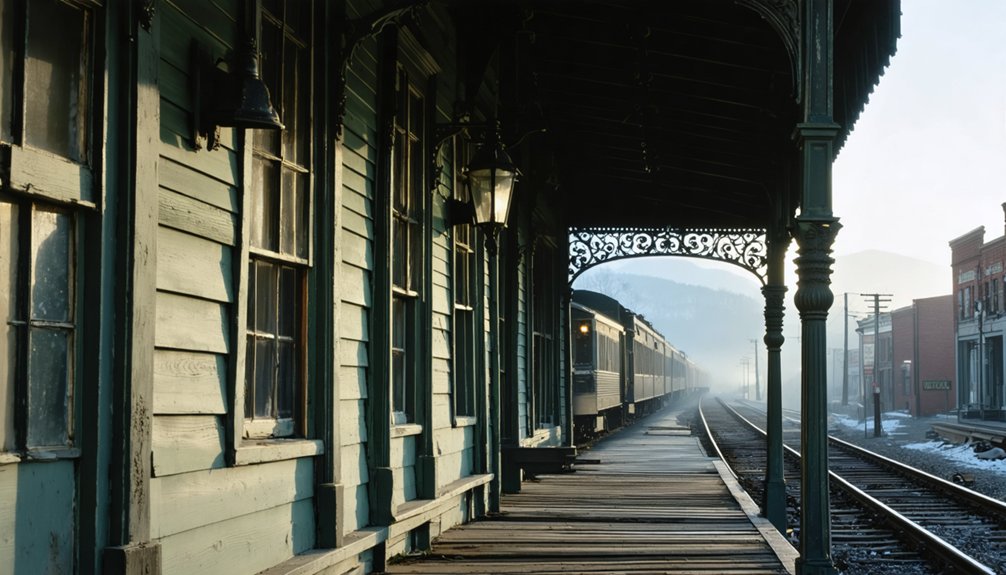
You’ll find Thurmond’s filming appeal in its remarkably intact streetscape—the 1917 National Bank building stands with its original multi-story facade facing the railroad tracks, joined by three other early 1900s commercial structures that create an authentic Main Street corridor.
The hillside above offers gabled, boarded-up houses from the boom era, their weathered exteriors and overgrown surroundings providing ready-made abandoned home settings that require minimal set dressing.
The restored railroad depot anchors street-level scenes with its functional platform positioned directly beside active tracks, while the 1925 coaling tower and massive water tanks loom as industrial backdrops that establish the town’s railroad heritage.
Historic Bank Building Facades
When filmmakers first scouted Thurmond for “Matewan,” the Bank of Thurmond Building’s four-story red brick facade immediately solved their period authenticity challenge. The 1917 structure’s limestone renovations from 1923 provided genuine early-20th-century architectural details without requiring artificial set construction.
The building’s camera-ready features included:
- Original ornate brickwork preserved through National Park Service bank preservation initiatives
- Ground-level storefronts showcasing authentic commercial architecture from multiple business adaptations
- Multi-story configuration creating visual depth for establishing shots of Commercial Row
- Limestone facade elements from the 1923 architectural renovation maintaining historical accuracy
- Cast iron and brick materials delivering weathered textures that digital effects couldn’t replicate
You’ll notice the structure’s mixed-use design—banking hall, offices, and residential spaces—created layered visual storytelling opportunities that modern reconstructions rarely achieve.
Hillside Abandoned Home Settings
Behind Thurmond’s Commercial Row, filmmakers discovered an equally authentic backdrop in the hillside worker housing that railroad companies had perched above the tracks decades earlier. You’ll find abandoned structures like the John Dragan House and Charles Wells House, both dating to 1900, featuring one-and-a-half-story designs that haven’t changed since construction.
The hillside decays reveal coal chutes on exteriors, peeling paint inside, and boarded windows that create perfect period authenticity. The Sid Childers house—originally a three-story powerhouse that burned in the 1930s—stands rebuilt with its brick second floor intact.
These precariously positioned dwellings, built by W.D. Thurmond and T.G. McKell for railroad workers, offer filmmakers genuine early-twentieth-century poverty aesthetics without set dressing.
Twenty-one of thirty-five structures remain historically eligible, providing ready-made locations.
Railroad Depot Street Scenes
Thurmond’s 1904 Chesapeake & Ohio Railway Depot anchors the town’s main street with brick craftsmanship and period-correct architectural elements that require minimal modification for early-twentieth-century scenes. The structure’s authentic details capture railroad-era America without artificial set dressing.
You’ll find camera-ready features throughout this preserved ghost town:
- Original wooden platform extends alongside rusted tracks, creating depth for wide-angle establishing shots
- Exposed brick facades show controlled urban decay that reads authentically on film
- Cast-iron hardware, vintage signage, and railway equipment remain intact through landmark preservation efforts
- Unobstructed sightlines along depot street eliminate modern infrastructure from frame
- Natural weathering provides texture without requiring aging effects in post-production
This combination of structural integrity and atmospheric deterioration delivers production value while respecting historical authenticity.
How Matewan Brought Union History to Life
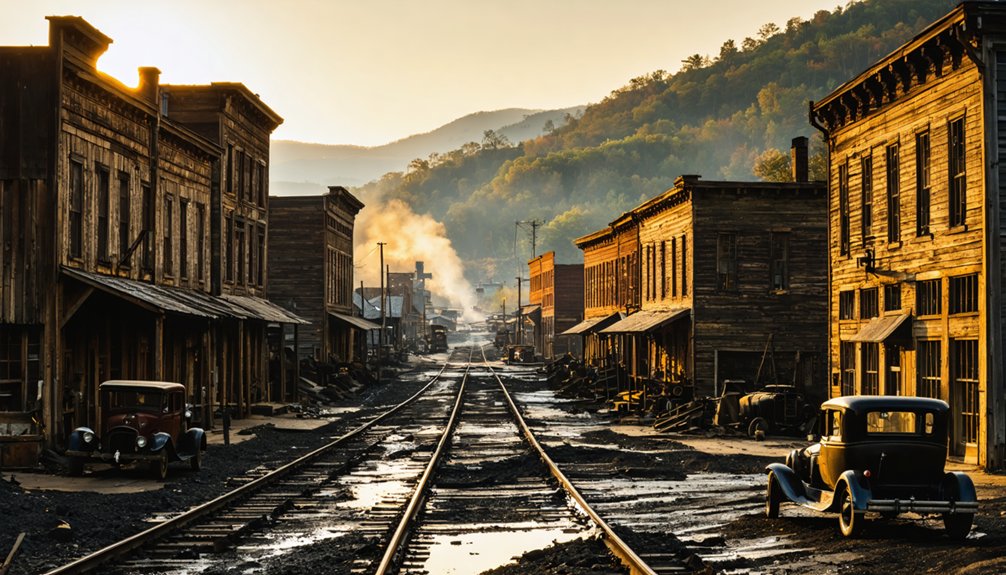
Although director John Sayles spent four years reworking his screenplay after completing *Brother From Another Planet*, he initially knew nothing about the Matewan Massacre that would define his 1987 film.
Sayles discovered the Matewan story during research, transforming four years of forgotten Appalachian history into his most politically urgent work.
You’ll find cinematographer Haskell Wexler captured this buried piece of mining history in Thurmond, a near-ghost town in Fayette County’s New River gorge.
The production faced practical constraints—limited light in the holler demanded careful time budgeting as they recreated the 1920 shootout between striking miners and Baldwin-Felts detectives.
The film unearthed coalfield labor movements that had been deliberately censored, sparking local pride and inspiring the West Virginia Mine Wars Museum‘s founding in Matewan.
Chris Cooper’s Joe Kenehan and James Earl Jones’s Few Clothes Johnson brought this class war between workers and coal operators into sharp focus.
Accessing Thurmond Within New River Gorge National Park
When you navigate to Thurmond within New River Gorge National Park and Preserve, you’ll exit U.S. Route 19 at Glen Jean and follow WV-25/Thurmond Road seven miles to this preserved 1920s coal town. The National Park Service maintains free access to explore independently.
Your visit includes:
- Historic Thurmond Depot visitor center operating 10 am-5 pm daily Memorial Day through Labor Day
- Self-guided walking tours through abandoned hillside homes and restored railroad structures
- Views of the former National Bank building housing Banker’s Club for local dining
- Outdoor activities throughout New River Gorge’s scenic terrain
- Weekend-only depot access during September and October
The district’s remarkably preserved Appalachian architecture reveals coal-era history without admission fees, giving you complete freedom to explore at your pace.
Nuttalburg and Other Abandoned Mining Communities
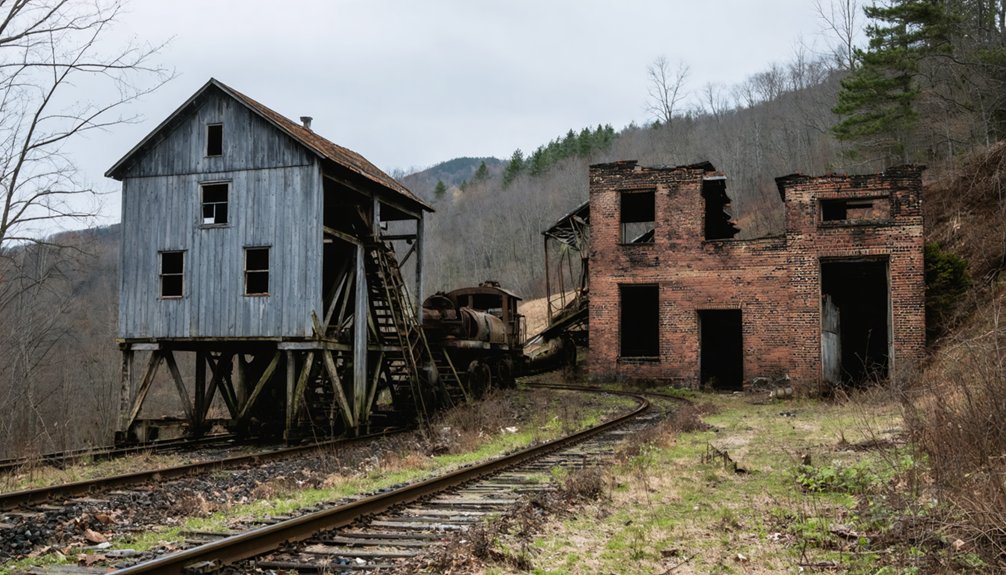
Beyond Thurmond’s preserved downtown streets, Nuttallburg sits three miles upstream where a four-foot-thick seam of smokeless coal once powered America’s industrial expansion.
Three miles upstream from Thurmond, a four-foot coal seam at Nuttallburg once fueled America’s industrial age.
You’ll find 40 beehive coke ovens clinging to hillsides hundreds of feet above the New River, alongside Henry Ford’s 1923 incline tipple—once the world’s largest coal transport structure. This ghost town shipped its first loads in 1873 and peaked at 300 residents before production ceased in 1958.
The National Park Service acquired the site in 1998, preserving authentic coal mining infrastructure without restoration. You can explore workers’ housing foundations, company store ruins, and mechanized mining equipment Ford installed during his vertical integration experiment.
Unlike sanitized historic sites, Nuttallburg remains deliberately undeveloped—raw industrial archaeology accessible via hiking trails.
Weirton’s Role in Modern Film Productions
Unlike West Virginia’s authentic ghost towns, Weirton’s 2500 Main Street thrived as a living community when Paramount transformed it into fictional Lillian, Ohio for J.J. Abrams’ *Super 8*. You’ll discover how 700 locals joined production across 25 locations during fall 2010, creating authentic 1979 Americana without abandonment.
The transformation included:
- Cathy’s Pies and Sandwiches repainted with period-accurate exteriors and 1970s booth installations
- Main Street’s 3000 Block hosting camera shops, auto dealerships, and battle sequences
- Weirton Millsop Community Center coordinating extras like street festivals organize volunteers
- Abundant Grace Bible Church doubling as Lillian Middle School
- Taylor Avenue through Elm Streets capturing evacuation chaos
Local eateries became film sets while maintaining operations. The steel mill backdrop provided industrial authenticity you’d expect from working-class America, proving active communities offer filmmakers freedom traditional ghost towns can’t—real texture, functional infrastructure, and invested participants.
West Virginia’s Legacy as a Stand-In for Americana
West Virginia’s abandoned coal towns function as time capsules for filmmakers seeking authentic American industrial decay. When you explore Thurmond’s preserved facades—intact since the 1870s through 1920s—you’re witnessing cultural heritage that required zero set reconstruction for *Matewan*’s 1987 production.
The town’s 1910 prosperity left distinctive railroad architecture along tracks that served as main street, creating visually authentic period settings. You’ll find boarding houses perched on hillsides, depot exteriors, and commercial strips documenting Appalachian design patterns.
The economic impact extends beyond initial filming; 4K theatrical restorations at venues like Carnegie Science Center’s IMAX introduce contemporary audiences to these landscapes, transforming ghost towns into cinematic landmarks.
Population dropped from 75,000 annual depot visitors to five permanent residents, yet structural preservation within New River Gorge National Park maintains accessibility for productions demanding genuine Americana backdrops.
Frequently Asked Questions
Are There Guided Tours Available to Explore Thurmond’s Filming Locations?
No guided tour logistics exist for Thurmond’s filming locations. You’ll explore independently, discovering Matewan sites through self-guided wandering. The National Park Service emphasizes historic preservation over film-themed tours, giving you freedom to roam preserved facades and atmospheric railroad-era buildings yourself.
Can Visitors Enter the Abandoned Buildings Seen in Matewan?
No, you can’t enter Thurmond’s abandoned buildings—ironically, freedom ends at boarded-up windows. You’ll peek through glass at empty rooms where Matewan filmed, while local legends and haunted legends swirl around these preserved, inaccessible structures within the national park.
What Permits Are Needed to Film in New River Gorge National Park?
You’ll need special use filming permits from New River Gorge National Park for commercial productions. Park regulations exempt groups of six or fewer under the EXPLORE Act, but larger crews require permits, insurance, and fees processed within 2-4 weeks.
How Do Production Crews Handle Preservation Concerns in Historic Ghost Towns?
You’ll find crews paradoxically preserve decay—filming crumbling facades without touching them. They’re managing preservation regulations through exterior-only shots, respecting boarded structures, and tackling restoration challenges by leaving ghost towns exactly as haunted as they found them.
Which Other John Sayles Films Were Shot in West Virginia?
Based on available records, Matewan remains John Sayles’ only West Virginia production. You won’t find other Sayles films steering through the state’s historic preservation requirements or filming regulations, though Matewan’s success demonstrated how independent filmmakers could authentically capture Appalachian landscapes.
References
- https://wvtourism.com/these-4-west-virginia-towns-made-it-to-the-big-screen/
- https://www.caseybarber.com/thurmond-wv/
- https://www.asfarasicantell.com/2021/04/abandoned-coal-towns-of-west-virginia/
- https://www.youtube.com/watch?v=yBKOIRxeNX0
- https://en.wikipedia.org/wiki/List_of_films_set_in_West_Virginia
- https://www.lpm.org/news/2017-10-09/matewan-revisited-film-unearthed-regions-buried-labor-history
- https://en.wikipedia.org/wiki/Matewan
- https://en.wikipedia.org/wiki/Matewan_(film)
- https://americanhistoryroadtrip.com/2024/01/23/the-mine-wars-of-matewan-wv/
- https://www.criterion.com/current/posts/6664-matewan-all-we-got-in-common