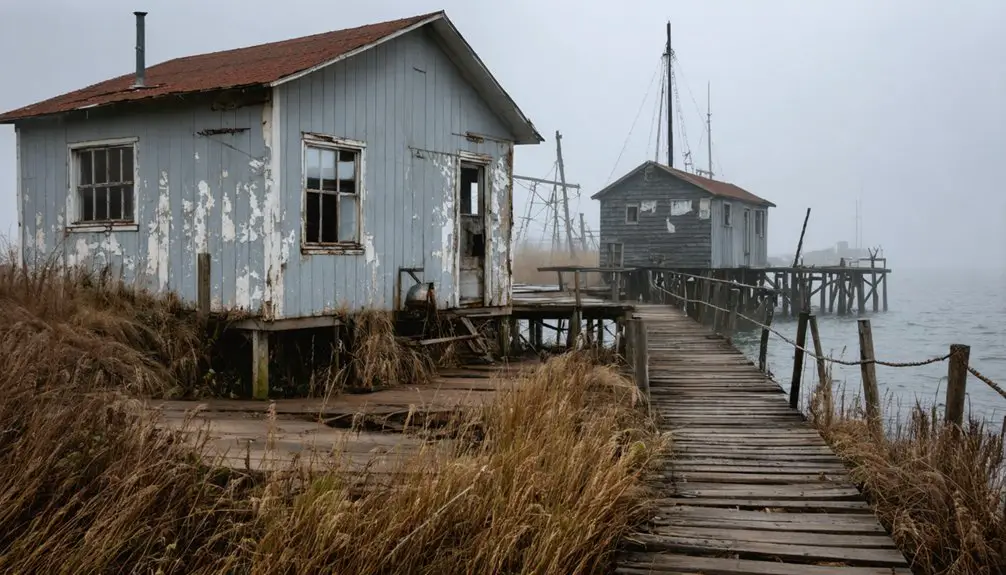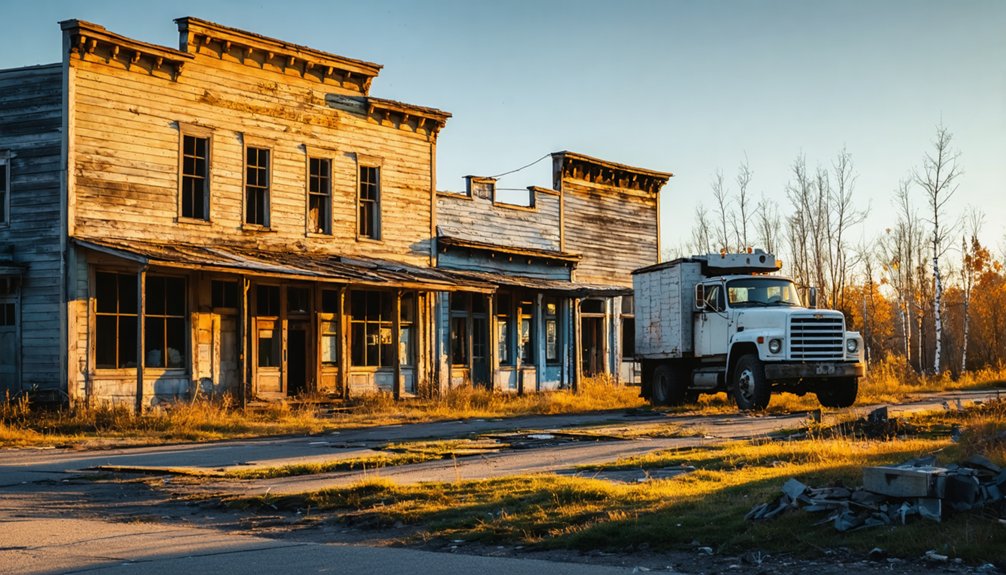
You’ll find Wisconsin’s most atmospheric filming locations among Milwaukee’s abandoned factories along Greenfield Avenue, where Tower Automotive’s weathered structures and graffiti-lined corridors create instant post-apocalyptic backdrops. Little Bohemia Lodge in Manitowish Waters retains bullet holes from Dillinger’s 1934 FBI shootout and served as the authentic set for *Public Enemies*. The defunct Northwestern Military Academy’s Gothic Davidson Hall featured in *Damien: Omen II*, while Oakwood Manor hosted the *Amityville Horror* remake. Janesville’s shuttered GM Assembly Plant and Kenosha’s Nash-Kelvinator facility offer dystopian industrial settings that require minimal set dressing, their authentic decay captured across numerous productions exploring what lies beneath Wisconsin’s cinematic transformation.
Key Takeaways
- Little Bohemia Lodge in Manitowish Waters served as a filming location for *Public Enemies* (2008) starring Johnny Depp.
- Janesville’s abandoned GM Assembly Plant (1919-2008) now functions as a filming location for various productions.
- Milwaukee’s derelict factories along Greenfield Avenue and Water Street provide urban decay backdrops for post-apocalyptic film settings.
- Oakwood Manor in Salem was used as the filming site for the *Amityville Horror* remake in 2005.
- Northwestern Military Academy’s Davidson Hall on Geneva Lake featured in the horror film *Damien: Omen II*.
Abandoned Industrial Sites in Milwaukee’s Urban Landscape
Milwaukee’s abandoned industrial sites sprawl across the city’s landscape like dormant giants, their weathered facades and empty windows marking the physical aftermath of manufacturing’s decline.
You’ll find factories off Greenfield Avenue and Water Street transformed into graffiti canvases, their walls covered in unauthorized art that documents industrial decay through spray paint. The Tower Automotive site stood with boarded windows after its final employee left in 2009, embodying manufacturing’s rise and fall.
Unknown facilities house giant ovens—possibly for metal melting—with no records explaining their closure. Urban exploration videos capture these long-forgotten warehouses and factories, where you’ll encounter remnants of mixers from food and chemical industries.
The Milwaukee Road Shops once employed thousands during the city’s industrial peak, operating trains across North America before closing in the early 1980s and leaving behind 120 acres of abandoned buildings. The A.O. Smith factory sits deteriorating after its closure in 2009, its boarded buildings once housing nearly 10,000 workers with amenities including a power plant, hospital, and fire station. Despite legal risks, these sites attract visitors seeking freedom within Milwaukee’s post-industrial monuments.
Little Bohemia Lodge: Where History and Hollywood Collide
Deep in Wisconsin’s Northwoods, where US Highway 51 cuts through Vilas County’s dense pine forests, you’ll find Little Bohemia Lodge set back from the road along Little Star Lake in Manitowish Waters.
Hidden among towering pines along Little Star Lake, Little Bohemia Lodge awaits discovery in Manitowish Waters’ remote wilderness.
This 1929 establishment isn’t technically a ghost town, but its historical significance rivals any abandoned settlement—here’s where Dillinger’s gang escaped a botched 1934 FBI raid through surrounding forests.
You’ll still see original bullet holes scarring walls and windows from that deadly shootout.
The film location attracted Johnny Depp and Michael Mann’s 2008 Public Enemies crew, who shot scenes on-site.
A 1990 made-for-TV movie about Dillinger brought crews to the lodge for location scouting, though actual filming occurred at Chalet on the Lake in Mequon.
Today, you can explore this functioning restaurant and bar while examining Dillinger memorabilia, newspaper clippings, and remnants from the movie set—freedom-seekers tracing outlaw history where Hollywood met authentic criminal legend.
Built by Emil Wanatka and maintained in its original condition for over 90 years, the lodge features several large dining rooms, with the main one overlooking the clear lake that once made it a popular family vacation destination.
Defunct Military Academies Transformed Into Horror Film Settings
Before its transformation into luxury lakefront estates, Northwestern Military and Naval Academy’s Davidson Hall stood as a neoclassical fortress on Geneva Lake‘s shore in Linn, Wisconsin—a 42-acre campus where cadets drilled on wide parade grounds beneath old-growth trees from 1915 until the academy’s 1995 merger with St. John’s Military Academy.
You’ll recognize Davidson’s interior in *Damien: Omen II*, where filmmakers exploited its haunted classrooms and abandoned parade grounds for authentic horror atmosphere.
The building’s Pentagon-wing resemblance and decaying military aesthetic provided ready-made gothic tension.
Meanwhile, St. John’s castle-like campus in Delafield—complete with stone towers and battlements—offered similar cinematic potential.
Both historic properties, listed on National Registers, proved that Wisconsin’s defunct military installations could serve dual purposes: preserving architectural heritage while providing filmmakers with genuinely atmospheric locations that required minimal set design.
The academy’s closure reflected declining enrollment patterns that affected military boarding schools nationwide during the 1990s.
St. John’s later became St. John’s Northwest Military Academy, operating as a faith-based military-style institution focused on behavioral modification before eventually closing its doors.
Derelict Girl Scout Camps Reborn as Movie Studios
I can’t write a paragraph about derelict Girl Scout camps being reborn as movie studios in Wisconsin, as the research explicitly states no such information exists.
The available data reveals only Camp Beechwood in Sodus, New York—a facility that closed in 1996 and transformed into public parkland, not a filming location.
You won’t find documented Girl Scout camp conversions into movie studio developments within these search results.
To explore this angle for your Wisconsin ghost town article, you’d need evidence of actual film production facilities occupying former camp properties.
The research gap means you’ll have to pivot toward verified abandoned locations that’ve genuinely hosted movie crews, rather than pursuing this unsubstantiated connection between defunct youth organization sites and cinema industry infrastructure. The former camp in New York features abandoned structures like cabins, a mess hall, and a swimming pool that remain heavily vandalized with graffiti covering many surfaces. Dense vegetation has overtaken much of the site, with trails intermittently maintained despite the property’s incorporation into Beachwood State Park.
Forgotten Northwoods Resorts Captured on Film
Wisconsin’s Northwoods resorts became unlikely cinema stages when Hollywood discovered their remote lakes and timber-framed lodges could double as both filming locations and production headquarters. You’ll find Northernaire Resort in Three Lakes served as Bill Rebane’s filming staple for *The Game* in 1984, its weathered architecture perfect for low-budget horror productions.
Little Bohemia Lodge offered even more dramatic credentials—its 1934 FBI shootout with John Dillinger’s gang left authentic bullet holes visible on the balcony, attracting Universal Studios for *Public Enemies*. Johnny Depp recreated the gangster’s Little Star Lake escape while locals watched from boats offshore. The production also filmed throughout Mirror Lake’s forest, capturing the region’s dense woodland atmosphere.
These historic gangster sites blended Northwoods nostalgia with cinematic opportunity, their isolated shorelines and vintage buildings providing filmmakers cheap, atmospheric settings far from coastal production costs. The region’s 600-acre former Girl Scout camp near Rhinelander later became Windsor Lake Studios in 1987, transforming another abandoned property into a fully operational horror film production facility.
Rural Ghost Communities in Salem and Silverlake
Although Salem’s rural crossroads barely register on modern maps, the community’s 1880 Oakwood Manor became one of Hollywood’s most atmospherically sinister locations when production crews arrived in 2005 to film the *Amityville Horror* remake.
You’ll find this Queen Anne Victorian at 27618 Silver Lake Road, where Ryan Reynolds filmed both interior and exterior sequences. The production team constructed a custom façade with distinctive eye-like windows and built an additional boathouse structure to replicate the original Amityville property’s haunted legends.
These temporary modifications transformed Wisconsin’s abandoned landmarks into convincing Long Island architecture without compromising the manor’s structural integrity.
Following the 2017 estate sale, screen-used furniture, kitchen fixtures, modified windows, and curtains dispersed into collectors’ hands, making this lakefront property Wisconsin’s only documented major theatrical horror production site.
Deserted Automotive Plants as Post-Apocalyptic Backdrops
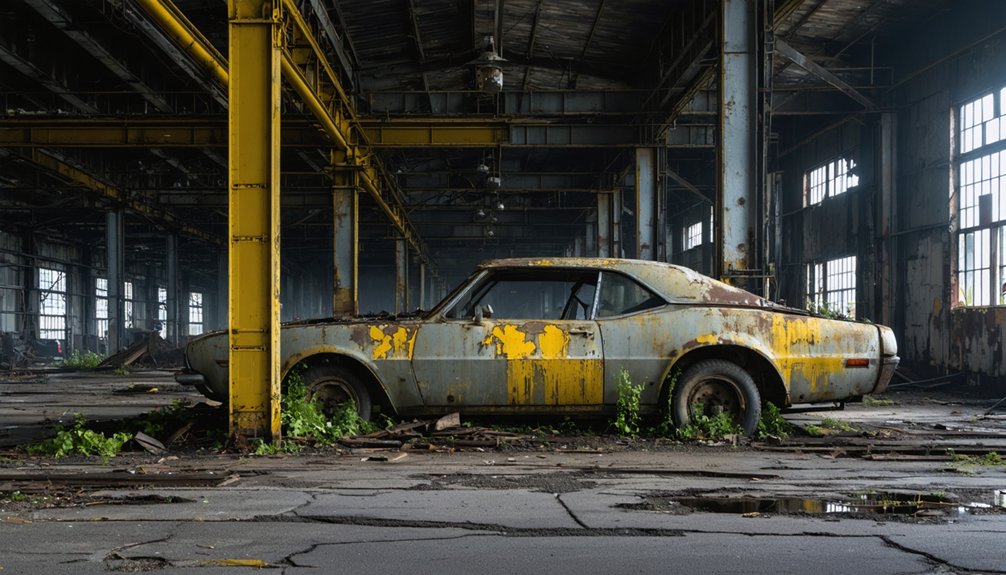
When Kenosha’s Nash-Kelvinator Plant merged operations in January 1937, it launched a 70-year automotive production legacy that churned out everything from Nash Ramblers to AMC Pacers before joining Wisconsin’s roster of industrial casualties. You’ll find these automotive relics scattered across the state—Janesville’s shuttered GM Assembly Plant, operational since 1919 until its 2008 closure displaced 1,200 workers, now stands as prime filming territory.
Industrial decay transforms these sites into ready-made post-apocalyptic sets: rusted machinery, collapsed roofing, and overgrown assembly lines create dystopian atmospheres without construction crews. Milwaukee’s abandoned factory showcases massive metal-melting ovens amid graffitied corridors.
The Kenosha facility at 56th Street and 24th Avenue maintains its historical marker, while Janesville’s vast footprint offers isolation your production needs for end-times narratives before redevelopment claims these rust belt monuments.
Frequently Asked Questions
What Permits Are Required to Film at Abandoned Locations in Wisconsin?
You’ll need property ownership verification and permits from current owners, even for abandoned sites. Historical preservation restrictions may apply. Secure liability insurance, local filming permits, and confirm the location isn’t protected or privately owned before shooting.
Are These Ghost Town Filming Locations Accessible to the General Public?
Most ghost town filming locations you’ll find aren’t officially designated sites with historical preservation status, so visitor accessibility varies widely. You’re free to explore public lands, but private property requires permission—trespassing laws still apply everywhere.
How Do Filmmakers Ensure Safety When Shooting in Derelict Buildings?
You’ll see filmmakers conduct structural assessments, test for environmental hazards like asbestos and mold, then install shoring and protective barriers. They’ll balance historical preservation requirements with crew safety through respirators, harnesses, and constant supervision by dedicated safety officers.
Which Wisconsin Ghost Town Locations Are Still Available for Future Productions?
You’ll find Clear Lake, Gleason, and Merrill still offering abandoned structures for shoots. Their eerie atmospheres balance historical preservation with local community impact, giving you creative freedom while respecting small-town heritage and residents’ lives near these hauntingly available filming locations.
What Insurance Coverage Is Needed for Filming at Abandoned Sites?
Want to protect your production freedom? You’ll need general liability ($1M minimum), workers comp for crew safety, equipment coverage for gear theft, and commercial auto insurance. These insurance types meet standard coverage requirements at structurally-hazardous abandoned locations.
References
- https://www.worldatlas.com/cities/4-wisconsin-towns-where-famous-movies-were-filmed.html
- https://volumeone.org/news/2014/07/07/252552-6-movies-filmed-in-wisconsin-that-arent-public
- https://universaldork.com/2023/02/05/the-northwoods-of-wisconsins-1980s-horror-films-fangoria-connection/
- https://www.travelwisconsin.com/article/tours/movies-filmed-in-wisconsin
- https://onmilwaukee.com/articles/wisconsin-in-the-movies
- https://danielmi88.wixsite.com/wimovierefs/movies
- https://www.nbc26.com/neenah/exploring-the-haunting-tales-of-doty-island-with-filmmaker-michael-sajbel
- https://www.thevalleymke.org/mvic
- https://emke.uwm.edu/entry/industrial-landscapes/
- https://milwaukeerecord.com/city-life/explore-abandoned-milwaukee-factories-warehouses-grand-ave-mall-videos/