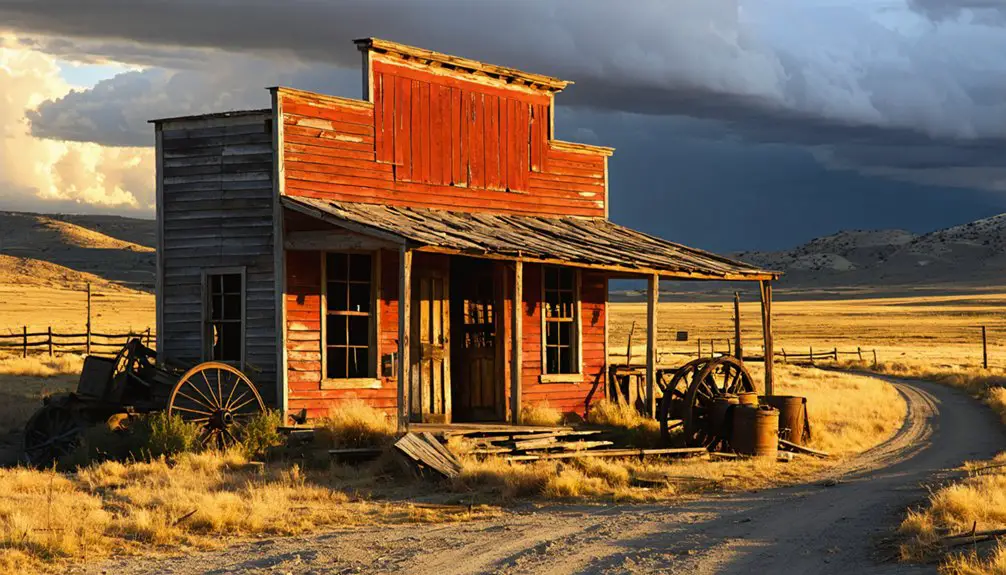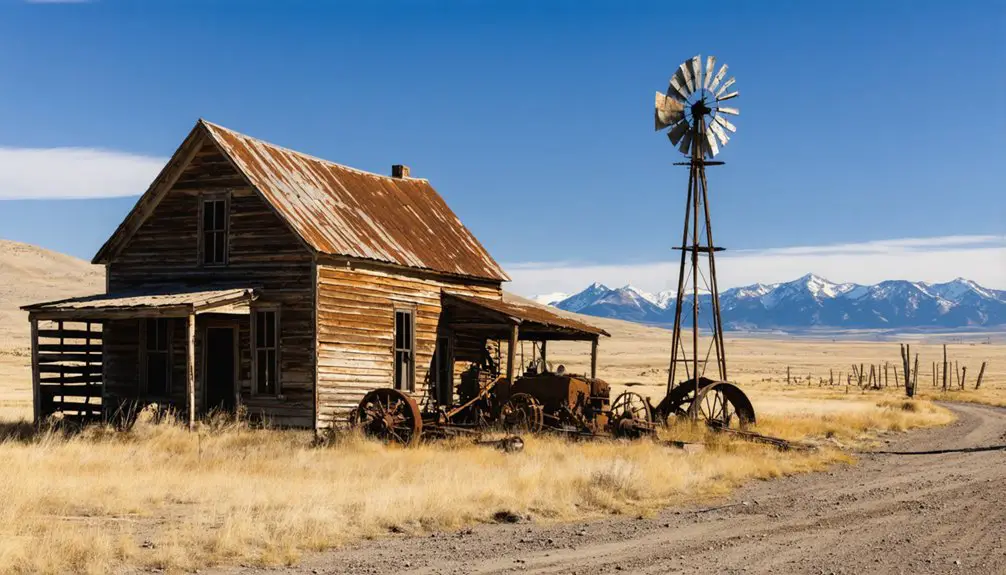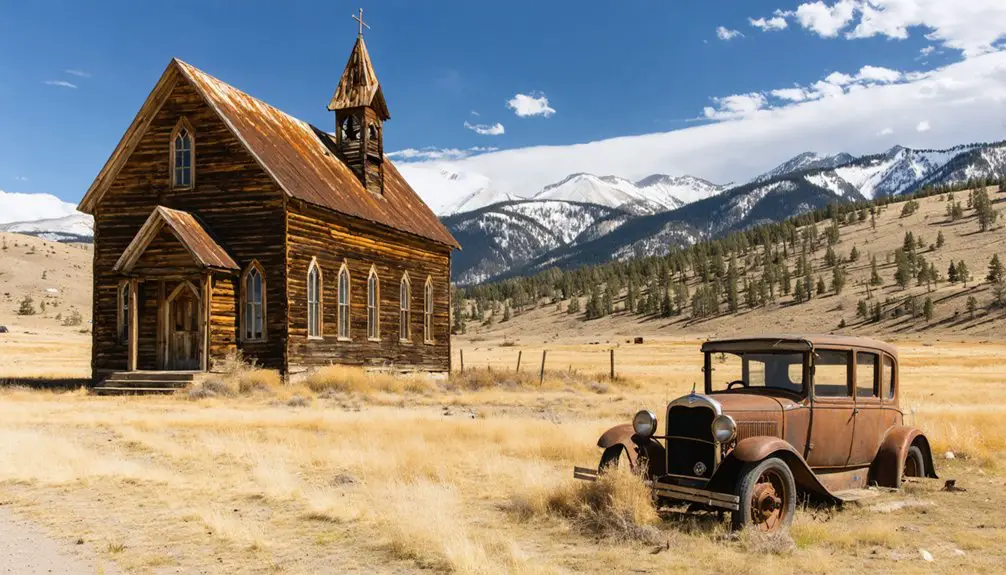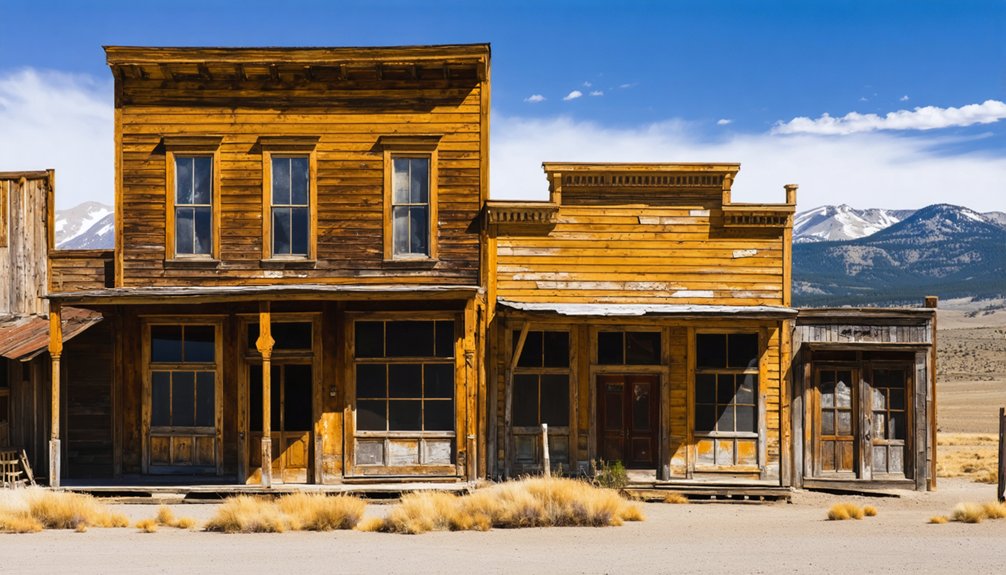
You’ll find Wyoming’s most filmed ghost town at Hell’s Half Acre, where *Starship Troopers* shot six weeks of scenes across 320 acres of alien-like terrain. South Pass City preserves 40 original 1860s structures available for period productions, while Jeffrey City offers authentic Cold War decay with abandoned uranium-era apartments intact since 1982. Kevin Costner filmed *Horizon* near remote Kirwin’s mountain ruins, and the Grand Encampment Copper District features a 16-mile aerial tramway system spanning wilderness. Each location below reveals specific production logistics, architectural details, and access considerations for filmmakers.
Key Takeaways
- Hell’s Half Acre served as the alien planet Klendathu in *Starship Troopers*, filmed over six weeks in 1996.
- South Pass City preserves over 40 original 1860s structures, offering authentic gold rush-era architecture for period films.
- Jeffrey City provides genuine Cold War-era decay with abandoned uranium mining infrastructure dating from its 1982 closure.
- Grand Encampment Copper District features 1890s mining ruins including a 16-mile aerial tramway with 370 towers.
- Wyoming’s preserved ghost towns offer filmmakers authentic Western settings with operational equipment and historical artifacts.
Hell’s Half Acre: Starship Troopers’ Alien Planet Klendathu
Located 40 miles west of Casper along US 20/26 in Natrona County, Hell’s Half Acre sprawls across 320 acres of deeply eroded terrain that resembles an alien world more than Wyoming rangeland.
Hell’s Half Acre’s 320 acres of eroded badlands create an otherworldly landscape that seems transported from another planet rather than central Wyoming.
This dramatic scarp of ravines, caves, and hard-packed earth became Klendathu—the Arachnid homeworld in Starship Troopers—during the film’s six-week shoot from April to June 1996.
The site’s otherworldly topography provided authentic alien landscapes for the Sixth Mobile Infantry Division’s disastrous landing sequence. The production featured life-sized robotic arachnids alongside CGI effects to bring the alien bug battles to life.
While a small restaurant and motel once perched atop the ravine before closing in 2005, you’ll now find interpretive signage and limited access through two open gates leading to a gravel lot. The 960-acre property is owned by Natrona County and has been closed to general public access since 2005.
No film locations have utilized Hell’s Half Acre since production wrapped.
South Pass City: Historic Gold Rush Town Available for Productions
Twenty-seven miles south of Lander via State Highway 28, South Pass City sits frozen in 1867 as Wyoming’s best-preserved gold rush settlement. You’ll find over 40 original structures maintained through historical preservation efforts, from the massive Carissa Mine stamp mill to weathered bunkhouses where miners once slept.
This mining heritage site offers production crews authentic 1860s architecture, operational gold extraction equipment, and thousands of period artifacts still displayed in their original locations.
Production advantages at South Pass City:
- Working stamp mill demonstrates actual rock pulverization and gold recovery processes
- Remote wilderness location eliminates modern infrastructure from camera angles
- Annual Gold Rush Days provide access to period-accurate reenactors and demonstrations
- Self-guided access allows location scouts to evaluate over 40 preserved buildings independently
The Carissa Mine’s industrial structures deliver gritty frontier authenticity unavailable in studio reconstructions. The site achieved county seat status during its 1867-1868 peak, when stamping mills and fifty houses rapidly transformed the settlement into a governing center for the expanding mining district. Nearby Palmetto Gulch placer claims showcase where partnership mining operations extracted free gold using elaborate water sluicing systems.
Jeffrey City: Abandoned Uranium Mining Town With Authentic Decay
Where else can you film genuine Cold War-era abandonment without set dressing? Jeffrey City delivers authentic uranium mining decay along Highway 287.
Jeffrey City offers filmmakers unmatched Cold War authenticity—real uranium town decay along Highway 287, no set dressing needed.
You’ll find empty apartment complexes, shuttered buildings, and infrastructure frozen since the 1982 mine closure—no reconstruction required. This isn’t manufactured atmosphere; it’s real town decay from a population crash that sent 95% of residents away by 1985.
Your production gains access to visually distinct eras: 1950s boom-town architecture, Olympic-sized pool ruins, and abandoned company housing that once sheltered 4,000 people. The town’s origins trace back to a 640-acre homestead established in 1931, decades before uranium discovery transformed it into a mining hub.
The landscape tells its own story—reminders of when Western Nuclear and Pathfinder employed 1,000 workers extracting 8 million tons of ore. The Split Rock Mill, built in 1957 to process ore from nearby deposits, expanded to handle 1,700 tons per day before the industry collapsed.
You’re filming actual American industrial collapse, not a Hollywood version. Semi-ghost status means minimal permitting complications while maintaining atmospheric authenticity.
Kirwin: Remote Mountain Setting in Kevin Costner’s Horizon
- La Sal’s infrastructure supported $100 million production needs.
- Constructed sets allowed narrative control impossible at historic sites.
- Snow-capped peaks provided Wyoming visuals without permit restrictions.
- Red-rock contrasts enhanced frontier isolation atmosphere.
- Utah’s wide, open spaces resembled the Wyoming landscapes Costner envisioned for the film.
- Film incentive programs offering tax credits helped attract the production to the region.
Grand Encampment Copper District: High Elevation Mining Ruins
Deep in the Sierra Madre Mountains, the Grand Encampment Copper District‘s skeletal infrastructure sprawls across high-elevation terrain that proved equally attractive to 1890s mining speculators and twenty-first-century location scouts.
You’ll discover remnants of the 16-mile aerial tramway—370 towers that once transported ore across wilderness at four miles per hour using gravity-powered engineering.
Mining innovations like this gravity-driven system and the district’s wood-fired cable stations create authentic backdrops filmmakers can’t replicate on soundstages.
The Grand Encampment Museum preserves tramway remnants and period structures, while high-elevation ruins remain accessible for productions requiring genuine frontier settings.
Ghost town preservation efforts maintain this district’s integrity, offering cinematographers unchanged vistas where copper operations once employed thousands before the 1909 collapse left communities abandoned to mountain winds.
The tramway’s 840 buckets carried 700 pounds each of copper ore, creating dramatic industrial scenes that authenticate period mining narratives for film productions.
The Penn-Wyoming Smelter, constructed primarily from wood with twelve storage bins holding 100 tons each, processed the district’s copper discoveries that began when Ed Haggarty filed his claim following the 1897 ore assay showing 33% copper content.
Frequently Asked Questions
What Permits Are Required to Film at Wyoming Ghost Town Locations?
You’ll need permits based on land ownership—federal, state, or private. Contact local authorities about historical preservation requirements and assess local community impact. Secure proper insurance, allow 2-4 weeks processing time, and respect the ghost town’s authentic character.
Are There Lodging Facilities Near These Remote Ghost Town Filming Sites?
You’ll find extremely limited local accommodations near Wyoming’s ghost town filming sites. Green Mountain Motel serves the Jeffrey City area, while Split Rock Café offers dining. Nearby amenities are sparse—you’ll need self-sufficient operations since major airports require five-hour drives.
What Time of Year Offers the Best Weather for Filming?
Summer and fall offer prime filming conditions for Wyoming ghost towns. You’ll enjoy seasonal weather with minimal precipitation, extended daylight, and stable temperatures. Fall’s crisp lighting enhances 8K cinematography, while summer’s consistency supports uninterrupted production schedules.
Can Production Crews Bring Electricity and Water to These Abandoned Locations?
Yes, you’ll need to truck in portable generators and water tanks since there’s no hydroelectric infrastructure or water supply infrastructure at these abandoned sites. You’ll transport everything from Denver or Salt Lake City, five hours away.
How Accessible Are These Ghost Towns for Transporting Film Equipment?
You’ll face significant transport challenges requiring 4×4 vehicles and long hauls from distant airports. Historical preservation restrictions may limit access routes, while your crew’s presence creates local community impact through road wear and equipment staging needs in fragile areas.
References
- https://emergefilmsolutions.com/ghost-town-film-location-jeffrey-city-wyoming/
- https://www.visitcasper.com/film/completed-projects/
- https://travelwyoming.com/blog/stories/post/5-wyoming-ghost-towns-you-need-to-explore/
- https://www.codyyellowstone.org/film-television/filming-locations/
- https://geekytourist.com/2017/10/02/8-places-in-wyoming-you-need-to-visit-if-youre-a-movie-geek/
- https://k2radio.com/kevin-costner-horizon-movie-stars-wyoming-but-mostly-filmed-in-utah/
- https://www.youtube.com/watch?v=z7LX0OZ7xt8
- https://giggster.com/guide/movie-location/where-was-starship-troopers-filmed
- https://cowboystatedaily.com/2025/04/27/photographer-visits-hells-half-acre-to-find-shoot-starship-troopers-location/
- https://www.tripadvisor.com/ShowUserReviews-g60437-d7266665-r452889010-Hells_Half_Acre-Casper_Wyoming.html