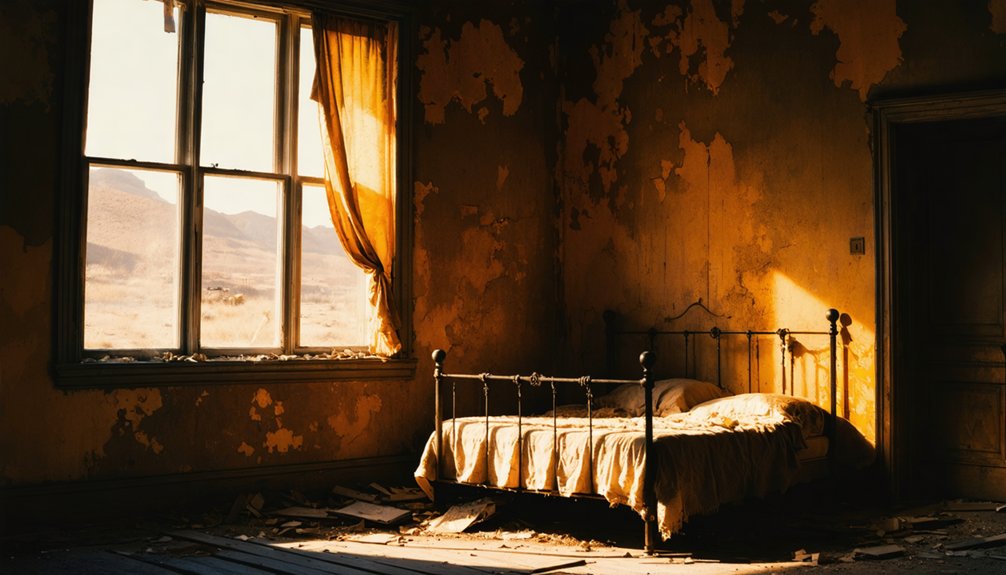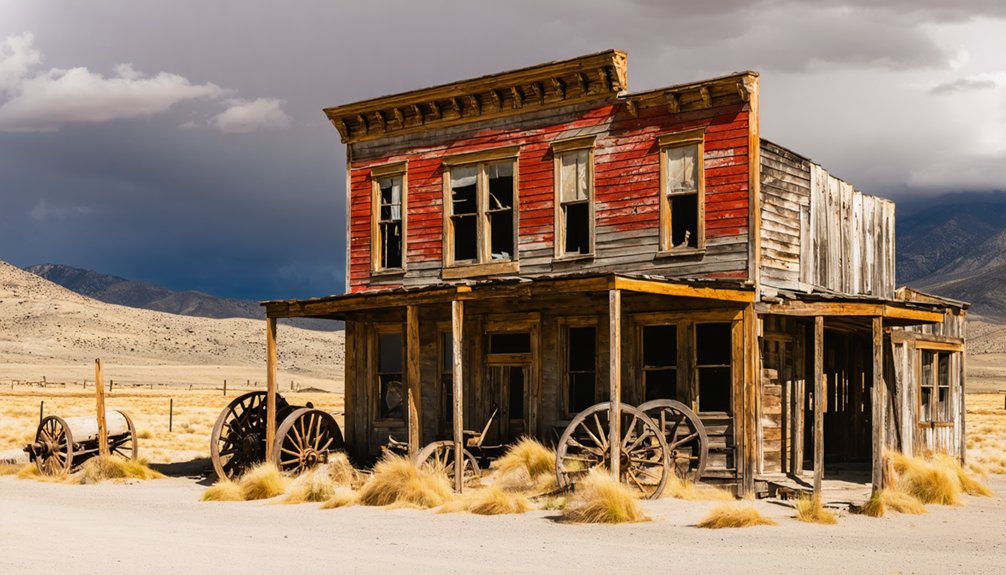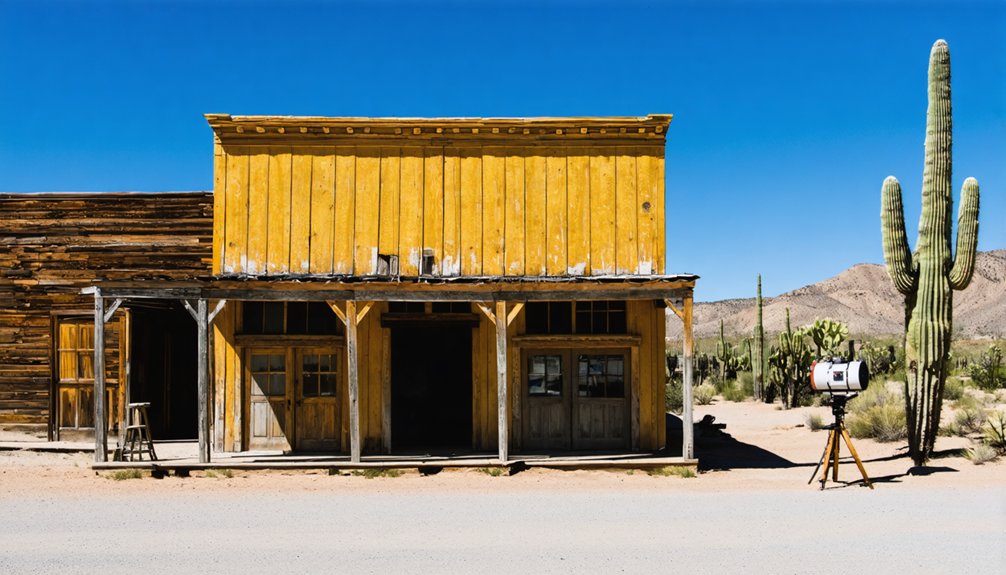
You’ll find authentic TV filming locations at Old Tucson Studios, which has hosted over 500 productions across its 300-acre backlot since 1939, and Goldfield Ghost Town, rebuilt from historical photographs with period-accurate buildings like the Mammoth Saloon. Ruby Arizona offers weathered 1915 adobe structures, while Cerro Gordo’s mining settlement at 8,500 feet preserves bullet-riddled buildings from the 1860s. Canyon de Chelly requires Navajo guides and permits submitted 30 days in advance to access its ancient cliff dwellings that provide unparalleled historical backdrops for your production needs.
Key Takeaways
- Old Tucson Studios, established in 1939, has hosted over 500 productions across 300 acres with authentic Western architecture and diverse backlots.
- Goldfield Ghost Town features reconstructed 1890s buildings, mining tunnels, and costumed actors, making it the Southwest’s only genuine rebuilt ghost town.
- Canyon de Chelly offers 800 archaeological sites and ancient cliff dwellings, requiring Navajo guides and permits submitted 30 days before filming.
- Ruby Arizona contains weathered 1915 structures within 362 acres, originally purchased in 1961 with intentions to develop a film set.
- Ragtown and Stedman sites near Ludlow provide authentic desert backdrops with minimal modern intervention, ideal for period-accurate cinematography.
Goldfield Ghost Town: From Mining Tours to Hollywood Sets
When prospectors struck gold in 1892, they sparked a settlement that would boom to 4,000 residents within five years, complete with three saloons, a boarding house, general store, blacksmith shop, brewery, butcher shop, and school.
By 1897, the gold vein faulted and Goldfield became a ghost town. The mining history didn’t end there—a 1910 revival brought new equipment and a cyanide plant, lasting until 1926.
Though the gold vein faulted in 1897, a 1910 revival with modern equipment kept Goldfield’s mining dreams alive until 1926.
Bob Schoose’s 1984 purchase transformed the five-acre mill site into something unique. His town reconstruction, guided by historical photographs, created authentic Wild West sets that filmmakers can’t resist.
You’ll find a reconstructed mining tunnel, Mammoth Saloon, museum, and General Store—all functioning as both tourist attractions and ready-made filming locations. Visitors can experience gold panning, mine tours, and railroad rides that bring the Old West to life.
The town features costumed actors on horseback and in wagons, adding living history elements to the period atmosphere. It’s the Southwest’s only genuine rebuilt ghost town, offering unmatched period authenticity.
Old Tucson Studios: Purpose-Built Western Filmmaking Destination
Unlike most ghost towns that evolved organically through boom-and-bust cycles, Old Tucson Studios emerged in 1939 as a calculated production asset—a replica 1860s frontier settlement constructed specifically for Columbia Pictures’ *Arizona* (1940).
You’ll find over 60 buildings of authentic Western architecture spanning 20 acres, positioned where unobstructed desert landscapes meet the Tucson Mountains.
The Pago Indian tribe fabricated 350,000 adobe bricks for this purpose-built facility that’s hosted 500+ productions, from *Tombstone* to *The High Chaparral*.
Three distinct backlots across 300 acres deliver varied terrain within a 30-mile production zone—no painted backdrops required.
Protected lands surrounding the studios preserve sightlines free from urban encroachment, letting you capture genuine frontier expansiveness in every direction.
The site sits 15 minutes outside Tucson, strategically nestled between Saguaro National Park and Tucson Mountain Park for maximum landscape versatility.
The April 1995 fire destroyed over 25 buildings and rare memorabilia, but the site reopened after 20 months of rebuilding with replacement structures and widened streets that departed from the original layout.
Cerro Gordo: A Century of Blockbuster Productions in the California Desert
You’ll spot Cerro Gordo’s weathered structures perched at 8,500 feet above Owens Valley—a silver mining settlement that extracted $17 million in ore between 1865 and 1900 before declining yields and an 1877 Union Mine fire shut down major operations by 1879.
Despite its rich mining history supporting 4,000 residents across buildings like the 1868 Belshaw House and 1904 Bunkhouse, there’s no documented evidence of blockbuster film productions here. The ghost town’s actual filming legacy remains minimal.
However, the allure of the area still attracts filmmakers seeking unique landscapes, particularly for projects set in filming locations in the desert southwest. Its striking vistas and historic structures provide an intriguing backdrop, even if they haven’t garnered significant cinematic recognition. Many directors have explored the juxtaposition of old mining relics against the vast desert, hoping to capture the ghost town’s haunting beauty on screen.
Cerro Gordo’s 4,000-resident mining heyday left historic structures behind, but Hollywood’s cameras never captured this authentic ghost town’s compelling story.
Though preservation efforts by current owners Brent Underwood and Jon Bier focus on historical tourism rather than Hollywood productions, a 2020 electrical fire destroyed the American Hotel, complicating restoration work.
The general store museum and rental accommodations showcase authentic mining artifacts, not movie sets. The town’s lawless past included bloody shootouts in dance halls and saloons, with bullet holes still visible in surviving structures today. Tours run daily from 9 a.m. to 5 p.m. with a recommended $10 donation, guided by longtime resident Desmarais who has managed the property for 22 years.
Ruby Arizona: Boom Town Turned Authentic Western Backdrop
Perched in Arizona’s Oro Blanco Mining District near the Mexican border, Ruby preserves approximately a dozen weathered adobe and wooden structures from its boom years as a lead-zinc-silver mining operation.
You’ll find Phil Clarke’s 1915 adobe mercantile building and the Montana mine mill standing among 362 acres of patented claims, where 600,000 tons of tailings remain south of the dam.
While a Tucson consortium purchased the site in 1961 specifically to develop it as a movie set and filming location, those plans never materialized.
The town received official recognition when it was granted a post office in 1912, the same year Arizona achieved statehood, and was named Ruby after the postmaster’s wife.
Instead, you’re facing significant preservation challenges—squatters occupied the town throughout the early 1970s, harsh desert weather continues battering structures, and vandals have accelerated deterioration.
Mining relics slowly crumble despite Ruby’s 1975 National Register listing, accessible to visitors willing to pay $15 per person.
The site remains open Thursday through Sunday during daylight hours, with on-site caretakers providing maps and overseeing safety protocols for those exploring the historic grounds.
Unlike the weathered ghost towns of Arizona’s mining era, Canyon de Chelly presents you with 800 archaeological sites and 1,000 rock art panels spanning nearly 5,000 years of continuous habitation.
You’ll need to secure both National Park Service approval and a Navajo-authorized guide to access the canyon floor for filming, as the Navajo Nation retains complete property rights over this 83,840-acre monument. The canyon’s year-round water sources and sediment-rich soil created the fertile conditions that originally attracted human settlement to this location.
The sandstone alcoves sheltering Ancestral Puebloan cliff dwellings—some positioned 152.4 meters up sheer canyon walls—offer cinematographers unmatched ancient backdrops that can’t be replicated on standard film sets. The canyon walls themselves formed from de Chelly sandstone deposited 230 million years ago when inland seas receded across North America.
Ancient Cliff Dwelling Preservation
Within the 83,Within the 83,840 acres of Canyon de Chelly National Monument, over 2,700 archaeological sites tell a story of nearly 5,000 years of continuous human habitation. You’ll find approximately 700 standing ruins here, though only 13 have received stabilization treatment against degradation.
The ancient preservation efforts balance protection with access—fences prevent climbing at sites like White House Ruin, while the archaeological significance remains visible from canyon overlooks. The Navajo Nation, who owns this land, teaches respect for Anasazi artifacts from childhood, maintaining cultural continuity alongside physical preservation.
Excavations like those at Antelope House reveal stratified layers from Basketmakers through Navajo occupation. The National Park Service collaborates with the Navajo to protect these multistoried cliff dwellings, built between 1060-1300 A.D., ensuring future generations can explore this remarkable timeline.
Filming at Canyon de Chelly requires steering through a dual-jurisdiction system where both federal and tribal authorities control access to these ancient sites.
You’ll need Commercial Film Permits submitted 30 business days before shooting, with costs determined individually. The National Park Service and Navajo Parks and Recreation Department jointly oversee permit regulations.
You can’t enter canyon areas without authorized guides accompanying your crew. Cultural sensitivity isn’t optional—these locations are sacred sites protected by Navajo Nation Law.
Climbing monuments, disturbing archaeological ruins, or filming without proper permits triggers legal action from tribal authorities. Drones and firearms are strictly prohibited.
Contact NPRD at 928-674-2106 for backcountry permits.
Rim overlooks offer self-guided access, but commercial photography requires valid tribal permits regardless of location.
Ragtown and Stedman: Forgotten Mojave Desert Film Locations
You’ll find Ragtown and Stedman Camp six miles south of Ludlow along the historic Bagdad-Chase Road, where crumbling foundations mark what was once San Bernardino County’s largest copper and gold mining operation.
The tent city of Ragtown served as a transient red-light district, while the formal company town of Stedman enforced strict prohibition rules—creating two distinct communities that filmmakers could exploit for contrasting desert scenes.
Today, only scattered concrete pads, rusted metal fragments, and traces of the old Ludlow and Southern Railroad bed remain visible across the Mojave landscape.
Historic Bagdad-Chase Road Route
Threading through the stark Mojave landscape between Ludlow and Amboy, the Bagdad-Chase Road traces a route that’s barely changed since the 1940s. This desert thoroughfare parallels the abandoned Ludlow and Southern Railroad bed, built in 1903 to haul ore from the Bagdad-Chase Mine to Santa Fe Railway connections.
Mining history shaped every mile of this road:
- First ore shipments in 1901 yielded high profits at Randsburg Company’s Barstow mill
- 100 short tons per day moved along railroad routes during peak production
- $1.5 million in gold, silver, and copper passed through here
- 75 miners worked the largest gold-copper producer in San Bernardino County
You’ll find the straight desert alignment on 1943 topographic maps, marking where the National Old Trails Highway once connected boomtown settlements to civilization.
Crumbling Foundations Remain Today
Beyond the main Bagdad-Chase corridor, two settlements emerged south of Ludlow that embodied opposite sides of frontier mining life. Stedman’s forty workers’ cabins once housed miners extracting millions in gold and copper, while nearby Ragtown’s tent city served those seeking pleasures banned in the company town—alcohol, gambling, and prostitution.
Today, you’ll find only scattered foundations where structured order met lawless freedom.
The urban decay here tells competing stories. Stedman’s crumbling cabin bases mark where corporate rules governed daily life. Ragtown’s traces are harder to locate—transient tent dwellings left minimal archaeological footprints in the shifting desert landscape. Both sites face severe preservation challenges. Without protective measures, these remnants of Mojave mining culture continue eroding, their film location potential fading as foundations return to dust.
Century-Old Desert Remnants
While most ghost town hunters chase the well-documented sites along Route 66, Ragtown and Stedman hide in the Mojave’s emptiness south of Ludlow, connected by the rutted Bagdad-Chase Road. These century-old mining outposts offer genuine filming backdrops where desert flora reclaims what miners abandoned.
What You’ll Find at These Remote Locations:
- Stedman’s skeletal cabin foundations – forty workers’ homes reduced to stone outlines among creosote.
- Ragtown’s tent city footprint – scattered artifacts where miners sought vices their company town banned.
- Wildlife sightings – roadrunners and kit foxes patrolling between ruins at dawn.
- Uncontrolled access – no gates, permits, or restrictions blocking your exploration.
The sites’ isolation preserves their authenticity. No commercialization dilutes what production scouts value: raw desert landscapes that haven’t changed since gold and copper operations ceased generations ago.
The Evolution of Ghost Towns as Television Production Sites
Since the 1848 gold rush at Sutter’s Mill initiated the Southwest’s boom-bust cycles, the region’s mining settlements have traced a path from economic centers to abandoned relics to carefully curated production sites.
You’ll find ghost town tourism transformed places like Tombstone and Shakespeare into economic engines during the post-war era, capitalizing on shootout legends and outlaw narratives.
Bodie’s frozen-in-time aesthetic attracted photographers seeking authentic urban decay, while Grafton’s proximity to Zion National Park made it ideal for *Butch Cassidy and the Sundance Kid*.
Television producers discovered these locations offered unmatched visual grandeur. The *Ghost Towns* series documented 20 Mule Team Borax operations, territorial prisons, and Apache battle sites including Fort Bowie.
Rhyolite and Mogollon became recurring on-location filming destinations, their weathered structures providing ready-made sets requiring minimal modification.
Accessing and Filming at Protected Desert Southwest Ghost Towns
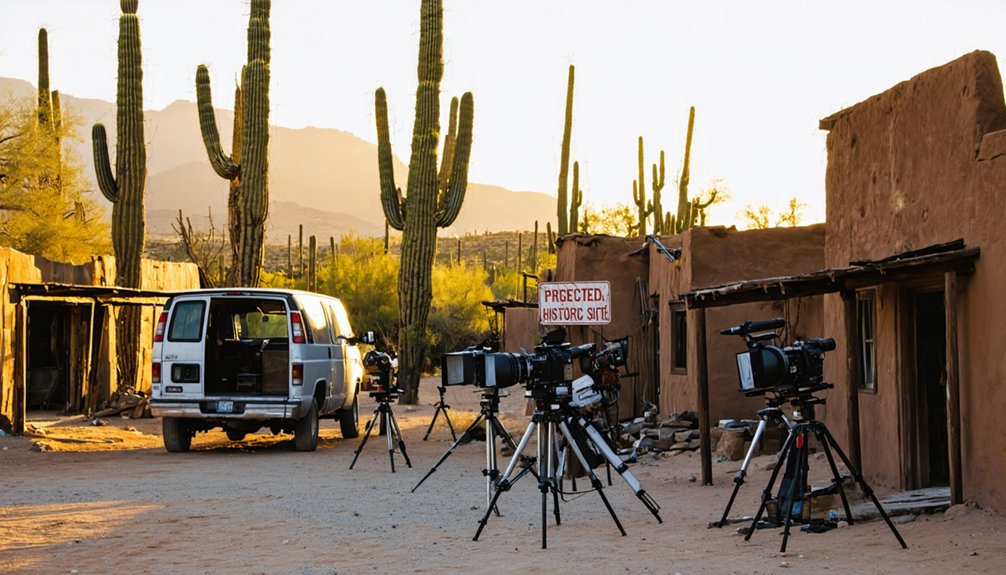
- County parks like Calico require commercial filming permits through local bureaucracy.
- Federal sites including Fort Bowie demand National Park Service approvals with stringent historical preservation guidelines.
- BLM-managed Swansea necessitates special use permits plus mandatory sign-in procedures at entrance registers.
- State-controlled Bodie involves California State Parks applications and location fees.
Private properties like Vulture City offer simpler negotiations directly with owners. However, protection measures preventing vandalism—designed for ghost town festivals and urban legends enthusiasts—create additional filming constraints.
Remote access requirements, including Panamint City’s hiking-only approach and Fort Bowie’s 1.5-mile trail, further complicate equipment transportation.
Frequently Asked Questions
What Permits Are Required to Film at Ghost Town Locations?
Planning a ghost town shoot? You’ll need commercial filming permits, liability insurance, and property owner approval. Filming restrictions vary by location, while permitting processes require 7-30 days advance notice depending on jurisdiction and specific site requirements.
How Much Does It Cost to Rent a Ghost Town for Production?
You’ll pay $118-$350 per hour (4-hour minimum) for established ghost town sets. However, historical preservation requirements and local community concerns can increase costs considerably. Budget extra for permits, insurance, security deposits, and specialized period-authentic props at $125 per shoot.
Are Accommodations Available Near Remote Desert Southwest Ghost Town Filming Sites?
You’ll find limited on-site accommodations near remote ghost towns, but nearby towns like Lone Pine, St. George, and Tucson offer lodging 20-90 miles away. Historic preservation restricts development, though primitive camping minimizes local community impact while maximizing your independence.
What Safety Precautions Must Film Crews Take in Abandoned Desert Structures?
You’ll need thorough hazard assessments covering structural instability, venomous wildlife, and heat exposure before entering. Implement emergency preparedness protocols including respirators for fungal spores, hydration stations, and real-time weather monitoring for flash floods and dust storms.
Can Tourists Visit Ghost Towns While Active Filming Is Taking Place?
You’ll likely hit a brick wall—active filming requires closed sets for equipment safety and production control. Visitor guidelines typically restrict access during shoots, though historic preservation sites may designate alternate viewing areas beyond camera range.
References
- https://www.youtube.com/watch?v=DzlJWdyLdr4
- https://blarefilms.net/goldfield-ghost-town/
- https://tubitv.com/tv-shows/200049790/s01-e05-the-desert-southwest
- https://www.youtube.com/watch?v=pgxZnFNQMTU
- https://www.youtube.com/watch?v=tZmA_VF6cm8
- https://www.youtube.com/watch?v=_xnY10y3N8U
- https://www.youtube.com/watch?v=WiQ-_sCF0sk
- https://www.dogfordstudios.com/new-video-ghost-towns-of-the-american-southwest/
- https://danielleoutdoors.com/goldfield-ghost-town/
- https://www.legendsofamerica.com/az-goldfield/