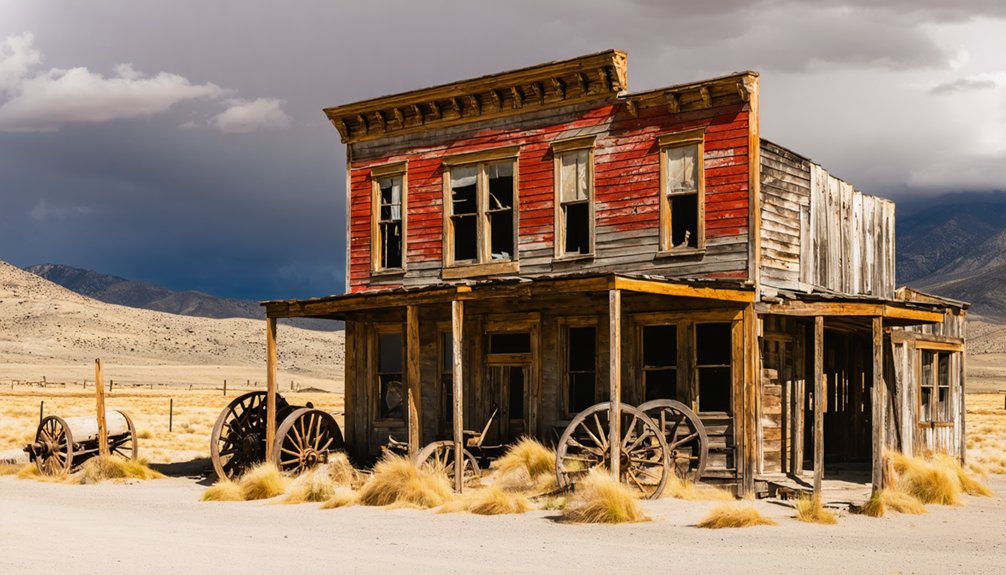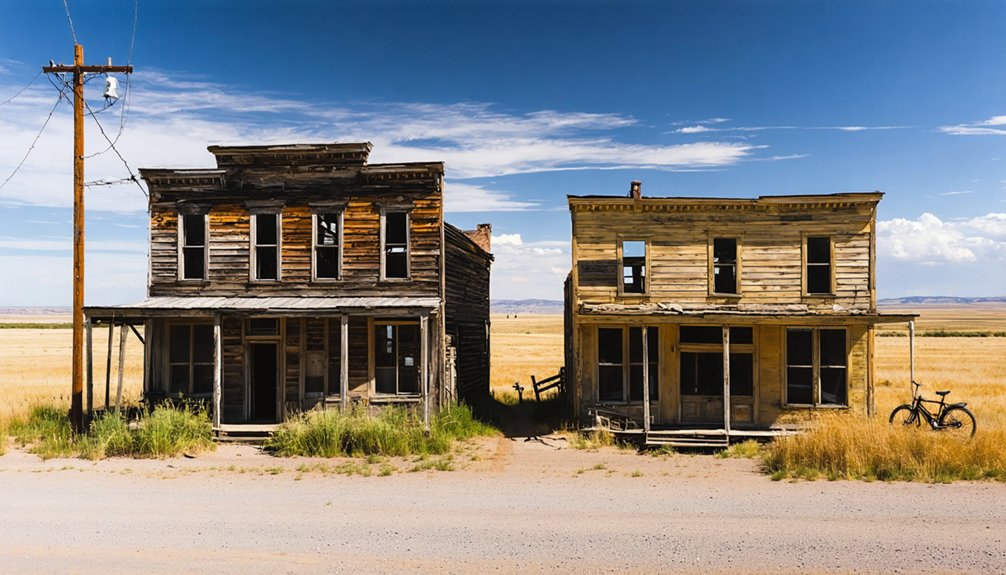
You’ll find authentic ghost town filming across the Great Plains, where Groom, Texas transformed into Rustwater for *Yellowstone* with its crumbling 1927 water tower and decayed gas stations requiring minimal set dressing. Oklahoma’s toxic Picher mine town, Kansas locations from *Supernatural*, and Alberta’s weathered structures standing in for frontier settlements offer production crews ready-made decay—peeling paint, broken windows, and genuine abandonment that would cost millions to recreate. These locations span mining camps to Route 66 ruins, each providing distinct atmospheric backdrops that reveal how infrastructure decline creates compelling television.
Key Takeaways
- Groom, Texas served as Rustwater in Yellowstone, utilizing abandoned Route 66 structures and minimal set dressing for authenticity.
- Picher, Oklahoma offers toxic post-industrial landscapes with 14,000 abandoned mine shafts and contaminated chat piles for atmospheric filming.
- Alberta ghost towns like Beiseker and Crossfield provide weathered frontier structures for period-authentic chase scenes and backdrops.
- Kansas locations including Quindaro and Hampton combine historic architecture with supernatural folklore for storytelling depth.
- Abandoned infrastructure along Route 66 corridor features iconic sites like U-Drop Inn and Roy’s Motel for nostalgic filming.
Groom’s Transformation Into Rustwater for Yellowstone’s Texas Storyline
When Yellowstone’s production team needed an authentic Texas ghost town for Jimmy Hurdstrom’s Season 4 storyline, they found their answer in Groom, a decaying Route 66 settlement in the Texas Panhandle.
The Groom history—established mid-20th century, then abandoned after Interstate 40’s 1970s bypass—provided perfect visual shorthand for faded cowboy heritage.
Director Taylor Sheridan capitalized on existing decay, applying minimal set dressing to transform crumbling gas stations and the shuttered Landis & Gyr factory into Rustwater’s rundown outskirts.
The iconic leaning water tower, bearing its “Lord, help” message since 1927, became vital water tower symbolism for Jimmy’s storyline—representing both desperation and resilience.
Production crews added temporary props like weathered vehicles and signage, but preserved rust, peeling paint, and debris.
This practical approach delivered authentic Texas desolation without expensive rebuilds, capturing Rustwater’s isolated atmosphere through Groom’s naturally deteriorating structures. The production also filmed scenes along Dalhart’s U.S. Highway 54, featuring the recognizable roadway signage that connected Jimmy’s journey through the Texas landscape. The nearby 6666 Ranch near Guthrie served as the primary location for Jimmy’s cowboy training sequences, one of the most famous ranches in the United States.
Picher and Surrounding Ghost Towns: Oklahoma’s Abandoned Mining Country
Few American ghost towns embody environmental catastrophe quite like Picher, Oklahoma—a former mining powerhouse that transformed from boomtown to toxic wasteland within a single century. You’ll find remnants of mining history everywhere: 14,000 abandoned shafts, 178 million tons of contaminated chat piles rising 200 feet high, and underground excavations that’ve destabilized 86% of remaining structures.
Founded in 1913, Picher once housed 14,252 residents and supplied over half the lead and zinc for World War I. The town’s largest ore strike in the region’s history generated over $20 billion in production value between 1917 and 1947. By 1926, the population peaked around 14,000, supported by a workforce of 14,000 miners and 4,000 service workers. The environmental hazards that killed the town—heavy metal poisoning, sinkhole risks, and EPA-mandated evacuation—now make it cinematically compelling.
Along with neighboring ghost towns Cardin, Treece, and Douthat, this desolate landscape offers filmmakers authentic post-industrial decay without restrictions from living communities.
Okmulgee’s Forgotten Buildings in Reservation Dogs
You’ll find the series’ most atmospheric location at 701 W 6th Street, where Bear and the gang transformed an abandoned building into their secret hideout throughout season one.
The structure’s peeling paint, broken windows, and deteriorating facade required minimal set dressing—Okmulgee’s authentic urban decay provided the perfect backdrop for scenes in episodes like “F*ckin’ Rez Dogs” and “Uncle Brownie.”
Production crews capitalized on the town’s numerous vacant buildings, which defined the visual landscape across all three seasons without needing constructed sets.
The hideout’s tranquil, leafy surroundings contrasted sharply with the building’s deterioration, creating a unique atmosphere for the group’s emotional scenes.
Okmulgee’s selection for primary filming stemmed from its embodiment of the Midwest rural town aesthetic that creator Sterlin Harjo envisioned for the fictional setting.
Abandoned 701 W 6th Building
At the intersection of 6th and Oklahoma streets, the abandoned building at 701 W 6th St stands as one of Okmulgee’s most recognizable filming locations from *Reservation Dogs*.
You’ll find this structure featured prominently in the episode “F*ckin’ Rez Dogs,” where it served as the group’s secret hideout. The production team capitalized on Okmulgee’s authentic deteriorating structures rather than constructing artificial sets, giving the series its raw, genuine aesthetic.
When you explore the area, you’ll notice the alley north of 6th Street west of Alabama—another nearby location used during filming. West 4th Street, situated between Oklahoma and Alabama approximately 213 meters away, also served as an additional filming site for the production.
This abandoned building exemplifies how Sterlin Harjo’s vision utilized actual Muscogee Nation reservation sites, creating opportunities for the local workforce while maintaining the show’s commitment to authentic storytelling within Northeast Oklahoma’s landscape. The series contributed to Okmulgee’s measurable economic benefits as production activity revitalized interest in the area’s historic structures and brought substantial investment to the community.
Hideout Scene Filming Details
Throughout *Reservation Dogs*’ three-season run, the abandoned building at 6th and Oklahoma streets functioned as the group’s primary hideout across multiple episodes, including “F*ckin’ Rez Dogs,” “Uncle Brownie,” and “NDN Clinic.”
The structure’s deteriorating brick facade, broken windows, and graffiti-marked walls provided the production with ready-made visual authenticity that reflected the economic realities of reservation life.
You’ll find the location’s genuine decay eliminated expensive set construction needs while capturing Okmulgee’s historical layers.
Local haunted legends surrounding abandoned downtown structures added atmospheric depth to scenes filmed inside these forgotten spaces.
Some crew members reported spectral sightings during night shoots, though production schedules never wavered.
The building’s strategic Okmulgee position allowed quick transitions between multiple filming locations throughout the northeastern Oklahoma production zone.
Production designers also utilized the alley north of 6th street west of Alabama for additional urban scenes featured in “NDN Clinic.”
Additional outdoor sequences were filmed at Meadow Lake Ranch near Sand Springs, where the show’s wooded scenes came to life across the property’s 260 acres.
Okmulgee’s Urban Decay Aesthetic
Without confirmation of specific filming locations, Okmulgee’s demographic data suggests environments featuring:
- Empty storefronts along main thoroughfares where businesses couldn’t sustain the declining customer base.
- Weathered facades with peeling paint and cracked windows characteristic of underinvested downtown districts.
- Abandoned commercial buildings reflecting the 7.6% population loss between 2010-2022.
- Deteriorating infrastructure that creates genuine backdrops without requiring extensive set dressing.
These elements deliver unscripted visual authenticity that manufactured sets can’t replicate.
Kansas Ghost Towns and Supernatural Locations Across 15 Seasons
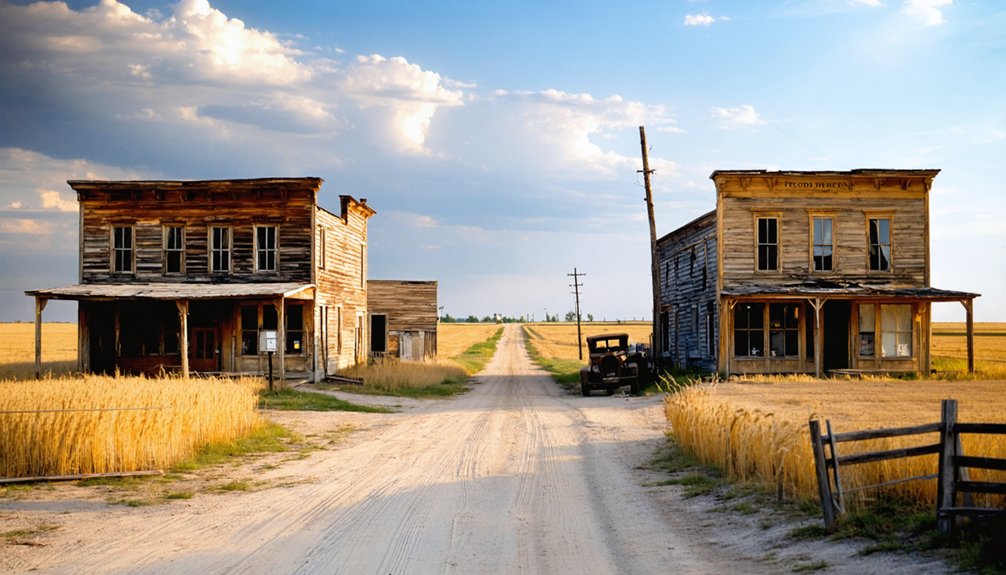
Kansas anchored the Winchester brothers’ mythology across 31 distinct references throughout Supernatural’s 15-season run.
Transforming real locations like Stull Cemetery into pivotal supernatural battlegrounds. You’ll find Stull’s small burial ground became the first apocalypse showdown site, drawing visitors chasing haunted legends tied to devil’s gate town folklore.
The state’s 308 ghost towns offer authentic backdrops—Quindaro preserves Western University’s HBCU foundations, while Hampton’s cemetery marks an airport-swallowed farming community.
Perth’s 1923 flood history adds genuine desolation, where a 21-foot river surge destroyed the resort town’s pavilion and bath house.
Real Kansas cities like Salina, Concordia, and Colby appeared dramatically different onscreen than their actual layouts, giving you filming locations that blend fact with Winchester fiction.
Alberta’s Stand-In Ghost Towns for The Abandons Western Drama
You’ll recognize these stand-in locations:
- Wayne’s abandoned structures – weathered buildings doubled as derelict frontier hamlets for chase sequences
- Dorothy’s vacant storefronts – captured the decayed pioneer architecture essential for period authenticity
- Beiseker’s isolated village – repurposed auto shop became a functioning period diner set
- Crossfield’s rural exteriors – provided additional ghost town backdrops with minimal modern infrastructure
These sites offered naturally occurring desert landscapes and forsaken aesthetics without extensive CGI budgets, proving Alberta’s capacity to substitute for Oregon’s rugged territorial past.
Kirwin Ghost Town and Wyoming’s Preserved Mining Heritage
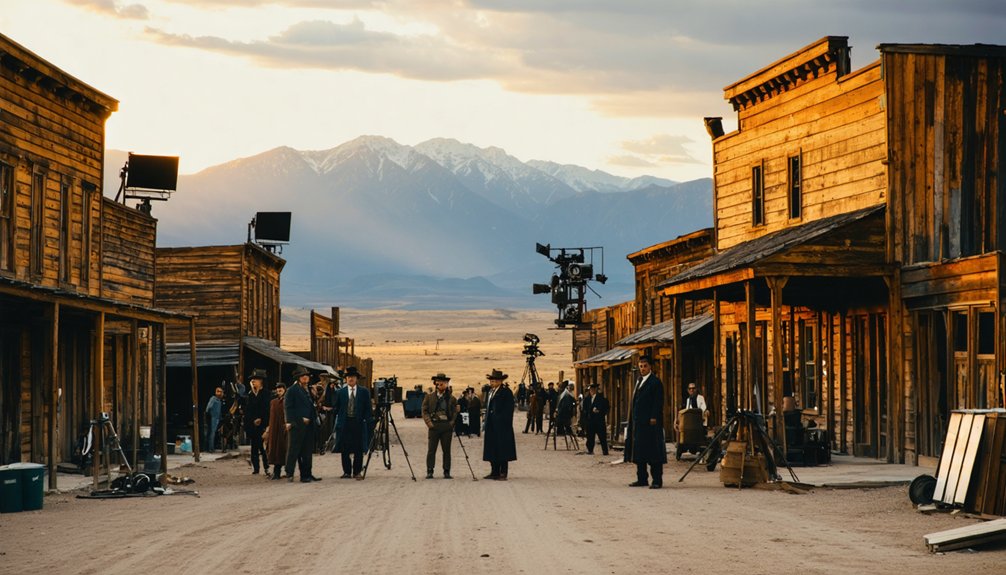
You’ll find Kirwin’s 38 original structures perched at 9,200 feet in Wyoming’s Absaroka Mountains. Two-story homes and an operational assay office survived a deadly 1907 avalanche that killed three miners and triggered mass abandonment.
The U.S. Forest Service has stabilized these buildings since 1999, preserving rusted tools and mine equipment exactly where workers left them when they fled.
This authentic setup, combined with nearby attractions like Old Trail Town’s relocated frontier buildings and Heart Mountain’s wartime structures, positions Wyoming’s ghost towns as ready-made filming locations that require minimal set dressing for period westerns.
Historic Kirwin Mining Structures
Though nestled at 9,000 feet in Wyoming’s remote Absaroka Range, Kirwin’s weathered mining structures stand as remarkably intact proofs of early 20th-century mineral extraction operations.
You’ll discover mineral exploration sites where 12,000 to 15,000 linear feet of tunnels penetrated deep into Spar Mountain’s volcanic formations.
The mining archaeology reveals sophisticated infrastructure that cost investors $1-4 million:
- Galena Ridge Tunnel – A 600-foot bore driven directly into copper, silver, and gold-bearing veins showing brilliant malachite-green staining.
- Three Crosscut Tunnels – Spanning 5,000 feet through bleached white rock altered by intense mineral-rich solutions.
- Byron Tunnel No. 2 – The only shaft that successfully shipped ore, yielding $65 per ton.
- Assay Stations – Where vein samples revealed extraordinary concentrations exceeding 100 ounces of silver per ton.
Old Trail Town Features
While Kirwin’s remote mountain setting showcases Wyoming’s mining heritage at its most rugged, Old Trail Town near Cody presents an entirely different preservation approach—a curated collection of 27 authentic 1890s structures relocated to the original Cody City townsite.
You’ll find Butch Cassidy’s actual Hole in the Wall Cabin among these buildings, providing ready-made Old West sets without construction costs. The site includes Jeremiah Johnston’s grave and Mountain Men monuments, offering authentic storytelling backdrops.
For Historic Preservation filming, you’ve got three additional options: South Pass City’s 24 buildings at 8,000 feet elevation near Oregon Trail ruts, Fossil’s intact railroad station and hotel, or Jeffrey City’s abandoned uranium boomtown with boarded-up workers’ quarters.
Small local crews require importing additional staff from Denver or Salt Lake City—both five hours away.
Heart Mountain Film Potential
Located 34 miles southwest of Meeteetse at the head of Wood River, Kirwin Ghost Town offers standing 1880s structures against Absaroka Mountain backdrops—authentic mining camp ruins that’ll eliminate set construction entirely. Kirwin preservation maintains original cabins where prospectors chased gold and silver from 1885 until the devastating 1907 avalanche.
This mining history site, accessible via Wood River Road through Shoshone National Forest, delivers genuine Western atmosphere your production needs.
Visual Elements Ready for Filming:
- Weather-beaten log cabins with hand-hewn beams casting dramatic shadows across dirt pathways
- Abandoned mining equipment scattered among wildflower meadows beneath snow-capped peaks
- Amelia Earhart’s unfinished cabin ruins one mile from main camp buildings
- Wagon roads snaking through untouched forest where outlaws once traveled from Meeteetse
High-clearance vehicle access keeps tourist traffic minimal, giving you exclusive shooting windows.
Old Trail Town’s Historic Buildings as Authentic Western Backdrops
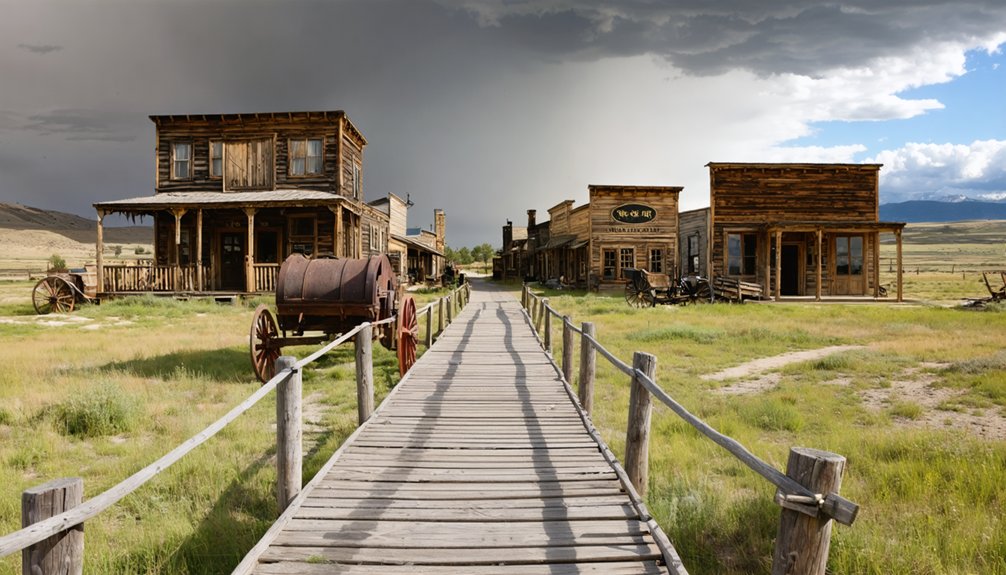
Since its establishment in spring 1967, Old Trail Town has provided filmmakers with 26 to 30 authentic Western structures that span the frontier era from 1879 to 1901.
You’ll find Bob Edgar’s collection strategically positioned along US Highway 16-20-14 in Cody, Wyoming, where historic architecture meets practical production access.
The site’s disassembled and reassembled buildings—including Rivers’ Saloon, a general store, and Butch Cassidy’s Hole in the Wall Cabin—offer genuine frontier backdrops without Hollywood facades.
Your crew can shoot Western landscapes with Yellowstone National Park’s terrain as a natural extension.
The 100 horse-drawn vehicles and period artifacts eliminate costly set decoration.
Open mid-May through September, the location operates 8 AM to 7 PM daily, giving you flexible filming windows within authentic 1880s-1900s settings.
Alfalfa County’s Network of Abandoned Oklahoma Settlements
Alfalfa County in northwestern Oklahoma contains a concentrated network of nine abandoned settlements that offer filmmakers authentic early 20th-century prairie locations within a single day’s drive. You’ll find these ghost towns scattered across former reservation land, accessible via red dirt backroads that cut through open rangeland.
Ingersoll represents the largest site, with a population booming to 1,000 after the Choctaw Railroad arrived in 1901 before complete abandonment by 1942.
Visual elements for period productions:
- Weathered wooden structures standing against endless prairie horizons
- Pioneer cemeteries with hand-carved headstones marking settlement histories
- Abandoned railroad corridors connecting Byron, Yewed, and Alger
- Original townsite footprints visible in rural Oklahoma grasslands
These historic remnants provide untouched backdrops without modern intrusions, letting your production capture authentic frontier atmosphere.
Route 66 Remnants and Great Plains Ghost Town Documentaries
The Mother Road’s ghost towns deliver ready-made film sets that span eight states and capture America’s mid-century decline in authentic detail.
You’ll find Supernatural exploiting Stull Cemetery’s haunted legends in Kansas and Dodge City’s Wild West atmosphere across multiple seasons.
Documentary crews favor accessible locations like Glenrio straddling the Texas-New Mexico line and Cuervo’s prominent church amid residential ruins.
Abandoned architecture defines these sites—Allenreed’s tree-overtaken gas station, Texola’s bypassed main street, and Roy’s Motel‘s working neon signs in Amboy.
Productions benefit from I-40’s devastation of these communities, leaving overgrown structures and desolate streets frozen since the 1960s.
Shamrock’s U-Drop Inn even inspired Pixar’s Cars, proving these locations transcend documentary work into mainstream entertainment.
Frequently Asked Questions
Do Filming Crews Restore Ghost Town Buildings Before Shooting Scenes?
You’ll find crews rarely restore ghost towns before filming. Instead, they select locations requiring minimal set dressing, avoiding costly restoration efforts. Preservation challenges make authentic structures ideal backdrops—existing decay provides visual atmosphere without major construction or interference.
Can Tourists Visit Ghost Towns After They’ve Been Used for Filming?
You’ll find excellent tourist accessibility at filmed ghost towns like 1880 Town near Murdo and Fort Bridger in Wyoming. These sites balance historic preservation with your freedom to explore authentic Old West structures and props from popular productions year-round.
In addition to these attractions, there are numerous ghost towns in the Great Plains that offer unique glimpses into life during the pioneering days. Each site tells its own story of the challenges and triumphs faced by early settlers, making them perfect spots for history buffs. Exploring these remnants can deepen your understanding of the region’s heritage while providing a chance to experience the stark beauty of the plains.
How Do Productions Handle Safety Hazards in Abandoned Mining Towns?
Productions handle abandoned sites like minefields requiring careful navigation. You’ll find crews conducting thorough structural inspections before filming, while simultaneously monitoring wildfire risk and implementing evacuation protocols to guarantee everyone’s freedom to work safely in these historic locations.
Are Local Residents Hired as Extras During Ghost Town Filming?
Yes, you’ll find locals hired as extras when productions value community involvement. Groom, Texas recruited exclusively from residents for *Indiana Jones*, creating authentic crowd scenes while giving townspeople freedom to participate in Hollywood filmmaking firsthand.
Do Property Owners Charge Fees When Ghost Towns Appear on TV?
You’ll find most ghost town owners don’t charge TV production fees, like 1880 Town’s Dances with Wolves props. Instead, they leverage filming for historical preservation and local economic impact through increased tourism, merchandise sales, and post-production visitor attention.
References
- https://www.timeout.com/news/the-abandons-the-filming-locations-behind-netflixs-wild-west-drama-120425
- https://www.visitamarillo.com/blog/post/lights-camera-panhandle-hollywoods-surprising-love-affair-with-the-texas-high-plains/
- https://www.travelks.com/blog/stories/post/supernatural-road-trip-in-kansas/
- https://giggster.com/guide/movie-location/where-was-reservation-dogs-filmed
- https://www.youtube.com/watch?v=xg8SpCG-wDg
- https://www.codyyellowstone.org/film-television/filming-locations/
- https://www.youtube.com/watch?v=ifra0DI–dY
- https://www.youtube.com/watch?v=IECzqQ-jIEM
- https://tv.apple.com/us/show/ghost-towns-americas-lost-worlds/umc.cmc.1wmuma9ftj2sskbfsxbhr8x5
- https://www.atlasofwonders.com/2018/06/yellowstone-filming-locations.html