You’ll find authentic Western filming locations scattered across the Mountain West’s ghost towns, where productions like *Westworld* used Paramount Ranch‘s rebuilt 1800s Main Street and *Butch Cassidy and the Sundance Kid* captured Grafton’s pioneer architecture near Zion National Park. California’s Cerro Gordo sits at 8,500 feet along treacherous switchbacks, while Oregon’s Golden features dual-steepled churches from *Gunsmoke* shoots. Utah’s Eureka maintains operational historic buildings among visible mining relics. Each site offers distinct terrain advantages worth exploring further.
Key Takeaways
- Paramount Ranch hosted over 130 films and evolved through Western shows like Tombstone Territory, Dr. Quinn, and Westworld before 2018 fire.
- Cerro Gordo, an authentic 337-acre mining town at 8,500 feet elevation, has been used for filming since the 1920s.
- Golden Oregon’s four historic structures and fake Gunsmoke cemetery made it popular for 1950s-70s shows like Bonanza.
- Grafton Utah’s five restored pioneer buildings served as the filming location for Butch Cassidy and the Sundance Kid in 1969.
- Eureka Utah’s operational historic buildings and authentic mining relics attract film crews seeking genuine mining town backdrops.
Paramount Ranch: From Classic Westerns to Westworld
Paramount Pictures transformed 2,700 acres of Santa Monica Mountains terrain into a cinematic canvas in 1927. Anchoring the property’s southwest corner were a barn, pavilion, and prop shed that would serve productions for decades.
Three humble structures in the Santa Monica Mountains became the foundation for Hollywood’s most enduring outdoor studio.
You’ll find this studio infrastructure hosted over 130 films through 1943. These landscapes were transformed into Welsh mining villages, medieval England, and African savannahs.
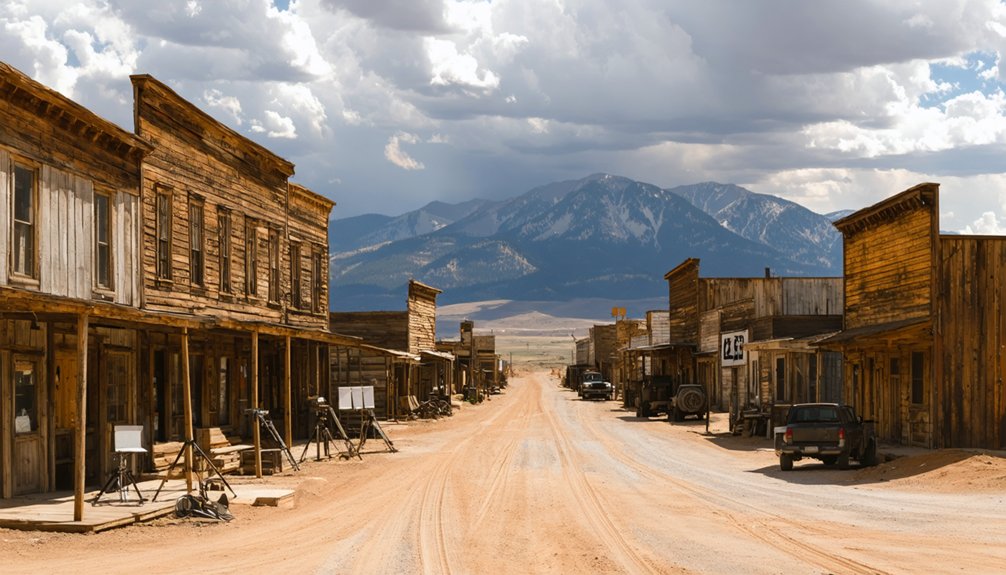
William Hertz expanded the ranch’s frontier in 1953, constructing Western Town across 326 acres as an authentic late-1800s Main Street. The town’s facades were built around existing support buildings to create the Western setting.
The National Park Service acquired portions in 1980, committing to historical preservation through complete rebuilds using archival photos.
You can trace Western Town’s evolution from Tombstone Territory through Dr. Quinn, Medicine Woman to HBO’s Westworld.
Rolling hills at 2903 Cornell Road provided versatile backdrops until the 2018 Woolsey Fire erased these structures. Rebuilding began in 2023 with $26 million in federal funding, completing a new pavilion, prop shed, barn, and restrooms by spring 2025.
Cerro Gordo Area: Desert Landscapes for Gunsmoke and Beyond
While Paramount Ranch recreated Western streetscapes through constructed sets, Cerro Gordo’s 337-acre mining town delivers authentic decay at 8,500 feet elevation in California’s Inyo Mountains. You’ll find rusted mining equipment, tumbled stone walls from Beaudry’s 1870s smelter, and the Gordon House’s haunted secrets embedded in bullet-riddled wood.
Film crews have accessed these locations since the 1920s, shooting sequences along Cerro Gordo Road’s climbing switchbacks and capturing overlook shots above Owens Lake. Notable filmmakers including John Wayne and Russell Crowe have utilized the abandoned mining town’s scenic landscape and mining history as ideal backdrops for their productions.
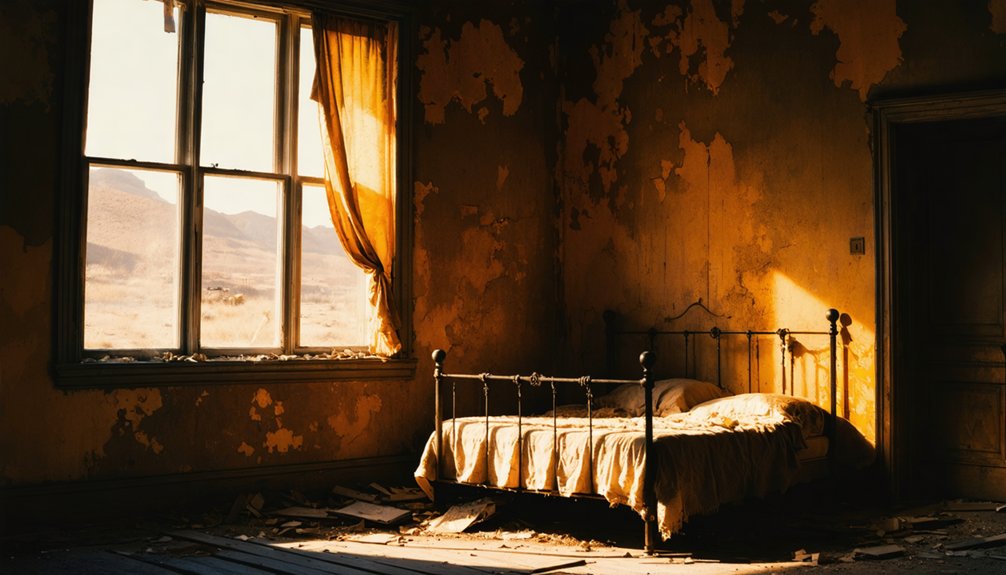
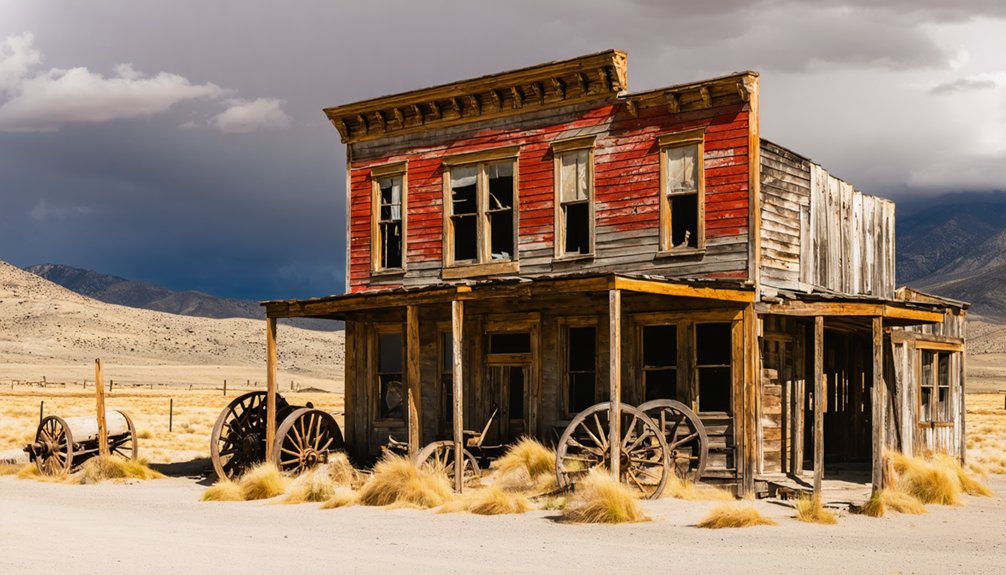
Explorers and photographers are drawn to the unique allure of ghost towns in the Mountain West, where the remnants of a bygone era tell stories of prosperity and decline. Each structure stands as a testament to the challenges faced by early pioneers, providing a hauntingly beautiful contrast to the rugged landscape. As visitors wander through these deserted streets, they often find themselves immersed in the silence that echoes the whispers of the past.
The terrain extends to Lone Pine and Alabama Hills, where productions like Tremors established specific coordinates—Paradise townsite at 36.2443611, -117.9734167. Reaching the site requires navigating 8.5 miles of unmaintained dirt road with switchbacks and steep drop-offs from Highway 136 south of Keeler.
Current owners generate restoration revenue through commercials and TV projects, maintaining filming nostalgia while offering corporate retreats. The graveyard overlooks valleys where hundreds rest unmarked, providing stark backdrops for desert storytelling.
Golden Oregon: a Heritage Site With Dual Church Steeples
How does a gold rush settlement survive 130 years without a single saloon? Golden, Oregon achieved this feat through Rev. William Ruble Sr.’s vision—he founded the town in 1890 with churches, schools, and orchards instead of drinking establishments.
You’ll find four main structures today: the 1892 Campbellite church (rebuilt 1950), Ruble’s residence, the 1904 mercantile/post office, and a weathered shed. The dual church steeples mark this National Register site near I-5 off Coyote Creek Road.
Gunsmoke constructed a fake cemetery here that still attracts filming tourism—visitors leave trinkets on prop graves. Bonanza also utilized these buildings during the 1950s-70s. The town’s name reflects its connection to wealth through the gold mining activity that originally drew settlers to the region.
Since 2011, Oregon Parks and Recreation manages this Heritage Site, though vandalism threatens the wooden structures. Historic preservation efforts continue through the Golden Coyote Wetlands organization. The community’s strict Christian doctrine prohibited saloons, dance halls, and brothels, forcing miners to seek entertainment in nearby Placer.
Grafton Utah: Butch Cassidy’s Picturesque Backdrop
Red rock cliffs tower over Grafton’s weathered structures where the Virgin River carved through Washington County’s cotton-growing experiment.
You’ll find five restored buildings from the original 1859 settlement, maintained through historical preservation efforts since 1997.
The 1886 schoolhouse and Alonzo Haventon Russell Home showcase authentic pioneer architecture that drew Hollywood here for *Butch Cassidy and the Sundance Kid* in 1969.
Though no evidence confirms the outlaws actually used this remote location as a hideout, the connection stuck.
The town made its Hollywood debut with *Old Arizona* in 1929, the first outdoor talkie nominated for five Academy Awards.
Founded by five families from Virgin in 1859, Grafton grew to become the second-largest settlement in the Virgin Valley before its eventual decline.
You can access the site via a 9-mile drive east of Zion National Park, where flood-scarred landscapes and cemetery markers tell stories of families who battled floods, disease, and isolation before abandoning their cotton mission between 1906-1944.
Eureka Utah: Mining Town Turned Modern Film Set
Unlike Grafton’s abandoned homesteads, Eureka’s silver boom created a functioning town that’s never fully disappeared.
You’ll find operational buildings from the 1870s Tintic Mining District standing along Main Street, where half a billion dollars in precious metals once flowed through. The mining history remains visible—head frames, tunnels, and the Chief Consolidated Mining Company headquarters provide authentic backdrops that don’t require Hollywood construction crews.
Film scouts favor Eureka’s preserved architecture: the Old Jail, Juab County Courthouse, and Historic City Hall deliver period authenticity.
You can explore downtown freely, though nearby mine shafts demand caution due to unstable ground and toxic air. The large head frame from the Bullion Beck Mine stands at the town’s west end as a prominent landmark of the mining era.
For haunted attractions, the Gatley Building’s reported paranormal activity adds atmospheric tension. The Historic City Hall is believed to be haunted with regular sightings reported by locals.
Production teams access genuine mining relics without venturing into fully abandoned ghost towns.
Frequently Asked Questions
Can Tourists Visit These Ghost Town Filming Locations Year-Round?
You’ll find tourist access varies by location and season. Historical preservation sites like Bannack offer year-round entry, but Montana’s winter snowpack and extreme desert temperatures impact accessibility. You’re free to explore, though weather dictates timing.
Do Production Companies Pay Fees to Film at These Sites?
Money talks: Yes, you’ll find production companies typically pay fees for filming rights, generating economic impact while funding preservation challenges. Rates vary by ownership—private ranches, municipalities, or federal land—affecting your access to remote, weathered locations.
How Are Historic Structures Preserved During Filming Activities?
You’ll find restoration techniques like minimal intervention and structural stabilization protect fragile buildings during shoots. Preservation challenges include controlling foot traffic, monitoring weather impacts on exposed wood, and ensuring film equipment doesn’t compromise delicate foundations in remote terrain.
Which Ghost Town Location Has Hosted the Most Productions?
Rhyolite’s drawn filmmakers since the 1920s, making it the most-filmed location. You’ll find historical preservation less restrictive here than state-controlled sites, though unauthorized filming still requires maneuvering Death Valley’s harsh terrain and federal land regulations.
Are There Guided Tours Available at These Filming Locations?
Like tumbleweeds rolling freely across open desert, you’ll explore these sites independently—no guided tours exist. You’ll navigate terrain using trail markers and historical signage, discovering haunted legends yourself while production crews secure filming permits for occasional shoots.
References
- https://californiathroughmylens.com/paramount-ranch-old-movie-town/
- https://www.visitutah.com/things-to-do/history-culture/ghost-towns
- https://www.youtube.com/watch?v=tZmA_VF6cm8
- https://www.youtube.com/watch?v=G1cxrDX28r0
- https://mwg.aaa.com/via/places-visit/western-ghost-towns
- https://www.barnesandnoble.com/w/ghost-towns-of-the-mountain-west-philip-varney/1118059593
- https://www.youtube.com/watch?v=9JXcemAa4Cs
- https://www.knightskypictures.com/behind-the-scenes
- https://www.youtube.com/playlist?list=PLVbf6aMq-JKHzNIUtsSlF97r5gV5qCGAz
- https://waves.edwardthomasco.com/santa-monica-paramount-ranch/